

By Ryan Bradshaw · Updated September 12, 2026 · Source: Work Insiders directory
As of September 12, 2026, 136 of 681 recruiting, lead-gen, and HR products in the Work Insiders directory ship a first-party MCP server — 20 percent. Visitor ID leads at 47 percent; sourcing and email verification sit at 44 percent. Texting is 4 percent. An API is not an MCP. Community servers do not count.
Key insights up front
Out of the 681 recruiting, lead generation and HR products tracked in the Work Insiders directory as of September 12, 2026, 136 ship a first party MCP server.
That is 20 percent of the market. Adoption is uneven: website visitor identification leads with 47 percent of its tools carrying the badge, sourcing and email verification are both at 44 percent, recruiting CRM, email finders, LinkedIn and outreach all sit near 40 percent, ATS and HRIS are both at 21 percent, and payroll is at 17 percent.
Texting is at 4 percent, and the fourteen HR categories added to the directory this month (benefits, compliance, recognition, wellbeing, internal comms and the like) are mostly at zero. A first party MCP is still the exception, not the rule, and 182 tools in the directory have a public API with no MCP at all, which is where most “AI ready” marketing actually lands.
Every number in this article comes from a full count of the Work Insiders directory, where each listing is tagged with its pricing model, its categories, whether it has an API, and whether the vendor ships its own MCP server. Community built servers and MCP clients do not count. Only the vendor’s own server does.
What changed since the first count?
The first edition of this census, published September 11, counted 102 MCP servers across 566 tools, or 18 percent. One day later the numbers are 136 of 681, or 20 percent. Most of that movement is the directory getting bigger and more accurate, not vendors shipping servers overnight, so it is worth being plain about what happened.
The directory added 14 HR categories and about 115 new listings, almost all of them without an MCP, which pushed the denominator up.
At the same time a vendor by vendor recheck of the MCP flag found 25 tools whose server we had missed, including HubSpot, Salesforce, Gong, Salesloft, Close, Workday, Personio, Remote, Visier, 6sense, Demandbase, Warmly, ZeroBounce and People Data Labs, and confirmed eight others we had wrongly assumed had one, such as Cognism, BambooHR, SAP SuccessFactors and Oracle HCM. The net effect is a more honest baseline.
The quarterly reruns from here will measure real adoption.
What is an MCP server, in recruiting terms?
MCP stands for Model Context Protocol. It is an open standard that lets an AI assistant such as Claude or ChatGPT talk directly to a piece of software, read its data, and take actions inside it, using the recruiter’s own login and permissions. Instead of a person clicking through five dashboards and copying candidate details between them, the assistant calls each tool on the recruiter’s behalf. For the full explainer, read what MCP means for recruiters.
One vendor describes it as the USB C for AI tools: any platform that exposes an MCP server can be connected to any compatible assistant in minutes, with no engineering work.
Why does first party matter more than any MCP?
A first party MCP is built and maintained by the vendor. A community MCP is built by a third party developer on top of the vendor’s public API, and it can break whenever the API changes, lag behind new features, or expose data in ways the vendor never reviewed. Several of the most talked about HR platforms only have community servers today.
BambooHR, for example, has seven or more community implementations, and its own server, announced in July 2026, is still a private beta with no published endpoint. That says a lot about demand and just as much about how many vendors have not caught up.
Work Insiders badges only the first party kind, because that is the one a hiring team can rely on next quarter. An MCP client, meaning a chat app that connects to other vendors’ servers, does not earn the badge either.
How many recruiting tools ship a first party MCP in 2026?
136 of 681 tools, or 20 percent. To put that in context, the wider MCP ecosystem has grown to over 9,400 public servers in the roughly eighteen months since the protocol was open sourced in November 2024, but the recruiting and HR slice of that is small and vendor led.
Most of the early movers are sourcing tools, visitor identification and intent platforms, contact data providers, outreach platforms and agency ATS vendors that sell to people who already live in an AI assistant all day.
Which categories have the most MCP servers?
The directory sorts every product into one or more of 46 categories. A tool can sit in several at once, so the category totals add up to more than the product count. Here is how the first party MCP badge is distributed across every category with at least ten tools, sorted by share:
| Category | Tools in category | With first party MCP | Share |
|---|---|---|---|
| Visitor ID | 19 | 9 | 47.4% |
| Sourcing | 66 | 29 | 43.9% |
| Email verification | 23 | 10 | 43.5% |
| Recruiting CRM | 60 | 24 | 40.0% |
| Email finders | 97 | 38 | 39.2% |
| 44 | 17 | 38.6% | |
| Outreach | 79 | 30 | 38.0% |
| Lead generation | 172 | 61 | 35.5% |
| EOR | 10 | 3 | 30.0% |
| Dialers | 21 | 6 | 28.6% |
| Benefits administration | 13 | 3 | 23.1% |
| HRIS | 47 | 10 | 21.3% |
| ATS | 114 | 24 | 21.1% |
| Time and attendance | 15 | 3 | 20.0% |
| Onboarding | 21 | 4 | 19.0% |
| Payroll | 41 | 7 | 17.1% |
| Scheduling | 25 | 3 | 12.0% |
| Interviewing | 55 | 6 | 10.9% |
| Background check | 25 | 2 | 8.0% |
| Assessments | 38 | 3 | 7.9% |
| Deliverability | 26 | 2 | 7.7% |
| Job boards | 31 | 2 | 6.5% |
| Texting | 24 | 1 | 4.2% |
| HR compliance | 11 | 2 | 18.2% |
| Learning | 10 | 2 | 20.0% |
Nine of the newly added HR categories (job descriptions, employee referrals, recruitment marketing, workforce management, recognition and rewards, succession and internal mobility, internal communications, wellbeing, candidate fraud and AI detection) have no first party MCP servers at all yet. You can reproduce any row by opening a category page and switching on the MCP filter, or start from tools with MCP for the full list.
Why do visitor identification and sourcing lead?
Because these are the workflows where an agent pays for itself fastest. Sourcing is search, enrich, rank, repeat, and an assistant can run all four steps in one window instead of a recruiter copying Boolean strings between tabs.
Visitor identification is the same loop pointed at clients instead of candidates: which companies are on the site, who at those companies, and what to send them. 29 of the 66 sourcing tools and 9 of the 19 visitor identification tools ship a first party server, and the visitor identification list is almost entirely 2026 launches: Vector, Warmly, 6sense, Demandbase, RB2B and Civic among them.
Pin, for instance, exposes 10 MCP tools across kickoff, review, tuning and per job memory, authenticates with OAuth instead of API keys, and includes the server free on every paid plan. SeekOut, Juicebox and Loxo carry the badge too. Sourcing vendors that started life as AI products are far more likely to have shipped an MCP than the older LinkedIn scraper generation, and the LinkedIn category’s 39 percent reflects the same split.
How many email finders and verification tools have an MCP server?
Email finders: 38 of 97, or 39 percent. Email verification: 10 of 23, or 44 percent. These vendors had a head start because their products were already API first. A lookup is the simplest possible thing to expose to an agent: send a name and a domain, get an email back. Hunter, Lusha, ContactOut, ZoomInfo, SignalHire, Tomba, ZeroBounce, People Data Labs and LeadMagic all carry the badge.
The catch for buyers is that an email finder with an MCP still bills the same credits per lookup whether a human or an agent asks, so an agent that enriches a thousand profiles overnight will burn through a plan fast. The badge tells you the connection exists. It does not tell you the meter is off.
How many ATS platforms have an MCP server?
24 of the 114 applicant tracking systems in the directory ship a first party MCP, which is 21 percent. That is roughly half the adoption rate of the sourcing and contact data categories, and the pattern inside the number is clearer than the number itself. The badge clusters around agency focused and AI native platforms, with the enterprise tier starting to move.
Workable‘s server now covers 94 tools across the hiring and HR lifecycle and is included at no extra cost. 100Hires exposes 130 MCP tools for pipeline actions like batch rejecting applicants below an AI score. PCRecruiter, Ashby, Greenhouse and Loxo all carry the badge.
On the other side, one AI native vendor states plainly that as of mid 2026 very few recruitment platforms have launched MCP servers and that most legacy ATS vendors have not. Bullhorn, BambooHR and Avionté all list a public API and no first party MCP.
Workday is the notable change: its Agent Ready Tools give agents access to HR data over MCP, in early access through Workday Extend since June 2026 with general availability planned for the second half of the year, so it now carries the badge with that caveat.
How many HRIS and payroll platforms have an MCP server?
HRIS: 10 of 47, or 21 percent. Payroll: 7 of 41, or 17 percent. This was the slowest corner of the market in the first count and it has moved the most, because the recheck picked up several servers that enterprise vendors shipped quietly.
Deel, HiBob, Lattice, Personio (in beta), Remote, Zoho People, Darwinbox and Workday (early access) are among the HRIS tools with the badge, and Visier’s server brings governed people analytics to any agent.
Caution is still the norm here because HRIS and payroll hold the most sensitive employee data. Many of the biggest names are covered only through community servers or through aggregators: one unified API vendor advertises 231 HRIS integrations reachable through a single MCP endpoint, which is useful for developers but is not the same as the vendor supporting it directly.
Why are texting, deliverability and interviewing so far behind?
Texting is at 1 of 24, deliverability at 2 of 26, and interviewing at 6 of 55. Texting carries compliance risk: an agent that can send SMS on a recruiter’s behalf is one bad prompt away from a consent problem, so vendors have kept the door shut.
The dialer category is further along at 6 of 21, led by JustCall, RingCentral and Close, because call logs and transcripts are read heavy and low risk.
Deliverability tools are mostly monitoring dashboards, and there is less for an agent to do inside them. Interviewing does have early movers. Hirevire’s server lets an agent pull screening data and draft next steps while the recruiter still makes the decision, and BrightHire carries the badge. But the category as a whole is waiting.
Do tools with an MCP charge extra for it?
Sometimes, and the badge alone won’t tell you. A meaningful share of the 136 MCP tools also offer a permanent free tier, including Hunter, Lusha, Tomba, Snov.io, RocketReach, Apollo, Clay, PhantomBuster, Warmly and Zoho Recruit, so you can test the connection before paying.
Others are quote only, meaning you cannot see a price without a sales call: BrightHire, Darwinbox, HiBob, iSmartRecruit, Outreach, Visier and PCRecruiter are in that group. And MCP access is sometimes gated behind a higher plan even when the vendor has shipped the server.
Workable includes most MCP tools on every plan but reserves advanced candidate and employee search for Premier plus and Enterprise. Workday’s is reached through a paid Extend subscription. Check the plan, not just the badge.
Does having an API mean a tool has an MCP?
No, and this is the most common confusion in vendor marketing. 182 tools in the directory have a public API and no first party MCP. An API lets a developer build an integration.
An MCP lets a non technical recruiter connect the tool to an AI assistant in a few minutes with no code. Work Insiders keeps the two flags separate on every card for exactly this reason, and the API only group includes plenty of well known names:
Woodpecker, hireEZ, BambooHR, Bullhorn, Avionté, Factorial, Fountain, Kaspr, HeyReach, Paylocity, Paycor and Cognism. If a vendor’s page says “AI ready” or “agent compatible” and you cannot find an MCP endpoint or connector instructions in their docs, assume it is API only.
Dialpad is the cautionary example: it markets an MCP server with 100 plus actions, but every button on that page goes to sales and there is no endpoint or setup guide, so it stays API only until one appears.
What are recruiters actually asking about MCP?
The questions that come up most in recruiting forums and vendor comment threads in 2026 are practical rather than technical, and they map closely to the directory data.
Which ATS should I pick if I want to use Claude or ChatGPT with it? Pick from the 24 ATS platforms with a first party server, and confirm the server is included in the plan you are buying.
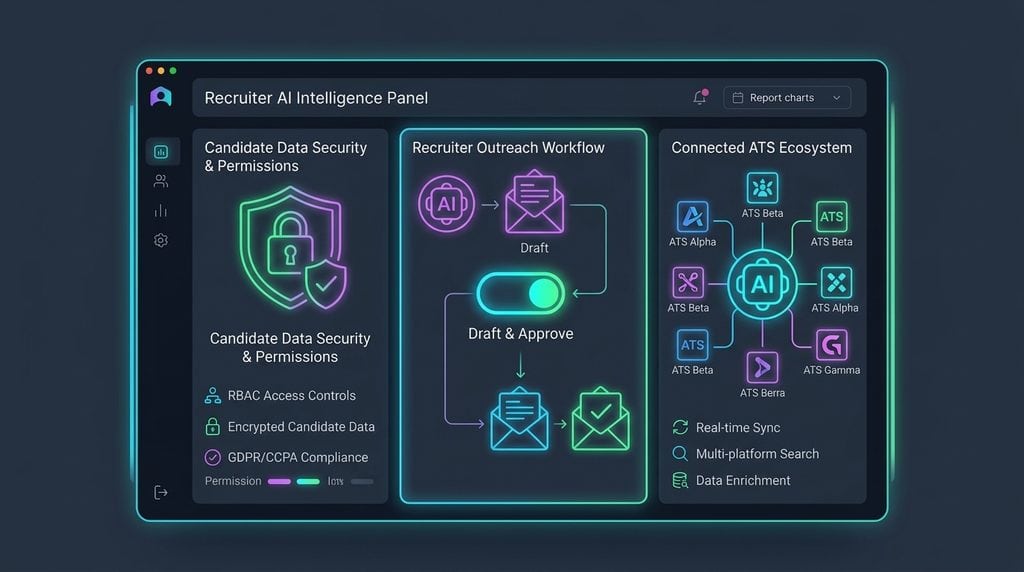
Can the AI see candidate data it should not? Not through a first party MCP built correctly. Workable, Spott and Pin all scope every session to the authenticated user’s existing role, so the assistant sees only what that person could already see. Personio goes further and lets an admin switch individual capabilities, such as reading compensation, on or off per connected AI tool. Community servers built on a shared API key are a different story, and that is the risk to ask about.
Will the agent send outreach without me approving it? That depends on the tool, not on MCP. Several servers, including Hirevire’s, are designed so the agent drafts actions while the recruiter still makes the decision. Read the tool list on the vendor’s MCP page before connecting it.
Is this worth it for a small agency? The strongest adoption is in visitor identification, sourcing, contact data, outreach and recruiting CRM, which is a signal that the vendors closest to agency workflows see the demand. Korn Ferry’s 2026 talent trends report found that over half of talent leaders plan to deploy autonomous AI agents this year.
How is MCP adoption changing over time?
This is the second edition of this count, one day after the first, and it should be read as the corrected baseline rather than as a trend. The directory is updated weekly and every listing is re checked when a vendor changes its MCP status, so the plan is to republish these numbers each quarter and track the change from 20 percent.
The expectation, based on vendor roadmaps published this year, is that ATS and HRIS adoption will climb fastest through 2027 as Workday, BambooHR and Personio move their servers from beta to general availability, while sourcing, visitor identification and contact data stay near the top.
Quick answers
How many recruiting tools have an MCP server in 2026? 136 of the 681 products in the Work Insiders directory ship a first party MCP server, or 20 percent, as of September 12, 2026.
Which category of recruiting software has the highest MCP adoption? Website visitor identification, at 47 percent of tools, followed by sourcing and email verification, both at 44 percent.
Which category has the lowest? Texting, at 4 percent, or 1 tool in 24. Nine of the newer HR categories are at zero.
How many ATS platforms have an MCP? 24 of 114, or 21 percent.
How many tools have an API but no MCP? 182.
Does an API count as an MCP? No. An API needs a developer to build on it. An MCP lets an AI assistant connect directly with the user’s own login and no code.
Where can I see the full list? On the MCP filtered directory, which is updated weekly.
Methodology
Counts were taken directly from the Work Insiders directory database on September 12, 2026. A tool is counted as having an MCP only when the vendor publishes and maintains its own server, verified against the vendor’s own documentation. Servers in open beta or early access count; servers that are announced but have no published endpoint, or that are only reachable by a sales call, do not.
Community servers, MCP clients, aggregator endpoints and API only integrations are excluded. Category totals overlap because a tool can belong to more than one category. AI agent templates published by Work Insiders are not counted as vendor adoption. Outside sources are linked where cited.