

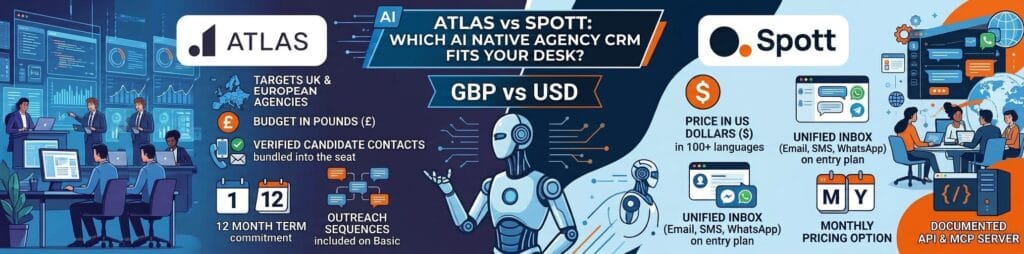
Pick Atlas if you are a UK or European agency that budgets in pounds and wants verified candidate contacts bundled into the seat: Basic is £105 and Premium is £135 per user a month, every plan runs on a 12 month commitment, and there is a 14 day free trial. Pick Spott if you price in dollars, want a unified inbox across email, SMS and WhatsApp on the entry plan, and want month to month billing as an option: on 21 October 2026 Spott showed Core at $119 per user a month billed annually ($149 monthly) and Pro at $179 ($219 monthly). Both are AI native ATS and CRM platforms built for agency desks, with AI notes, semantic search and in house migration from Bullhorn.
Prices and features checked on each vendor’s own site on 21 October 2026. Neither vendor paid for or reviewed this article.
What is the difference between Atlas and Spott?
Both sell one system that replaces a legacy agency ATS and CRM, with AI at the centre rather than added later. The differences are where each company is based, what the seat includes, and how you pay.
Atlas is built by Atlas Recruitment Technology Ltd, and its terms of service name London as the venue for disputes. Atlas calls its product a “CRMx”, a CRM with context: it records calls, emails, WhatsApp messages and meetings, then lets AI agents tag candidates, update salaries and draft follow ups from that memory. Its pricing is in pounds and ties every plan to 12 months.
Spott is headquartered in Leuven, Belgium, and was founded in November 2024. Its Series A post says it raised $21 million in September 2026, led by Balderton Capital, for a total of $24.2 million, and that 500+ agencies run on Spott. Spott prices in US dollars by default, with a monthly or yearly choice.
We compared Spott with another agency platform in Loxo vs Spott. Spott’s prices have moved since then, as the cost section below shows.
How do Atlas and Spott compare side by side?
Everything in this table comes from each vendor’s own pricing, product and integrations pages.
| Feature | Atlas | Spott |
|---|---|---|
| Built for | Recruitment agencies, including executive search and contract desks | Agencies running perm, temp, contract and executive search |
| Published currency | Pounds (GBP) | US dollars by default; EUR, AUD and GBP options on the page |
| Entry price | £105 per user a month (Basic) | $119 per user a month billed annually, $149 monthly (Core) |
| Commitment | 12 months on every plan | Yearly or monthly billing; contract term not stated on the pricing page |
| Free trial | 14 days | Guided trial or demo; no length stated |
| AI note taker | Included, with full transcripts and custom templates | Included on Core, 100+ languages, in person recording in the mobile app |
| Semantic search and matching | Magic Search in plain English, with reasons for each match | AI Search and Matching on Core, with explained match scores |
| Contact enrichment | Included on Premium (£135) | Enrichment credits charged on top; Data Enrichment listed on Pro |
| Unified inbox | Captures email, calls, WhatsApp and meetings | Unified Inbox for email, SMS and WhatsApp on Core |
| Outreach sequences | Included on Basic | Multi channel sequences on Pro |
| Job board posting | Broadbean and idibu integrations | Broadbean, idibu and VDAB integrations |
| Open API | Listed on its integrations page | REST API listed on its integrations page |
| MCP server | Remote MCP server in beta, enabled per user by an admin | Official Spott MCP for Claude, ChatGPT and other MCP clients |
| Data migration | In house, most done in 2 to 3 weeks | In house, about 4 weeks |
How much do Atlas and Spott cost in 2026?
Both publish per user prices, which is rare for agency software. Atlas publishes in pounds and Spott in dollars, so we show each in its own currency and do not convert.
| Plan | Published price | What it adds |
|---|---|---|
| Atlas Basic | £105 per user a month | AI candidate sourcing, unlimited searches, talent pools, pipeline tracking, outreach sequences, ATS integrations, onboarding and support |
| Atlas Premium | £135 per user a month | Everything in Basic plus verified mobile numbers and personal emails on shortlisted profiles |
| Atlas Agency and Enterprise | Custom, for 10 desks and up | Consolidated billing, security and DPA review, custom onboarding, named contact, volume discounts |
| Spott Core | $119 billed annually ($139 struck through), $149 monthly | AI native ATS and CRM, AI note taker, AI search and matching, unified inbox, CV reformatter and shortlists |
| Spott Pro | $179 billed annually ($199 struck through), $219 monthly | Automations, marketing suite, multi channel sequences, data enrichment |
| Spott Enterprise | Custom (the card also shows €149 per user) | Custom terms and DPA, advanced roles, multi office management, strategic contact |
The Atlas pricing page says every plan runs on a 12 month commitment, and paying yearly gets you 12 months for the price of 10. On Premium, Atlas says verified contacts are “the only difference” from Basic. The Spott pricing page says AI token spend is included on every plan and that the only extra cost is enrichment credits for emails and phone numbers. Spott does not publish a credit price.
Did Spott’s price change?
Yes, at least for now. In September 2026 Spott showed Core at $139 billed annually and Pro at $199. On 21 October 2026 the yearly cards showed $119 and $179 with the old figures struck through, and monthly prices of $149 and $219. Spott does not say whether the lower yearly price is a time limited offer, so ask it to confirm the rate and the renewal price in writing.
What does each one cost per year for 1, 5 and 10 recruiters?
This is a Work Insiders calculation from the published list prices above, before VAT, sales tax and Spott enrichment credits. The Atlas table assumes the £105 and £135 figures are the pay monthly rate and applies its 12 for 10 offer for the yearly column. Atlas quotes agencies with 10 desks and up, so treat the 10 recruiter row as a ceiling to negotiate from.
| Recruiters | Atlas Basic, pay monthly (GBP) | Atlas Basic, pay yearly (GBP) | Atlas Premium, pay monthly (GBP) | Atlas Premium, pay yearly (GBP) |
|---|---|---|---|---|
| 1 | £1,260 | £1,050 | £1,620 | £1,350 |
| 5 | £6,300 | £5,250 | £8,100 | £6,750 |
| 10 | £12,600 | £10,500 | £16,200 | £13,500 |
| Recruiters | Spott Core, annual (USD) | Spott Core, monthly (USD) | Spott Pro, annual (USD) | Spott Pro, monthly (USD) |
|---|---|---|---|---|
| 1 | $1,428 | $1,788 | $2,148 | $2,628 |
| 5 | $7,140 | $8,940 | $10,740 | $13,140 |
| 10 | $14,280 | $17,880 | $21,480 | $26,280 |
A like for like comparison depends on what you need. If verified contact data matters, compare Atlas Premium with Spott Core plus the enrichment credits you would buy. If outreach sequences matter, note that Atlas includes them on Basic, while Spott puts multi channel sequences on Pro.
Which has better AI for agency recruiters?
On paper the AI lists are close. Both record calls, write notes, search your database in plain language and explain why a candidate matches. The differences are in the details.
How do the AI note takers compare?
The Atlas note taker joins calls and video meetings, keeps a full transcript you can replay, and turns it into notes using templates you write. Its FAQ says it uses the OpenAI API and that OpenAI does not train on the data. If you do not invite the Atlas bot to an event, it does not record.
Spott’s conversation memory page says its own note taker records online and in person meetings in 100+ languages, with searchable, timestamped transcripts and summary templates for interviews, intake calls and negotiations. The Spott mobile app records in person conversations too. Spott says customer data is never used to train models.
Which one matches candidates to jobs better?
We have not tested either on the same roles, so we cannot call a winner. Atlas offers Magic Search in plain English and Magic Columns, which score every candidate against criteria you write. Spott’s matching page describes semantic search across CVs, notes and conversations, hard filters such as salary and location, and a weighted scorecard it builds from your criteria. Spott’s pricing FAQ describes it as “Not keyword matching, not a GPT wrapper.”
What about automation and AI agents?
Atlas says its agents tag candidates, sync salaries, send emails and summarize meetings from captured memory, and its about page describes background “digital workers” announced for this summer. Spott puts automations on Pro, and its Series A post says it is expanding proactive agents. Ask each vendor to show which agents are live today on your plan.
How do they handle candidates, clients and pipelines?
Both keep candidates, clients and jobs in one record set. Atlas leans into business development: its homepage describes an opportunities pipeline on a drag and drop Kanban board, ranked by deal value, role fit and recent activity, and its comparison pages describe an automatically updated likelihood of winning. It also builds client search reports and candidate reports from your notes, and its contract management handles rates, approvals and expenses.
Spott offers list or Kanban views with drag and drop stages, custom attributes and views, on brand candidate presentations, speculative presentations, and analytics with team dashboards. Its homepage says it stays fast at 1M+ candidate records and supports perm, temp, contract and executive search revenue models.
Is Atlas or Spott better for a small recruitment agency?
For a desk of 1 to 5 recruiters, Spott Core billed annually is the lower dollar commitment if you do not need much contact data, and it includes the unified inbox. Atlas suits a small UK desk that wants verified contacts in a fixed seat price and is happy to commit for 12 months after a 14 day trial. Atlas Premium avoids a separate enrichment bill, which helps if you source cold every week.
Which is better for sourcing and outreach?
Atlas’s sourcing page describes a Chrome extension, multi touch campaigns across email, phone, social and to do lists, open tracking, and AI drafts built from intake notes and job ads. It says it aggregates GDPR compliant contact databases with a billion emails and phone numbers. Premium includes verified mobiles and personal emails on profiles you shortlist.
Spott offers a Chrome extension, enrichment that fills missing emails, phones and LinkedIn URLs, outreach campaigns, and bulk WhatsApp templates through the WhatsApp Business API. Its integrations page also lists Juicebox, Pin and the Belgian VDAB CV database as sourcing connections. Contact data costs credits on top of the seat.
Can Spott or Atlas replace Bullhorn?
For many permanent and executive search desks, yes. Both list Bullhorn as a system they migrate from, and both run the migration in house. For high volume temp and contract pay and bill, check more carefully. Atlas’s own Bullhorn comparison says to choose Bullhorn if high volume contract pay and bill is your centre. Spott lists Xero and SAP Fieldglass today, with QuickBooks, RSM InTime and Timesheet Portal marked as coming soon.
How long does data migration take?
Atlas’s migration page says most migrations finish in 2 to 3 weeks, with a mapping dashboard you sign off, 300 or more automated checks, a staging review, and a parallel week for Bullhorn moves. It lists past moves from Bullhorn, Loxo, Recruiterflow, Vincere, JobAdder, Invenias and Voyager Infinity. Spott says four weeks is typical and lists Bullhorn, Vincere, JobAdder, Loxo and Recruiterflow.
Which integrations, API and MCP support do they have?
The Atlas integrations page lists Gmail and Google Workspace, Outlook, Teams, Zoom, Google Meet, WhatsApp, Aircall, Ringover, RingCentral, Devyce, Broadbean, idibu, Xero, OneUp, CoRecruit, Vente AI, an Open API and a Claude connector. Atlas founder Jordan Shlosberg launched the connector in a June 2026 post. Its help center now documents a remote Atlas MCP server, in beta, that you add to Claude as a custom connector once an admin turns on MCP access for each user. A REST API with your own API key is documented too. One FAQ on the integrations page still says MCP is coming soon, which is out of date.
The Spott integrations page lists Microsoft and Google email and calendars, Zoom, WhatsApp, Aircall, Ringover, RingCentral, Dialpad, Devyce, Broadbean, idibu, Docusign, Xero, SAP Fieldglass, OneUp, Creditsafe and recruitment website builders. It lists an official Spott MCP for Claude, ChatGPT and any MCP client, which can search, create and update records, plus a REST API.
Is Atlas or Spott better for UK or US agencies?
Atlas fits UK agencies most naturally: it is a UK limited company, its terms use London courts, and it publishes prices in pounds. Its pricing page shows a USD option, but we could not read a dollar price, so US buyers should ask for a dollar quote.
Spott is European but now invests in the US. Its US expansion post describes a New York team for sales, customer success and partnerships, and its Series A post says New York and Sydney already bring 20% and 15% of revenue. Spott says data is hosted in the EU by default, with regional options, and that it holds ISO 27001.
Do Atlas and Spott compare themselves fairly?
Treat both vendors’ comparison pages as sales material. The Atlas comparison hub scores Atlas against Bullhorn, Loxo, Recruiterflow and others on criteria Atlas chose, and its Bullhorn page claims page loads of 0.1 seconds against 4 seconds for Bullhorn. The Spott comparison matrix does the same against Bullhorn, Loxo and Vincere. Neither page compares Atlas with Spott directly.
Who should choose Atlas?
- UK and European agencies that budget in pounds.
- Desks that want verified mobiles and personal emails in a fixed seat price (Premium).
- Teams that want outreach sequences on the entry plan.
- Executive search and contract desks that send client search reports.
- Buyers comfortable with a 12 month commitment after a 14 day trial.
Who should choose Spott?
- US, Australian and European agencies that want dollar or euro pricing.
- Teams that want a published monthly price (confirm the contract term with Spott).
- Desks that live in WhatsApp and SMS and want them in one inbox on Core.
- Agencies that want an MCP server out of beta and a REST API for their own builds.
- Firms that want EU data hosting by default.
| If your priority is | Lean towards | Why |
|---|---|---|
| Budgeting in pounds | Atlas | Publishes GBP prices |
| Paying month to month | Spott | Monthly price with no 12 month term stated; Atlas requires 12 months |
| Contact data in the seat | Atlas Premium | Verified contacts included; Spott charges credits |
| Lowest published entry price | Depends on currency | £105 against $119 annual; compare at your exchange rate |
| WhatsApp and SMS inbox | Spott | Unified inbox listed on Core |
| Outreach on the entry plan | Atlas | Sequences on Basic; Spott sequences on Pro |
| Fastest stated migration | Atlas | 2 to 3 weeks against about 4 |
| Longest free trial stated | Atlas | 14 days; Spott does not state a length |
What are the best alternatives to Atlas and Spott?
If neither fits, these agency platforms are listed in our directory with current pricing and their own alternatives.
| Tool | What it does differently | Best for |
|---|---|---|
| Agency ATS and CRM with its own sourcing database | Desks that want a talent graph in the seat | |
| Incumbent agency ATS with a large marketplace | Staffing firms with deep back office needs | |
| Agency ATS and CRM with a public API | Small and mid size agencies | |
| Agency ATS and CRM with MCP and API | Boutique and mid size desks | |
| Agency ATS with front and back office | Larger perm and contract agencies | |
| Recruiting CRM for staffing agencies | US staffing and search firms | |
| Lower cost ATS with AI recommendations | Budget conscious teams |
See every option in our recruiting CRM category and our ATS category.
How do you trial Atlas or book a Spott demo?
Atlas offers a 14 day free trial on Basic and Premium from its pricing page, and a demo form for agencies with 10 desks or more. Before the trial ends, confirm whether your contract starts on day 15 and how renewal works, because Atlas’s terms say subscriptions renew automatically.
Spott’s pricing page offers trial buttons that book a trial kickoff call, plus a demo booking page. Its FAQ describes a guided walkthrough before you commit. Ask Spott for your enrichment credit price, the renewal rate after any discount, and a migration timeline.
Run the same test on both: load one real role you struggled to fill, record a live candidate call, and see which system writes the better note and finds someone you had missed.
Quick answers
Is Atlas cheaper than Spott?
It depends on currency and billing. Atlas Basic is £105 per user a month on a 12 month commitment. Spott Core showed $119 billed annually or $149 monthly on 21 October 2026. Spott also charges enrichment credits, which Atlas Premium includes.
Does Atlas price in dollars?
Atlas publishes prices in pounds. Its pricing page shows a USD option, but we could not read a dollar figure, so ask Atlas for a dollar quote.
Do Atlas and Spott have free trials?
Atlas offers 14 days free. Spott offers a guided trial or demo but does not state a length.
Can I move from Bullhorn to Atlas or Spott?
Yes. Both migrate Bullhorn data in house. Atlas says most migrations take 2 to 3 weeks and Spott says about 4 weeks.
Do Atlas and Spott have an MCP server?
Yes. Atlas has a Claude connector launched in June 2026. Spott has an official MCP server for Claude, ChatGPT and other MCP clients. Both also list an open API.
Which one includes a WhatsApp inbox?
Both capture WhatsApp. Spott lists a unified inbox for email, SMS and WhatsApp on Core and bulk WhatsApp templates. Atlas lists a WhatsApp integration and records WhatsApp into its memory.
Can I pay monthly?
On both, yes. Spott charges more per month than its annual rate. Atlas lets you pay monthly, but every plan still runs on a 12 month commitment, and paying yearly gets you 12 months for the price of 10.
Free newsletter
Get the Work Insiders weekly
One email a week: the recruiting and HR tech news that mattered, the tools we just added to the directory, and one practical guide. No spam, and you can unsubscribe in one click.