

Quick verdict: SeekOut Recruit Core is a fair deal at $149 per month paid annually, and it is not the only shape this purchase can take. Some teams need a cheaper contact layer rather than a full sourcing platform. Some need agents that run outreach as well as search. Some need the sourcing to live inside the applicant tracking system so nobody copies data between tabs. Below are six options, all with a published entry price, grouped by the job they actually do.
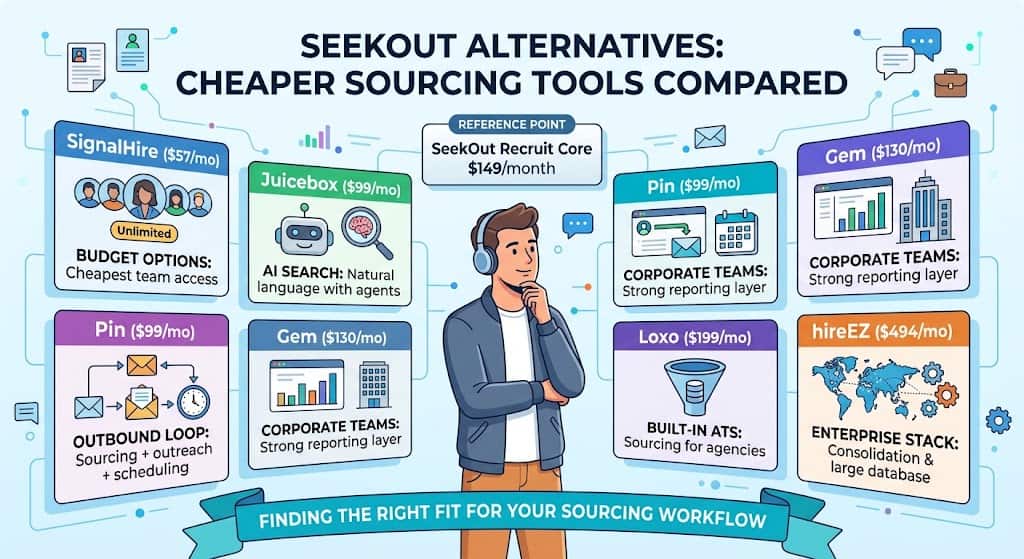
The short list: SignalHire for the cheapest team access, Juicebox for AI search with agents, Pin for sourcing plus scheduling, Gem for corporate talent teams, Loxo for agencies, hireEZ for enterprise consolidation.
What are you replacing when you leave SeekOut?
Be precise about this, because the alternatives are not interchangeable. SeekOut sells three things in one seat: search across a very large people graph, filters for diversity and internal mobility, and a workflow for engaging what you find. Most teams that cancel only use one of them heavily.
If you mainly reveal contact details, a finder costs a third of the price. If you mainly need search plus outreach, an AI sourcing platform covers it. If you need the data inside your ATS, buy the ATS that includes sourcing instead.
| Tool | Published entry price | Best at | Watch out for |
|---|---|---|---|
| SignalHire | $57 per month, annual | Unlimited seats on every paid plan | Runs on credits, so plan list volume |
| Juicebox | $99 per seat per month, annual | Natural language search with AI agents | Agents are $199 per agent per month |
| Pin | $99 per user per month, annual | Sourcing, outreach and scheduling together | Solo is annual billing only |
| Gem | $130 per month | Corporate talent teams that need reporting | Enterprise plans are custom by headcount |
| Loxo Professional | $199 per user per month, annual | Sourcing built into an agency ATS | Annual plans are paid up front |
| hireEZ | $494 per month | Consolidating a whole recruiting stack | A real floor, with enterprise pricing quoted |
Which is the cheapest way to keep a team sourcing?
SignalHire, at $57 per month billed annually, because every paid plan includes unlimited users. A four person team shares one subscription and one credit pool, which is a different economic model to anything else on this list.
You get a Chrome extension, bulk export, a database of more than 850 million profiles, ATS and CRM integrations, and built in email sequences that send from your own mailbox. What you do not get is candidate search with the depth of a dedicated sourcing platform, so treat it as a contact layer rather than a SeekOut replacement if filters are why you bought SeekOut.
Which is best for AI search?
Juicebox, at $99 per seat per month billed annually or $119 month to month. You describe the person you want in plain language and it builds the search, which changes how quickly a new sourcer becomes productive. The plan includes 500 contact credits and 500 export credits, and the Growth tier at $179 per seat annually raises that to 1,500 of each plus three mailboxes per user.
Agents are the upsell. They cost $199 per agent per month and bring unlimited contact and email credits with them, so the maths only works once an agent is genuinely running a desk’s outreach.
Which covers the whole outbound loop?
Pin, at $99 per user per month on Solo, billed annually, with 500 contact lookup credits. The Professional plan is $135 per user per month annually or $179 month to month and includes two AI agents per user, 1,000 credits per seat and five mailboxes per user. Business is unlimited and quoted.
Pin’s pitch is that sourcing, outreach and interview scheduling sit in one product, so a small team can run a full outbound process without stitching three tools together. There is a free tier with five contact lookups a week if you want to test the data first.
Which suits a corporate talent team?
Gem, from $130 per month on the startup self serve plan for teams of one to ten full time employees on yearly billing. Companies under 30 employees get the all in one product free for six months and 50 percent off afterwards, and teams between 30 and 100 employees get reduced rates from day one.
Gem’s strength is the reporting layer rather than the raw database. If the reason your head of talent keeps rebuilding spreadsheets the night before a board meeting is that nobody trusts the funnel numbers, that is the problem Gem is built to solve. Enterprise plans that combine Gem with an ATS are custom priced by headcount.
Which puts sourcing inside the ATS?
Loxo Professional, at $199 per user per month billed annually. It searches a proprietary graph of more than 850 million professionals in the same motion as your own database, returns contact details with shortlists, and includes 2,500 credits per seat each month pooled across the team.
For an agency, this is usually the cheapest total because it removes the separate ATS subscription entirely. For a corporate talent team already committed to an applicant tracking system, it is the wrong shape.
Which replaces the whole stack?
hireEZ, starting at $494 per month for a solo recruiter with a seven day trial. Above that, hireEZ does not publish a per seat rate at all and prices against the contracts it consolidates, validating the case in a four week verification with your own workflows before you sign.
It reaches more than one billion profiles across more than 45 channels and offers more than 40 native ATS integrations, so it sits on top of your existing system rather than replacing it. This is an enterprise purchase, and the full head to head covers how it compares with SeekOut directly.
Quick answers
What is the cheapest SeekOut alternative?
SignalHire at $57 per month billed annually, with unlimited seats. It is a contact finder rather than a full sourcing platform, so compare on the job you need done.
Which alternative has the biggest database?
hireEZ and SeekOut both state more than one billion profiles. Loxo states more than 850 million and SignalHire the same. Coverage in your niche matters more than the headline count.
Do any offer a free trial?
Yes. SeekOut itself runs 14 days with no card, hireEZ runs seven days, Pin has a free tier with five lookups a week, and Juicebox has a free plan with limited searches.
Which is best for diversity sourcing?
SeekOut remains the strongest on diversity and internal mobility filters, which is why some teams keep it alongside a cheaper contact tool rather than replacing it.
Do these integrate with an ATS?
hireEZ lists more than 40 native ATS integrations, SignalHire and Gem integrate with common systems, and Loxo is the ATS. Check your specific system before buying.
Should I buy sourcing or contact data?
If you can already build a list and just need details, buy contact data and save the difference. The contact finder comparison covers that side.
The bottom line
SeekOut is priced sensibly for what it does, so the alternatives that win do so by changing the job rather than undercutting the price. SignalHire wins on shared team access. Juicebox and Pin win on AI search with outreach attached. Gem wins on reporting for corporate teams. Loxo wins when the sourcing belongs inside the ATS. hireEZ wins when the real problem is five contracts nobody can defend.
Decide which of those sentences describes your team, then trial two of them on the same hard role before you cancel anything.
Sources: SeekOut pricing, SignalHire pricing, Juicebox pricing, Pin pricing, Gem pricing, Loxo pricing, hireEZ pricing