

Loxo and Spott both sell an all in one ATS and CRM for agency recruiters. They do not sell the same bet.
Loxo is older. It markets a Talent Intelligence Platform that bundles Loxo ATS and Loxo CRM with a large vendor owned talent graph, outreach, and agents. Spott is newer (founded 2024, Y Combinator W25). It markets Spott ATS and CRM as AI native, with records that stay current from your own calls, emails, and messages.
If you are a new recruiter choosing a desk system, start with that fork. Do you want a built in sourcing database as the main reason to consolidate? Or do you want conversation context, client presentation, and published seat AI on every tier? For plain definitions of how ATS and CRM differ on a desk, see ATS vs CRM. This piece is a product comparison, not a redo of that concept.
Both vendors publish attack pages about each other. Treat those as advocacy. Confirm prices on the live pages before you sign.
What ATS and CRM questions should a new recruiter ask first?
Buy the workflow you will actually run in week two. Not the demo deck.
Ask where the candidate record gets updated. From a vendor graph refresh, from your own activity, or from both? Ask whether email, SMS, WhatsApp, and LinkedIn work is native, integrated, or reminder only. Ask what client delivery means for you: a portal, a status report, or a branded presentation. Ask what sits on the published base plan versus a higher tier or a credit meter.
Ask about migration, support speed, and what happens if you upgrade off a free or trial path. Reddit is louder on those ops details for Loxo than for Spott.
Extensions help you capture profiles. They are not a license to scrape Recruiter. Keep LinkedIn outreach and email hygiene separate when that is how your desk already runs. See how to cold email and cold email best practices before you wire a sending domain to a new CRM.
What is Loxo, in plain terms?
Loxo is a recruiting platform out of Austin, Texas that bundles an ATS, a recruiting CRM, a sales CRM for business development, outreach campaigns and a people search engine the company says covers more than a billion profiles. It is the more established of the two, with a 4.6 rating from over 160 reviews on G2 and 128 verified reviews on Capterra. Almost 95 percent of its reviewers work at companies with fewer than 50 employees, which tells you exactly who it serves best.
What is Spott, in plain terms?
Spott is an AI native ATS and CRM founded in Leuven, Belgium in November 2024 by three former management consultants. It joined Y Combinator’s Winter 2025 batch and raised $3.2 million in seed funding led by Base10 Partners. Its headline features are semantic search, a built in note taker, a unified inbox that pulls LinkedIn, WhatsApp, email and phone calls into one view, and automatic profile enrichment.
Do Chrome extensions beat LinkedIn ToS, or just vendor claims?
Neither vendor’s public docs give you scrape powers that LinkedIn forbids. Do not buy as if they do.
Loxo Chrome extension says you can add profiles with a click, with available contact info, then drop people into jobs, campaigns, lists, or call queues, and send email or SMS from the extension. Activities log to the CRM. The FAQ says it works on Chrome pages where a candidate profile exists (GitHub, job boards, portfolio sites, and similar) and “pulls what it can see.” That page does not claim Recruiter scraping or automated InMail or connection sending.
Spott Chrome update is clearer on LinkedIn pressure. Spott says LinkedIn enforced its User Agreement harder in Q1 2026, so extensions had to change. Spott moved to Chrome’s Side Panel. Remaining LinkedIn paths Spott documents: public profile or public URL lookup (including from Recruiter or Sales Navigator pages), plus manual entry or LinkedIn Resume PDF parse. Spott says it stopped reading LinkedIn page data directly.
On Loxo Spott fact check, Loxo says it does not scrape LinkedIn. It says professional data comes from tier 1 B2B aggregators as publicly available information. Loxo also says it does not send InMails or connection requests, and that LinkedIn automation outside LinkedIn’s partner program violates LinkedIn’s terms. Loxo frames that as a compliance choice.
Adding a public profile or refreshing a record you own is useful. Harvesting Recruiter results or blasting connections is a ToS and account risk story. Buy the desk. Keep LinkedIn work inside LinkedIn’s rules.
Who is Loxo vs Spott best for: solo, small team, or larger?
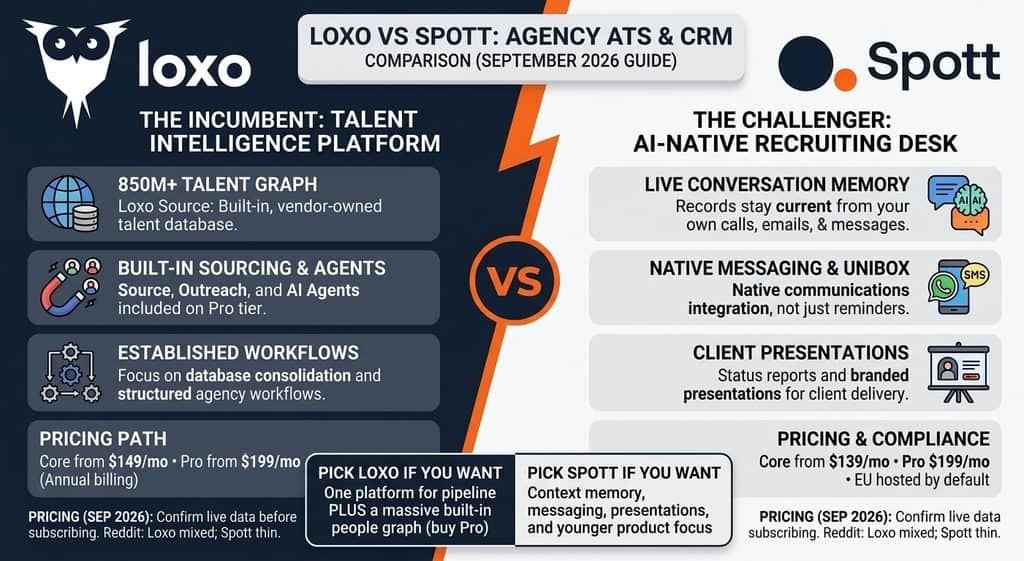
For a solo or small desk that wants one login for pipeline plus a large built in people graph, Loxo’s Professional path is the consolidation pitch. Live Loxo pricing (checked 4 Sep 2026) lists Core from $149 per user per month billed annually (ATS and recruiting CRM, natural language AI search included) and Professional from $199 (Loxo Source on an 850M+ talent graph, agents, 2,500 credits per seat per month pooled). Enterprise is custom. The page shows a 7 day Professional trial. Confirm live. Older marketing and Reddit still mention free forever. The Sep 2026 cards do not show Free Forever. Ask Loxo what “Start free” still means.
For a small agency that wants conversation memory, WhatsApp and email linked to records, branded presentations, and EU hosting by default, Spott is the newer bet. People Managing People publishes a Spott review aimed at agency ATS and CRM buyers, not in house TA. It quotes from $139 per user per month billed annually. Strengths it names: context matching, Conversation Memory, Unibox, presentations, white glove migration. Gaps it names: contracting module still rolling out, limited mobile, external sourcing via third parties rather than a Loxo style owned graph.
Larger teams should price seats, credits, enrichment, and migration together. Loxo markets free migration for Core teams of three or more seats. Spott markets about four week migrations. Neither replaces a scoped SOW.
What do Spott and Loxo claim about each other?
Read both primary pages. They disagree on almost every marketing line.
What does Spott’s comparison page say?
On Spott’s Spott vs Loxo page (Aug 2026), Spott frames Loxo as an all in one ATS and CRM around an 800M+ vendor talent graph, and Spott as AI native with the source of truth in your own activity. Spott says semantic matching is in its base plan, while Loxo’s natural language and semantic search sit on a quote only Professional tier. Spott lists its Core at $139 and Pro at $199 per user per month annual, AI in base, enrichment credits as the usage line. Spott says it is EU hosted by default, ISO 27001, GDPR first, and does not train on customer data. Spott still concedes Loxo wins for a built in sourcing database, US brand, free entry (historical), and structured workflows.
Spott’s Aug 2026 Loxo price rows (Free plus Basic at $169, Professional quote only) do not match Loxo’s live Sep 2026 cards (Core $149 with AI search included, Professional $199 with Source and agents published). Treat those Spott rows as dated advocacy. Confirm on loxo.co/pricing.
What does Loxo’s fact check say?
On Loxo Spott fact check (last reviewed April 2026), Loxo says it found 16 inaccurate or misleading claims. Loxo says Spott’s “Dwight Schrute” example is unquoted Boolean misuse. Loxo says it has built proprietary AI and ML since 2013 and is on a seventh generation of networks, so “bolted on AI” is false. Loxo says Spott’s own terms include full term commitment, auto renewal, and non refundable fees, so lock in criticism cuts both ways. Loxo denies LinkedIn scraping, denies missing migration help, and denies being US only. As of that April page Loxo also claimed monthly, annual, and a free PLG tier. Confirm free status live. Sep 2026 cards emphasize Core, Professional, Enterprise, and a 7 day trial.
You cannot settle “AI native” from press copy. You can settle the invoice by matching the demo seat to the order form.
Are there real third party Spott vs Loxo writeups?
A dedicated independent Spott vs Loxo bake off was not found on the open web for this draft (checked 4 Sep 2026). No standalone Loxo review in this piece replaces a live demo either. The loudest head to heads are the vendors’ own pages.
PMP Spott review is real third party coverage of Spott alone. It positions Spott for agencies and staffing, not corporate in house TA, and says teams that need full contracting, strong mobile, or a built in external sourcing database should confirm fit.
SelectSoftware Spott review (July 2026) lists Loxo as an alternative. It is not a lab bake off. It notes Spott is early, with fewer integrations and no payroll or invoicing depth. Older “Loxo is free to start” lines can be stale versus current Loxo pricing cards.
Use third party pages for category fit. Do not treat them as a finished Spott versus Loxo scorecard.
How do Loxo and Spott compare side by side?
| Topic | Loxo (public claims) | Spott (public claims) |
| Positioning | Talent Intelligence Platform: ATS, CRM, Source, outreach, agents | AI native ATS and CRM; records update from your activity |
| Talent graph | Loxo Source on Professional; 850M+ on live pricing page | No owned Loxo style graph; enrichment and LinkedIn workflows |
| Search | Live Core card includes natural language AI search; agents on Professional | Semantic matching marketed in base plan |
| Chrome and LinkedIn | Extension adds or refreshes profiles from web pages; fact check denies scrape and InMail automation | Side Panel; public URL lookup and PDF parse after Q1 2026 LinkedIn enforcement (Spott’s words) |
| Pricing (4 Sep 2026) | Core from $149, Professional from $199, annual, paid up front; confirm live | Core from $139, Pro $199 annual per Spott and PMP; confirm live |
| Compliance marketing | GDPR and CCPA pages; regional data centers claimed on fact check | EU hosted by default, ISO 27001, no training on customer data (vendor) |
| Best fit signal | Consolidate sourcing subscription into the ATS seat | Context, Unibox, presentations, EU default hosting |
| Reddit last 12 months | Several mixed agency threads | Thin name drops, almost no day to day reviews |
Numbers move. Re check vendor pricing pages before you budget.
How Much Does Loxo Cost Compared to Spott in 2026?
Spott is cheaper at the entry point and far easier to budget for. Loxo is cheaper if you can genuinely live on the free tier, and more expensive than it looks the moment you need its AI.
| Loxo | Spott | |
|---|---|---|
| Free plan | Yes, one user, forever | No, demo and trial only |
| Entry paid price | $169 per user per month | $139 per user per month (annual) |
| Mid tier | Professional, quote only | Pro at $199 per user per month |
| Top tier | Enterprise, quote only | Enterprise, custom |
| Pricing published? | One tier only | All tiers |
Loxo runs four tiers and publishes a dollar figure for exactly one of them. The Free plan gives a single user the ATS, recruiting CRM and Chrome extension. Basic at $169 adds the sales CRM, job posting, multiple users, dashboards, analytics, resume parsing and support. Professional and Enterprise both require a sales conversation.
Spott runs three tiers and prices all of them openly. Core at $139 per user per month billed annually covers the AI native ATS and CRM, custom objects, email, social and WhatsApp sync, and AI search and matching. Pro at $199 adds automations, multichannel sequences, data enrichment and priority support. Enterprise adds custom terms, advanced permissions, flexible invoicing and a dedicated point of contact.
Where do the hidden costs show up?
On Loxo, the cost surprise is usually the tier jump. The AI sourcing and outreach automation featured in Loxo’s marketing are Professional features, not Basic ones, and industry estimates put Professional somewhere in the $250 to $400 per user per month range. Multiple Capterra reviewers also report automatic annual price increases of roughly five percent written into contracts, which buyer guides flag as a real factor over a three year term.
On Spott, the cost surprise is smaller but real. Spott states that AI token spend for matching, note taking, outreach drafting and recommendations is included in every plan, and that the only extra charge is enrichment credits for finding contact details. That is a cleaner model than credit metering across multiple features, but enrichment heavy teams should still ask for a credit estimate before signing.
Which Platform Has Better AI for Recruiters?
It depends on whether you want AI that finds people or AI that removes admin work.
Loxo’s AI strength is reach. Its search engine covers a very large pool of profiles with verified contact information attached, plus natural language search and AI agents on the Professional tier. If your bottleneck is that you do not have enough candidates, Loxo addresses that directly.
Spott’s AI strength is memory and context. Candidate profiles update automatically from call transcripts, meeting notes and emails. Its semantic search matches on meaning rather than keywords, and Spott says it uses vector databases so every match is explainable. If your bottleneck is that you already have 100,000 candidates you cannot find again, Spott addresses that directly. One customer quoted on Spott’s own site describes 150,000 dormant candidate records becoming searchable after enrichment filled in missing emails and LinkedIn URLs.
Worth knowing: this comparison has turned competitive in public. Spott published a head to head article arguing that Loxo’s AI is bolted onto older architecture, and Loxo responded with a public fact check disputing sixteen specific claims, including the assertion that Loxo lacks true semantic search. Read both, then test the search yourself on your own roles during a demo. Do not let either vendor pick the demo role for you.
What has Reddit said since September 2025?
Window: 1 September 2025 through 4 September 2026. Older threads are out of scope.
Loxo has a real, mixed conversation. Spott is thin. No Reddit bake off titled Spott versus Loxo.
Loxo in window: Sep 2025 Loxo thread (BD weak, support slow, mixed long time user). Sep 2025 experiences (price and sourcing knocks, portal praised). Oct 2025 switching (messaging and LinkedIn integration pain). Jan 2026 just started (email send issues, mixed Source views, free upgrade trap claim). Feb 2026 leave Loxo (outreach disappointment, Spott name dropped). Feb 2026 alternative (average sourcing, retainer fee gap). May 2026 vs RecruiterFlow (Loxo as sourcing engine, Spott also suggested). Jul 2026 solo options (likes Loxo after Bullhorn, free versus paid chat).
Spott: in Sep 2025 solo ATS, one commenter at a four person agency called Spott AI first and said it does not lock you in. Elsewhere Spott is a pass by name in Loxo shopping threads. That is not a day to day review corpus.
Reddit is a warning list (data quality, outreach, support, LinkedIn workflow, contracts), not a winner. Run the tests yourself.
Which should you pick, and what FAQs matter?
Pick Loxo if you want one platform mainly for a large built in talent graph plus ATS and CRM, and you will buy the Professional seat that includes Source and agents on the current public cards. Pick Spott if you want conversation context, semantic matching marketed in the base plan, client presentations, and EU default hosting, and you accept a younger product with thin Reddit proof.
Do not decide from Spott’s table alone or Loxo’s fact check alone. Trial the same three reqs. Verify contacts before you send. Confirm pricing, credits, enrichment, migration, and LinkedIn workflow on a live call. More tools sit in the Work Insiders directory.
Is Spott just a Loxo clone?
No. Spott’s public story is activity and context as the source of truth, plus EU hosting defaults. Loxo’s is a Talent Intelligence Platform around an owned graph. Independent side by side labs are still missing.
Does Loxo still have a free plan?
As of the 4 Sep 2026 Loxo pricing page, published cards are Core, Professional, and Enterprise, plus a 7 day Professional trial. Older pages, Reddit, and Loxo’s April fact check still talk about free PLG or free forever. Confirm with Loxo before you budget that way.
Can either replace LinkedIn Recruiter?
Not as a default. Loxo markets Source to cut separate sourcing spend. Spott markets enrichment and LinkedIn workflows without a Recruiter sized owned graph. Users in this Reddit window still keep Recruiter or Sales Nav beside Loxo often enough. Prove it in your trial.
Whose comparison page should I trust?
Neither as gospel. Spott’s Aug 2026 page sells Spott. Loxo’s April 2026 fact check sells Loxo. Use them as a disputed claim checklist, then verify on live product and legal pages.
Where should a new recruiter start?
List must haves: pipeline, email logging, portal or presentations, sourcing graph yes or no, WhatsApp yes or no, EU hosting yes or no. Demo both. Price the tier you will use. Choose one system of record.
The Bottom Line
Pick Loxo if you want scale, sourcing reach and a low risk entry point, and you are comfortable negotiating for the tier that unlocks the AI. Pick Spott if you want transparent pricing, an interface built for how recruiters actually work in 2026, and AI that quietly maintains your database instead of asking you to maintain it.
The deciding test is simple. Book both demos, bring one real role you struggled to fill last quarter, and make each platform search for it live. The tool that surfaces someone you had not already considered is the one worth paying for.
Quick Answers
Is Spott cheaper than Loxo? Yes at the entry level. Spott Core starts at $139 per user per month billed annually versus Loxo Basic at $169. Loxo is cheaper only if the free single user plan meets your needs.
Does Loxo have a free plan and does Spott? Loxo has a free forever plan for one user with a limited number of monthly contact reveals. Spott has no permanent free tier, only a demo and guided trial.
Which is better for AI sourcing? Loxo, if sourcing means searching a large external database of profiles with contact data. Spott, if sourcing means surfacing the right people from the database you already own.
How long does it take to switch? Spott quotes about four weeks for a typical migration and handles the work in house. Loxo reviewers generally describe implementation as straightforward with good training.
Which has more proof behind it? Loxo, clearly. It has years of verified reviews across G2, Capterra and Trustpilot. Spott has strong early ratings but a much smaller sample and less than two years of history.
Can I use both? Not sensibly. Both are systems of record. Running two means your data splits in half, which is the exact problem either one is meant to solve.
Free newsletter
Get the Work Insiders weekly
One email a week: the recruiting and HR tech news that mattered, the tools we just added to the directory, and one practical guide. No spam, and you can unsubscribe in one click.