

Applicant Tracking System vs Recruiting CRM: When You Need Both
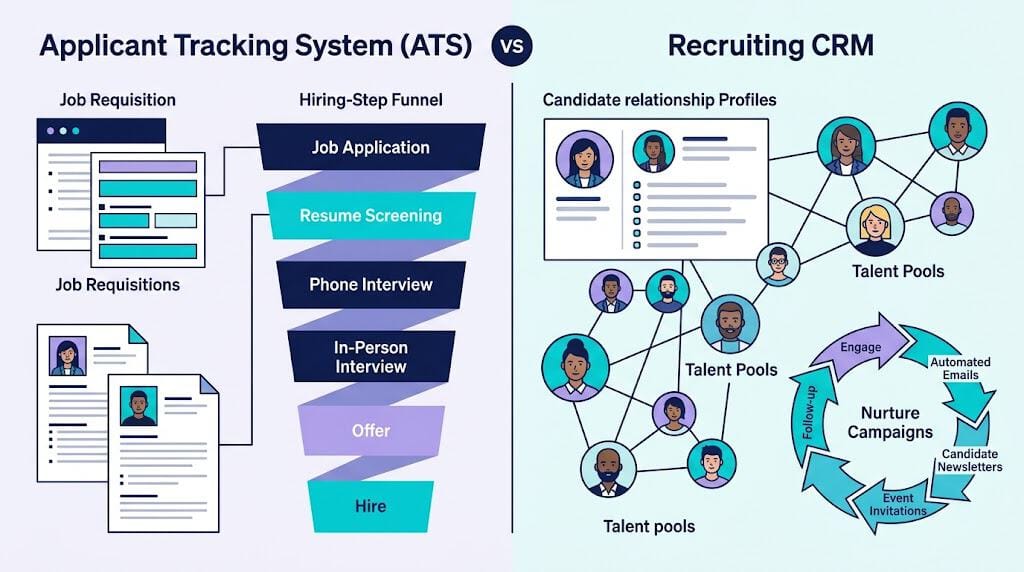
Applicant Tracking System vs recruiting CRM is a split in primary objects, not a branding fight. The applicant tracking system is built around the requisition. The recruiting CRM is built around the person who has not applied yet.
Mix them up and you get two records for one human, consent stored in the wrong system, and a talent pool that vanishes when the job closes.
Greenhouse draws the line on a clock. In its CRM versus ATS article, Greenhouse says the ATS manages hiring after a candidate applies. The recruiting CRM finds, segments, and stays in touch before they apply. Greenhouse also says a CRM cannot replace an ATS, and that bundled is not the same as connected.
HubSpot repeats the split in its recruiting CRM guide. A recruiting CRM nurtures people before they apply. An ATS manages active applicants from application to offer. HubSpot tells teams to integrate both. The ATS is the system of record for applications. The recruiting CRM is the system of record for relationships and, often, consent.
What is ATS vs CRM?
An ATS runs requisition to hire workflow. Applications land. Stages move. Interviewers leave scorecards. Approvals fire. Compliance needs an audit trail. The job is the spine.
LinkedIn Talent Blog defines an ATS in its ATS overview post as recruiting software that serves as a centralized repository for candidate data, including applications, resumes, and team notes.
Indeed describes ATS work in ATS and CRM as automating posting, screening, and scheduling. Those are job tasks. They assume someone already applied, or is about to.
A recruiting CRM holds a talent relationship pipeline of people who have not applied: passive talent, past applicants, referrals, silver medalists, and talent communities. Nurture campaigns, segmentation, and privacy preferences live here.
iCIMS explains the pairing in its candidate CRM overview. A CRM manages talent nurturing. An ATS manages requisitions, applications, and interviews. They are best together. A recruiting CRM is unlike a generic CRM.
Work Insiders lists ATS tools in its software directory.
How is a recruiting CRM different from an ATS?
The ATS object is the job. Greenhouse lists ATS work as hiring stages, scorecards, structured interviews, job posting, reporting, and governance such as audit trails and role based permissions. The recruiting CRM object is the person. Greenhouse lists CRM work as campaigns, segmentation, sourcing notes, and privacy preferences including opt in and opt out.
SmartRecruiters draws the same line in its recruitment CRM FAQ. CRM converts passive talent into applicants. An ATS processes applicants. A Talent Acquisition Suite, in SmartRecruiters language, includes both, plus a universal candidate profile, GDPR handling through one data flow, a native CRM with its ATS, and HCM integrations.
Lever uses another label. In TRM versus ATS, Lever says an ATS tracks applicants. Talent relationship management is candidate centric and keeps communication going beyond the hiring cycle. Lever’s product overview and ATS plus CRM pages position ATS plus CRM in one platform.
Indeed says a CRM builds relationships with active and passive candidates through follow up, talent pools, and metrics such as time to fill or cost per hire. Data can flow from ATS to CRM so teams do not enter the same data twice. Jobvite describes Source and CRM as identifying, segmenting, and engaging talent, then inviting CRM people to apply through rediscovery with Jobvite ATS. Beamery frames a talent CRM product as sitting with the ATS: talent pools, silver medalists, consent, and HCM employees.
The ATS is where a req lives. The recruiting CRM is where a person lives when there is no req, or when the req has closed.
How does a sales CRM differ from a recruiting CRM?
A sales CRM is a third thing. Salesforce Sales Cloud and HubSpot, used as general CRMs, are built for customers and deals. They are not an ATS.
HubSpot is explicit. Its recruiting page says HubSpot CRM can support candidate relationships and outreach, and that it is not a purpose built ATS. HubSpot connects to ATS tools through its integration marketplace.
Salesforce Talent Recruitment Management is easy to confuse with Sales Cloud. It is not the same product. Salesforce documents Talent Recruitment Management as a Public Sector Solutions data model with requisitions, postings, applications, evaluation, vetting, and hiring objects. That is separate from Sales Cloud’s customer and deal objects.
iCIMS makes the category point: a recruiting CRM has workflows, automation, and compliance designed for talent acquisition. A generic sales CRM does not.
When do you need both?
You need an ATS if you hire through requisitions. Almost every company that posts jobs does. You need a recruiting CRM when the people you want are not in today’s applicant list, and you plan to stay in touch on purpose.
Workday compares the shapes in ATS versus CRM. An ATS is a linear hiring funnel: application, screen, interview, offer, hire. A CRM is cyclical. Contacts move in and out of engagement over months or years. Workday’s conclusion for talent teams is direct: if your strategy depends on a passive, long term pipeline, an ATS alone is not enough.
SHRM captured the buyer confusion. In recruitment tech stack, Tim Sackett told SHRM that talent stacks start with the ATS. He also said products blend, and buyers get lost. He grouped best of breed tools such as Jobvite, Greenhouse, and iCIMS separately from enterprise requisition systems such as Oracle, SAP, and Workday. Sackett’s filter is blunt. Will recruiters use it? Will it make hiring faster or raise quality of hire? He also said most companies do not need a complex CRM. It needs a team to run it. What many teams actually want is marketing automation: a top of funnel connection that produces more candidates. Mass email is not that. Sackett called mass email spam.
Needing both is not buying two logos. It means someone owns nurture, with consent, and someone owns the req. That can be two products, or one platform with real depth on both sides.
When does a company outgrow ATS only?
You outgrow ATS only when the ATS database is full of people you never talk to, and when hard to fill or high volume hiring depends on those people coming back.
Kyle Lagunas, then leading talent attraction at General Motors, told SHRM in GM tech stack that the ATS he inherited was configured mainly for compliance, not performance. He wanted the ATS to just be the ATS. He layered a Beamery CRM on Workday through APIs so the team could keep engaging people after apply. Silver medalists, he said, might leave and return later with new skills. That is the outgrow signal. The ATS took applications. It could not be the long term relationship layer.
Sackett’s complementary advice: mine your ATS database. People already told you they want to work for you. If you cannot segment, campaign, or store opt in status without wrecking the req workflow, the ATS is the wrong home. Workday lists three ways to grow past a single silo: a native unified platform, API based connections, or middleware. Workday also describes a large integration catalog around its HCM. Skip ownership rules and you copy the mess into two databases.
Who owns the candidate record?
Systems own fields. People own tasks.
Phenom walks through this in two way integrations. Name a system of record per field, not per human. Phenom notes that candidate status is often created in the ATS and mirrored elsewhere. Job requisitions often open in the HCM and surface in the ATS. After hire, the employee record belongs to the HRIS or HCM.
Consent, communication preferences, campaign history, and talent community membership often belong in the recruiting CRM. That is where opt in and opt out are enforced. Application data, stage history, scorecards, interview notes tied to a req, and the compliance audit trail belong in the ATS. Contact basics (name, email, phone) are shared, and they are where duplicates breed. After someone is hired, the HRIS owns the employee. The recruiting CRM may still hold alumni interest, with consent.
Sourcers and recruiters both working the same person is a process problem. Give one owner for outreach in a time window. Let the ATS show every open req they are in. Let the CRM show every campaign they are on. If those views disagree, your integration is one way in the wrong direction.
How should ATS and CRM integrations work?
Greenhouse’s warning is the right test: connected versus bundled. If the CRM cannot segment by skill or past interview performance, Greenhouse says you have a mailing list. If the ATS tracks stages but cannot support structured evaluation, you have a spreadsheet with a login.
Phenom separates two way from one way. A one way integration pushes data from system A to system B. A two way integration lets either side write, with rules for which write wins. Two way is not always better. Audit exports can stay one way. Skip field level ownership and you get sync loops.
Indeed describes a common one way pattern: data flows from ATS to CRM so recruiters do not repeat data entry. Workday groups the architecture choices as native unified, API based, or middleware. Lagunas chose APIs: Beamery on Workday, ATS kept as the ATS. SmartRecruiters sells the native path: CRM and ATS on one profile so GDPR requests do not fork. iCIMS says its CRM can also sit on another applicant tracking tool.
Test a silver medalist who later applies, a referral already in a campaign, and a new hire who must land in the HRIS. If any of those three creates a second profile, you are not done.
How do vendor labels blur ATS and CRM?
Buyers hear ATS, CRM, TRM, TAS, CXM, and Source and CRM. The labels overlap on purpose.
Lever calls the combined product TRM and says ATS and CRM live in one platform. SmartRecruiters calls the combined idea a Talent Acquisition Suite. Jobvite splits Source and CRM from its ATS, then integrates them. Greenhouse warns that packaging is not integration. Workday writes about ATS versus CRM and then offers recruiting inside HCM. HubSpot writes about recruiting CRM while remaining a general CRM with an ATS marketplace.
Sackett told SHRM the overlap is overwhelming. Ignore the acronym and ask two questions. What is the primary object? What is the system of record for this field?
How do agencies use ATS and CRM?
Corporate talent teams use a recruiting CRM for people who have not applied, and an ATS for reqs. Staffing firms split the world differently. Our Loxo vs Spott comparison looks at two agency platforms that combine both.
Bullhorn describes the split in staffing ATS CRM. For agencies, the ATS side is candidate management and placements. The CRM side is clients and sales: job orders, accounts, and the revenue pipeline. Sales and recruiting sit on one platform so a placement has both a person and a client.
That is why an agency can say our CRM and mean clients, while a corporate TA team says our CRM and mean silver medalists. Same three letters. Different object.
What questions do hiring teams ask?
Can Salesforce or HubSpot replace our ATS?
Not if you need requisitions, applications, scorecards, and a hiring audit trail. HubSpot says a recruiting CRM works before apply and an ATS works from application to offer, and that HubSpot is not a purpose built ATS. Salesforce Sales Cloud is a customer and deal system. Salesforce Talent Recruitment Management is a Public Sector Solutions data model with requisitions and applications, not Sales Cloud with a new coat of paint. Renaming Deal to Candidate does not make a general CRM into an ATS.
Do we need a recruiting CRM if we already have Greenhouse or Workday?
Only if you will run a real nurture practice. Greenhouse says CRM cannot replace ATS. Workday says an ATS alone is not enough when you need a passive, long term pipeline. Sackett told SHRM most companies do not need a complex CRM without a team. If nobody will segment, write content, and honor opt out, skip the extra product and mine the ATS first. If you do need the CRM layer, let the ATS be the ATS.
Who owns a candidate if a sourcer and a recruiter both work them?
Give one outreach owner at a time. Put application and stage ownership on the ATS. Put consent and campaign membership on the recruiting CRM. Phenom’s rule: name the system of record per field. When both people can edit the same email and the same status, you have duplicates, not two owners.
What happens to silver medalists when a req closes?
If they live only on the req, they disappear with it. That is ATS only behavior. Beamery’s talent CRM pitch is to resurface silver medalists. Lagunas told SHRM the talent journey goes beyond apply, and silver medalists may be ready later. Jobvite’s rediscovery invites CRM people to apply when a new job matches. Move the person to a community with consent before you close the req.
You need both when the job and the person stop being the same object. If you cannot name which system owns consent, stage, and employee status, you are choosing where the next duplicate will be born.
Free newsletter
Get the Work Insiders weekly
One email a week: the recruiting and HR tech news that mattered, the tools we just added to the directory, and one practical guide. No spam, and you can unsubscribe in one click.