

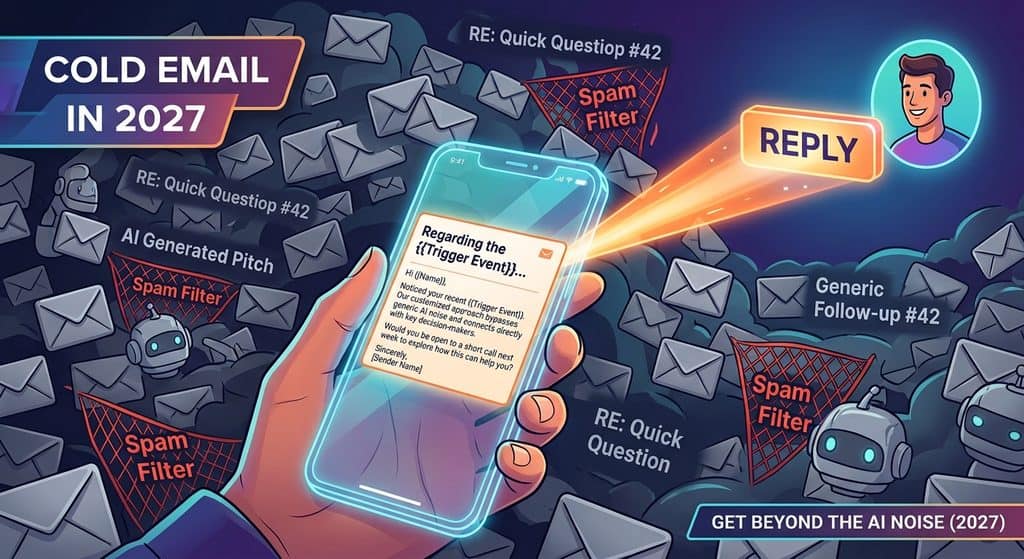
Cold email still works in 2026 if it passes two filters: the inbox provider’s spam model and a reader who has seen a thousand AI written pitches this month. Keep it under 65 words, open with a true reason for writing, use the prospect’s own words, vary every sentence so no two sends match, and write differently for Google and Microsoft inboxes. Let AI do the research. Keep the voice human.
Why is cold email harder to get right in 2026?
Everyone now has an AI tool that writes cold email outreach slop, and most of it sounds the same. Spam filters have been trained on millions of these lookalike emails, and so have the people reading them. Software catches the repeated patterns. People catch the hollow tone.
Get flagged by either one and your email is finished. The goal is copy that reads like a person did the homework, adjusted for the inbox that receives it.
What research should you do before writing a cold email?
Listen to your buyers before you write a word. People resist being pitched, but they respond when they hear their own frustrations played back in their own language.
Spend half an hour pointing an AI research tool at Reddit threads, Quora, review sites like G2 and Capterra, and the niche forums where your buyers complain. Pull out five things:
- Top problems. The handful of pains they mention most often.
- Exact phrases. How they describe those pains, word for word.
- Wrong beliefs. Assumptions you could respectfully challenge.
- Vendor complaints. What annoys them about the tools and providers they use now.
- Buying moments. The events that push them to start shopping. For recruiters these are the hiring signals worth watching.
Strong salespeople already do this on calls: they repeat back what the buyer said and ask a question on top of it. A cold email is the written version of that habit, and that half hour saves a dozen rewrites.
What does every prospect want to know from a cold email?
Every cold reader runs the same silent checklist:
- What’s in it for me, in money or time?
- Have you done this for someone like me?
- Do you know anything about my business?
- Is this a real person or a scam?
- Is this worth my next ten seconds?
Answer all five fast. A good target is a whole email under about 65 words, with the core answers in roughly 50. Any sentence that answers none of the five is padding, and padding is exactly what pattern matching filters feed on.
Which cold email frameworks work best right now?
Pick one structure per campaign. The examples below are written for a staffing agency emailing a VP of Engineering whose company just raised money and posted several backend roles. Fields in double braces are merge tags your sending tool fills in for each contact.
| Framework | What it does | Best used for |
|---|---|---|
| Trigger, Think, Proof, Ask | Real reason, hidden problem, proof, easy next step | Most first emails |
| Humble follow up | Fresh angle, one new proof point, smaller ask | Second email in the thread |
| No pitch opener | Observation and a question, pitch saved for email two | Lists that get hammered with outreach |
| Peer note | Reads like one operator messaging another | Only when the client story is real |
1. Trigger, Think, Proof, Ask
- Trigger: the true reason you’re writing today. A made up trigger can sour a prospect on you for good. If AI writes this line, feed it only verified data and tell it to skip any contact with no real trigger. Here is how to catch triggers with Grok.
- Think: raise the next problem they haven’t budgeted for, the way an insider would. Fresh funding usually means pressure to ship, a hiring backlog and new managers stretched thin.
- Proof: strongest first. Say you’re already doing this for companies like theirs. Next best, describe exactly what you’d do for them and how fast. Last, a short case study with a named result. Skip the vague “we help companies get more meetings” line. Everyone sends it.
- Ask: a soft question beats a calendar link. Better still, offer something useful they can use without a call.
Subject: the backend roles
{{first_name}}, noticed five backend openings went up right after the round.
Senior backend searches tend to run 60+ days, and the roadmap rarely waits that long.
We’re filling these exact seats for Series A teams right now, usually with a shortlist inside two weeks.
Want the shortlist process? I can send it over either way.
2. The humble follow up
A gentler second note in the same thread a few days later. Admit you’re following up, come at the point from a new angle, add one proof point and shrink the ask.
Following up once, I know these pile up.
Short version: we place senior engineers for growing product teams and only bill when someone starts.
If hiring is covered, no worries. If a salary benchmark for these roles would help, reply “bench” and I’ll send it. No call needed.
3. The no pitch opener
Email one sells nothing. It makes a sharp observation, predicts the problem that usually comes next for companies at that stage, and asks who owns it. Email two explains why you asked. Because the first message doesn’t look like a pitch, it tends to pull the best replies on lists that are already saturated.
Subject: quick question
{{first_name}}, looks like {{company}}’s engineering team has grown fast this year.
The usual next squeeze: referrals dry up just as the hiring plan doubles.
When that happens, does recruiting land with you or with your talent lead?
The reveal goes out automatically, same thread, to anyone who didn’t reply:
Here’s why I asked: we run the searches that pick up when referrals run out.
If it’s on your plate, worth a short call. If it’s your talent lead’s, could you point me their way?
Anyone who answers email one should drop out of the sequence and get a real reply from a person.
4. The peer note
This reads like a quick message between two operators: you mention a recent conversation with a similar company, name the issues they had, ask if it sounds familiar, then explain what you’re doing about it. Only use it when that conversation really happened. AI models will happily invent one if you let them.
Should you personalize every cold email one to one?
Not always. There are two honest ways to personalize, and each fits a different job.
- Segment level: one script per audience, tuned to the pain that whole group shares. Right for big lists, where belonging to the segment is the relevance.
- One to one: AI researches each contact and writes a custom opener from something real, such as a review they got, a job they posted, an article they wrote or a hire they made. Right for high value accounts and signal based campaigns.
The rule that holds either way: AI handles the research, a human owns the voice. Have an experienced writer build and tune the prompts, review sample outputs before every full run, and keep the model boxed in by the framework. Unsupervised AI copy is how outreach ends up sounding like everyone else’s, and recruiters on Reddit rank it among the costliest automation mistakes.
How should cold email copy change for Google and Microsoft inboxes?
Check the prospect’s MX record and write to match. Our free bulk MX checker sorts a whole list at once. This is a copy decision, not a sending decision: you don’t need to send from Google to reach Google users, and Google and custom mail servers tend to land well across the board right now.
Google Workspace companies (MX points to aspmx.l.google.com). Gmail’s filtering is strict but rewards real relevance. This is where your researched one to one openers belong, and a little extra length is fine when every line earns its place.
Microsoft 365 companies (MX ends in mail.protection.outlook.com). Microsoft’s scoring is steadier and more predictable for cold mail, and it covers most small businesses and enterprises. Keep the first touch to one short line that sounds like an internal note: “Are you the one handling X?” or “Who owns Y over there?” The only goal is a reply. Once anyone at the company answers, you’re trusted in that environment, you can reach their colleagues, and you can open with “{{name}} pointed me to you.” Brief whoever handles replies on this before launch.
On Microsoft first touches, send no links and no tracking. Security gateways like Mimecast and Proofpoint open links in a sandbox, and that can hurt your domain. Domain age matters more here too: under about 90 days of warm up is risky against gateway protected companies.
| Recipient setup | How hard to reach cold | What to send first |
|---|---|---|
| Microsoft 365 with Mimecast or Proofpoint | Easiest, predictable | One line question, no links |
| Microsoft 365 with Barracuda | Easy, lighter on cold mail | One line question, no links |
| Google Workspace on its own | Medium, strict filtering | Researched one to one opener |
| Google Workspace with Proofpoint or Mimecast | Hardest, two separate filters | Short, relevant, no links |
If your buyers skew enterprise, weight your list builds toward Microsoft 365 companies. You gain a delivery edge before writing a word.
What is spintax and why does every sentence need it?
Spintax swaps in alternate wording on each send so no two emails match. Gmail cares less about individual spam words now and more about behavior, and thousands of identical sentences become a fingerprint no matter how clean the wording is. Either personalize every message one to one or spintax every line:
{Quick one|Fast question}, {saw|noticed} {{company}} {posted|opened} {five backend roles|a batch of backend openings} after the round.- Write three to five options for each phrase.
- Every combination must read naturally.
- Keep the call to action concrete. If the ask is “reply,” every variant says reply, never a vague “let me know.”
- Put the most variation into subject lines and openers, where pattern checks focus.
- Paste each script into our free spintax checker to catch broken braces and lines with no variation.
- Most cold email platforms read spintax natively; see how Instantly and Smartlead compare.
How do you keep cold emails out of spam?
- Plain text only. No HTML design, images or logo signatures.
- No tracking. Turn off open and link tracking, and ideally send no links in email one.
- Check every script. Run it through our free cold email spam checker and keep a blocked word list your tools enforce.
- Authenticate your domains. Confirm SPF, DKIM and DMARC with our email setup checker. Separate sending domains and warmup come first; our guide to cold email infrastructure covers the setup, and you can compare deliverability tools side by side.
- Clean and verify the list. Bounces count against your domain. Run the list through our lead list cleaner, then see what each verifier charges with the verification cost calculator.
- Add a playful opt out. Something like “reply ‘not now’ and I’ll vanish quietly” keeps you compliant, shows personality and often earns a friendly reply. Every real human response, even a no, tells the provider people engage with your mail.
What should you check before a cold email script goes live?
Run every script through these ten checks. Any “no” means it isn’t ready.
| # | Check |
|---|---|
| 1 | Under 65 words? |
| 2 | Leads with a tested, low risk offer rather than your main service? |
| 3 | Uses your buyers’ own words for their industry? |
| 4 | Takes an angle competitors aren’t sending? |
| 5 | Every sentence has spintax variants? |
| 6 | Fits the list and the signal that built it? |
| 7 | Sounds natural read aloud? |
| 8 | At least one line that breaks the cold email pattern? |
| 9 | Every sentence doing work, nothing filler? |
| 10 | If it claims to be personal, does the detail actually matter? |
Quick answers
How long should a cold email be in 2026?
Under about 65 words for a first touch. For Microsoft 365 companies, one short line is often better. Longer emails only work when every extra line is specific to the reader. Our cold email statistics show how length and timing affect replies.
Can I use ChatGPT or Claude to write cold emails?
Yes for research and first drafts, no for unsupervised sending. Give the model a framework, real data and permission to skip contacts with no genuine trigger, then have a person review samples before every run. Our BD prompts for recruiters are a good starting point.
Should I put links in a cold email?
Not in the first email, especially to Microsoft 365 companies behind a security gateway. Save links for after someone replies.
Do I need SPF, DKIM and DMARC for cold email?
Yes. Google’s sender guidelines FAQ asks senders to keep spam rates below 0.1% and never reach 0.3%, and Microsoft began enforcing its own requirements for senders of 5,000+ emails a day in May 2025. Those rules target consumer inboxes, but business filters lean on the same signals.
What is the best follow up email after no reply?
A short note in the same thread that admits it’s a follow up, makes the point from a new angle, adds one proof point and asks for less than the first email did.
Does spintax still work against Gmail?
It helps because Gmail looks for identical content across many sends. It only works when every variant reads naturally; clumsy swaps make the email sound robotic to the human reading it.
How do recruiters use cold email differently from sales teams?
Recruiters have stronger triggers to work with: funding rounds, new job posts and team growth are public and timely. Lead with that trigger, offer something useful like a salary benchmark or shortlist, and keep the ask small. Our outbound ROI calculator shows what that pipeline is worth in placement fees.
Free newsletter
Get the Work Insiders weekly
One email a week: the recruiting and HR tech news that mattered, the tools we just added to the directory, and one practical guide. No spam, and you can unsubscribe in one click.