

By Ryan Bradshaw · Updated November 1, 2026
Quick answer: ATS stands for applicant tracking system. It is the software employers and recruiting agencies use to post jobs, collect applications, store candidate records, move people through interview stages and record the hire. Almost every large employer runs one: Jobscan found a detectable ATS at 487 of the Fortune 500 (97.4%) in 2026. An ATS mostly organizes and searches applications. In most setups a person, not the software, decides who is rejected.
What does ATS stand for?
In hiring, ATS means applicant tracking system. Some vendors and recruiters call it a “recruiting system”, “talent acquisition system” or simply “the hiring software”. If you see ATS on a job site, in a resume guide or in a recruiter’s message, this is what it means.
The name is literal. The system tracks applicants: who applied, to which job, when, what stage they reached, who interviewed them and why they were hired or turned down. Before ATS software, that record lived in email folders, spreadsheets and paper files.
What does an ATS actually do?
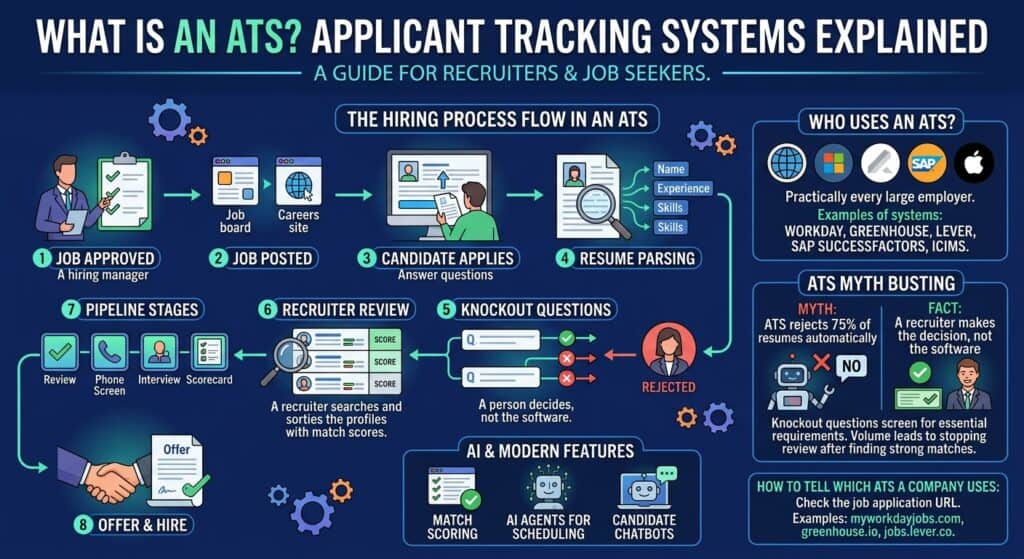
An ATS covers the hiring process from the moment a role is approved to the moment the new hire’s details pass to HR and payroll. These are the jobs nearly every system does, whether it costs nothing or six figures a year.
| Hiring step | What the ATS does |
|---|---|
| Job approval | Holds the requisition: title, pay range, hiring manager, budget sign-off |
| Job posting | Publishes the job to the company careers page and pushes it to job boards such as Indeed and LinkedIn |
| Application | Runs the apply form, screening questions and resume upload |
| Resume parsing | Reads the resume and copies name, contact details, jobs, education and skills into searchable fields |
| Search and filtering | Lets recruiters search every candidate by skill, title, location or keyword, including people who applied years ago |
| Pipeline stages | Moves candidates through stages such as review, phone screen, interview and offer |
| Communication | Sends emails and texts, often from templates, and logs every message |
| Interviews | Schedules interviews and collects interviewer scorecards |
| Offer and hire | Generates the offer letter and hands the new hire to the HR system |
| Reporting and compliance | Tracks time to hire, source of hire and the records employers must keep for equal opportunity and data protection rules |
How does an ATS work, step by step?
- A job is opened. The hiring manager or recruiter creates the job in the ATS, and it goes through any approval the company requires.
- The job is posted. The ATS publishes it on the careers site and sends it to job boards. Every application, wherever it starts, lands back in the ATS.
- The candidate applies. They create an account or apply as a guest, upload a resume and answer screening questions.
- The resume is parsed. The system pulls the text into structured fields. A clean resume parses well. A resume built from tables, text boxes or images may come through jumbled or empty.
- Knockout questions run. Many employers ask yes or no questions about must-haves, such as work authorization, a required license or willingness to work on site. Some route a wrong answer straight to rejection.
- A recruiter reviews. The recruiter sorts and searches the applicant list, often by skills from the job description, and reads the resumes that look closest.
- Candidates move through stages. Each phone screen, interview, scorecard and note is recorded against the candidate.
- Offer and hire. The offer is sent and accepted, and the new hire’s record moves to the HR system for onboarding and payroll.
Who uses an applicant tracking system?
Practically every large employer. Jobscan’s 2026 ATS usage report detected an ATS on the careers sites of 487 Fortune 500 companies, or 97.4%. That share has stayed between 97% and 99% every year Jobscan has checked since 2018. The 13 it could not detect may simply run systems they built themselves.
Big employers cluster around a few vendors. Jobscan puts Workday at more than 40% of the Fortune 500 and SAP SuccessFactors at 12%. Our own S&P 500 ATS study, which checks every company’s careers site, finds Workday at 50% of the companies we could identify.
Across a wider set of more than 13,000 companies, the picture spreads out. In the same Jobscan report, Greenhouse leads at 19.0%, then Workday at 17.5%, Lever at 15.6% and iCIMS at 14.4%. Small businesses often start with a free plan or the hiring module inside their HR software. Our directory lists 205 applicant tracking systems, and our live ATS market tracker breaks them down by price, free plans and who they sell to.
Does an ATS reject resumes automatically?
Mostly no. You have probably read that “75% of resumes are rejected by an ATS before a human sees them”. That figure traces back to a 2012 sales pitch from Preptel, a resume optimization company that shut down soon after and never published a study behind the number. It has been repeated ever since without a source.
What recruiters report is different. In Enhancv’s interviews with 25 US recruiters, 23 said their system does not auto-reject resumes for formatting, content or design. Only 2 had set up rules that reject on match score or experience. The common filter was knockout questions, which 84% relied on to screen for things like work authorization, a license or location.
So where do applications vanish? Volume. A popular remote role can draw hundreds or thousands of applicants in days. Recruiters search and sort the list, read the closest matches first, and stop once they have a strong shortlist. Applying early, answering knockout questions honestly and using the words from the job description matter far more than beating a robot. Our guide to the ATS-friendly resume format covers exactly what the parser needs.
ATS vs CRM vs HRIS: what is the difference?
| System | Who it tracks | Main job |
|---|---|---|
| ATS | People who applied to an open job | Manage applications through to the hire |
| Recruiting CRM | People who have not applied yet | Build talent pools and nurture passive candidates |
| HRIS / HCM | Current employees | Employee records, payroll, benefits, time off |
The lines blur. Many modern ATS products include CRM features, and enterprise suites such as Workday and SuccessFactors sell recruiting as one module of the HR system. Agency recruiting software usually combines ATS and CRM because agencies manage client companies as well as candidates. See our guide to recruiting CRM software for the agency side.
What types of ATS are there?
- Enterprise HR suite modules. Workday Recruiting, SAP SuccessFactors and Oracle Recruiting. Bought with the HR system, priced by employee count, and dominant in the Fortune 500. See our Workday ATS guide.
- Standalone corporate ATS. Greenhouse, iCIMS, Lever, Ashby and SmartRecruiters. Chosen by talent acquisition teams that want a better recruiting tool than the suite default. Compare two of them in Ashby vs Greenhouse.
- Small business ATS. Simple systems with published monthly prices or free plans. Start with our list of free applicant tracking systems and our guide to recruiting software for small business.
- Agency ATS. Systems such as Bullhorn, Loxo and Recruit CRM that track clients, job orders, submittals and placement fees. See staffing agency software.
For picks by buyer type, our best applicant tracking systems roundup lists prices from each vendor’s own page.
How is AI changing applicant tracking systems?
Three changes stand out in 2026. First, many systems now give each applicant a match score or ranking, so recruiters see the closest fits at the top of the list. Second, vendors are adding AI agents that screen, schedule and answer candidate questions. Workday bought HiredScore for matching and Paradox for conversational screening and scheduling. Third, more ATS vendors now run MCP servers, which let assistants such as Claude and ChatGPT read and update the ATS directly. Our tracker of which ATS tools have an MCP server shows where each vendor stands.
AI ranking brings legal duties. Several US states and cities now regulate automated hiring tools, and the Mobley v. Workday lawsuit is testing whether a software vendor can be liable for biased screening. Our guide to the AI resume screener covers how scoring works and the laws that apply.
How can you tell which ATS a company uses?
Open one of the company’s jobs and click apply. The web address you land on usually names the system: myworkdayjobs.com for Workday, greenhouse.io for Greenhouse, icims.com for iCIMS, jobs.lever.co for Lever. Our free Hiring Radar Chrome extension does this for you on any careers page, along with the number of open roles and how old each post is.
Quick answers
What is an ATS in simple terms?
It is the software a company uses to manage hiring: post jobs, collect applications, keep candidate records and track each person from application to hire.
What does ATS stand for on a resume?
Applicant tracking system. An “ATS resume” or “ATS-friendly resume” is one formatted so the system can read it accurately.
Do all companies use an ATS?
Nearly all large ones do. Jobscan detected one at 97.4% of the Fortune 500 in 2026. Many small businesses still hire from email and spreadsheets, or use the hiring module in their HR software.
Is it true that an ATS rejects 75% of resumes?
No. The figure comes from an unsourced 2012 sales pitch. Most systems sort and search applications, and a person makes the rejection decision. Knockout questions are the common exception.
What is the most popular ATS?
Workday is the most used ATS among the largest US employers. Across a wider mix of company sizes, Greenhouse, Workday, Lever and iCIMS each hold a large share.
Is an ATS the same as an HRIS?
No. An ATS tracks applicants before they are hired. An HRIS tracks employees after they join. Some vendors sell both in one suite.
Free newsletter
Get the Work Insiders weekly
One email a week: the recruiting and HR tech news that mattered, the tools we just added to the directory, and one practical guide. No spam, and you can unsubscribe in one click.