

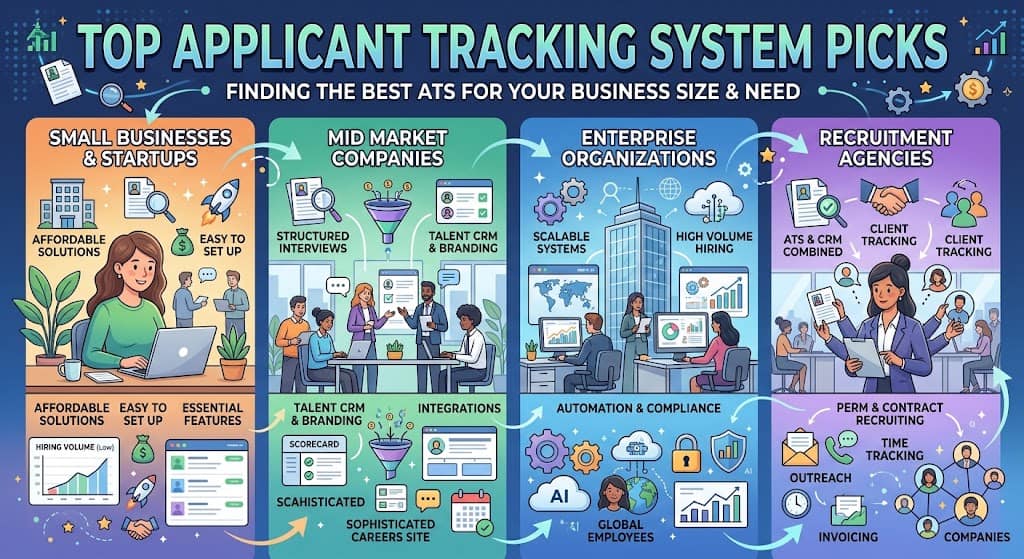
Quick answer: The best applicant tracking system depends on who you hire for and how many hires you make. For small businesses, Dover (free) and Breezy HR are the easiest starts. For SMBs that want a published price, Workable. For fast growing startups, Ashby. For mid market teams that need structure, Greenhouse or Lever. For high volume enterprise hiring, SmartRecruiters. For recruitment agencies, Recruit CRM, Recruiterflow, Bullhorn or Loxo, depending on the desk.
Who it suits: founders, HR managers, talent leaders and agency owners choosing a first ATS or replacing one that recruiters avoid.
What to check: whether pricing is per user, per company size or per job, which features sit on the plan you are quoted, and how you get your data out if you leave.
What is the best applicant tracking system in 2026?
There is no single best applicant tracking system, because an ATS built for a 10 person company and one built for a 20,000 person employer solve different problems. The best ATS is the one your recruiters and hiring managers use every day without being chased, at a price that fits your real hiring volume.
Our picks below come from the 177 systems in the Work Insiders ATS directory. Prices are as listed on each vendor’s own pricing page in September 2026, and quote based means the vendor publishes no price.
| Best for | Pick | Entry price as listed, September 2026 | Why it wins |
|---|---|---|---|
| Free ATS for small teams | Free with unlimited users and jobs; Premium $199 per month | Most generous free plan we found | |
| Small business, one role at a time | Free for 1 position; Startup $157 per month annual | Polished careers site and 50+ job boards | |
| Budget AI ATS | From $49 per month, billed annually | AI scoring and outreach at a small business price | |
| SMB wanting a published price | Standard $299 per month for 1 to 20 employees | ATS, talent CRM and AI agent in one plan | |
| Fast growing startups | Foundations from $400 per month, up to 100 employees | ATS, sourcing, scheduling and analytics in one record | |
| Mid market structured hiring | Quote based (Core, Plus, Pro) | Scorecards, structured interviews, huge integration list | |
| Mid market with candidate nurture | Quote based | ATS and CRM on one candidate record | |
| Employer brand and career site | Quote based; unlimited users and jobs on every plan | Career site first ATS with no seat limits | |
| Enterprise and high volume | Essential starting at $14,995 | CRM, texting and job distribution in every plan | |
| Agency perm desk | $95 per user per month annual | ATS, client CRM and invoicing together | |
| Agency contract and temp desk | Starter $99 per user per month | Scales into timesheets and pay and bill | |
| Agency tech or outbound desk | Core $149 per user per month, billed annually | Sourcing and outreach built into the ATS | |
| Cheapest paid ATS | $15 per user per month yearly, $19 monthly | Lowest published per user price on our list |
Which applicant tracking systems do most companies use?
Almost every large employer runs an ATS. Jobscan’s 2026 ATS usage report detected an applicant tracking system at 97.4% of Fortune 500 companies, or 487 of 500. Workday alone runs talent acquisition at over 40% of them, and SuccessFactors at 12%.
The picture changes outside the Fortune 500. Across more than 13,000 companies in Jobscan’s resume scanner data, Greenhouse was the most common ATS, ahead of Workday, Lever and iCIMS.
| ATS | Share of Fortune 500 | Share of 13,000+ companies |
|---|---|---|
| Workday | Over 40% | 17.5% |
| SuccessFactors | 12% | Not in top four |
| Greenhouse | Not in top two | 19.0% |
| Lever | Not in top two | 15.6% |
| iCIMS | Steady, not quantified | 14.4% |
Popular is not the same as best for you. Workday wins in the Fortune 500 because it is already the HR system of record there, not because recruiters prefer its ATS.
How do you choose the right applicant tracking system?
Choose an ATS by answering five questions before you book a single demo. A senior talent acquisition consultant in a r/Recruitment thread on the best and worst ATS gave the same advice: write down your requirements, size, locations and budget first, then let that list drive the demos.
| Question | Why it matters | What it points to |
|---|---|---|
| Do you hire for your own company or for clients? | Agencies need client, placement and fee tracking | Agency ATS and CRM versus a corporate ATS |
| How many roles are open at once? | Free and per job plans cap active jobs | Free plans for 1 to 3 roles; paid plans beyond |
| Who needs to log in? | Per user pricing gets expensive with many hiring managers | Unlimited user plans if managers review candidates |
| What must it connect to? | HR system, calendar, email and job boards | Check the integration list before the demo |
| How long is the contract? | Annual prepay is a cash flow risk for small firms | Monthly billing while you test fit |
Do I need an ATS or a recruiting CRM?
An ATS moves applicants through open jobs to an offer. A recruiting CRM nurtures people you may hire later, or for an agency, tracks clients and business development. Many modern systems do both. Our explainer on ATS vs recruiting CRM covers when you need each.
What is the best applicant tracking system for small business?
The best applicant tracking system for a small business is usually free or under $300 a month, takes an afternoon to set up, and lets every hiring manager log in without paying per seat. Dover, Breezy HR and Workable are the safest shortlist.
Dover’s free plan lists unlimited users and jobs, 100+ job board integrations and Gmail and Outlook sync, with AI applicant scoring on its $199 Premium plan. Breezy HR’s free Bootstrap plan gives unlimited users but one active position, and its Startup plan is $157 a month billed annually. Workable Standard costs $299 a month for companies with 1 to 20 employees and rises with headcount, with a 15 day free trial. See every limit in our guide to free applicant tracking systems.
What is the cheapest ATS with AI features?
100Hires starts at $49 a month billed annually and includes AI scoring, outreach and a first party MCP server, so you can run it from Claude or ChatGPT. Manatal is cheaper per seat at $15 per user a month on yearly billing and includes AI candidate recommendations, but its Professional plan caps you at 15 jobs.
When is a spreadsheet still enough?
A spreadsheet works for two or three hires a year with one person making decisions. Once several managers review the same candidates, or you post to more than one job board, you lose track of who saw whom, and a free ATS costs nothing to try.
What is the best ATS for startups and mid market companies?
For startups growing fast, Ashby is the most common recommendation, and for mid market teams that need structured interviews and many integrations, Greenhouse and Lever lead. The consultant in the r/Recruitment thread summed it up: Ashby is geared toward smaller, rapid growth companies, while Greenhouse has capabilities you might need if you are global and handle data rules in many countries.
Ashby Foundations starts at $400 a month for companies up to 100 employees, with 10% off annual billing, and higher plans are quoted. Greenhouse sells Core, Plus and Pro by quote, and only Pro includes unlimited CRM events, which matters for campus hiring. Lever keeps its ATS and nurture CRM on one candidate record and is also quote based. Teamtailor suits companies that care most about the career site and includes unlimited users and job postings on every plan.
Is Greenhouse worth the price?
Greenhouse is worth it when you hire across several teams that need consistent scorecards, structured interviews and reporting, and when you rely on many connected tools. A company making 15 hires a year with one recruiter usually gets the same value from Workable or Ashby at a published price. Compare them side by side in the ATS directory.
What is the best ATS for enterprise and high volume hiring?
For enterprises, the shortlist is SmartRecruiters, iCIMS, Workday Recruiting and SAP SuccessFactors, and the right one usually depends on your HR system. SmartRecruiters publishes a starting point, with Essential starting at $14,995 and CRM, texting and job distribution on every plan. The others are quote based.
Be careful with an ATS bundled into your HR suite. In the same r/Recruitment thread, the consultant warned that Workday often includes its ATS at no extra cost, but talent teams then lose features, hiring cycles get longer, and companies end up buying another tool on top. Other recruiters in that thread named Workday the ATS they liked least. If your HR system is Workday, test its recruiting module on real roles before assuming it is free.
Do enterprises need a separate recruiting CRM?
Often, yes. Large employers running events, campus programs and talent communities across countries usually add a CRM such as Avature, Beamery or Phenom. Our guide to the best recruiting CRM for in house teams compares them.
What is the best ATS for recruitment agencies?
Agencies need an ATS and CRM in one system that tracks candidates, clients, placements and fees. Corporate ATS products track applicants but not the client side of an agency desk, so they are the wrong tool for most recruiters running a desk.
| Agency type | Pick | Entry price as listed, September 2026 |
|---|---|---|
| Perm desk wanting invoicing | $95 per user per month annual, $109 monthly | |
| Search or perm desk running outbound | $149 per user per month (Platform) | |
| One or two person desk | $85 per user per month annual, up to 2 users | |
| Contract or temp desk | Starter $99 per user per month | |
| Niche tech desk | $139 per user per month annual | |
| Agency running AI from Claude or ChatGPT |  Vitae AI Vitae AI | $79 per recruiter per month with AI agents |
| Agency wanting MCP on a long running ATS | From about $115 per user per month, final price by quote | |
| AI first agency CRM | £105 per user per month (Basic), 14 day free trial |
Why is PCRecruiter on our agency list?
PCRecruiter is the agency ATS we use every day at Work Insiders. It is a long running ATS and recruiting CRM that keeps search, pipelines and placements in one system, and in 2026 it added a vendor documented MCP server plus an open API, so you can query your desk from Claude or ChatGPT. The PCRecruiter FAQ says accounts start at around $115 per user a month. The final price comes by quote and includes a one time setup and training fee. The trade offs: it was not built from the ground up for AI, and its email sequencing feels clunky next to Loxo or Recruiterflow.
What makes Atlas different from a traditional agency ATS?
Atlas is an AI first recruiting CRM for agency desks, built so you can ask in plain English which candidates are live and where each role stands. It turns calls and transcripts into usable notes, keeps candidates, clients and roles on one desk, and ships an official Claude connector. Atlas Basic costs £105 per user a month and Premium, which adds verified contact enrichment, costs £135, with a 14 day free trial. Atlas publishes prices in pounds only, so US agencies should confirm the billing currency before signing.
For a full breakdown by desk type, read best ATS for a new agency, or go straight to the cheapest agency ATS if budget is the filter.
How much does an applicant tracking system cost?
An applicant tracking system costs anywhere from $0 to well over $15,000 a year. What you pay depends far more on the pricing model than on features, so match the model to how you hire.
| Pricing model | Example as listed, September 2026 | Cheapest when |
|---|---|---|
| Free plan | Dover free; Breezy HR free for 1 position | You hire a few roles a year |
| Per user | Manatal $15; Recruit CRM $95; Loxo $149 | Few people log in |
| By company size | Workable $299 for 1 to 20 employees; Ashby from $400 | Many hiring managers need access |
| Per active job | JOIN from $17 per active job per month annual | You run one or two roles at a time |
| Quote based | Greenhouse, Lever, Teamtailor, Workday | You can negotiate a multi year deal |
What hidden costs come with an ATS?
The usual extras are implementation and migration fees, premium job board posting, texting, AI credits and extra seats for hiring managers. Ask for a written quote that lists every add on at your real headcount and hiring volume, and ask for a sample data export before you sign.
What are the most common mistakes when buying an ATS?
The most common mistake is buying for the company you hope to be in three years instead of the one you are today. Teams pay for enterprise features they never configure, while recruiters go back to spreadsheets. In the r/Recruitment thread, one ATS vendor noted that many small teams try Workday or Greenhouse and then realise it is more than they need.
- Skipping the hiring manager test: if managers find it hard to leave feedback, hiring slows no matter how good the recruiter view is.
- Ignoring data export: check you can get candidates, notes and files out in a usable format.
- Trusting the demo: run two or three live roles through a trial before you commit.
- Buying AI you cannot explain: if the ATS ranks candidates, you should see why. Our guide to the AI resume screener covers what to ask.
Quick answers
What is the number one applicant tracking system?
By Fortune 500 usage it is Workday, at over 40% in Jobscan’s 2026 report. Across a wider set of 13,000+ companies, Greenhouse is the most used at 19.0%.
What is the best free applicant tracking system?
Dover, because its free plan lists unlimited users and jobs. Breezy HR is the better pick if you want a polished careers site and only hire one role at a time.
What is the easiest ATS to use?
Small business tools such as Breezy HR, Workable and Dover are built for managers who log in occasionally, and Teamtailor’s unlimited users suit the same need. Test with your own hiring managers during a trial, since ease depends on who uses it.
Which ATS is best for a recruitment agency?
Recruit CRM or Recruiterflow for perm desks, Bullhorn for contract and temp, Loxo or Spott for tech, PCRecruiter if you want MCP on a proven agency ATS, Atlas for an AI first CRM, and Manatal when cash is tight.
How long does it take to set up an ATS?
Free and small business tools can be live in a day. Mid market systems usually take a few weeks, and enterprise rollouts with HR system integration often take months.
The bottom line
The best applicant tracking system is the one that fits how you hire today. Start free with Dover or Breezy HR if you hire a few roles a year, choose Workable or Ashby when you need a full system at a published price, move to Greenhouse, Lever or SmartRecruiters as volume and structure grow, and pick an agency platform if you recruit for clients. Trial it on live roles before you sign. Compare all 177 systems in the ATS directory.
Sources: Jobscan ATS report, r/Recruitment thread, Dover pricing, Breezy pricing, Workable pricing, Ashby pricing, Greenhouse pricing, Lever pricing, SmartRecruiters pricing, Manatal pricing, Recruit CRM pricing, Recruiterflow pricing, Crelate pricing, Bullhorn pricing, Loxo pricing, Spott pricing, JOIN pricing, PCRecruiter FAQ, Atlas Claude connector
Free newsletter
Get the Work Insiders weekly
One email a week: the recruiting and HR tech news that mattered, the tools we just added to the directory, and one practical guide. No spam, and you can unsubscribe in one click.