

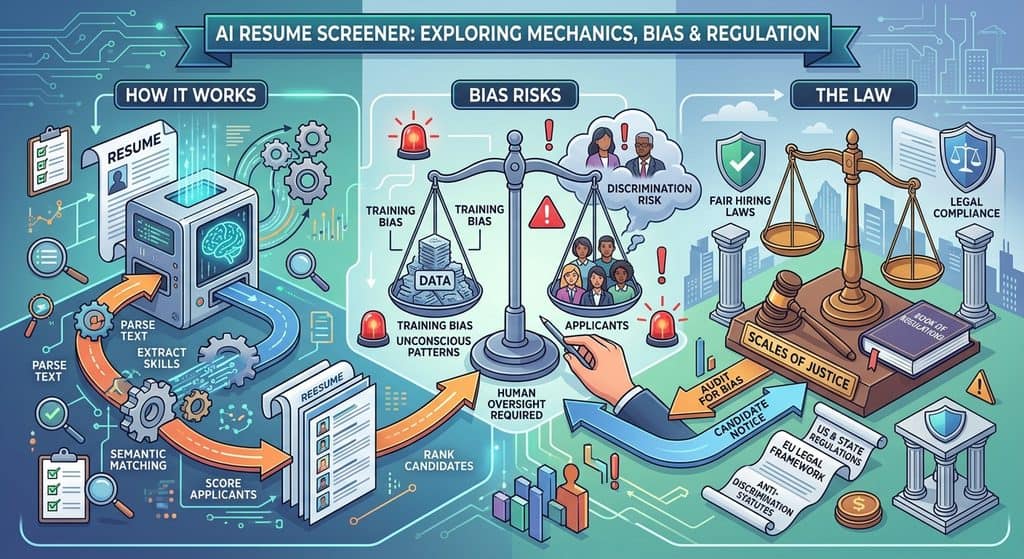
Quick answer: An AI resume screener reads every application, compares it with the job’s requirements and ranks or scores candidates so a recruiter starts with a shortlist. The good ones explain each score and let you overrule it. The risky ones hide their logic, reject people automatically and have never been checked for bias.
Who it suits: teams getting hundreds of applicants per role who cannot read every resume before the best people accept other offers.
What to check: how it matches (keywords, embeddings or a large language model), whether it shows evidence for each score, whether you can run a bias check on your own data, and which hiring laws apply where you recruit.
What is an AI resume screener?
An AI resume screener is software that reads resumes and ranks applicants against a job’s requirements before a human looks at them. It can sit inside your ATS, run as a separate tool you upload resumes to, or work as an agent that processes each new applicant automatically. SHRM research found 44% of organizations using AI in recruiting apply it to screening resumes.
An AI resume screener is not the ATS itself. The ATS stores applications and moves them through stages, as our explainer on how an ATS works shows; the screener decides who rises to the top.
How does AI resume screening actually work?
AI resume screening works in five steps: parse the resume into fields, compare them with the job, score the match, apply knockout rules, and rank the results for a human. Each step can fail in its own way.
What does resume parsing do?
Resume parsing turns a PDF or Word file into structured fields such as titles, employers, dates, skills and education. Poor parsing is a common silent failure, because a two column layout can scramble dates and titles before any AI sees them. Newer tools such as ResuPick use multimodal models that read the page layout as an image to reduce this problem.
How is keyword matching different from semantic matching?
Keyword matching looks for exact words from the job description, so “people operations” can miss a resume that says “HR generalist”. Semantic matching converts both the resume and the job into embeddings, which are numeric representations of meaning, and measures how close they are. Semantic matching catches synonyms and related skills, but it can also rate a vague resume highly because it sounds similar.
How do scoring and knockout rules work?
Scoring gives each candidate a number or grade, often weighted across must have skills, years of experience and nice to have extras. Knockout rules are hard filters, such as “must hold a nursing license” or “must be authorised to work in the UK”. Knockouts are legally the riskiest part, because a badly worded rule can screen out a protected group at scale.
What changes when a large language model ranks resumes?
A large language model reads a resume more like a person, weighs context such as career changes, and writes a reason for each score. The tradeoff is learned bias and different answers to the same resume on different runs, so insist on evidence you can check.
| Method | How it decides | Main strength | Main risk |
|---|---|---|---|
| Keyword matching | Counts exact terms from the job ad | Predictable and easy to explain | Misses synonyms; rewards keyword stuffing |
| Semantic (embedding) matching | Measures similarity of meaning | Finds related skills and titles | Hard to explain why one resume scored higher |
| Rules and knockouts | Pass or fail on set criteria | Fast removal of clear mismatches | Can exclude protected groups by proxy |
| Trained scoring model | Learns from past hiring outcomes | Reflects what worked before | Copies past bias in the training data |
| LLM ranking | A language model reads and grades each resume | Reads context and writes reasons | Name and wording bias; inconsistent runs |
How accurate are AI resume screeners?
AI resume screeners are accurate at removing obvious mismatches and much weaker at spotting unusual candidates who would do the job well. One internal recruiter on r/Recruitment who gets 500 resumes described the sorting as “very questionable”, and another commenter in the same thread found a screener marking bootcamp graduates and career changers as low matches, including an engineer who later passed the technical interview.
Resume quality is also getting worse as an input. Gartner found 39% of candidates used AI during the application process, so more resumes are tailored to mirror the job ad. A screener that rewards overlap with the job ad will rank the best rewritten resume, not the best candidate, which is why many teams add a short structured interview from the AI interviewing category.
Is AI resume screening biased?
AI resume screening can be biased, and the best known studies show large effects. A University of Washington team varied names across more than 550 real resumes and had three large language models rank them for over 500 job listings. The UW study found the models favoured white associated names 85% of the time versus 9% for Black associated names, and never favoured Black male associated names over white male associated names.
Amazon’s experimental recruiting engine is the older warning. Reuters reported in 2018 that the tool, trained on ten years of mostly male resumes, learned to penalise resumes containing the word “women”, and Amazon abandoned it, as the BBC summarised. The lesson is that a model trained on past hiring decisions reproduces the pattern in those decisions.
Vendors can now be sued directly. In Mobley v. Workday, the court approved a nationwide age discrimination collective in May 2025 and, in June 2026, let California and disability claims proceed, according to SHRM’s case summary. Workday denies the claims, but the case shows “the vendor did it” is no defence.
What laws apply to AI resume screening in 2026?
AI resume screening is regulated by a patchwork of city, state and EU rules on top of general anti discrimination law. Dates moved a lot in 2026; the table reflects September 2026 and is not legal advice.
| Law | Where | Status, September 2026 | What it requires |
|---|---|---|---|
| Local Law 144 | New York City | Enforced since July 5, 2023 | Bias audit within one year of use, public audit summary, candidate notice 10 business days before use |
| HB 3773 (Human Rights Act amendment) | Illinois | In effect since January 1, 2026; draft rules withdrawn June 2026 | Notice when AI is used in employment decisions; no discriminatory AI; no zip codes as a proxy |
| Senate Bill 189, replacing the Colorado AI Act | Colorado | Takes effect January 1, 2027, subject to a pending court challenge | Notice when automated tools materially influence decisions; explanation and human review after adverse outcomes |
| EU AI Act, Annex III | European Union | Recruitment AI is high risk; obligations apply from December 2, 2027 | Risk management, documentation, human oversight, logging |
| Title VII, ADA, ADEA | United States | In force; EEOC AI guidance removed in 2025 | No disparate impact or disability screen outs, whatever the tool |
What does NYC Local Law 144 require from employers?
NYC Local Law 144 bars employers and agencies from using an automated employment decision tool unless it had a bias audit within the past year, the results summary is public, and candidates got notice, per the DCWP rules page. Enforcement has been light: a December 2025 State Comptroller audit found DCWP flagged one issue across 32 companies, while auditors found at least 17 potential violations. DCWP can impose civil penalties of $500 to $1,500 per day for violations.
Did the EEOC withdraw its AI hiring guidance?
Yes. In early 2025 the EEOC removed its 2023 Title VII technical assistance on AI and its 2022 ADA guidance, according to Cooley’s alert. The underlying statutes did not change, so an AI screener that screens out older, disabled or minority applicants at a higher rate still creates liability.
When do the Illinois and Colorado AI laws take effect?
Illinois HB 3773 took effect on January 1, 2026. Its implementing rules were published in May 2026 and then withdrawn in June, so notice duties apply without detailed rules, as Seyfarth explains. Colorado repealed its 2024 AI Act in May 2026 and replaced it with a narrower law effective January 1, 2027, per Davis Wright Tremaine.
When do EU AI Act rules for hiring tools apply?
The EU AI Act treats AI used in recruitment as high risk. The Digital Omnibus, in force since July 27, 2026, moved those obligations from August 2, 2026 to December 2, 2027, according to Usercentrics’ legal team. Disclosure that a person is talking to an AI, relevant to chat based screeners, still applies from August 2026.
Which AI resume screening tools are worth comparing?
The right AI resume screening tool depends on volume and on whether you want a new ATS. Prices are from each vendor’s own pricing page, as listed, September 2026. See the full AI screening directory.
| Tool | Entry price | How it prices | Best fit |
|---|---|---|---|
| Hello Recruiter | Free ATS; Starter $29 per month | Per organization; 4,000 AI evaluations on Starter | Small teams with high volume |
| Klearskill | $10 per month (your own AI key); Pro $50 per month | Flat, unlimited CVs | Budget teams comfortable with API keys |
| ResuPick | $25 for 150 credits; 20 free credits | One time credit packs that never expire | Occasional batch screening |
| Litespace | Growth $59 per month | Credits: 1 per resume, 5 per AI interview | Teams wanting screening plus pre screens |
| Cernor | From $199 per live role | Per role, no subscription | One off high volume roles |
| Senseloaf | Starter $199 per month annual | 1,500 shared credits, 3 seats | Agencies wanting agents in their ATS |
| Workable | Standard $299 per month | ATS plus agent credits from $0.095 | SMBs replacing their ATS |
| SeekOut | Recruit Core $149 per month annual | Per seat; inbound screening is an add on | Teams that also source |
| CiiVSOFT | Quote based | Runs inside your existing ATS | Mid size and enterprise TA |
| Eightfold | Quote based | Enterprise talent intelligence | Large enterprises |
What does screening 500 applicants cost on each tool?
Screening 500 applicants for one role costs very different amounts depending on the pricing model. On Hello Recruiter Starter, 500 evaluations fit inside the $29 monthly allowance. On Litespace, 500 resumes exceed the Growth plan’s 250 credits, so you would need the $249 Business plan. Workable’s agent uses 500 credits, covered by the 3,000 free starter credits the first time and about $60 after that at $0.12 per credit. Cernor charges its $199 per role however many people apply.
Can a free AI agent screen resumes?
Free agent templates handle light screening if you already pay for the platform they run on. Scout writes a hiring scorecard and scores a shortlist against it with evidence and gaps, and Talent Bot reviews each new applicant daily against a fixed role definition. Both run inside Grok Bot, listed in our AI agents hub.
How do you choose and audit an AI resume screener?
You choose an AI resume screener by testing it on your own past applicants and checking three things: whether it agrees with your best hiring decisions, whether it explains itself, and whether any group passes at a much lower rate. If you are still picking a system of record, start with the ATS directory, because many ATS platforms now include a screener.
| Check | What good looks like | Red flag |
|---|---|---|
| Explainability | Every score links to lines in the resume | A single number with no reasons |
| Human override | Recruiters can promote any rejected candidate | Automatic rejection emails |
| Back test | Past hires rank in the top quarter | Past hires scattered or near the bottom |
| Bias audit | Independent audit with impact ratios published | Vendor says the tool “removes bias” |
| Your own adverse impact check | Pass rates by group within four fifths of the top group | No export of scores to test |
| Knockout rules | Few, written by you, reviewed by HR or counsel | Hidden filters on gaps, age or location |
| Data and training | Your candidate data not used to train shared models | Vague answers on data use |
| Candidate notice | Template notice for NYC, Illinois and EU applicants | No help with notice or audits |
| ATS write back | Scores and notes land on the candidate record | Separate login and CSV exports only |
How do you run a simple adverse impact check yourself?
Export the screener’s pass or fail results for a few hundred applicants, group them where you lawfully hold demographic data, and divide each group’s pass rate by the highest group’s pass rate. A result below 0.8, the long standing four fifths rule of thumb, is a signal to investigate the criteria before you keep using the tool.
Which questions should you ask a vendor before signing?
Ask which matching method the tool uses, whether it has an independent bias audit, whether it can reject without a human, and who is liable if a claim arises. One recruiter on r/Recruitment who compared several screeners listed the red flags as tools promising to eliminate bias, black box scores and tools that make overriding the AI hard.
Quick answers
Can an AI resume screener legally reject candidates on its own?
In many places it can, but it is risky. NYC requires a bias audit and notice first, and US discrimination law applies to any automated screen out, so keep a human approving rejections.
Is ChatGPT a good AI resume screener?
A general chatbot can summarise resumes, but the UW study found large language models showed strong name based bias when ranking. Use a tool that scores against written criteria and shows evidence.
What is the cheapest AI resume screener?
Klearskill starts at $10 per month if you supply your own AI key, and Hello Recruiter Starter costs $29 per month with 4,000 evaluations, as listed, September 2026.
Does AI resume screening work for senior roles?
It works poorly for senior roles, where context matters more than keyword overlap. Read senior resumes yourself.
Do candidates know when AI screens their resume?
Often not, although NYC and Illinois require notice. With only 26% of candidates trusting AI to judge them fairly, clear notice helps.
The bottom line
An AI resume screener saves real hours on volume roles, but only if it explains each score, keeps a human on every rejection and passes a bias check on your own applicants. Test two or three tools on past roles before you buy, and plan for NYC, Illinois, Colorado and EU notice rules now. Compare options in the AI screening directory.
Sources: UW resume bias study, BBC on Amazon, SHRM on Workday, SHRM Talent Trends, Gartner candidate survey, NYC DCWP AEDT, NY Comptroller audit, Cooley on EEOC, Seyfarth on Illinois, DWT on Colorado, Usercentrics on EU, r/Recruitment screening thread, r/Recruitment tools thread, Hello Recruiter pricing, Klearskill pricing, ResuPick, Litespace pricing, Cernor, Senseloaf pricing, Workable pricing, SeekOut pricing, CiiVSOFT
Free newsletter
Get the Work Insiders weekly
One email a week: the recruiting and HR tech news that mattered, the tools we just added to the directory, and one practical guide. No spam, and you can unsubscribe in one click.