

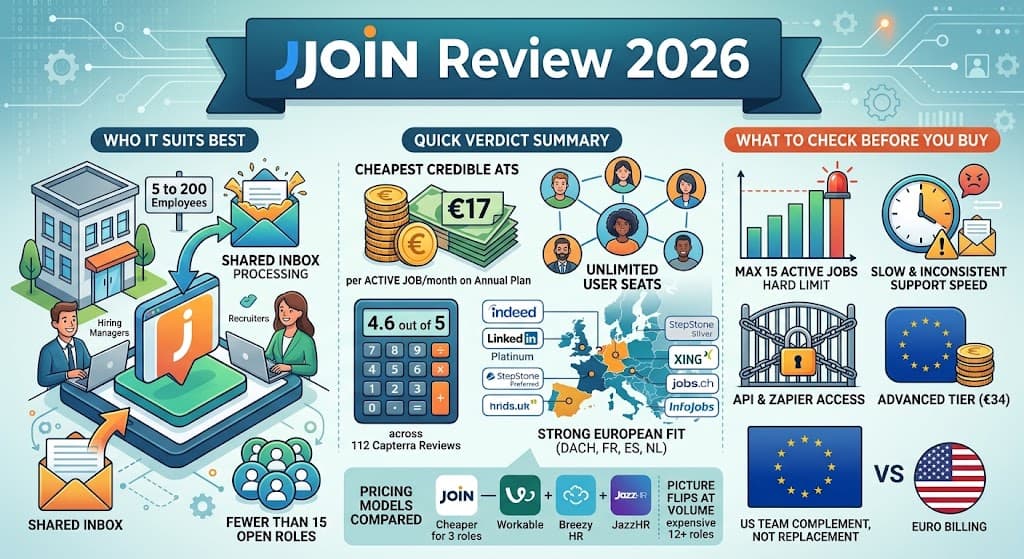
Quick verdict: JOIN is one of the cheapest credible applicant tracking systems you can buy, starting at €17 per active job per month on an annual plan, with unlimited user seats on every tier. It scores 4.6 out of 5 across 112 Capterra reviews. It is a strong fit for a small employer in Germany, Switzerland, Austria, France, Spain or the Netherlands that posts a handful of roles at a time. US teams can absolutely use it, and many do for European roles, though the board network and euro billing mean it tends to earn its place alongside a US system rather than replacing one.
Who it suits best: teams of roughly 5 to 200 people who run hiring out of a shared inbox, want the whole interview panel to have a login without paying per seat, and open fewer than 15 roles at once.
What to check before you buy: support speed is the most common gripe in customer reviews, API and Zapier access sit on the higher €34 tier, and every plan caps you at 15 active jobs unless you move to a quoted Enterprise contract.
What is JOIN and who is it built for?
JOIN is recruiting software that combines job ad distribution with a full applicant tracking pipeline. You write one job ad, JOIN handles the formatting and field mapping for each board it sends the ad to, and every application returns to a single pipeline where your team screens, schedules, scores and messages candidates. Edit the original ad once and every live posting updates.
The company behind it is JOIN Solutions AG, a team of about 95 people working from Pfäffikon in Switzerland, Berlin, Barcelona and Poznań. Its about page reports more than 20,000 customers and over 30 million applications processed. The positioning is explicit: small and midsize hiring teams in the DACH region, France and Spain.
That focus is worth knowing before you compare feature lists. An ATS is only as useful as the candidates it brings you, and JOIN’s reach is strongest where its board partnerships are. If you hire in Munich or Madrid, that network is a real advantage. If you hire in Ohio, the global channels still work and the regional ones matter less, so the value sits in the workflow more than the distribution.
Why does the cost of a bad hiring process keep coming up?
Because the software bill is rarely the expensive part. SHRM benchmarking data puts the average cost per hire near $4,700, and the real costs climb once you count manager hours. Against that, €17 or €34 per job is not the decision. Whether the tool saves those hours and speeds up the offer is.
How much does JOIN cost in 2026?
JOIN publishes three tiers on its pricing page. Standard is €17 per active job per month billed annually, or €20 billed monthly. Advanced is €34 per active job per month billed annually. Enterprise is quoted individually and starts at a minimum of 15 open roles. All prices exclude VAT, and JOIN also publishes price lists in USD, GBP, CHF, PLN and SEK.
Standard covers the basics well: organic posting to a network of more than 10 boards, a branded career page, an AI job ad builder, a Chrome extension for saving profiles, a talent pool, pipeline management, interview scheduling, scorecards, automated messages, roles and permissions, and unlimited user seats. Screening questions on Standard are predefined rather than custom.
Advanced is where the tool becomes programmable. Custom screening questions, interviewer pools, Zapier and Make connections, API access, candidate export, spontaneous applications and chat support all sit on that tier. If you want JOIN to talk to your HRIS, your payroll system or a Slack workflow, budget for Advanced rather than Standard.
What counts as an active job?
An active job is any role in Online or Offline status, meaning hiring is still in progress. Online jobs are published and taking applications. Offline jobs are unpublished but still let you work the candidates you already have. Both count toward your limit. Archiving a filled role frees the slot immediately, and you can unarchive it later.
This is the pricing detail that trips people up. You are not buying seats or a company subscription, you are renting job slots. A team that fills three roles and archives them pays far less than one leaving twelve stale postings Offline. Housekeeping is a line item.
How does JOIN compare on price to other small business ATS tools?
Three roles on JOIN Standard costs roughly €51 per month on an annual plan. Workable’s pricing starts at $299 per month for the Standard plan at 1 to 20 employees. Breezy HR pricing offers a free tier limited to one active position, with the Startup plan at $157 per month billed annually. JazzHR pricing starts at $1,000 per year for the Hero plan, which begins at three job postings per month.
| Tool | Entry price | What you pay for | Free tier | Trial |
|---|---|---|---|---|
| JOIN Standard | €17 per job, per month, billed annually | Active job slots, unlimited seats | None | 14 days |
| JOIN Advanced | €34 per job, per month, billed annually | Adds API, Zapier, custom screening | None | 14 days |
| Workable Standard | $299 per month at 1 to 20 employees | Company size, unlimited active jobs | None | 15 days |
| Breezy HR Startup | $157 per month, billed annually | Company plan, unlimited positions | Yes, 1 active position | 14 days |
| JazzHR Hero | $1,000 per year | Annual plan, from 3 postings monthly | None | Demo led |
So for a company hiring two or three roles at a time, JOIN is genuinely cheaper, often by a factor of three or four. The picture flips at volume: twelve open roles costs about €204 per month on Standard, and Workable or Breezy start looking competitive again because their plans do not meter jobs. Work out your realistic concurrent role count before comparing headline prices, because these models measure different things.
What do you actually get for the money?
How far does JOIN’s multiposting reach?
JOIN advertises publishing to more than 10 organic boards and over 250 paid boards from one click, and it names Indeed Platinum partner, LinkedIn Silver partner and StepStone Preferred Partner status. Paid placements bought through JOIN carry no markup, and the company claims placements are up to 50 percent cheaper than going direct on many regional boards.
Read the board list before you buy. The names that dominate are StepStone, XING, Arbeitsagentur, jobs.ch, InfoJobs, France Travail, APEC, Jobware, meinestadt and Kleinanzeigen, alongside global channels like Indeed, LinkedIn, Google for Jobs, Adzuna and Jooble. That is a European media network with worldwide aggregators attached, not a US one.
Every application carries its source board into the pipeline, and that is the feature that quietly earns back the subscription. Once you can see one board sending forty applicants and zero interviews while another sends six applicants and two hires, you can stop funding the first one.
Is the free posting actually free?
Not in the sense most people mean. JOIN’s own free posting page is blunt about it: organic distribution carries no separate media fee, but the software itself is paid after the trial, starting at €20 per active job per month on Standard. What you avoid is the per board media spend, not the subscription. Paid and sponsored placements are an optional extra on top.
How good is the screening and interview workflow?
Better than the price suggests, and unusually well documented. JOIN’s screening feature gives every application question one of three tiers. Optional questions can be skipped. Required questions must be answered but gate nothing. Knockout questions reject the application automatically the next day if the answer fails the rule.
Five of the seven question types can act as knockouts: boolean, single select, multi select, numeric and date. Text and file upload cannot, because there is no rule to match free text against. Every automatic rejection is logged on the candidate profile with the answer given and the rule that fired, the candidate is emailed rather than silently dropped, and a recruiter can reverse a wrong rejection in one click.
That audit trail is worth more than it looks. Automated candidate decisions now sit inside the EU AI Act’s human oversight expectations, and being able to show which rule rejected whom, and that a human could reverse it, is exactly the evidence a regulator or an unhappy applicant will ask for.
Interview scheduling works off a booking link that respects every interviewer’s calendar, with two way sync to Google Calendar and Outlook. Scorecards let you define rating criteria per role so the whole panel rates the same attributes on the same scale, and the scores aggregate on one profile. None of this is novel, but it is all included at the entry price rather than sold as an upgrade.
What do reviewers actually complain about?
The Capterra profile puts JOIN at 4.6 out of 5 from 112 reviews: ease of use 4.7, features 4.5, value for money 4.5 and customer service 4.5. Ninety one percent of reviewers are small businesses, and 94 percent of sentiment is positive.
The recurring criticisms are consistent enough to take seriously. Support responses are described as slow and inconsistent, which matters more when the entry tier gets email only and chat is reserved for Advanced. Reviewers also report syncing delays with some boards, friction around account approval when a board requires a connected company profile, and wishes for deeper customization.
One complaint deserves its own sentence: some employers raised concerns about fake listings on the platform affecting employer brand. Any open posting network attracts fraudulent ads, and it is a fair question for a sales rep during the trial.
What does the community ask most often about JOIN?
English language discussion of JOIN on Reddit and similar forums is thin, which itself says something about its geographic footprint. The questions that do recur across review sites and buyer forums cluster tightly: whether it is really free, whether its boards reach your market, whether support answers when something breaks, and whether candidates should trust an application that redirects to an unfamiliar domain.
Is JOIN legitimate, and why do candidates see it on applications?
Yes, JOIN is a real company with a real product. Candidates meet the domain because employers host their branded career pages and application forms on it, so clicking apply can land you on a join.com company profile. That is normal ATS behavior, the same way applicants land on Greenhouse or Workday URLs.
On security, JOIN states it is certified to ISO 27001:2022, hosts primarily in the EU, and builds GDPR rights, candidate consent and automated retention rules into the candidate record. Documentation sits at its trust center. The company reports 99.99 percent platform uptime, though only Enterprise contracts carry an actual uptime SLA.
Ordinary caution still applies to candidates. A legitimate platform does not vouch for every ad on it, and any employer asking for payment or bank details before an offer should be treated as fraudulent whatever software delivered the ad.
Should a US employer use JOIN?
It depends on where your candidates are, and the honest answer for most US teams is that JOIN works better as a second system than a first one. The paid board network leans toward Germany, Switzerland, Austria, France, Spain and the Netherlands, so a good share of those 250 boards will not be reaching your market, even though Indeed, LinkedIn and Google for Jobs carry worldwide. Billing runs in euros with VAT excluded and SEPA direct debit for European customers. Compliance tooling is built around GDPR, so if you are large enough to need EEO or OFCCP reporting you will still want a US system handling that.
There is one clear exception. If you are a US or UK company hiring into a European office, JOIN is an efficient way to buy that market’s job board access without signing separate contracts with StepStone, XING and France Travail. Run it alongside your main ATS for the European roles only, and the per job pricing works in your favor precisely because you are not running many roles through it.
Quick answers
Does JOIN have a free plan?
No. There is a 14 day free trial of the Advanced plan with up to five active jobs and no credit card required. After that, Standard starts at €20 per active job per month, or €17 if you pay annually. Organic board distribution has no separate media fee, but the software is paid.
How long is JOIN’s free trial and does it auto bill?
Fourteen days, on the Advanced tier, capped at five active jobs. JOIN states the trial ends automatically and you are billed only if you actively choose to continue.
How many jobs can I post on JOIN?
Up to 15 active jobs on both Standard and Advanced. You cannot exceed the limit. Archive a filled role to free a slot instantly, or move to a quoted Enterprise plan, which starts from 15 open roles.
Does JOIN charge per user?
No. Every tier includes unlimited user seats for HR, hiring managers and anyone who interviews, plus unlimited candidates. This is the clearest advantage over per seat competitors when you have a large interview panel and a small hiring volume.
Does JOIN have an API and Zapier integration?
Yes, on Advanced and Enterprise only. API access, Zapier, Make and candidate export are all excluded from Standard, so plan on €34 per job per month if automation matters to you.
Can I cancel JOIN at any time?
Yes. Cancellation takes effect at the end of the current billing cycle. Adding jobs or upgrading takes effect immediately, while reducing jobs or downgrading waits until the cycle ends.
Is JOIN GDPR compliant?
JOIN states that GDPR rights are built into every candidate profile, hosting is EU primary, and the company holds ISO 27001:2022 certification. Knockout rejection decisions are logged with the answer and rule that triggered them, which supports both GDPR audits and the EU AI Act human oversight requirement.
The bottom line
JOIN does one thing very well: it gives a small European hiring team a complete, tidy, genuinely usable recruiting workflow for less than the price of a single sponsored job ad on most premium boards. The unlimited seats, the honest knockout screening with its audit trail, and the per board source tracking are all better than the price band would lead you to expect.
Buy it if you hire a few roles at a time in continental Europe, want your hiring managers working in the tool rather than in your inbox, and are comfortable with email support on the entry plan. Look at other options for your main system if your candidates are mostly American, if you routinely run more than 15 roles at once, or if the integration your hiring depends on would push you to the Advanced tier anyway.
The sensible next step is the 14 day trial with five real jobs posted, not test ones, so you can see which boards return candidates in your market before any money changes hands.
Sources: Join pricing, Join about, Join screening, Join free posting, Join trust center, Capterra JOIN reviews, SHRM recruitment costs, Workable pricing, Breezy HR pricing, JazzHR pricing