

Work Insiders counted 114 applicant tracking systems on September 13, 2026: 33 agency, 61 corporate, 20 HR suites. 24 (21%) ship a first-party MCP server; 72 (63%) have a public API. Ten have a free tier. Among the 40 that publish a price, the median starting price is $79 a month.
Data pulled from the Work Insiders directory on September 13, 2026. Counts change as listings are added. The category page is always the live number.
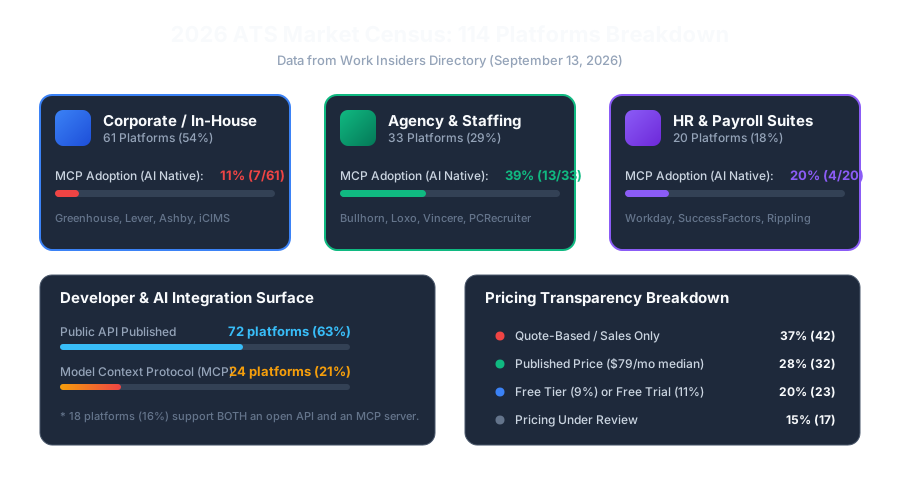
What are the key ATS market numbers in 2026?
The ATS category on Work Insiders holds 114 applicant tracking systems. 33 are built for staffing and search agencies, 61 for in house corporate hiring teams, and 20 are HR suites with an ATS module bolted onto payroll, HRIS or workforce management.
24 platforms (21%) ship a Model Context Protocol server so an AI agent can work inside them. Read what an MCP is for recruiters. 72 platforms (63%) publish an API. 10 (9%) offer a real free tier, 13 offer a free trial only, and 42 (37%) will not show a price until you book a demo.
| Metric | Count | Share of 114 |
|---|---|---|
| Agency and search firm ATS | 33 | 29% |
| Corporate and in house ATS | 61 | 54% |
| HR suites with an ATS module | 20 | 18% |
| Permanent free tier | 10 | 9% |
| Free trial only | 13 | 11% |
| Published paid price | 32 | 28% |
| Quote based, no public price | 42 | 37% |
| Pricing still under review | 17 | 15% |
| MCP server | 24 | 21% |
| Public API | 72 | 63% |
| Neither MCP nor API | 36 | 32% |
Put another way: if you run a small agency, roughly two thirds of the tools built for you publish a price you can act on today. If you are buying a full HR suite, three out of four will make you talk to sales first.
And if you want an ATS that plugs straight into Claude, ChatGPT or Grok through MCP, your odds are far better on the agency side of the market (39%) than on the corporate side (11%).
How big is the applicant tracking system market?
The global ATS market is worth about $3.17 billion in 2026 and is projected to reach $4.33 billion by 2030, according to Research and Markets.
Other analyst houses land in a similar range, between $2.65 billion and $3.2 billion for 2026, with growth of roughly 7% to 9% a year. The spread comes from how each firm defines the category. Some count only standalone ATS software. Others fold in the recruiting modules inside HCM suites.
Adoption at the top of the market is close to total. Jobscan’s annual audit detected an ATS on 97.8% of Fortune 500 career sites in 2025. Workday alone powers more than 39% of them and SAP SuccessFactors another 13%.
That concentration at the enterprise end is why the interesting competition happens further down: among agencies, mid market companies and hourly employers, where 100 plus vendors fight for the same desks.
How many ATS platforms are there?
Nobody has a definitive count, because the line between an ATS, a recruiting CRM and an HR suite keeps moving. G2 lists 122 ATS products in its category. Our directory holds 114 as of this census, up from 108 when we ran our first count on September 11.
The two lists do not overlap perfectly. We include agency desk tools like Bullhorn, Loxo and Vincere that review sites sometimes file under staffing software. We include HR suites like Rippling and Workday only when the ATS module is a real product people buy on its own merits.
The honest answer to “how many ATS platforms are there” is somewhere between 110 and 130 that a buyer in the US or Europe would realistically shortlist, plus a long tail of regional tools and open source projects. We stop counting when a tool no longer has a public website, an active pricing page and a working sign up or demo flow.
What is the difference between an agency ATS and a corporate ATS?
An agency ATS is built for a recruiting firm that places candidates with many clients. A corporate ATS is built for one employer hiring for itself.
The difference shows up in the data model. Agency tools carry client companies, job orders, placements, fees and often a full CRM for business development. Corporate tools carry requisitions, hiring managers, interview kits and offer approvals.
As The Undercover Recruiter puts it in its four way comparison, Greenhouse leads on structured corporate hiring data while Bullhorn is unmatched for agency metrics like fill rate, billable hours and gross margin.
| Agency ATS | Corporate ATS | HR suite with ATS | |
|---|---|---|---|
| Who buys it | Staffing, search and RPO firms | One employer’s TA team | HR or finance, as part of a payroll deal |
| Core record | Client, job order, placement, fee | Requisition, hiring manager, offer | Employee record, with candidates upstream |
| Built in CRM | Almost always | Sometimes, as an add on | Rarely |
| Typical pricing | Per recruiter seat, published | Per company or per active job | Per employee per month, quoted |
| Reporting focus | Fill rate, billable hours, margin | Time to hire, pipeline, interview scores | Headcount, cost, compliance |
| Examples | Bullhorn, Loxo, PCRecruiter, Vincere | Greenhouse, Lever, Ashby, iCIMS | Workday, UKG, Rippling, BambooHR |
How does the 114 split between agency, corporate and HR suites?
We tagged every platform by who it is primarily sold to. The split is an editorial call, so a few tools sit on the fence (Zoho Recruit, Manatal and iSmartRecruit all sell to both sides), but the shape is clear.
| Segment | Platforms | Share | Examples |
|---|---|---|---|
| Agency and search firms | 33 | 29% | Bullhorn, Loxo, Vincere, PCRecruiter, Recruit CRM, Crelate, JobAdder, Avionté, CEIPAL, JobDiva |
| Corporate and in house | 61 | 54% | Greenhouse, Lever, Ashby, iCIMS, Workable, SmartRecruiters, JazzHR, Breezy HR, Teamtailor, Pinpoint |
| HR suites with an ATS module | 20 | 18% | Workday, SAP SuccessFactors, UKG, Rippling, BambooHR, Paycor, Paylocity, Personio, Factorial, Darwinbox |
Inside the corporate bucket there is a second split worth knowing about. Around ten of the 61 are built for hourly and high volume hiring rather than salaried roles: Fountain, Workstream, Harri, Paradox, Team Engine, Hireology, CareerPlug, Wizehire and a few others.
These lean on text to apply, chat screening and shift scheduling instead of scorecards and structured interviews. If you hire restaurant, retail, logistics or franchise staff, that sub group is your real shortlist.
Which ATS do staffing agencies actually use?
Reddit threads on r/recruiting and r/RecruitmentAgencies keep coming back to the same handful of names. A roundup of five threads found the discussion splits into two groups: small and new agencies looking for something affordable and simple, and high volume temp shops leaving Bullhorn for something built for their scale.
The names that come up for small desks are Recruit CRM, Loxo, Manatal, Zoho Recruit and Crelate. The names for temp and contract volume are Avionté, JobDiva, CEIPAL and TempWorks.
One construction recruiter in those threads admitted to running most of the real work in Excel while nominally paying for a name brand tool. That is more common than any vendor case study will tell you.
Our own desk runs on PCRecruiter as the ATS and CRM, with an MCP connection into Grok so the bot team can search candidate and manager records directly. That is not a recommendation for everyone. It is one working example of an agency stack where the ATS is the system of record and the AI does the searching.
How many ATS platforms have a free tier?
Ten of the 114 platforms (9%) offer a genuinely free tier you can use indefinitely. Another 13 (11%) offer a free trial that ends after 14 to 30 days.
We count those separately because a trial is not a free plan, and plenty of “free ATS” lists blur the two. You can browse the live set on our free ATS page, which updates automatically as pricing changes.
| Platform | Segment | Paid plans start at | MCP |
|---|---|---|---|
| Breezy HR | Corporate | $143/mo | No |
| Candidately | Agency | $49/mo | No |
| CVViZ | Corporate | $99/mo | No |
| Dover | Corporate | Quote | No |
| Homebase | HR suite | $20/location/mo | No |
| Hyring | Corporate | Quote | Yes |
| InfiniteInterfaces | Corporate | Quote | No |
| Jobsoid | Corporate | Quote | No |
| Nova Recruiter | Agency | Quote | Yes |
| Zoho Recruit | Both | $25/mo | Yes |
The free tiers cluster on the corporate side. Seven of the ten are corporate tools, two are agency tools and one is an HR suite (Homebase, which gives small hourly employers a free plan for one location).
Agencies get free trials instead. Loxo, Jarvi, Leonar, Ezekia and RecruitBPM all let you run a desk for a couple of weeks before paying.
Is a free ATS good enough for a small business?
For one to three open roles at a time, yes. The free plans on Breezy HR, Zoho Recruit and Dover cover job posting, a candidate pipeline, basic email and a careers page.
Where they stop is usually the number of active jobs, the number of users, job board syndication or reporting. The moment you need two recruiters working the same pipeline, or you want postings pushed to Indeed, LinkedIn and ZipRecruiter automatically, you are on a paid plan.
The trap is not the free plan itself but the export. Check that you can pull your candidate data out as a CSV before you load 500 resumes into a tool you might outgrow.
How much does an applicant tracking system cost?
40 of the 114 platforms (35%) publish a starting price on their website. Among the 37 that quote in US dollars, the median published entry price is $79 per month.
| Published starting price (USD) | Platforms | Examples |
|---|---|---|
| Under $50/mo | 13 | Factorial $5, Manatal $15, Leonar $16, Jarvi $19, Zoho Recruit $25, RecruitBPM $29, ApplicantStack $30, Recruit CRM $35 |
| $50 to $99/mo | 12 | Crelate $55, JazzHR $59, CATS $69, JobScore $69, HiringThing $76, Recooty $79, Stardex $79, Tracker RMS $79, Recruiterflow $83, CVViZ $99, Textkernel $99 |
| $100 to $199/mo | 7 | Ashby $100, TalentLyft $100, HireHive $119, Top Echelon $119, Homerun $129, Signals $139, Breezy HR $143, Loxo $149 |
| $200/mo and up | 5 | Wizehire $249, Workable $249, BambooHR $250, Kula about $427, Team Engine $500 |
| Priced in EUR or GBP | 3 | TRAFFIT €64, Tribepad £579, d.vinci €785 |
Published prices are almost always per user or per seat on the agency side and per company or per active job on the corporate side. A five recruiter agency paying $79 a seat is spending $395 a month before add ons like texting, job board credits or contact data.
A ten person startup on a flat $250 a month corporate plan pays the same whether two or ten people log in. That structural difference matters more than the headline number when you compare tools across segments.
Why do so many ATS vendors hide their pricing?
42 platforms (37%) are quote based: no price anywhere on the site, just a demo form. Add the 17 we have not been able to tag confidently and the true number is closer to half the market.
| Segment | Free tier | Free trial | Published paid price | Quote based | Under review |
|---|---|---|---|---|---|
| Agency (33) | 2 | 5 | 14 | 9 (27%) | 3 |
| Corporate (61) | 7 | 7 | 16 | 18 (30%) | 13 |
| HR suite (20) | 1 | 1 | 2 | 15 (75%) | 1 |
| All 114 | 10 | 13 | 32 | 42 (37%) | 17 |
The pattern by segment is stark. 15 of the 20 HR suites are quote only, because they are selling payroll, benefits and time tracking in the same contract and the ATS is one line item. Only 9 of the 33 agency tools hide their price.
Agency buyers are recruiters who compare tools for a living and walk away from a demo form, so agency vendors publish. Corporate buyers are HR generalists who expect a sales cycle, so enterprise vendors negotiate.
We handle this on the directory with a pricing facet: free, free tier, free trial, paid or quote. A tool only gets the quote label on positive evidence that it sells through demos. If we cannot find a price and cannot confirm a sales only model, it stays untagged for manual review rather than guessed.
How many ATS platforms have an MCP server?
24 of the 114 (21%) ship a first party Model Context Protocol server as of this census.
MCP is the open standard, originally published by Anthropic, that lets an AI assistant like Claude, ChatGPT or Grok read from and write to a piece of software through a defined set of tools rather than through screen scraping or a custom integration.
For a recruiter, an ATS with an MCP server means you can ask your AI assistant to find every candidate who interviewed for a controller role in the last six months, summarize the notes, and draft a follow up, without leaving the chat.
| Segment | MCP platforms | Names |
|---|---|---|
| Agency (13 of 33, 39%) | 13 | Atlas, Ezekia, iSmartRecruit, Jarvi, Leonar, Loxo, Manatal, Nova Recruiter, PCRecruiter, Recruit CRM, Recruiterflow, Spott, Stardex |
| Corporate (7 of 61, 11%) | 7 | 100Hires, Ashby, Greenhouse, Hyring, Pinpoint, Workable, Zoho Recruit |
| HR suite (4 of 20, 20%) | 4 | Darwinbox, Personio, Rippling, Workday |
You can filter the whole directory to MCP enabled tools on the MCP listings page. When we ran our first census two days earlier, the ATS category sat at 19%. Two of the six new listings shipped with MCP, which is a small sample but points the same direction as every other category we track.
Are agency or corporate ATS platforms more likely to support MCP?
Agency tools, by a wide margin. 13 of the 33 agency platforms (39%) have an MCP server. Only 7 of the 61 corporate platforms (11%) do, and 4 of the 20 HR suites (20%).
The agency number is driven by a wave of newer desk tools built around AI from the start. Atlas, Spott, Stardex, Nova Recruiter, Leonar and Jarvi all list MCP as a headline feature, and the established players PCRecruiter, Loxo, Recruit CRM, Recruiterflow and Manatal have added it.
On the corporate side, Greenhouse, Ashby and Workable are the recognizable names with MCP. Lever, iCIMS, SmartRecruiters and Jobvite expose an API but no MCP server yet.
The reason is structural. Agency recruiters spend their day searching a database of people they already know, which is exactly the task an AI assistant with database access is good at. Corporate recruiters spend more time coordinating hiring managers and interviews, where the AI value is less obvious and the compliance stakes around automated decisions are higher. Expect the corporate number to rise, but slower.
How many ATS platforms have a public API?
72 of the 114 (63%) publish an API. Of those, 18 have both an API and an MCP server, and 54 have an API only.
| Integration surface | Platforms | Share | Examples |
|---|---|---|---|
| API and MCP | 18 | 16% | Greenhouse, Ashby, Workable, Workday, Rippling, Loxo, PCRecruiter, Recruit CRM, Manatal, Zoho Recruit |
| API only | 54 | 47% | Lever, iCIMS, SmartRecruiters, Bullhorn, JazzHR, Breezy HR, Teamtailor, SAP SuccessFactors, UKG |
| MCP only | 6 | 5% | Atlas, Darwinbox, Ezekia, iSmartRecruit, Nova Recruiter, Spott |
| Neither | 36 | 32% | ApplicantPro, CareerPlug, Paradox, Trakstar Hire, Wizehire, NEOGOV, Infor HCM |
Six platforms expose MCP without a documented public API, which is a new pattern: the AI connection arrives before the developer one. The remaining 36 platforms (32%) have neither, and they are concentrated among small business corporate tools and a handful of HR suites that integrate through partner marketplaces rather than open endpoints.
Does an ATS need an API if it has MCP?
For most recruiters, no. An API is for developers building an integration: syncing candidates to a job board, pushing placements to payroll, feeding a BI dashboard. An MCP server is for people talking to an AI assistant.
If your team is three recruiters and nobody writes code, MCP gives you more day to day value than an API you will never call. If you run a 40 seat agency with an IT contractor and a Power BI dashboard, you want the API, and MCP is a bonus.
The safest bet is a tool with both, and 18 of the 114 now qualify.
What do the numbers say about where the ATS market is heading?
Three things stand out.
First, MCP is spreading fastest where AI does the most obvious work, which is candidate search on agency desks.
Second, transparent pricing is an agency market feature and a corporate market exception, and that gap is unlikely to close because the buyers are different people with different expectations.
Third, the free tier is a corporate small business play, not an agency one, so agencies should budget for a paid seat from day one and evaluate on trial.
The 114 count will keep moving. We add tools every week, retire ones that shut down or get absorbed, and rerun the MCP and pricing counts every quarter so the percentages in this article stay honest. The ATS category is always the live number.
Quick answers
How many applicant tracking systems are there?
Work Insiders tracks 114 as of September 2026. G2 lists 122. The realistic shortlist universe for a US or European buyer is 110 to 130 platforms.
What percentage of ATS platforms have MCP?
21%, or 24 of 114. Agency tools lead at 39%, HR suites sit at 20%, corporate tools trail at 11%.
What percentage of ATS platforms have an API?
63%, or 72 of 114. 18 have both an API and MCP, 54 have an API only, 6 have MCP only, 36 have neither.
How many ATS platforms are free?
10 have a permanent free tier (9%) and 13 more have a free trial (11%). Seven of the ten free tiers are corporate tools.
How much does an ATS cost per month?
Among the 40 platforms that publish a price, the median US dollar starting price is $79 per month. Entry plans run from $5 to $500 per month. 42 platforms are quote based.
What is the difference between an agency and a corporate ATS?
An agency ATS tracks clients, job orders, placements and fees for a recruiting firm serving many employers. A corporate ATS tracks requisitions, interviews and offers for one employer. 33 of the 114 are agency tools, 61 are corporate, 20 are HR suites with an ATS module.
Which ATS is best for a small staffing agency?
Recruiters on Reddit most often name Recruit CRM, Loxo, Manatal, Zoho Recruit and Crelate for small desks, and Avionté, JobDiva or CEIPAL for temp and contract volume. All five small desk picks publish a price and four of the five have an MCP server.
How was this data collected?
Every count comes from the Work Insiders directory database on September 13, 2026: the ATS category taxonomy, the pricing facet, and the per listing MCP and API flags, which we verify against vendor documentation. The agency, corporate and suite split is an editorial classification based on who each vendor sells to. Corrections go to support@workinsiders.com.