

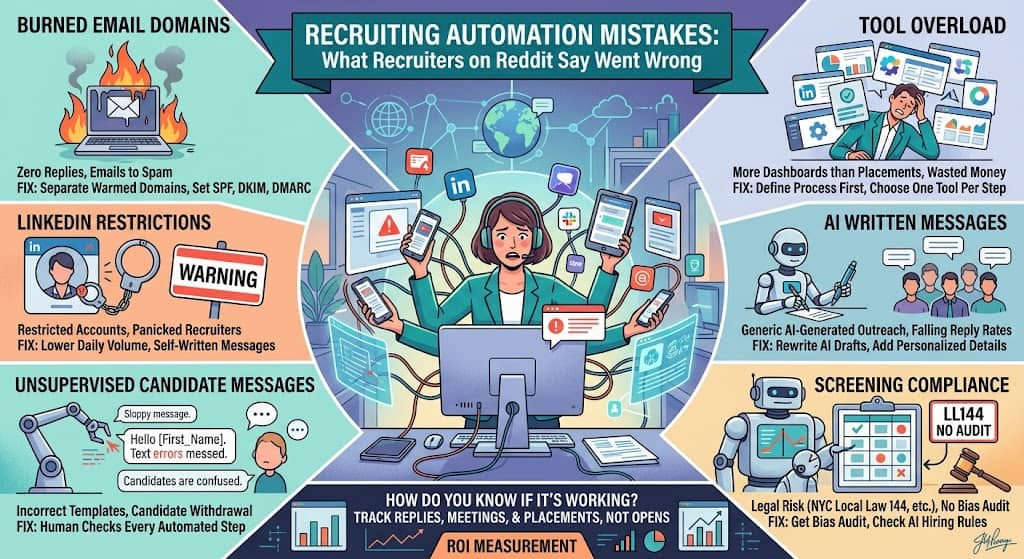
Quick answer: The recruiting automation mistakes that come up again and again on Reddit are about speed, not software. Recruiters burn new email domains by sending too much too soon, put their LinkedIn accounts at risk with automation tools, send AI written messages that sound like everyone else’s, buy tool after tool before the process works, and let systems talk to candidates with no human watching. A sixth mistake is legal: using an automated screening tool on New York City candidates without a bias audit.
What fixed it for recruiters: lower volume, separate sending domains with SPF, DKIM and DMARC set up, short messages a human actually wrote or edited, one simple stack instead of six tools, and a person checking every automated step that touches a candidate. Free checks like our SPF DKIM DMARC checker and spam word checker catch the most common email problems before you send.
Who this is for: agency owners, solo recruiters and in house teams who have automated outreach or screening, or are about to, and want to avoid the mistakes other recruiters already paid for.
What are the most common recruiting automation mistakes?
We read recruiter threads on r/RecruitmentAgencies, r/recruiting, r/Recruitment and r/humanresources and kept only mistakes recruiters described from their own desks. Reddit comments are personal accounts, so treat them as field reports rather than proof.
| Mistake | Sign you’re making it | Fix |
|---|---|---|
| Blasting cold email from new or main domains | Zero replies, not even out of office messages; test emails to friends land in junk | Pause, check DNS, send from separate warmed domains, restart at 5 to 10 a day |
| Automating LinkedIn at high volume | Warnings, “unusual activity” prompts or a restricted account | Keep volumes low, write first messages yourself, protect your main profile |
| Sending AI written messages unedited | Candidates call your messages generic; reply rates fall | Use AI for a draft, then rewrite with one real reason you picked this person |
| Buying tools before fixing the process | More dashboards than placements; several tools doing the same job | Write the process down first, then pick one tool per step |
| Letting automation talk to candidates unsupervised | Messages go out in your name that you never saw; wrong templates | Review every automated candidate message and spot check the output weekly |
| Automated screening with no compliance check | A tool scores or rejects applicants and nobody knows if it was audited | Check NYC Local Law 144 and other AI hiring rules; get a bias audit where required |
Why are my recruiting cold emails going to spam?
Usually because the domain has no reputation and volume jumped too fast. A new agency owner in r/RecruitmentAgencies said all of their BD emails go to spam three weeks after launch: “I haven’t gotten a single organic response.” They had bought 7 domains and 35 mailboxes, warmed them for two weeks, and still found that a message to a friend’s work address went to junk. Their next plan was a $10K LinkedIn Recruiter seat.
Replies pushed back. One recruiter called it “a reputation issue, not a copy problem” and “a trust game, not a volume game.” Another said to stop sending cold email from the main business domain at once, because invoices and client mail live there too.
In an earlier thread, the same founder had warmed three domains for a month, then started sending 50 emails a day through Apollo on day one and got no replies in three days, “not even an out of office.” Friends only received about half the test emails. Replies called the jump to 50 a day “a classic rep kill” and said warmup is not permission to blast.
What did recruiters say fixed it?
The advice in both threads lines up with Google’s own sender guidelines, which ask every sender for SPF or DKIM, ask bulk senders for DMARC too, tell senders to keep reported spam below 0.3%, and say to start with low volume and increase slowly.
- Stop and diagnose. Pause every sequence, then check that SPF, DKIM and DMARC pass. Our free DNS record checker reads all three plus MX in a few seconds.
- Use separate domains. Keep your main domain for clients and candidates, and send outreach from lookalike domains with their own records.
- Restart small. Recruiters suggested 5 to 10 a day at first, rising slowly, with one commenter capping each inbox at 25 a day and another at 30 to 35.
- Write for one reader. As one commenter put it: “If your email could be sent to 100 different businesses, you deserve to go to SPAM.” Run each template through our spam word checker to catch unfilled merge tags and pushy phrases.
- Clean the list. One commenter warned that data from a large contact database bounced, and bounces hurt reputation. Verify addresses before the first send.
Which tools help with email deliverability?
Our deliverability tools category compares 29 options. For a small desk, the usual setup is separate inboxes from a provider like Premium Inboxes (from $3.50 per inbox a month), warmup from Mailreach (from $20 a month), list cleaning with ClearBounce (from $4 per 1,000 credits on a founders rate that runs through 2026), and a sequencer that rotates inboxes, such as Smartlead (from $39 a month). Confirm prices with each vendor.
Can LinkedIn automation get a recruiter’s account restricted?
Yes. LinkedIn’s prohibited software page bans bots and extensions that automate activity on the site and says members who use them “risk having their accounts restricted or shut down.”
When a recruiter in r/Recruitment asked whether accounts really get restricted or whether it was a scare tactic, the answers were mixed. One said a colleague was warned while using HeyReach. A team lead said seven accounts sending 18 to 20 connection requests a day, five days a week, had no issues. A Waalaxy user advised setting limits “a bit below standard.” The comment that sums up the risk for most recruiters: “If I lost my LinkedIn I would be dead.”
What is the safer way to use LinkedIn?
Keep daily volume low, write the first message yourself, and never risk the profile your network knows you by. For what to say, reported reply rates and tools with prices, see our guide to LinkedIn hiring manager outreach, or compare tools in the LinkedIn outreach directory.
Do candidates notice AI written recruiter messages?
They do, and recruiters say it is getting worse. A recruiter with 20 years in agency work started a thread because candidates kept telling them they were tired of obviously AI generated messages. One candidate in the thread wrote: “I assume every recruiter message is AI or boilerplate unless it comes from one of two or three recruiters that I know personally.”
A corporate recruiter with 15 years of experience made the bigger point in an r/recruiting rant: automating outreach at scale makes “bad behavior faster and easier,” and every tool that makes it easier to send slightly customized AI messages to a bigger list pushes response rates down for everyone.
What works better than AI written outreach?
Short, specific messages a person wrote or edited. In the same thread, an in house recruiter said short organic LinkedIn messages to passive candidates had a 53% response rate in 2025, up from about 25% before the AI wave, and added: “People are excited to talk to you when you don’t use AI.” Another recruiter noted that the more AI spreads, the easier it is to stand out “by just picking up the phone.” These are single recruiters’ own numbers, not benchmarks.
If you use AI, do what one recruiter described: never send the first draft, and rewrite it with details from the person’s profile. Our lesson on personalizing outreach with AI and the free AI instructions builder help an assistant write in your voice instead of a generic one.
A 30 second edit check before you send: Does the first line name something only this person has done? Is there one clear reason you picked them? Is it under 100 words? Would you be comfortable if they asked, “did a bot write this?” If any answer is no, rewrite it.
Should you buy recruiting automation tools before fixing your process?
No. Recruiters who did it first describe wasted money and extra work. In an r/RecruitmentAgencies thread on automation tools that help, one commenter said their team “wasted money on 6” tools before settling on Recruit CRM, and another said half the automation tools they tried “just end up being extra work” before Recruiterflow stuck. A solo owner who linked Recruit CRM, lemlist and Zapier said setup took longer than expected.
In an r/Recruitment thread on how brutal 2026 feels, one recruiter said their team tried stacking tools and “just ended up with more dashboards than actual placements.” A tech recruiter with 20 years in the market added that the small shops winning now “aren’t the ones buying more tech” but the ones who picked a niche and stayed in it.
How do you decide what to automate first?
Automate steps you already do the same way every time, and keep judgment human. The happiest automation stories were small, boring jobs: an interview reminder email 24 hours before and a text an hour before, scheduling through Calendly, follow up reminders inside the ATS. Write your process down first with our free recruiting playbook builder, then use the AI task checker to see which steps to hand off. If you want one system for sequences and placements, Recruiterflow starts at $149 per user a month; compare others in our best agency software list.
What goes wrong when automation talks to candidates without a human checking?
A recruiter at a large national agency in r/recruiting described how their ATS began emailing candidates in their name, sending reengagement emails and texts to people they had relationships with, “that I have no control of and also cant see.” Another commenter warned that candidates pull back from one sided automation when they are not confident anyone is looking.
Sloppy templates do as much damage as AI. A commenter in the AI messages thread above said what bothered them more was a template still reading “Hello [First_Name]” and a “went with another candidate” email for a job reposted three days later. A candidate in that thread put the other side plainly: “I’d rather get something than nothing.”
How do you keep a human in the loop?
One r/RecruitmentAgencies founder built an n8n workflow that reads the jobs inbox, uses ChatGPT to judge fit, and sends either next steps or a polite rejection. It handled 45 applications, led to one hire and saved about 7 hours in a month, and the founder still planned a manual review to check it was making the right calls. That is the right habit. If you build something similar in n8n (free to self host, cloud from €20 a month), route anything that rejects a person to a human for approval, and read a sample of sent messages every week.
Is automated candidate screening legal?
It depends on where you hire and how the tool is used. In New York City, Local Law 144 bars employers and employment agencies from using an automated employment decision tool unless it has had a bias audit within the past year, a summary of the audit is public, and candidates got the required notices. The city says that notice must go out 10 business days before the tool is used, and enforcement began on July 5, 2023.
Recruiters disagree about how common automatic rejection is. In r/recruiting, many said most systems reject through knockout questions, not by reading resumes, while others said match scores bury lower ranked applicants. In an r/humanresources thread, one HR lead said their ATS auto screens job hoppers and they never look at the filtered resumes. Another reply: “This is where regulations and laws need to be created ASAP.” A tool that scores or filters people is exactly what these laws target.
What should you do before turning on automated screening?
Find out which laws apply to the places you hire, ask the vendor for its most recent bias audit, tell candidates when AI is involved, and keep a human reviewing rejections. Our lessons on AI hiring laws and AI bias audits explain the rules in plain language. If you need an independent audit, Warden AI runs HR AI bias audits, including NYC LL144 style reports, priced by quote. This is general information, not legal advice.
How do you know if your recruiting automation is working?
Track replies, meetings and placements, not opens. Google’s sender guidelines say Google does not track open rates and that low open rates are not an accurate sign of a deliverability problem. The founder in the deliverability thread spotted the problem from a missing signal: not even an out of office reply.
| What to track weekly | What it tells you | What to do if it drops |
|---|---|---|
| Bounces and out of office replies | Whether mail is reaching real inboxes | Pause sending, check DNS, clean the list |
| Human replies per 100 sends | Whether the message and targeting work | Rewrite the first line, narrow the list |
| Meetings or calls booked | Whether replies are the right people | Change who you target, not the volume |
| Job orders or submittals | Whether conversations turn into business | Lead with a real candidate or market insight |
| Placements | Whether the whole system pays for itself | Cut tools that do not touch this number |
Our lesson on measuring AI recruiting ROI covers the setup, and the stack cost estimator adds up what your tools cost per month so you can compare it with placements.
Quick answers
What is the biggest recruiting automation mistake?
On Reddit, it is sending too much cold email too soon from new or main domains. It can leave a new agency with no replies at all and a domain that needs weeks to recover.
How many cold emails a day can a recruiter send safely?
Recruiters in the threads we read suggested starting at 5 to 10 a day and capping each inbox at around 25 to 35 once it is warmed. Google advises starting low and increasing slowly.
Should recruiters use AI to write outreach?
As a first draft only. Candidates and recruiters on Reddit say unedited AI messages are easy to spot and get ignored.
Does NYC Local Law 144 apply to recruiting agencies?
Yes. It covers employers and employment agencies that use an automated employment decision tool for candidates, and requires a bias audit, a public summary and notice to candidates.
The bottom line
Recruiters on Reddit rarely blame the software. They blame sending too fast, trusting AI drafts, stacking tools and unchecked automation. Fix the domain setup first with our free DNS checker, send less and write better, keep a human on anything that touches a candidate, check the law before you automate screening, and judge every tool by placements. Compare options in our outreach tools directory.
Sources: BD emails to spam, deliverability thread, LinkedIn restriction thread, AI messages thread, AI recruiting thread, automation tools thread, recruitment in 2026, forced AI thread, n8n workflow thread, auto reject thread, ATS filter thread, Gmail sender guidelines, LinkedIn prohibited software, NYC AEDT law
Free newsletter
Get the Work Insiders weekly
One email a week: the recruiting and HR tech news that mattered, the tools we just added to the directory, and one practical guide. No spam, and you can unsubscribe in one click.