

By Ryan Bradshaw · Live tracker, counts refresh from the Work Insiders directory · Last count November 5, 2026
Every number on this page is read from the email finders category of the Work Insiders directory and updates itself when a listing changes. For a shortlist of picks, see our top work email finders.
Live from the Work Insiders directory · updated November 5, 2026
Email finder tracker
142
email finder and contact data tools in the directory
45%
ship a first party MCP server (64)
39%
offer a free tier you can keep (55)
$49/mo
median starting price across 111 US dollar prices
Email finders against the rest of the directory
| Group | Tools | MCP | Free tier | Hide price | Median start |
|---|---|---|---|---|---|
| Email finders | 142 | 45% | 39% | 9% | $49/mo |
| Email verifiers | 40 | 53% | 38% | 0% | $39/mo |
| Whole directory | 1,288 | 23% | 21% | 32% | $49/mo |
How email finders charge
Free tier 55 Free trial only 23 Paid 46 Quote only 13 Not tagged 5
Starting prices, US dollars a month
How email finders connect to AI and other software
API and MCP 58 API only 37 MCP only 6 Neither 41
MCP servers (64)
1Lookup, AI Ark, Airscale, Amplemarket, Anymail Finder, Anysite, Apollo, Argorant, Betterleap, Cleanlist, Collective, CompanyEnrich, ContactOut, Coresignal, Crustdata, Datamagnet, Dievio, Dropcontact, Emailchaser, Enrich.so, Enrow, Explorium, Findymail, FullEnrich, Fuse, GetLeads, GMaps Lead Finder, GMapsScraper.ai, Happierleads, Heartbeat, Hunter, Icypeas, Instalent, Kalent, Kuration, Leadfeeder, LeadIQ, LeadMagic, LeadMarina, LeadOcean, Leadpipe, LinkFinder AI, LinkMCP, LinkupAPI, Lusha, Moltsets, NinjaPear, Oppora, Prospeo, ReachHQ, RocketReach, SalesQL, ScoutMesh, Seamless.AI, SearchOS, SignalHire, Snov.io, Superagnt, SyncGTM, Tomba, UserGems, Vector, WaLead, ZoomInfo
Email finders with a free tier
Show all 55 free tiers
| Tool | Paid plans from | MCP |
|---|---|---|
| Ad Call | $39/mo | No |
| AI Ark | $49/mo | Yes |
| Apollo | $49/user/mo | Yes |
| BDsniper | $82.50/mo | No |
| BetterContact | $15/mo | No |
| Cleanlist | $37/seat/mo | Yes |
| Clearout | $16/mo | No |
| Clodura.AI | $99/mo | No |
| Collective | €95/seat/mo | Yes |
| ContactOut | $49/mo | Yes |
| CUFinder | $49/mo | No |
| D7 Lead Finder | $44.99/mo | No |
| Datagma | $39/mo | No |
| Dievio | $29.99/mo | Yes |
| Freckle | $99/mo | No |
| GetLeads | $497/mo | Yes |
| GetProspect | $34/mo | No |
| GMaps Lead Finder | $19/mo | Yes |
| GMapsScraper.ai | $29/mo | Yes |
| Hunter | $34/mo | Yes |
| Kaspr | $49/user/mo | No |
| Kendo | $14/mo | No |
| Kuration | $49/mo | Yes |
| Lead Rocks | $29/mo | No |
| LeadIQ | $200/mo | Yes |
| LeadLeaper | $29/mo | No |
| LeadMarina | $39/mo | Yes |
| LeadOcean | $97/mo | Yes |
| Lusha | $37.45/mo | Yes |
| Lyne.ai | $39/mo | No |
| Minelead | $39/mo | No |
| Moltsets | $27/mo | Yes |
| NioLeads | $29/mo | No |
| Nymeria | $39/mo | No |
| Oppora | $34/mo | Yes |
| People Data Labs | $98/mo | No |
| PipiLeads | $9.95/mo | No |
| Predictrasearch | €7.99/mo | No |
| Prospeo | $37/user/mo | Yes |
| RB2B | $79/mo | No |
| ReachStream | $29/mo | No |
| RocketReach | $33/mo | Yes |
| SalesQL | $29.25/mo | Yes |
| Seamless.AI | Sales-quoted | Yes |
| SignalHire | $57/mo | Yes |
| Skrapp | $29/mo | No |
| Snov.io | $29.25/mo | Yes |
| Societeinfo | €32/mo | No |
| Spadework | €270/mo | No |
| Surfe | $39/user/mo | No |
| SyncGTM | $49/mo | Yes |
| Tomba | $37/mo | Yes |
| UpLead | $99/mo | No |
| Voila Norbert | $39/mo | No |
| Wiza | $49/user/mo | No |
How the numbers have moved
| Count | Tools | MCP | API | Free tier | Quote only | Median start |
|---|---|---|---|---|---|---|
| November 5, 2026 | 142 | 64 | 95 | 55 | 13 | $49/mo |
| November 4, 2026 | 142 | 64 | 95 | 55 | 13 | $49/mo |
| November 3, 2026 | 141 | 63 | 93 | 49 | 15 | $49/mo |
| November 2, 2026 | 141 | 63 | 93 | 49 | 15 | $49/mo |
| November 1, 2026 | 141 | 63 | 93 | 49 | 15 | $49/mo |
| October 31, 2026 | 141 | 63 | 93 | 49 | 15 | $49/mo |
| October 30, 2026 | 141 | 63 | 93 | 49 | 15 | $49/mo |
| October 29, 2026 | 139 | 62 | 91 | 48 | 15 | $49/mo |
Counts come straight from the directory and refresh when a listing changes. A free tier is a plan with no end date; timed trials are counted separately. Starting prices are US dollars a month from each vendor's own pricing page, so per credit and euro prices are left out of the median.
What are the key email finder statistics in 2026?
The email finders category on Work Insiders holds 142 email finder and contact data tools. 64 of them (45%) ship a first party MCP server, against 23% across all 1,288 tools in the directory. 95 (67%) publish an API.
On pricing, 55 (39%) offer a free tier with no end date, 23 more offer a free trial only, 46 are paid from the first lookup, and 13 (9%) hide the price behind a sales call. Among the 111 tools that list a monthly US dollar price, the median entry plan is $49 a month and 56% start under $50.
Put simply, this is one of the most open and most AI ready corners of recruiting software. Across the whole directory 32% of tools make you book a demo to see a price. Among email finders it is 9%.
What changed since the September count?
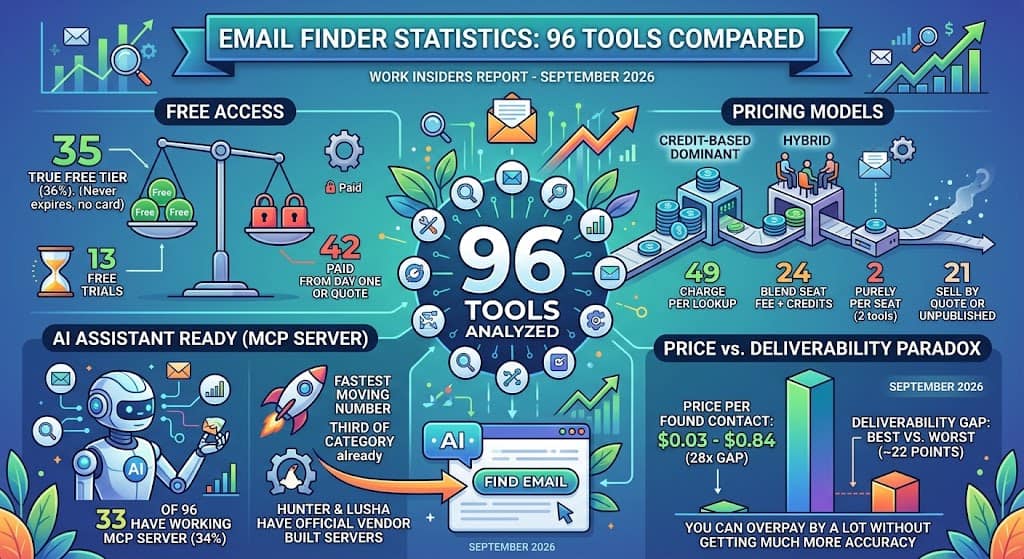
On September 12, 2026 the category held 96 tools, with 33 MCP servers, 35 free tiers and 5 quote only vendors. By October 8 it held 120, with 50 MCP servers and 41 free tiers. The new listings were a mix of enrichment APIs built for AI agents and contact databases aimed at recruiters, and many of them arrived with an MCP server on day one. This page now runs live, so the next change shows up the day a listing changes.
How many email finder tools have a free tier?
55 of the 142 tools (39%) have a free tier you can keep using month after month. That is about twice the rate across the whole directory, where 21% of tools offer one.
“Free” gets used loosely on pricing pages, so we are strict about it. A tool only gets the free tier tag when the plan has no end date and asks for no card. Timed trials are tagged separately and never count as free, and 23 tools in this category offer only a trial. The full live list sits in the tracker above, and you can browse every tagged tool on the free tools page.
What does a typical free email finder plan include?
A small monthly allowance and not much else. Hunter’s free plan gives 50 credits a month, and its pricing page says credits reset monthly and do not roll over. Skrapp’s free plan gives 50 credits for one user.
The catch on almost every free plan is what sits behind the paywall: bulk uploads, list exports, CRM sync and API access. A free tier is a fine way to test find rates on your own candidates. It is rarely enough to run a desk on.
How many usable emails does a free plan actually produce?
Fewer than the credit number suggests. The formula that matters is free credits multiplied by find rate multiplied by deliverability.
A finder with 50 free credits, a 65 percent find rate and 80 percent deliverability yields about 26 usable emails on paper. Tools that only charge when they find an address stretch that further, because a miss costs nothing. Either way, 50 credits is roughly one week of light sourcing for one recruiter, not a month.
How much does an email finder cost?
126 of the 142 tools (89%) publish a starting price. Among the 111 that quote a monthly or yearly price in US dollars, the median entry plan is $49 a month, the cheapest starts at $9, and 62 of them (56%) start under $50. The price chart in the tracker shows where the entry plans cluster.
Another 12 tools list their price in euros or pounds, Kaspr and Dropcontact among them. We leave those out of the median rather than convert them at a moving exchange rate. The median across every category in the directory is $49 a month, and our live recruiting software pricing tracker has the full picture.
How much does an email finder cost per contact?
Anywhere from a few cents to nearly a dollar. Cleanlist’s 2026 roundup puts the cost per found contact at $0.03 for Cleanlist and $0.84 for ZoomInfo, a spread of 28 times, while the gap in deliverable email rate between best and worst was only about 22 points.
Read that as a vendor benchmark: Cleanlist ran it on its own data and came out cheapest. The shape still matches what our directory shows. Entry plans for pure email finding cluster low, and the expensive end is enterprise data suites where you are paying for direct dials, intent data and a sales platform bundled in. If you only need email addresses for standard recruiting, a tool in the few cents per contact range is the sensible budget.
Is credit based or seat based pricing more common?
Credits, among the tools built mainly to find emails. Hunter, Skrapp, Snov.io and Prospeo all sell a monthly pool of credits. Hunter goes further and allows unlimited team members who share one pool, so a three recruiter desk pays the same as a solo recruiter on the same plan.
Seat pricing belongs to the bigger platforms. Apollo, Lusha and Sales Navigator charge per user, because the seat buys a whole prospecting suite rather than lookups alone. For teams under five people who mainly need addresses, a shared credit pool almost always costs less. Seats make sense only when every person on the team uses the full platform.
Do email finders charge credits for failed lookups?
Some do, and it can double your real cost on a hard list. Read the credit rules, not the plan name. Hunter charges one credit per email found and nothing when no address comes back. Skrapp advertises a fair credit policy on paid plans that only charges for deliverable emails. A tool that bills every attempt will burn through a pool twice as fast on niche or senior candidates, where find rates are lowest.
How many email finder tools have an MCP server?
64 of the 142 (45%) ship a first party Model Context Protocol server, against 23% across the whole directory. That makes contact data one of the most AI ready categories we track. Our live MCP tracker ranks every category.
MCP is the open standard that lets an AI assistant like Claude, ChatGPT or Grok call a tool directly. Read MCP for recruiters for the background. With an email finder connected, you can type “find the email for the head of talent at Acme” into a chat and get a verified address back without opening the vendor’s app.
58 tools have both an API and an MCP server, 37 have an API only, 6 have an MCP server only, and 41 have neither. The recognizable names with MCP include Hunter, Apollo, Lusha, ZoomInfo, RocketReach, Snov.io, ContactOut and Findymail. Skrapp, Kaspr, Cognism, Wiza, UpLead and People Data Labs publish an API but no MCP server yet.
How does Hunter’s MCP server work?
It is the clearest example of a vendor built server. According to Hunter’s MCP page, it is included on every plan, free accounts too, and works with Claude, ChatGPT, Gemini and any other MCP client. It exposes Domain Search, Email Finder, Email Verifier, company and person enrichment, and lead lists. Your existing credits and limits apply. We only count a tool as MCP ready when the vendor supports the server itself, not when a third party has built a wrapper.
Does MCP make an email finder cheaper?
No. Hunter states plainly that credits are counted the same way wherever a lookup runs: web app, API, browser extension or any other product. What MCP changes is accuracy inside AI workflows. An assistant left to itself will happily invent an address that looks right. Connected to a real finder, it returns verified data or says it could not find one. If your team already drafts outreach in an AI chat, an MCP connected finder removes the copy and paste step and the guesswork at the same time. It does not remove the bill.
Do email finders also verify emails?
Most check addresses before returning them, but only 18 of the 142 are also listed in our email verification category, which holds 40 tools. Dedicated verifiers are even further along on MCP, at 53%.
The practical rule is simple. Whatever finder you use, run any exported list through a verifier before a campaign, and keep an eye on your deliverability. One bad list can hurt a sending domain for weeks.
How accurate are email finder tools?
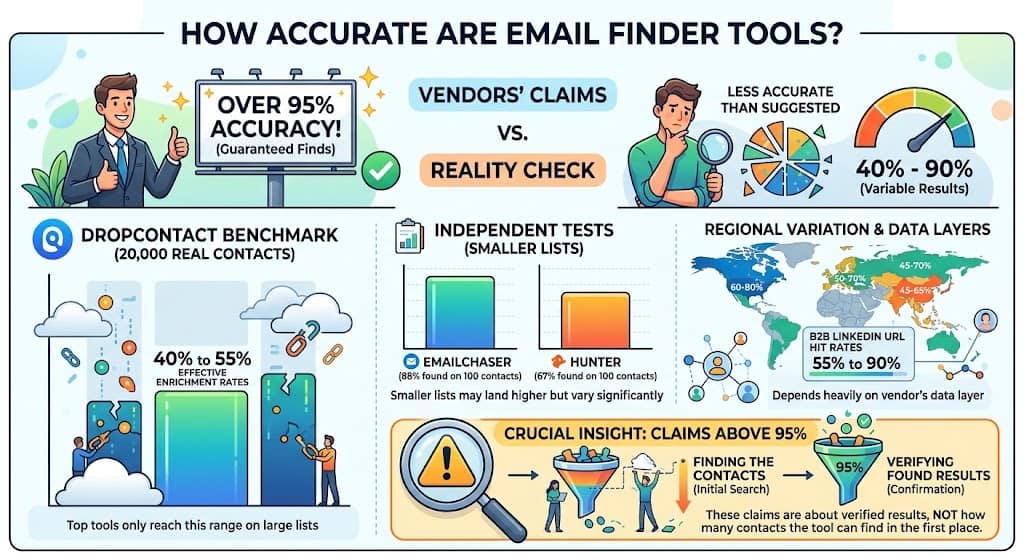
Less accurate than vendor pages suggest. Dropcontact’s benchmark ran 15 email finders against the same file of 20,000 real contacts and counted only emails that were found and then proved usable. The results ranged from 14.2 percent at the bottom to 54.9 percent for Dropcontact itself at the top.
That is another vendor run test, so weigh the ranking accordingly. The useful lesson is the range. On a large, messy list, even the best tool leaves close to half the contacts without a usable address. Treat any accuracy claim above 95 percent as a claim about the emails a tool returns, not about how many contacts it can find in the first place.
Why do waterfall email finders score higher?
Because they ask more than one source. A single source finder returns whatever its own database holds. A waterfall finder such as FullEnrich, BetterContact or Cleanlist sends each contact through several data providers in turn and stops when one returns a verified address. That lifts find rates, especially on smaller companies and European contacts. The trade off is price, since the waterfall pays every provider it touches and passes that cost on.
How fast does contact data go stale?
Fast enough that last quarter’s list is already leaking, and faster for recruiters than for sales teams, because passive candidates are exactly the people changing jobs. Ask every vendor two questions: when was this record last refreshed, and do you verify again on export. A free finder with stale data costs more than a paid tool with fresh data, because every bounce compounds against your sending reputation.
What do the numbers say about where email finders are heading?
Three things stand out. First, MCP is becoming standard in this category faster than almost anywhere else, because finding and verifying an address is exactly the kind of small, well defined job an AI assistant can hand off. Second, pricing is open and cheap at the entry level, so the real differences are in credit rules and find rates, not the headline number. Third, the category is filling with enrichment APIs built for agents rather than people, which means the tools you choose increasingly matter more to your AI workflow than to your browser.
Looking for personal rather than work addresses? Our guide to personal email finders covers the tools recruiters use on LinkedIn profiles.
Quick answers
How many email finder tools are there?
Work Insiders tracks 142 email finder and contact data tools as of November 5, 2026.
How many email finders have a free tier?
55 of 142, or 39%. Another 23 offer a free trial only, which we count separately.
How many email finders have an MCP server?
64 of 142, or 45%, against 23% across the whole directory. Hunter, Apollo, Lusha and ZoomInfo are among them.
How much does an email finder cost per month?
The median published starting price is $49 a month across 111 US dollar prices, and 56% start under $50. 13 tools are quote based.
Is credit based pricing better than seat based?
For teams under five who mainly need addresses, yes. Credits share across people. Seats multiply the bill by headcount.
Do free credits roll over?
Almost never. Most free plans reset monthly and discard unused credits. Some paid plans, Skrapp’s among them, do roll credits over.
How is this data collected?
Every count is read live from the Work Insiders directory: the email finders category, the pricing tags, starting prices from each vendor’s own pricing page, and the per listing MCP and API flags, which we verify against vendor documentation. It refreshes whenever a listing changes. If your tool is listed wrong or missing, use the submit form or email support@workinsiders.com.
Free newsletter
Get the Work Insiders weekly
One email a week: the recruiting and HR tech news that mattered, the tools we just added to the directory, and one practical guide. No spam, and you can unsubscribe in one click.