

By Ryan Bradshaw · Updated September 2026 · Source: Work Insiders directory
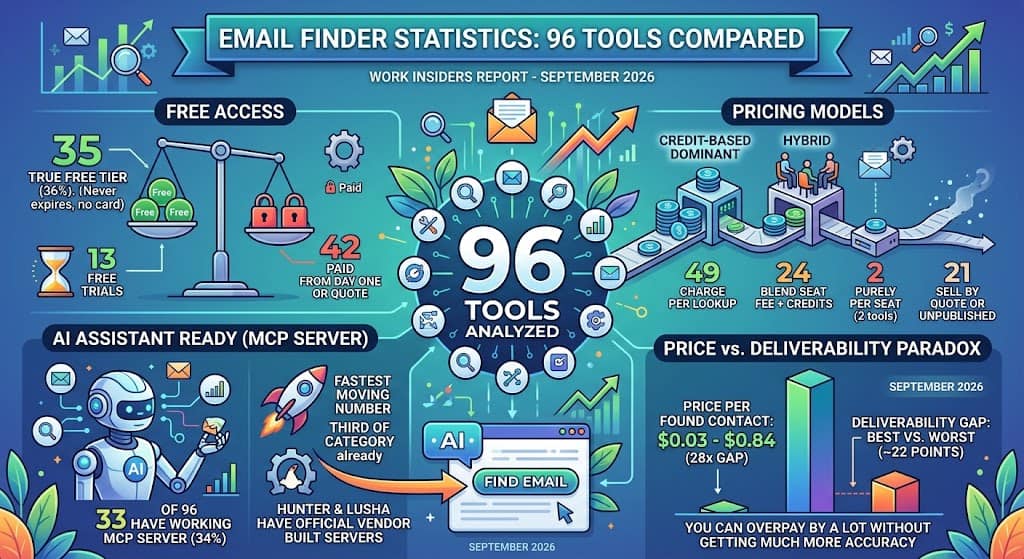
Work Insiders tracks 96 email finder tools. 49 charge per lookup, 24 blend seat plus credits, 2 are seat-only, and 21 hide the price. 33 ship a first-party MCP. 35 have a free tier. Published cost per found contact runs about $0.03 to $0.84. Counts are from the directory, rerun quarterly.
Work Insiders tracks 96 email finder tools in its recruiting software directory. This report counts how many of them offer a free tier, how many charge by credit versus by seat, and how many have shipped an MCP server so an AI assistant can run lookups directly.
Counts come from the directory database as of September 2026. Vendor pricing changes often, so we rerun this quarterly.
What are the key email finder statistics for 2026?
35 of the 96 email finders in the directory offer a true free plan or free tier, meaning a plan that never expires and never asks for a card. 13 offer only a time limited free trial, 42 are paid from day one or quote only, and 6 have not published enough pricing detail to tag.
Credit based pricing is the dominant model: 49 tools charge per lookup, 24 blend a seat fee with a credit allowance, only 2 charge purely per seat, and 21 sell by quote or do not publish a readable price grid. 33 of the 96 have a working MCP server.
Industry wide, the price per found contact ranges from about $0.03 to $0.84, a gap of roughly 28 times, while the deliverability gap between best and worst tool is only about 22 points. In plain terms, you can overpay by a lot without getting much more accuracy.
| Email finder statistic | Tools | Share of 96 |
|---|---|---|
| Free plan or free tier | 35 | 36% |
| Free trial only | 13 | 14% |
| Paid from day one | 37 | 39% |
| Quote only | 5 | 5% |
| Credit based pricing | 49 | 51% |
| Hybrid (seat + credits) | 24 | 25% |
| Seat only | 2 | 2% |
| Has an MCP server | 33 | 34% |
| API but no MCP server | 22 | 23% |
How many email finder tools have a free tier?
35 of 96 tools, or 36 percent, have a free plan or free tier you can keep using month after month. Another 13 give you a short trial, 37 are paid from the first lookup, 5 only quote, and 6 do not publish enough to tag. This matters because “free” gets used loosely on pricing pages.
A 7 day trial with 5 credits is not a free plan. In our directory, a tool only gets the free tier tag when the plan has no end date and no card requirement. Free trials are tagged separately and never count as free. You can browse every tagged tool on the free tools page.
What does a typical free email finder plan include?
Most free tiers land between 25 and 150 lookups a month. Hunter‘s free plan gives 25 searches a month, Skrapp‘s free plan gives 150 finds a month, and Apollo’s free plan gives 75 credits a month.
A few tools skip caps entirely. Emailchaser offers unlimited free single searches, which is rare. The catch on almost every free plan is that unused credits vanish at the end of the month, and bulk upload, API access, and exports are locked behind paid tiers.
| Tool | Free plan allowance | Resets |
|---|---|---|
| Hunter | 25 searches a month | Monthly |
| Apollo | 75 credits a month | Monthly |
| Skrapp | 150 finds a month | Monthly |
| Emailchaser | Unlimited single searches | No cap |
How many usable emails does a free plan actually produce?
Fewer than the credit number suggests. The formula that matters is free credits multiplied by find rate multiplied by deliverability.
A finder with 50 free credits, a 65 percent find rate, and 80 percent deliverability yields about 26 usable emails on paper, and closer to 15 to 20 in practice. That is the honest number to plan around. Fifty credits is roughly one week of light sourcing for one recruiter, not a month.
Is credit based or seat based pricing more common for email finders?
Credit based pricing is far more common. 49 of the 96 tools charge per lookup, 24 use a hybrid where you pay per seat and each seat gets a credit allowance, and 21 are sales quoted or do not publish a readable price grid. Only 2 tools charge purely per user seat with no credit meter at all: LinkedIn Sales Navigator and Swordfish. The hybrid model is where costs surprise people, because the listed price is never the real price.
Hunter combines per seat pricing with a credit system for lookups, so the listed price is rarely what you end up paying. Apollo works the same way. Apollo bills per seat, and a five person team on its Professional plan pays $4,740 a year.
| Pricing model | Tools | What you pay | Examples |
|---|---|---|---|
| Credit based | 49 | Per lookup, no user fee | Snov.io, Lusha, Clay, Tomba |
| Hybrid | 24 | Per seat plus a credit allowance | Apollo, ZoomInfo, RocketReach, Kaspr |
| Seat only | 2 | Per user, no credit meter | LinkedIn Sales Navigator, Swordfish |
| Quote or unpublished | 21 | Sales call required | Cognism, People Data Labs, hireEZ |
Which pricing model is cheaper for a small recruiting team?
For teams under five people, credit based almost always wins. Per seat pricing that scales aggressively is a warning sign for teams above five reps, while bulk credits in a shared workspace favor team wide adoption.
Credits let two or three recruiters share one pool without buying three licenses. Seat pricing makes sense only when every person on the team needs the full platform, not just lookups.
Sales intelligence platforms like Apollo, Lusha, ZoomInfo and Cognism price the seat on the whole feature set, so the per email cost ends up higher unless the team also uses the CRM, intent data, and sequences.
Do email finders charge credits for failed lookups?
Some do, and it doubles your real cost. Some tools charge per lookup whether or not they find anything, while others charge only for valid results, and that difference alone can double your effective cost.
GetEmail charges a credit whether the lookup succeeds or fails, which at about $0.196 per attempt adds up fast.
On the other side, Derrick charges five credits per email and bills only when an address actually comes back, and AnyMail Finder uses a pay for success model that charges only for verified addresses. Before you buy, read the credit rules, not the plan name.
How much does an email finder cost per contact?
Anywhere from three cents to nearly a dollar. Cleanlist’s benchmark put the low end at $0.03 per found contact and the high end at $0.84 for ZoomInfo. In the middle, Clay runs about $0.18 per verified email with a 96 percent find rate, and Skrapp about $0.05 on paid plans with an 81 percent find rate.
The same source draws a useful line: going above $0.10 per email only makes sense for high value enterprise outreach. For recruiters filling standard roles, a tool in the $0.03 to $0.08 range is the sensible budget.
What is a fair monthly price for a solo recruiter?
Between $20 and $50 a month buys a serious tool. Entry pricing across twelve LinkedIn email finders ranged from €9 a month (Derrick) and $20 a month (Findymail) up to $99 a month (ContactOut, Lusha) for comparable credit pools.
Skrapp’s Starter plan is $29 a month for 1,000 emails. Paying $99 or more is usually paying for phone numbers, intent data, or an outreach suite bundled in. If you only need addresses, you are overpaying.
How many email finder tools have an MCP server?
33 of the 96 email finders in the directory, or 34 percent, have a working MCP server as of September 2026. Another 22 offer an API but no first party MCP server. MCP, short for Model Context Protocol, is the open standard that lets an AI assistant like Claude or ChatGPT call a tool directly. See what an MCP is for recruiters.
With it connected, you can type “find the email for the head of talent at Acme” into a chat and get a verified address back without opening the vendor’s app. That is a third of the category already, and it is the fastest moving number in this report.
Our wider count found that 18 percent of tools across all recruiting categories had MCP servers, so email finders are running at nearly double the site wide average.
Which email finders offer an official MCP server?
Hunter and Lusha are the two clearest examples with vendor built servers. Hunter’s MCP works with all Hunter plans including free accounts, and existing request limits and credits still apply.
It exposes Domain Search, Email Finder, Email Verifier, and company lookups to any MCP client. Lusha’s MCP server lets Claude and ChatGPT find, verify, and enrich contacts through natural language, and requires a Lusha API key with an Admin or Manager role plus a plan with credits. Smaller vendors are following.
Derrick adds an API and MCP endpoint on its €20 a month plan. Third party wrappers exist for many others, but we only count a tool as MCP ready when the vendor supports it.
Does MCP make an email finder cheaper?
No. Credits are billed exactly the same way whether a human or an AI runs the lookup. What MCP changes is accuracy inside AI workflows. When an AI confidently invents a lead’s email address, it undermines your research flow.
Hunter’s MCP gives the assistant real contact data so it stops inventing addresses and people who don’t exist. If your team already drafts outreach in an AI chat, an MCP connected finder removes the copy paste step and the hallucination risk at the same time. It does not remove the bill.
How accurate are email finder tools?
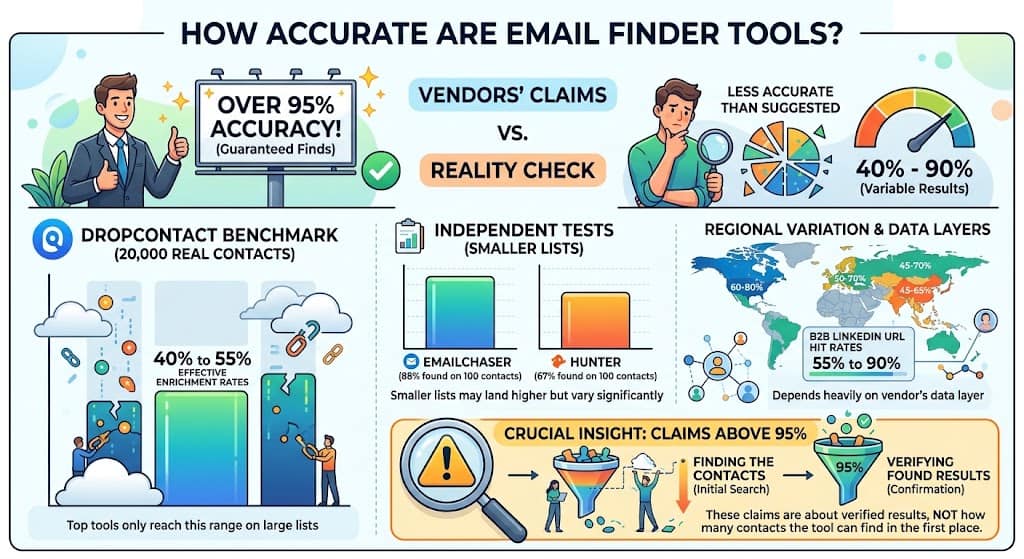
Less accurate than vendor pages suggest, and it varies by region. A Dropcontact benchmark of 20,000 real contacts found that even top tools reach only 40 to 55 percent effective enrichment rates. Independent tests on smaller lists land higher. In a 100 contact test,
Emailchaser found 88 percent of addresses versus 67 percent for Hunter, and hit rates on B2B LinkedIn URLs cluster between 55 and 90 percent depending on the vendor’s data layer.
Treat any claimed accuracy above 95 percent as a claim about verified results, not about how many contacts the tool can find in the first place.
Why do waterfall email finders score higher?
Because they ask more than one source. Single source finders return one guess per contact, while waterfall finders query many sources and verify before returning, which is why they win on deliverability.
Clay’s waterfall runs a prospect through more than ten data providers in sequence until it finds a verified email, giving it the highest find rate and lowest bounce rate in one benchmark. The trade off is price, since you pay for every provider the waterfall touches.
How fast does email finder data go stale?
Fast enough that last quarter’s list is already leaking. At least 23 percent of any email list degrades within a year, and the rate is worse for recruiters sourcing passive candidates who change jobs often.
Apollo verifies contacts once against a static database, which is why exported Apollo lists are known for bounces. Ask every vendor two questions: when was this record last refreshed, and do you re verify on export. A free finder with stale data costs more than a paid tool with fresh data, because every bounce compounds.
What are people on Reddit asking about email finders?
The same three questions come up in r/recruiting and r/sales threads every month. First, “is there a free email finder that actually works.” The honest answer is yes for low volume, and the Reddit consensus is telling.
Redditors generally agree Hunter works better as a verification layer than a primary source, which is a valid way to use its free plan. Second, “why does my Apollo list bounce so much.”
That is the static database problem above, and the fix is running any export through a verifier before sending. Third, “credits or seats, which one won’t screw me.” For anyone under five users, credits. The section on credit rules above covers the trap to avoid.
Quick answers
How many email finders have a free tier? 35 of the 96 in the Work Insiders directory, or 36 percent. Free trials are counted separately and do not qualify.
Is credit based pricing better than seat based? For teams under five, yes. Credits share across people. Seats multiply the bill by headcount.
How many email finders have an MCP server? 33 of 96 as of September 2026, with another 22 offering an API but no MCP server. Hunter and Lusha have official vendor built servers.
What is a fair price per email? Three to eight cents for standard recruiting. Above ten cents only makes sense for high value enterprise outreach.
Which email finder is most accurate? Waterfall tools that query multiple providers score highest. Independent find rates range from about 55 to 90 percent, and no tool is above that ceiling.
Do free credits roll over? Almost never. Most free plans reset monthly and discard unused credits.
How we counted
Every tool in the email finders category carries a pricing tag (free, free tier, free trial, paid, or quote) and an MCP flag in the directory database. Counts in this report are pulled from those fields, not from vendor marketing copy.
Credit versus seat classification was done by reading each vendor’s live pricing page, and any tool whose pricing page could not be read was placed in the quote or unknown bucket rather than guessed.
The category held 94 tools at our 11 September 2026 census and 96 at publication after two listings were added. The count is rerun quarterly. If your tool is listed wrong or missing, use the submit form or email support@workinsiders.com.