

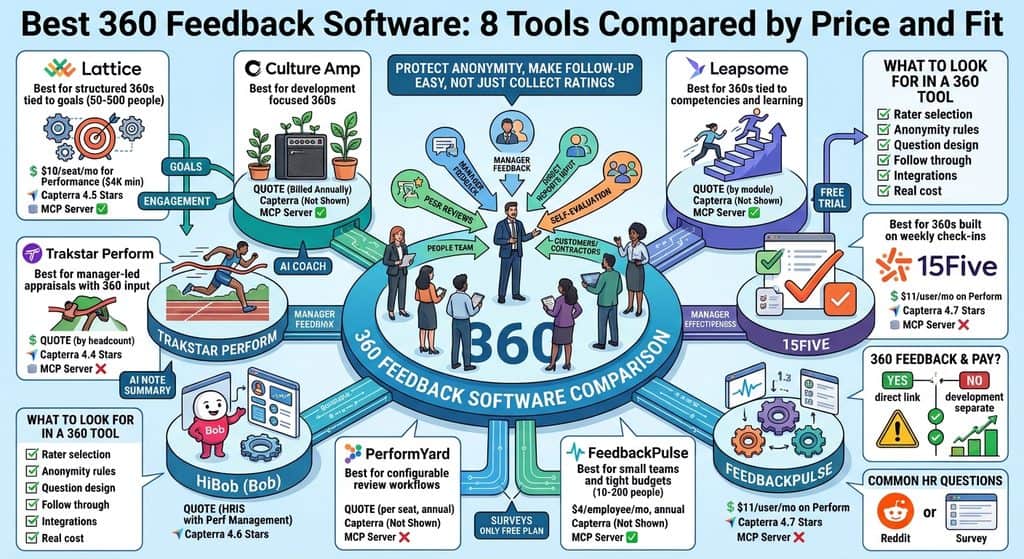
Quick answer: For most companies of 50 to 500 people, Lattice is the safest pick for 360 feedback, because it pairs structured 360 cycles with goals and publishes its price ($10 per seat a month for Performance, billed annually). Pick FeedbackPulse if you are small and on a budget (360s start at $4 per employee a month), Culture Amp if 360s are about development rather than ratings, and 15Five if you want 360s on top of weekly manager check ins.
The catch: the software is the easy part. In a survey of 1,000 US workers, 79% would opt out of 360 reviews if they could, mostly over office politics. Choose a tool that protects anonymity and makes follow up easy, not just one that collects ratings.
Who this is for: HR leads, founders and people teams choosing 360 feedback or performance review software for the first time, or replacing a tool that nobody finishes.
What is 360 feedback software?
360 feedback software collects reviews of one person from several directions at once: their manager, their peers, their direct reports and themselves, sometimes with customers or contractors added. The software sends the requests, chases the people who have not answered, hides who said what, and rolls the answers into one report the person can act on.
You can run a 360 with a survey form and a spreadsheet. The reason teams buy software is the hard parts: choosing raters fairly, keeping comments anonymous, hitting a deadline across dozens of people, and turning a pile of comments into a conversation with a manager. That is also where the tools below differ most.
How common are 360 reviews?
Very common. The same LiveCareer survey found 71% of organizations run 360 reviews regularly. It also found 74% of workers had received 360 feedback they felt was unfair, biased or inaccurate, and 48% said the process amplifies office politics. Usage is high and trust is low, which is why the setup choices matter.
How do the best 360 feedback tools compare?
This table compares the nine tools on the points buyers ask about first. Prices come from each vendor’s own pricing page as recorded on each tool’s Work Insiders listing, and ratings are Capterra scores we checked ourselves, shown only where a tool has 10 or more reviews.
| Tool | Best for | Starting price | Free plan | Capterra | MCP server |
|---|---|---|---|---|---|
| Structured 360s tied to goals, 50 to 500 people | $10/seat/mo for Performance ($4,000 yearly minimum) | No | 4.5 (207) | Yes | |
| Development focused 360s plus engagement surveys | Quote, billed annually | No | Not shown | Yes | |
| 360s linked to competencies, goals and learning | Quote, by module | No (free trial) | Not shown | Yes | |
| 360s on top of weekly manager check ins | $11/user/mo on Perform (Engage from $4) | No | 4.7 (895) | No | |
 FeedbackPulse | Small teams of 10 to 200 on a budget | $4/employee/mo, annual | Surveys only, up to 10 people | Not shown | Yes |
| Configurable review stages and approvals | Quote, per seat, annual | No | Not shown | No | |
| 360 cycles inside a full HRIS | Quote | No | 4.6 (178) | Yes | |
 Trakstar Perform | Manager led appraisals with 360 input | Quote, by headcount | No | 4.4 (287) | No |
 Peoplebox | 360s and OKRs run from Slack or Teams | $16/employee/mo (Performance $8 plus 360 add on $8) | No | 4.6 (244) | No |
An MCP server lets an AI assistant such as Claude or ChatGPT read and act inside the tool, for example pulling a review summary or sending reminders. It is not essential for 360s, but five of these nine now ship one.
Which is the best 360 feedback software for each situation?
We ranked these for a typical company of 50 to 500 people running its first or second 360 cycle. We weighed fit for 360s specifically, whether the price is published, Capterra ratings with review counts, and how much the tool helps after the feedback is collected.
1. Lattice: best overall for structured 360 cycles
Lattice runs 360s inside its Performance product, where reviews connect to goals, one to one meetings and engagement surveys. It is one of the few suites in this group with a public price: Engagement is $4 per seat a month, Goals $8 and Performance $10, all billed annually, with a $4,000 yearly minimum. It holds a 4.5 on Capterra from 207 reviews and ships a first party MCP server that covers reviews, goals and feedback.
Watch out for: pricing is modular, so the real figure depends on which products you stack, and a team of 20 still pays the $4,000 minimum. Lattice is a good fit from about 50 people up.
2. Culture Amp: best for development focused 360s
Culture Amp is built on engagement science, and its 360s lean toward growth rather than ratings that feed pay decisions. AI Coach is included across its Engage and Perform products to help managers turn survey themes and review results into conversations. It also offers an MCP connector and a developer API.
Watch out for: there is no published price. Everything is quoted by headcount, products and service tier and billed annually, so it suits companies with a proper budget line for people tools, often 200 people and up.
3. Leapsome: best for 360s tied to competencies and learning
Leapsome lets you buy modules one at a time: reviews, goals and OKRs, engagement, learning and an HRIS. Its 360 reviews can be mapped to competency frameworks and linked to learning paths, so feedback turns into a development plan inside the same tool. AI agents that draft reviews and summarize meetings, and an MCP connector, come with every plan, and there is a free trial.
Watch out for: pricing is quoted and depends on modules, user count and bundle discounts. If you only want a simple 360, the module menu can be more than you need.
4. 15Five: best for 360s built on weekly check ins
15Five is a manager effectiveness platform first. Weekly check ins, one to ones and engagement surveys are the core, and 360s and AI assisted reviews sit on top. It has the strongest user rating in this group, 4.7 on Capterra from 895 reviews, which reflects how easy managers find the day to day habit.
Watch out for: the $4 Engage seat does not include 360s. Those sit on Perform at $11 per user a month or Total Platform at $16, and coaching and compensation are extra. Budget for Perform if 360s are the reason you are buying.
5. FeedbackPulse: best for small teams and tight budgets
FeedbackPulse is the cheapest serious option here. Its free plan covers pulse surveys for up to 10 people, and Pro, at $4 per employee a month billed annually, adds 360 feedback, performance reviews, eNPS benchmarks and AI summaries in one price. Survey answers stay hidden until at least three people respond, which helps with the anonymity worries that sink many 360 programs. It also has a first party MCP server.
Watch out for: Slack and Microsoft Teams integrations and goals sit on the Max plan at $8 per employee. It is a young, small vendor without its own SOC 2 report, so larger companies with a security review process may struggle to get it approved.
6. PerformYard: best for configurable review workflows
PerformYard is performance review software without a full HR suite around it. You pick the modules you need, such as reviews, goals, compensation and engagement, and build review cycles with your own stages, approvals and forms. Onboarding and training are included, and it syncs with ADP, BambooHR, Gusto, Rippling, UKG, Workday and Paylocity.
Watch out for: prices are per seat, billed annually and only available by quote. It does not include payroll or a core HRIS, so it suits teams that already have one.
7. HiBob: best if you want 360s inside your HRIS
HiBob, usually called Bob, is a mid market HRIS with performance management built in. Review cycles can combine self, manager, upward and peer questions, and reviews draw on each person’s goals and history already stored in Bob. It holds a 4.6 on Capterra from 178 reviews and has an official MCP server.
Watch out for: you are buying an HRIS, not a 360 tool. It only makes sense if you also want Bob for core HR, onboarding and time off, and pricing is quoted.
8. Trakstar Perform: best for manager led appraisals with 360 input
Trakstar Perform, now sold by Mitratech as Mitratech Perform, is built around getting appraisals finished on time. It offers unlimited review templates, 100+ competencies, automated reminders with live progress tracking, and 360 feedback from managers, peers, direct reports and people outside the company. Its newer AI Note Summary drafts a review from collected feedback for the manager to edit. It rates 4.4 on Capterra from 287 reviews.
Watch out for: 360 input feeds a manager mediated appraisal, so it is less suited to a standalone development 360. Pricing is a quote based on headcount, and add ons such as succession planning can cost extra.
9. Peoplebox: best for 360s and OKRs inside Slack and Teams
Peoplebox runs reviews, cascading OKRs, 1:1s, engagement surveys and 360s, and most of it happens inside Slack or Microsoft Teams, so employees can give feedback and finish reviews without logging in to another tool. Its 360 add on uses expert built or custom templates, role based competencies, anonymous or open reviews, and AI written personal reports. It rates 4.6 on Capterra from 244 reviews, and it also sells Nova, an AI recruiter that runs phone screens, if you want hiring and performance from one vendor.
Watch out for: the 360 module is an add on. Performance Management is $8 per employee a month and 360 another $8, both billed annually, so budget about $16 a person for 360s. Compensation, development plans and engagement cost extra too.
What should you look for in a 360 feedback tool?
Feature lists look alike, so test these six things in a demo instead. Each one decides whether people trust the process and whether managers follow through.
- Rater selection: who picks the raters, and can a manager or HR approve the list? Approval stops people picking only friends.
- Anonymity rules: is there a minimum number of responses before results show, and who can see attributed comments? Ask to see the setting, not just hear about it.
- Question design: can you use competencies or your company values, and keep it short? Long forms produce vague answers.
- Follow through: does the report turn into a development plan, goals or a manager conversation, or does it end as a PDF?
- Integrations: does it sync people and reporting lines from your HRIS so you are not building rater lists by hand?
- Real cost: which plan actually includes 360s, what is the minimum contract, and is pricing per employee reviewed or per everyone in the company?
Should 360 feedback be tied to pay?
Most experts say no, at least not directly. The Academy to Innovate HR recommends deciding up front between development versus evaluation, because it changes who should pick the raters and how candid people will be. When ratings affect pay or promotion, people tend to inflate scores for friends and settle scores with rivals. Many teams run 360s for development and keep pay decisions in a separate, manager led review.
How much does 360 feedback software cost?
Of the nine tools here, four publish a price and five sell by quote. Published prices for a plan that includes 360s run from $4 to about $16 per person a month.
| Team size | FeedbackPulse Pro | Lattice Performance | 15Five Perform | Peoplebox with 360 |
|---|---|---|---|---|
| 10 people | About $480 a year | $4,000 a year (minimum) | About $1,320 a year | About $1,920 a year |
| 50 people | About $2,400 a year | $6,000 a year | About $6,600 a year | About $9,600 a year |
| 200 people | About $9,600 a year | $24,000 a year | About $26,400 a year | About $38,400 a year |
These figures multiply each published per person rate by headcount for a year at annual billing. They leave out add ons, taxes and any volume discount, so treat them as a starting point for a quote. Lattice’s $4,000 yearly minimum sets its 10 person figure. Check our performance software category for current prices on every tool we list.
What do HR people on Reddit ask about 360 tools?
The same questions come up in HR communities such as r/humanresources and r/AskHR. Here are straight answers.
Can I just use Google Forms or SurveyMonkey for a 360?
For a handful of people, yes. It breaks down once you have more than a few reviewees, because you end up tracking who owes which form in a spreadsheet, chasing people by email and hand building reports. Anonymity is also harder to guarantee when you can see the raw responses. A low cost tool such as FeedbackPulse Pro, at $4 per employee a month, is a cleaner step up for small teams.
How many raters should each person have?
A common range is five to ten: the manager, three to five peers, and direct reports where the person manages people. Fewer than three in any group makes it easy to guess who said what, which is why good tools hide results below a minimum response count.
Do managers actually read 360 results?
Only if the tool and the process make them. Pick software that puts results into a scheduled conversation or development plan, and set a deadline for the follow up meeting just as you set one for the feedback itself.
Quick answers
What is the best 360 feedback software?
For most companies of 50 to 500 people, Lattice, because it combines structured 360 cycles with goals and publishes its price. Small teams on a budget should start with FeedbackPulse, and development focused programs suit Culture Amp.
Is there free 360 feedback software?
Not really. FeedbackPulse has a free plan for up to 10 people, but it covers pulse surveys only; its 360 reviews start on Pro at $4 per employee a month. The other tools here offer a demo or trial rather than a free plan.
Which 360 tool has the best user rating?
15Five, with 4.7 on Capterra from 895 reviews as checked by Work Insiders. Peoplebox has 4.6 from 244 reviews, HiBob 4.6 from 178 and Lattice 4.5 from 207.
Are 360 reviews anonymous?
Usually, for peers and direct reports, while the manager’s feedback is often attributed. Good tools only show results once a minimum number of people respond, so no single answer can be traced back.
How often should you run 360 reviews?
Once or twice a year is typical. Running them more often tends to cause survey fatigue, so many teams pair a yearly 360 with lighter pulse surveys and regular one to ones.
The bottom line
Start with what the 360 is for. If it feeds a structured review cycle, Lattice is the strongest all round choice with a published price. If it is about growth, Culture Amp or Leapsome. If you are small, FeedbackPulse gets you running for $4 a person. If your managers already live in weekly check ins, 15Five, and if your team lives in Slack or Teams, Peoplebox. Whichever you choose, test the anonymity settings and the follow up flow in the demo, because those decide whether people trust the results. Compare every option side by side in our performance management directory.
Sources: HRD on LiveCareer, AIHR 360 guide, Lattice pricing, 15Five pricing, HiBob review guide, Mitratech Perform, Peoplebox pricing
Free newsletter
Get the Work Insiders weekly
One email a week: the recruiting and HR tech news that mattered, the tools we just added to the directory, and one practical guide. No spam, and you can unsubscribe in one click.