

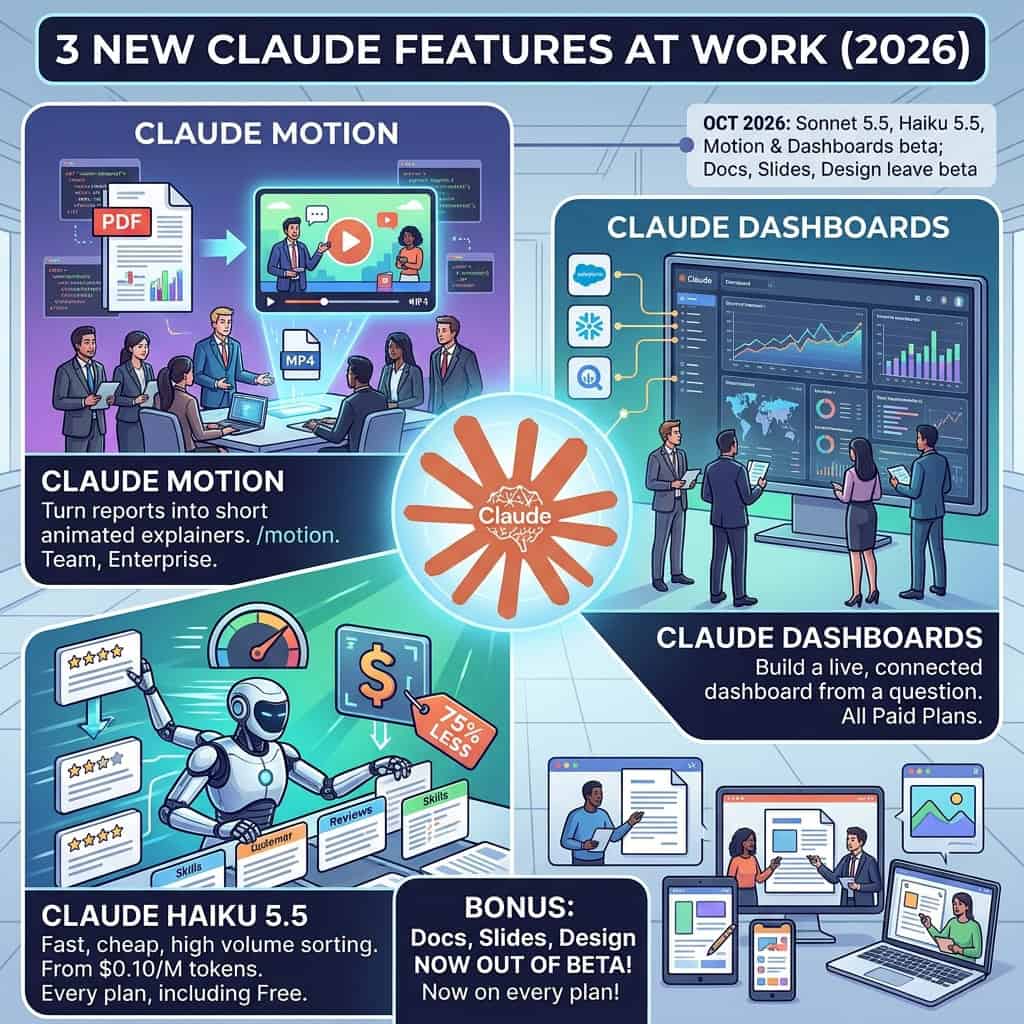
Anthropic shipped three Claude upgrades you can use at work this week. Claude Motion turns a report into a short animated explainer you download as an MP4 (Team and Enterprise, type /motion). Claude Dashboards connects to Salesforce, Snowflake, BigQuery and other data sources and builds a dashboard that stays live (all paid plans). Claude Haiku 5.5 is a faster, cheaper model for high volume jobs, priced at $0.10 per million input tokens against $1 for Haiku 4.5, and you can pick it on every plan, Free included. Bonus: Docs, Slides and Design left beta the same day and are now on every plan.
Plans, prices and dates checked against Anthropic’s announcements and independent coverage on 23 October 2026. Motion and Dashboards are still labelled beta, so details can change.
What did Anthropic just release for Claude?
Two launches landed a day apart. On 7 October 2026 Anthropic released Claude Haiku 5.5, its smallest and cheapest current model. On 8 October it put Claude Dashboards and Claude Motion into beta and took the beta label off Docs, Slides and Design, according to Anthropic’s launch post.
The common thread is that Claude now hands you the finished thing, not just text about it. You ask for the dashboard, the animation or the deck itself, and you can see how Claude built it: every dashboard chart shows the query behind it, and every animation is code you can edit. Anthropic also says people have made more than 45 million docs, decks and designs in Claude since those tools appeared in every conversation.
| Feature | Status | Plans | How to start | Output |
|---|---|---|---|---|
| Claude Motion | Beta | Team, Enterprise | Type /motion | MP4 download |
| Claude Dashboards | Beta | Pro, Max, Team, Enterprise | Connect a data source, then ask | Live dashboard |
| Claude Haiku 5.5 | Released | Free, Pro, Max, Team, Enterprise | Model picker | Chat and API |
| Docs, Slides, Design | Out of beta | Every plan, Free included | Ask in any chat | PowerPoint, PDF, Google Slides |
What is Claude Motion and how do you use it at work?
Claude Motion turns a prompt, a report or a set of numbers into a short animated explainer that plays like a video. You can tweak it in an editor or ask Claude for changes, then download it as an MP4. Anthropic’s own examples are a quarterly report turned into a 30 second explainer for an all hands, motion added to a chart in a board deck, and a product walkthrough for customer onboarding.
The part most people miss: Motion is not a video generator. Claude writes code that animates your own text, charts, shapes and images, so there is no generated footage and no AI people. That is why you can change one number in a chart and only that bar moves. When you want real footage or a voiceover, you open the piece in Adobe, Descript, HeyGen, Higgsfield, invideo, Luma AI or Runway, which was a named launch partner according to Runway’s partner note.
Prompt to try: “Turn this into a 30 second animated explainer for our next team meeting, highlighting our biggest wins and key numbers.”
Type /motion in the message box to invoke it. Team and Enterprise plans only. Exports to MP4.
How can recruiters use Claude Motion?
Anywhere you would otherwise build another slide nobody remembers. An agency recruiter can turn a quarterly placement report into a 30 second recap for a client review. A talent acquisition lead can animate the hiring funnel for an all hands, showing applications, interviews and offers dropping stage by stage. A recruiter doing business development can animate a local salary and demand snapshot to open a pitch.
Two limits to know. Motion is only on Team and Enterprise, so Pro and Max users will not see it. And on Enterprise it starts switched off: an admin has to turn it on under Organization settings, then Artifacts.
What are Claude Dashboards and which data can they connect to?
Claude Dashboards builds a dashboard from a plain language question and keeps it current as the data changes. Anthropic names Amazon Redshift, BigQuery, ClickHouse, Databricks and Snowflake as data platforms, plus apps you have already connected to Claude, such as Salesforce. You click any number to see the query behind it, and each chart shows when its data was last refreshed.
Anthropic pitches it for quick, exploratory questions, the kind that usually mean filing a ticket with the data team or writing SQL yourself. When a question needs deeper work, you send the dashboard on to Amplitude, Grafana, Hex, Mixpanel, Omni, Perplexity, PostHog or Sigma, with Looker, monday.com and Tableau listed as coming soon.
Prompt to try: “Build me a dashboard showing this quarter’s revenue by region and how this week’s sales compare to last month.”
Available on all paid plans. Dashboards update as the underlying data changes.
Can Claude Dashboards read my ATS or CRM?
Only if Claude can reach the data. Salesforce works through its connector. If your placements, submittals or candidate pipeline sit in an ATS that is not connected to Claude, the data has to land in a warehouse like Snowflake or BigQuery first, a point eesel’s Dashboards review makes about support tools too. Our guide to MCP servers for recruiters shows which everyday tools already connect.
Sharing has a catch as well. Every viewer needs a Claude account and access to the connected data, as one early tester found when building a finance dashboard. That suits a team already on Claude, less so a client who is not. Before you trust a number in a meeting, click it and read the query.
How much cheaper is Claude Haiku 5.5?
Anthropic says Haiku 5.5 costs about 75% less to run than Haiku 4.5 on average. At list price the cut per token is bigger: Haiku 5.5 is $0.10 per million input tokens and $0.50 per million output tokens for prompts up to 100,000 tokens, against $1 and $5 for Haiku 4.5, as Beam’s price breakdown lays out. Prompts over 100,000 tokens cost five times more, $0.50 and $2.50, so very long jobs save less.
| Model | Input per 1M tokens | Output per 1M tokens | On the Free plan? |
|---|---|---|---|
| Haiku 5.5 (prompts up to 100K) | $0.10 | $0.50 | Yes |
| Haiku 5.5 (prompts over 100K) | $0.50 | $2.50 | Yes |
| Haiku 4.5 | $1.00 | $5.00 | Leaving 29 Oct |
| Sonnet 5.5 | $2.00 | $10.00 | Yes |
| Opus 5.5 | $4.00 | $20.00 | No |
If you use Claude in the chat app on a subscription, you do not pay per token, so the price matters less than the speed. Haiku 5.5 is listed as the fastest option in the model picker, and Notebookcheck reported that every plan from Free to Enterprise can select it on web, iOS and Android. Haiku 4.5 leaves the picker on 29 October.
Prompt to try: “Go through these 50 customer reviews, group them by common complaints, and tell me the top 5 things I should improve.”
Pick Haiku 5.5 from the model dropdown. Available on every plan, including Free.
What does that review job cost through the API?
Here is a worked example for teams that run jobs through the API. Assume 50 reviews of about 150 words each, roughly 10,000 input tokens, and a 1,500 token summary back. Run that 1,000 times, say once for every product or location you track, and the bill looks like this at list price.
Real runs vary with how much the model thinks before answering, so treat these as list price estimates, not a quote. Still, DataCamp’s hands on test found Haiku 5.5 matched Haiku 4.5’s perfect score on its task while costing about 25 times less, partly because Haiku 4.5 spent more on thinking.
Which recruiting jobs suit Haiku 5.5?
Repetitive, high volume work where speed beats depth: grouping candidate survey comments, tagging hundreds of job descriptions by skill, cleaning and labelling a lead list, or summarizing interview feedback forms. Keep a person on any decision about who moves forward; a fast model is a sorting aid, not a hiring manager. For deep research or a tricky client email, switch back to Sonnet or Opus.
What changed with Claude Docs, Slides and Design?
All three moved out of beta on 8 October and are now on every plan, Free included. Anthropic listed the upgrades that came with it: your team and Claude can edit the same doc, deck, design or dashboard; you can share outside your company if your admin allows it; PowerPoint and PDF downloads keep their formatting; decks go straight to Google Slides as editable files; and you can edit on your phone. Enterprise gets customer managed encryption keys, and admins choose which templates their company uses.
One housekeeping note: the standalone Claude Design site is closing. It stays open until 14 December, and Anthropic says chats and comments there will not carry over, so save anything you need before then.
Which plan do you need for each feature?
| Feature | Free | Pro | Max | Team | Enterprise |
|---|---|---|---|---|---|
| Haiku 5.5 | Yes | Yes | Yes | Yes | Yes |
| Docs, Slides, Design | Yes | Yes | Yes | Yes | Yes, on by default from 15 Oct |
| Dashboards | No | Yes | Yes | Yes | Yes, admin turns on |
| Motion | No | No | No | Yes | Yes, admin turns on |
If you are on Free, start with Haiku 5.5 and a deck in Slides. On Pro or Max, add Dashboards once you connect a data source. Motion needs a Team or Enterprise seat. For more ways to put Claude to work on a recruiting desk, see how to source candidates with Claude or read our Claude listing.
Quick answers
Is Claude Motion a video generator?
No. Claude writes code that animates your own text, charts, shapes and images, then exports an MP4. There is no generated footage and no AI people.
Can I use Claude Motion on the Pro plan?
Not yet. Motion is in beta on Team and Enterprise only. Pro and Max get Dashboards, Docs, Slides, Design and Haiku 5.5.
Do Claude Dashboards update on their own?
Yes. Once connected to a source like Snowflake or Salesforce, the dashboard refreshes as the data changes, and each chart shows when it last refreshed.
Is Claude Haiku 5.5 free?
In the chat app, yes: Free plan users can pick it on web, iOS and Android. The API is paid, from $0.10 per million input tokens.
Is Haiku 5.5 good enough to replace Sonnet?
For high volume sorting, tagging and summarizing, often yes. For long research, careful writing or judgment calls, Sonnet 5.5 or Opus 5.5 is still the safer pick.
What happens to Haiku 4.5?
It leaves the Claude model picker on 29 October 2026, and Haiku 5.5 takes its place.
Where should you start?
Pick the one that removes a chore you already have. If you build the same report deck every month, try Motion on the next one. If you keep asking someone for the same numbers, connect the data and ask Claude for a dashboard. If you have a pile of comments, reviews or forms to sort, switch to Haiku 5.5 and paste them in. Each takes one prompt to test.
Free newsletter
Get the Work Insiders weekly
One email a week: the recruiting and HR tech news that mattered, the tools we just added to the directory, and one practical guide. No spam, and you can unsubscribe in one click.