

Quick answer: To become a recruiter in 2026, pick a lane (agency, in house, RPO, or sourcer), learn the basics of Boolean search and intake calls, build a small portfolio of real sourcing work, and apply for entry level sourcer, coordinator, or agency associate roles. A degree helps for corporate HR jobs, but agencies hire on drive, sales ability, and proof you can find people.
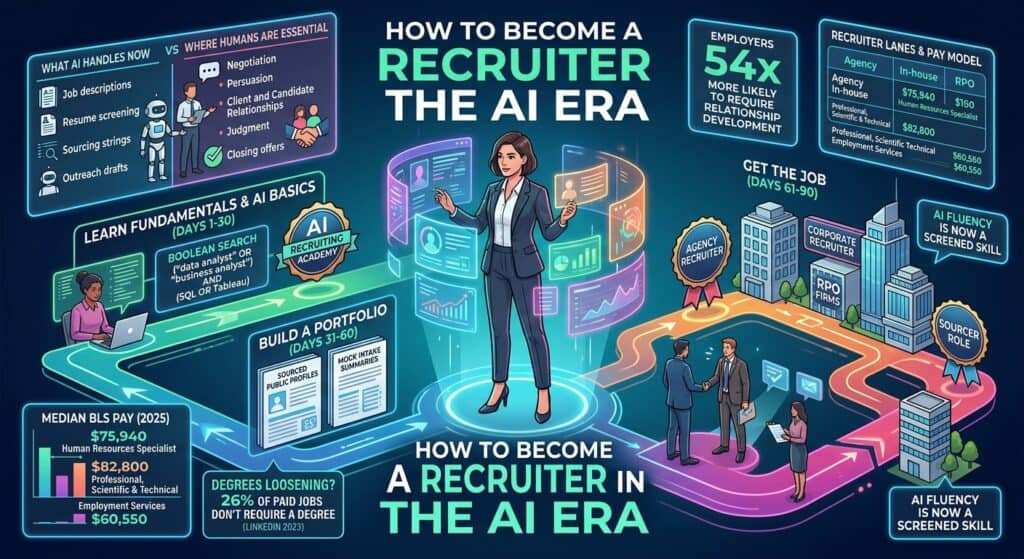
What changed in 2026: AI now drafts job ads, screens resumes, and writes first outreach. Employers want recruiters who use those tools well and spend the saved time on relationships, judgment, and closing. LinkedIn found employers were 54x more likely to require relationship development in recruiter job posts.
Who this is for: Career changers, new grads, salespeople, HR assistants, and anyone searching for a job as a recruiter with no experience, without a degree, or from home.
What does a recruiter actually do in 2026?
A recruiter finds, persuades, and hires people for open roles. The work splits into five parts: the intake call with the hiring manager, sourcing candidates, outreach and screening, managing interviews, and closing the offer. That core has not changed in 20 years. What changed is how much of the middle is now handled by software.
The Bureau of Labor Statistics groups recruiters under Human Resources Specialists, who recruit, screen, and interview applicants and place new hires. In practice, the best recruiters behave more like salespeople with a research habit than like HR administrators. You sell a job to a candidate who was not looking, and you sell a candidate to a manager who is skeptical.
Is a recruiter a sales job or an HR job?
It depends on the lane. Agency recruiting is a sales job with revenue targets. In house recruiting sits inside HR or talent acquisition and is measured on hires, speed, and hiring manager satisfaction. Both require persuasion. If you hate phone calls and rejection, recruiting will be hard in any lane.
Which type of recruiter should you become?
Your first decision is where you work, because it sets your pay model, your daily rhythm, and how easy it is to get hired. Agencies hire beginners most often. Corporate teams usually want some experience. RPO firms and sourcing roles sit in between and are a common back door for people with no recruiting history.
| Recruiter type | Who pays you | Pay model | Best entry route |
|---|---|---|---|
| Agency (contingency) | A staffing or search firm, funded by client placement fees | Base salary plus commission on placements, or a draw against commission | Associate recruiter or resourcer role; hires for drive, not credentials |
| Retained executive search | A search firm paid up front by the client | Salary plus bonus tied to completed searches | Research associate supporting senior partners |
| In house (corporate) | The employer directly | Salary plus annual bonus and benefits | Recruiting coordinator, or move over after a year or two of agency work |
| RPO (recruitment process outsourcing) | An outsourcing firm embedded in a client company | Salary, sometimes with hiring metric bonuses | Junior recruiter or sourcer on a high volume client account |
| Sourcer | Agency, RPO, or corporate team | Salary, often lower than full cycle recruiters | A portfolio of sourced candidate lists and Boolean strings |
| Contract recruiter | A company or agency, by the hour | Hourly rate, no long term guarantee | Not an entry route; needs a track record first |
My advice after two decades in technical recruiting: if you have no experience, start at an agency or an RPO. You will make more calls in six months than many corporate recruiters make in two years, and that repetition is what makes you employable everywhere else.
Do you need a degree or certification to become a recruiter?
You do not need either to get hired at most agencies. The BLS says HR specialists typically need a bachelor’s degree in HR, business, or communications, but that describes the broad occupation, which includes benefits and compensation roles. Recruiting desks, especially at staffing firms, are far more flexible.
Employers are also loosening degree rules in general. LinkedIn reports that 26% of paid job posts on its platform did not require a degree in 2023, up from 22% in 2020. If you want to understand why that matters for your own career, read our guide to skills based hiring.
How to become a recruiter without a degree?
Lead with evidence of work, not credentials. A one page portfolio of sourced profiles, a sample outreach sequence, and a short write up of how you would run an intake call will beat a certificate for most agency owners. Prior sales, retail management, hospitality, or customer service experience also translates well because it proves you can handle people and quotas.
Are recruiting certifications worth it?
The BLS notes that certification is usually voluntary, though some employers prefer it, mainly for HR generalists. For a new recruiter, spend your time on free skill building first. A paid certificate makes more sense once you are in a corporate HR track and want to move up.
How much do recruiters make?
The median annual wage for human resources specialists was $75,940 in May 2025. The lowest 10% earned less than $47,180 and the highest 10% earned more than $128,720. Those are the most recent BLS figures, and they cover base wages, so agency commission upside is not fully captured.
Industry matters. In May 2025, BLS medians were $84,100 in government, $82,800 in professional, scientific, and technical services, $79,270 in manufacturing, $64,130 in healthcare and social assistance, and $60,550 in employment services, where most staffing agencies sit. Commission can push a strong agency biller well above that base.
What is the job outlook for recruiters?
BLS projects employment of HR specialists to grow 6% from 2025 to 2035, faster than the 3% average for all occupations, with about 73,700 openings a year. The occupation had 939,700 jobs in 2025. BLS also expects firms that sell HR services to grow faster than in house HR, which points toward agencies and RPOs as the bigger hiring pool.
Is it a good time to look for recruiter jobs?
It is a steady market, not a hot one. Indeed’s index of US human resources job postings stood at 96.23 on September 18, 2026, measured against a February 2020 baseline of 100. That means HR and recruiting postings are running slightly below pre pandemic levels. Expect competition for remote roles and a better hit rate on in office agency desks.
Which recruiting tasks does AI do now, and which still need a human?
AI is already standard on recruiting teams. SHRM’s 2025 research found 51% of organizations use AI to support recruiting, most often for writing job descriptions (66%), screening resumes (44%), automating candidate searches (32%), customizing job postings (31%), and communicating with applicants (29%). LinkedIn found that talent teams using generative AI saved 20% of their workweek.
| Task | Who does it in 2026 | What you still need to know |
|---|---|---|
| Writing job descriptions | Mostly AI, edited by the recruiter | What the manager really needs versus the wish list |
| First pass resume screening | AI with human review | How to spot false negatives and keep screening fair |
| Building search strings and lists | AI assisted, human refined | Boolean logic, so you can check and fix what the tool produced |
| First outreach drafts | AI drafts, human personalizes | Why this person would move, in one honest sentence |
| Interview scheduling and reminders | Automated | Almost nothing; let the tool do it |
| Call notes and summaries | AI note takers | What to ask so the notes are worth reading |
| Intake meeting with the hiring manager | Human | How to push back on unrealistic requirements |
| Reading motivation and red flags | Human | Judgment built from many real conversations |
| Offer negotiation and closing | Human | Counteroffers, timing, and candidate fears |
| Client and candidate relationships | Human | Trust that brings repeat business and referrals |
The pattern is clear. AI owns the volume work. Humans own the moments where someone has to decide, persuade, or be trusted. If you want to see how working recruiters use these tools day to day, browse our list of AI recruiting tools and the common automation mistakes to avoid.
What skills get you hired as a recruiter now?
Hiring managers for recruiting roles are screening for five things. First, sales instinct: can you pitch a role in 30 seconds and handle a no. Second, intake discipline: can you turn a vague request into a clear profile. Third, research skill: can you find people who are not applying. Fourth, judgment: can you tell a strong candidate from a polished one. Fifth, closing: can you get an offer accepted without surprises.
AI fluency is now on that list too. SHRM found two thirds of respondents disagree that their organization has been proactive in training staff to work alongside AI. That gap is your opening. A beginner who can show prompts, workflows, and results already looks more prepared than many current employees.
How do you become a recruiter with no experience? A 30/60/90 day plan
This plan assumes about ten hours a week and no budget. Every step produces something you can show an employer.
Days 1 to 30: learn the fundamentals
- Learn Boolean basics with our Boolean search guide, then practice in the free Boolean string builder.
- Write ten strings for real roles you find on job boards, such as
("data analyst" OR "business analyst") AND (SQL OR Tableau) AND (Chicago OR remote). - Work through the free lessons in the AI Recruiting Academy to learn how recruiters use AI for sourcing, outreach, and screening.
Days 31 to 60: build a portfolio
- Pick three open roles at real companies. For each, write a mock intake summary, a Boolean string, and a list of 15 matching public profiles (names and links only, no personal contact data).
- Use the recruiting prompt library to draft outreach, then rewrite each message in your own voice. Show both versions so employers see your editing judgment.
- Practice LinkedIn search with our LinkedIn Boolean guide.
Days 61 to 90: get the job
- Apply to associate recruiter, sourcer, recruiting coordinator, and RPO junior roles. Do not only target senior corporate titles.
- Message agency owners and recruiting managers directly, with your portfolio link in the first message. That outreach is itself a work sample.
- In interviews, walk through one portfolio role end to end, from intake to closing plan.
- Ask every agency how commission, draws, and ramp periods work before you accept.
Can you become a recruiter from home?
Yes, but remote recruiter jobs are harder to land as a beginner. Most new recruiters learn fastest by sitting near experienced billers and hearing how they handle calls. Remote roles also attract many experienced applicants, which makes the competition steeper when overall HR postings are running slightly below their pre pandemic baseline.
The realistic path is to start in office or hybrid for your first year, build a placement record, then move to a remote desk. Sourcing and RPO roles are the most remote friendly entry points because the output, candidate lists and screened pipelines, is easy to measure from anywhere. A remote recruiter also needs a clean tech setup; see our agency tech stack guide for what most desks run.
What do Reddit users ask about becoming a recruiter?
The same questions show up again and again on r/recruiting and r/recruitinghell. Here are honest answers from someone who has run a desk.
Is agency recruiting commission only?
Some agency roles are commission only, but most entry level jobs pay a base salary plus commission, or a draw against future commission. Commission only offers shift all the risk to you during the months before your first placement. Ask for the base, the commission split, any draw repayment rules, and the realistic time to first placement in writing.
Is recruiting burnout real?
Yes. Agency recruiting brings daily rejection, monthly targets, and deals that collapse at the offer stage. SHRM found 41% of organizations report candidates ghosting during the interview process, so losing candidates you worked hard on is normal, not personal. Recruiters who last build routines, track activity rather than mood, and specialize in one niche.
Is recruiting dying because of AI?
The data says no. BLS still projects faster than average growth for the occupation, and LinkedIn reports 73% of TA pros expect AI to change how companies hire, not to remove recruiters. What is dying is the recruiter whose only skill is posting jobs and forwarding resumes. The recruiter who runs strong intakes and closes offers is getting more leverage from AI, not less.
Quick answers
How long does it take to become a recruiter?
With focused effort, many people land an entry level agency or sourcer role within three months. The 30/60/90 day plan above is built around that timeline. Becoming genuinely good takes a year or more of live desk work.
How do I become a recruiter for jobs in a specific industry?
Pick an industry you already understand, such as tech, healthcare, or trades, and apply to agencies that specialize there. Your industry knowledge helps you talk credibly with candidates and managers from day one.
What is the median salary for a recruiter?
BLS reports a median of $75,940 for HR specialists in May 2025. Agency recruiters often earn a lower base, with a median of $60,550 in employment services, plus commission on top.
Do recruiters need to know AI tools?
Yes. SHRM found 51% of organizations already use AI in recruiting, mostly for job descriptions and resume screening. You do not need to be technical, but you should be able to prompt, check, and edit AI output.
What is the easiest recruiter job to get first?
Agency associate recruiter, sourcer, and recruiting coordinator roles are the most open to beginners. Agencies in particular care more about drive and communication than a resume full of HR experience.
Can I learn recruiting for free?
Yes. Free Boolean guides, a string builder, and the AI Recruiting Academy lessons on Work Insiders cover the core skills. Pair them with a portfolio of real sourcing work and you have everything most hiring managers ask to see.
The bottom line
Becoming a recruiter in 2026 is less about credentials and more about proof. Choose agency, RPO, or sourcing as your entry lane, learn Boolean search, build a three role portfolio, and show that you can use AI tools without letting them do your thinking. The pay is solid, the BLS outlook is positive, and the human parts of the job, intake, judgment, and closing, are worth more now that software handles the rest. Start with the free lessons in the AI Recruiting Academy.
Sources: BLS Occupational Outlook Handbook, LinkedIn Future of Recruiting, LinkedIn Talent Blog, SHRM AI in HR, SHRM Talent Trends, Indeed via FRED
Free newsletter
Get the Work Insiders weekly
One email a week: the recruiting and HR tech news that mattered, the tools we just added to the directory, and one practical guide. No spam, and you can unsubscribe in one click.