

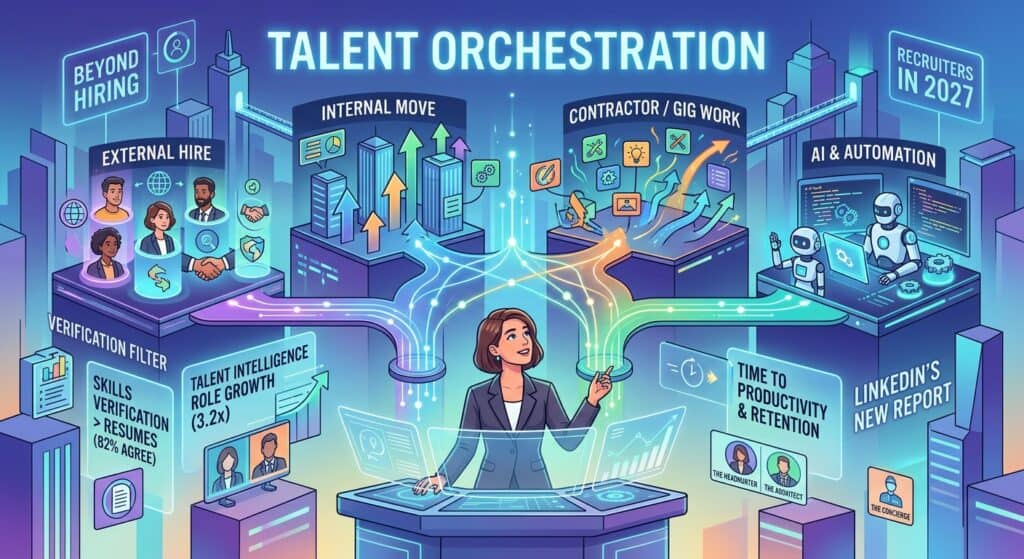
Quick answer: LinkedIn’s new Future of Talent report, Beyond Hiring: The Rise of Talent Orchestration, argues that recruiting is turning into a bigger job. Instead of only filling requisitions, talent teams will decide whether work should be done by a new hire, an internal move, a contractor or AI. Postings for Talent Intelligence roles grew 3.2x in a year, 82% of talent leaders expect skills verification to replace the resume as the most trusted signal, and the metrics that matter are moving from time to fill toward time to productivity and retention.
Who this is for: Recruiters, agency owners and talent leaders who want the useful parts of a 28 page report in ten minutes, checked against outside data.
What is talent orchestration?
Talent orchestration is LinkedIn’s name for a wider recruiting remit. In the report’s words, if acquisition is about filling jobs, orchestration is about resourcing work. That means coordinating people, processes, data and AI so the business makes better workforce decisions, not just more hires.
In practice it changes the first question a recruiter asks. The old intake started with “I need to hire a data engineer.” The new one starts with “what outcome does the business need, and what mix of people, skills and technology gets us there?” The answer might be an external hire, but it could just as easily be retraining someone internally, borrowing a contractor or automating part of the work. LinkedIn launched the idea at its Talent Connect event in New York, as HR Brew reported.
What does the report actually measure?
The findings come from three sources: a survey of 771 HR and talent acquisition leaders fielded in June 2026, LinkedIn platform data on job postings, skills and recruiter conversations, and interviews with talent leaders at companies including Mastercard, HubSpot, PepsiCo, Cisco, Nestlé and HSBC.
| Detail | What the report says |
|---|---|
| Survey size | 771 HR and talent acquisition leaders |
| Fielded | June 2026 |
| Countries | US (200), UK (131), Germany (129), India (126), France (125), Australia (60) |
| Company size | Over 1,000 employees only: 51% had 1,001 to 5,000, 34% had 5,001 to 10,000, 15% had more than 10,000 |
| “AI frontier” group | Leaders at the highest AI maturity stage who report significant AI impact on five or more metrics and high agency in their role |
| Platform data window | Job postings and skills, January to July 2025 vs January to July 2026 |
Most of the headline comparisons pit that AI frontier group against everyone else, which LinkedIn calls the “peer set.” Keep that in mind: the frontier group is defined partly by reporting big AI results, so it is a picture of what the most optimistic adopters believe, not a random sample of all employers.
Why is LinkedIn saying this now?
Because hiring volume is low and the pressure on talent teams is high. The report says global hiring is still 30% below pre pandemic levels, job transitions are at a 10 year low and skills in a typical job are changing about 35% a year. It also found 75% of talent leaders say their role is harder than ever.
The US government data tells the same story. The latest BLS JOLTS release put the August 2026 hires rate at 3.3% and the quits rate at 1.9%, both essentially flat. Fewer people are moving and fewer are being hired, so every hire gets more scrutiny and backfilling is no longer automatic. When you cannot simply hire your way out of a skills gap, the job shifts toward deciding where the skills should come from.
Oddly, the mood is upbeat. 85% of talent leaders believe talent acquisition is entering its most influential era, 80% say the role is becoming more intellectually stimulating and 77% say it is becoming more enjoyable.
What are the key numbers at a glance?
| Finding | Number |
|---|---|
| Growth in share of Talent Intelligence job postings, year over year | 3.2x |
| Growth in share of Strategic Talent Advisor postings (largest senior talent category) | 2.1x |
| Management skills appearing in recruiter job postings vs a year ago | 10x more likely |
| Business skills appearing in recruiter job postings | Nearly 5x more likely |
| Leaders who say identity verification will be a critical hiring step | 82% |
| Leaders who say skills verification will replace resumes as the top signal | 82% |
| Recruiters who find it harder to tell real applications from fake ones | 1 in 3 |
| AI frontier leaders who expect lifecycle metrics to replace point in time metrics | 98% |
How will the recruiter job change?
The report’s bluntest line is that not all recruiters will recruit. LinkedIn splits the future team into four personas, each with a different day job.
| Persona | What they do | Evidence in the report |
|---|---|---|
| The Headhunter | Builds long term relationships with high value talent through dinners, roundtables, niche communities and branded events | AI frontier leaders are 2.5x more likely to expect big increases in high touch engagement spending |
| The Advisor | Turns talent intelligence into workforce plans and guides build, buy, borrow and redeploy decisions | Strategic Talent Advisor postings up 2.1x, Talent Intelligence up 3.2x |
| The Architect | Designs and runs the AI agents, workflows and candidate journeys behind hiring | 49% of frontier leaders expect recruiters to build, train and manage AI recruiting agents |
| The Concierge | Guides internal mobility, retention and redeployment for existing employees | 36% of frontier leaders expect recruiters to support mobility and redeployment |
Is this a real shift or just new job titles?
Some of both. The job posting data is real movement: employers are writing “talent intelligence” and “strategic advisor” into roles at a much faster rate, and LinkedIn says recruiters changing roles internally between 2020 and 2025 increasingly moved into Talent Acquisition Partner and Business Partner titles. But a share of that is relabeling. A good test is whether the new title comes with access to workforce planning meetings and business data. If it does not, it is the old job with a new name.
What will recruiters be responsible for in three years?
Here are the top five responsibilities AI frontier leaders expect recruiters to own by 2029.
Top expected recruiter responsibilities (AI frontier leaders)
Responsible AI use in hiring: 60%
Designing and optimizing AI enabled recruiting funnels: 54%
Building, training and managing AI recruiting agents: 49%
Workforce planning and build, buy, borrow decisions: 48%
Using data to improve recruiter and team effectiveness: 46%
Source: LinkedIn, Beyond Hiring: The Rise of Talent Orchestration (2026)
Three of the five are about running AI rather than doing recruiting tasks by hand. That lines up with outside research: in Korn Ferry’s 2026 survey of 1,674 talent leaders, 52% planned to add autonomous AI agents to their teams. If you are not sure what an agent looks like in a recruiting workflow, our AI agents directory lists the live options.
Which recruiter skills matter most now?
| Rank | Skill | Share of AI frontier leaders naming it |
|---|---|---|
| 1 | AI literacy | 41% |
| 2 | Critical thinking, including checking AI output | 33% |
| 3 | Skills based hiring expertise | 30% |
| 4 | Adaptability | 25% |
| 5 | Data analysis | 22% |
Note the second item. Knowing how to use AI is not enough; recruiters are expected to catch it when the AI is wrong. Our free AI Recruiting Academy covers both halves for recruiters starting from zero.
Why is trust now the biggest hiring problem?
Because AI made it cheap to fake a candidate. LinkedIn says trust is now the number one hiring integrity topic recruiters discuss on its platform, and US recruiter conversations about it doubled in a year. Applications per applicant are up 30% since February 2020, and in the US 1 in 10 tech jobs goes viral with applicants.
Outside research backs this up. Gartner predicts that by 2028 one in four candidate profiles worldwide could be fake, and 6% of 3,000 candidates it surveyed admitted to interview fraud, either posing as someone else or having someone pose as them, according to HR Dive. The trust problem runs both ways: only 26% of candidates trust AI to judge them fairly, and offer acceptance fell to 51% from 74% two years earlier, per Personnel Today.
What will replace the resume as the main signal?
A stack of verified signals rather than one document. Here is how talent leaders rated each.
| Trust signal | All talent leaders agree | AI frontier leaders vs peers |
|---|---|---|
| Identity verification becomes a critical hiring step | 82% | 1.6x more likely to strongly agree |
| Skills verification replaces the resume as the top signal | 82% | 1.8x |
| Referral programs and networks used to cut through noise | 80% | 1.6x |
| Social signals (mutual connections, endorsements) count more | 78% | 1.6x |
More than 8 in 10 leaders also expect assessments to move to the top of the funnel and AI conducted interviews to become a standard first screen. The report’s own advice is to verify at the start of the process, not the end. HubSpot’s VP of talent and people experience put it simply: when AI can generate a resume in seconds, referrals matter more because you have real data on how that person performs.
Which recruiting metrics will matter in 2027?
Metrics that follow the hire after day one. Quality of hire stays the north star, but the report expects it to be measured by outcomes instead of a manager’s opinion at 90 days.
| Today’s metric | Tomorrow’s metric | Question it answers |
|---|---|---|
| Quality of hire by opinion (manager satisfaction, 90 day check in) | Quality of hire by outcome (business impact over time) | Was this the right person? |
| Time to fill, cost per hire | Time to productivity, results delivered | How fast did they create value? |
| Offer acceptance rate, interview to hire conversion | Internal fill rate, critical talent retention | Did they stay and grow? |
LinkedIn’s own VP of talent acquisition described time to fill as a baseline you watch only because it matters when it breaks, while his team builds dashboards linking interview scores to performance 12 to 18 months in. If you need to put a dollar figure on better hiring before you get there, try our recruiting ROI calculator.
How do AI frontier teams differ from everyone else?
Mostly in how connected they are. Frontier teams are far more likely to share data and plans with the rest of HR.
AI frontier leaders vs their peers
AI frontier Peer set
TA integrated with workforce planning and people analytics: 75% vs 40%
TA integrated with talent management: 73% vs 41%
Strongly agree winners will decide based on visible skills: 70% vs 38%
TA integrated with learning and development: 69% vs 41%
Strongly agree teams will anticipate future skills: 60% vs 35%
Source: LinkedIn, Beyond Hiring: The Rise of Talent Orchestration (2026)
The pattern is clear. The teams getting the most out of AI are the ones whose hiring data already connects to performance, learning and planning data. AI on top of a siloed process mostly speeds up the silo. HSBC is the report’s clearest example: it merged talent acquisition and talent management into one enterprise talent function and already fills 45% of roles through internal mobility.
How should a talent team be structured?
Centrally, for most companies. When asked how talent acquisition will be organized, leaders answered:
Expected talent acquisition structure
Centralized with some recruiters embedded in the business: 40%
Centralized within HR: 31%
Mostly embedded in business units, some central: 21%
Fully decentralized into business units: 7%
Source: LinkedIn, Beyond Hiring: The Rise of Talent Orchestration (2026)
About 4 in 10 leaders also expect recruiters to become deeply specialized by function or skill area. A central structure is what keeps that specialist knowledge shared instead of locked inside one team.
What should recruiters and agencies do next?
- Change your intake questions. Ask what outcome the role must deliver and whether the work could be covered internally, by a contractor or by a tool before you open a search. You become the person who prevents bad requisitions, not just the one who fills them.
- Bring market data to every kickoff. Talent supply, salary ranges and competitor hiring are what make you an advisor. Our tools directory lists the talent intelligence and sourcing platforms that supply it.
- Put verification at the front. Add identity checks and a short skills exercise before the first long interview, especially for remote roles.
- Track one metric past the hire. Even a simple 6 or 12 month retention check on your placements gives you a quality story your competitors cannot tell.
- Agencies: sell the relationship layer. If corporate teams move toward planning and AI operations, the headhunter persona of curated, high touch search is the work they will most want to buy in.
Should you take the report at face value?
Take the direction seriously and the precise numbers with care. Three things to keep in mind:
- LinkedIn sells the solution. The report points to its own Hiring Assistant 2 and Learning Career Hub several times. The trends are real, but the framing favors tools that verify skills and connect hiring to learning, which is exactly what LinkedIn offers.
- The frontier group selects for optimism. Leaders qualified partly by reporting strong AI results, so their beliefs naturally run ahead of the average employer’s.
- Only large companies were surveyed. Every respondent works at a company with more than 1,000 employees. Small businesses and most staffing agencies are not represented.
Even so, the core argument holds up against independent data: low hiring volume from BLS, rising candidate fraud from Gartner and agent adoption plans from Korn Ferry all point the same way.
Quick answers
What is talent orchestration in simple terms?
It means deciding how work gets done (hire, develop, move someone internally, contract or automate) instead of only filling open jobs.
Will AI replace recruiters?
The report says no, but it says the job splits. Some recruiters will focus on relationships, others on planning, AI operations or internal mobility.
What is a talent intelligence role?
A role that analyzes skills and labor market data to guide hiring and workforce plans. Its share of job postings grew 3.2x year over year.
Are resumes going away?
Not yet, but 82% of talent leaders expect verified skills to replace them as the most trusted signal.
How many fake candidates are there?
Gartner predicts one in four candidate profiles worldwide could be fake by 2028.
What metric replaces time to fill?
Time to productivity, alongside retention and internal fill rate. Time to fill becomes a baseline you watch, not a goal.
The bottom line
Recruiting is being pulled upstream. With hiring flat and AI flooding the funnel with noise, the most valuable talent professionals will be the ones who can verify who is real, advise on whether a hire is even the right answer and prove their hires delivered. For the monthly market picture, read the Staffing Market Brief, follow our daily recruiting tech news, and look up any unfamiliar terms in the recruiting glossary.
Sources: LinkedIn, Beyond Hiring: The Rise of Talent Orchestration (Future of Talent Report, 2026), HR Brew, BLS JOLTS, HR Dive, Personnel Today, Korn Ferry
Free newsletter
Get the Work Insiders weekly
One email a week: the recruiting and HR tech news that mattered, the tools we just added to the directory, and one practical guide. No spam, and you can unsubscribe in one click.