

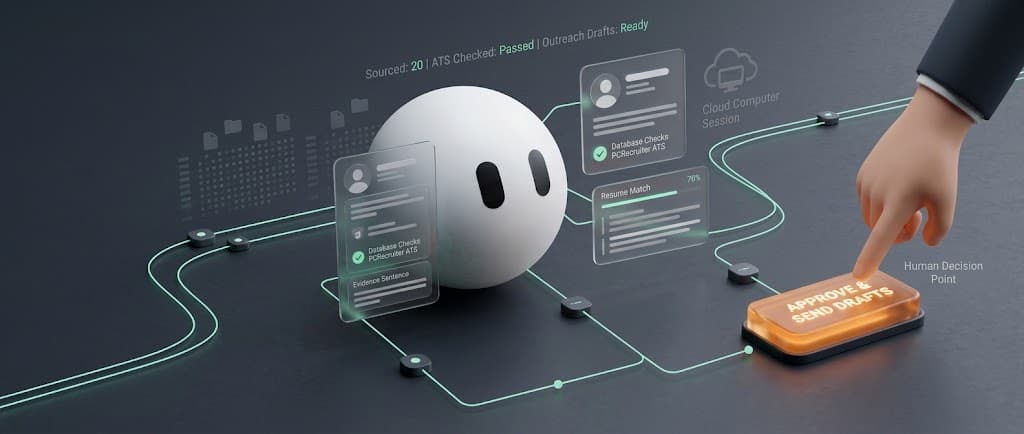
Grok Bot for recruiting works when you treat it as a junior sourcer that finds evidence and drafts work, while you stay the person who sends, rejects, and decides.
A hiring chatbot answers a question and leaves you inside five other tabs. A recruiting bot is supposed to finish a desk job: build a shortlist, write the note, file the record, and stop before anything leaves the building.
Grok, the chat model on X, is not Grok Bot. SpaceXAI launched Grok Bot in August 2026 as named teammates that sit on a cloud computer, sign into your tools, and come back when a human call is required. See the SpaceXAI Grok Bot launch announcement.
SHRM finds recruiting is the most common HR use of AI, and the strongest hiring teams fill staff roles about five days faster than the rest. LinkedIn finds companies that use AI-assisted messaging most are nine percent more likely to make a quality hire.
Those gains show up when a human still owns send, reject, and the offer. Read the SHRM AI in HR report and the LinkedIn Future of Recruiting AI report.
This is the beginner version of the desk we already run. The rule we do not bend: nothing reaches a candidate until you approve the exact wording.
What is Grok Bot for recruiting?
Grok Bot is a named AI teammate with memory and a persistent cloud computer that has a browser, files, and a terminal.
You message it the way you would message a sourcer on your team. You give it a role, a source list, a stop rule, and a deliverable. It works across apps and websites, including tools with no clean API, and it keeps going after you close the laptop.
Official product docs treat Talent Scout as a first-class job. The starter prompt they publish is the beginner playbook: find 20 people who meet the must-have criteria, exclude anyone already in the ATS, explain the evidence, draft outreach in your voice, do not contact anyone. Read that prompt in the Grok Bot docs and on the official use cases page.
Work Insiders publishes recruiting templates on the AI agents for recruiting page. They cover sourcing, screening, outreach, interviewing, and people ops.
Do not confuse Grok Bot with Grok Recruiter. Grok Recruiter is the candidate-side video interview some applicants meet when they apply to SpaceXAI. Grok Bot is the operator-side teammate you staff on your own desk.
How we run Grok Bot at Work Insiders
We do not write about this from the docs alone. Work Insiders runs a Grok Bot team every day. One bot searches new and old job openings for hiring leads. One finds candidates on the public web and builds shortlists.
One writes competitor reports. One queries our ATS, PCRecruiter, over its MCP connection so no shortlist repeats a name we already hold. The outreach itself runs through Instantly, on data the bots gathered, and every sequence is approved by a person before it starts.
That is the desk this guide is built from, and every rule below is one we learned by breaking it first. You can see the full stack on our best recruiting tools page, and our count of which recruiting tools have an MCP server shows which ATS and CRM platforms a bot can query directly.
How is Grok Bot different from a hiring chatbot?
A hiring chatbot lives in a chat window. You paste a job description. It returns bullets. You still have to open LinkedIn, the ATS, the sequencer, and the calendar yourself.
Grok Bot is built to finish that middle stretch inside the real tools. It can sign into a sourcing site, pull public profiles, write a scored list, and leave the send button untouched.
Grok the chatbot and Grok Bot share a model family. They do not share a job. Grok answers. The bot acts. We unpacked that split in What is Grok Bot vs a chatbot.
ChatGPT, Claude, and Gemini can write a strong job description and a decent scorecard. They are excellent first drafts. They are not a desk. They do not keep a login session overnight, and they do not pass a file from a sourcer bot to a coordinator bot in a group chat.
| Hiring chatbot | ChatGPT / Claude / Gemini | Grok Bot | |
|---|---|---|---|
| Where it works | One chat window | One chat window | Its own cloud computer with a browser |
| Can sign into your ATS or sourcing tool | No | No | Yes, with your login |
| Keeps working after you close the laptop | No | No | Yes |
| Hands files between bots | No | No | Yes, in a group chat |
| Writes a job description | Yes | Yes, strong | Yes |
| Builds a checked shortlist | No | Draft only | Yes, with evidence per name |
| Sends the message | Sometimes, automatically | No | Never, unless you say so |
Grok Bot can do that pass. Several bots share one cloud computer on your account. Files, browser sessions, and logins are shared on purpose so handoffs work. That is also the security warning. A sourcing bot that can open Gmail can read Gmail. Grant the least access you can live with.
Reddit threads in r/recruiting keep circling the same complaint. One giant prompt produces a pretty list that no one can use. The fix is a roster. One bot researches. One bot screens. One bot drafts. You approve.
What recruiting work can a beginner hand over first?
Start with read-and-prepare work. Do not start with send.
The jobs that pay off in week one are the jobs a junior recruiter already owns. Turn a messy intake into a tight brief. Find people who match must-haves. Write evidence next to each name. Leave outreach in draft.
Can Grok Bot source candidates for you?
Yes, if you give it a narrow role and a place to look.
Paste the job description. Name the must-haves, the nice-to-haves, the locations you will hire in, and the companies that are out of bounds. Tell it to return a list with a public profile URL, the evidence sentence, and a gap note. Tell it to skip anyone already in your ATS.
That last instruction is not polish. Gem’s 2026 recruiting benchmarks found 46 percent of sourced hires now come from people already in the ATS or CRM, up from 26 percent in 2021. A bot that cannot check the database is just adding duplicates to the pile. See the Gem 2026 hiring report.
Work Insiders templates such as Hiring Signal Desk and Req-to-Outreach are built for this shape of work. Req-to-Outreach takes a job description and returns a ranked shortlist plus one email per person. It still waits for your yes.
Do not ask the bot to scrape LinkedIn. The user agreement forbids robots and scripts that copy profiles. Use approved search and public pages you are allowed to open. If a workflow would get a human sourcer banned, it will get a bot banned faster.
Can Grok Bot screen resumes without making the hire?
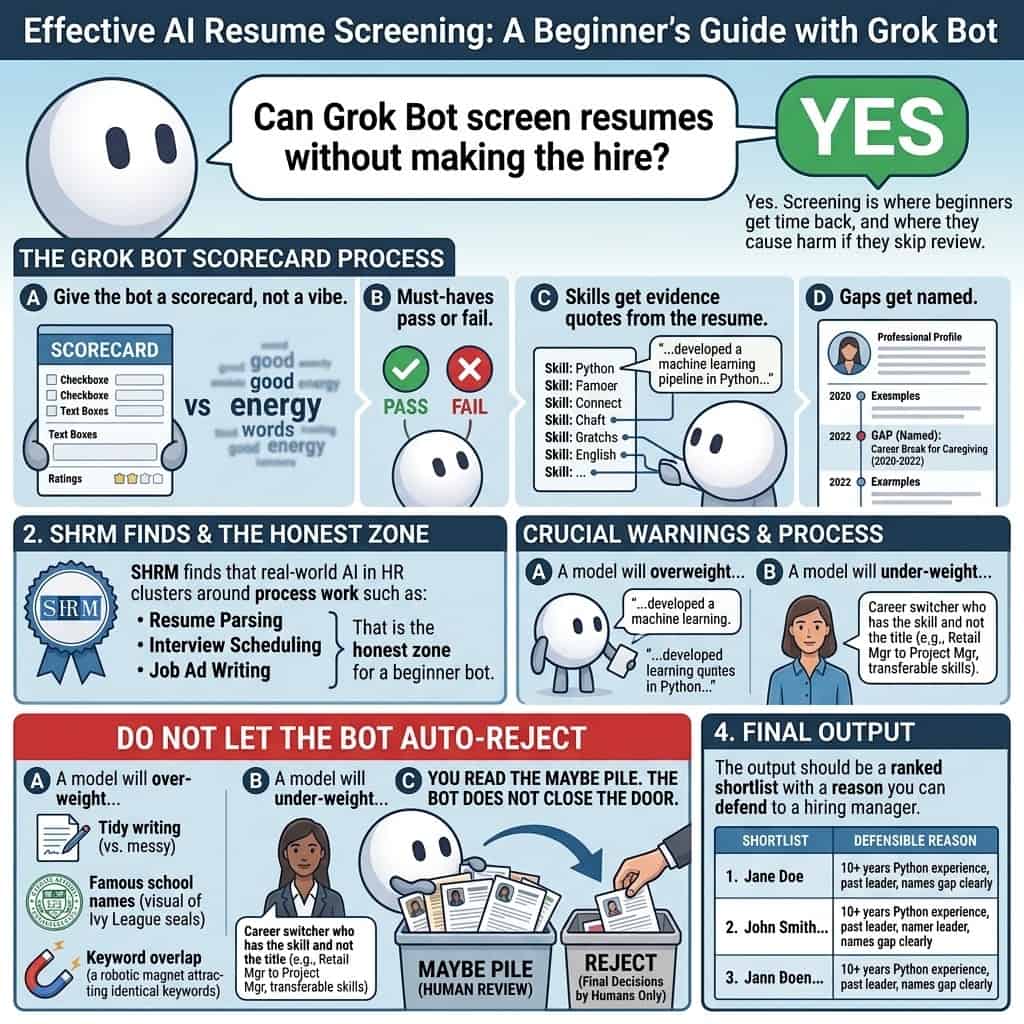
Yes. Screening is where beginners get time back, and where they cause harm if they skip review.
Give the bot a scorecard, not a vibe. Must-haves pass or fail. Skills get evidence quotes from the resume. Gaps get named. The output should be a ranked shortlist with a reason you can defend to a hiring manager.
SHRM finds that real-world AI in HR clusters around process work such as resume parsing, interview scheduling, and job ad writing. That is the honest zone for a beginner bot.
Do not let the bot auto-reject. A model will over-weight tidy writing, famous school names, and keyword overlap. It will under-weight a career switcher who has the skill and not the title. You read the maybe pile. The bot does not close the door.
Can Grok Bot write outreach that candidates will answer?
It can draft outreach that sounds like you, if you feed it your voice and one true hook.
The official Talent Scout prompt already says the quiet part: draft personalized outreach in my voice, do not contact anyone.
LinkedIn’s Future of Recruiting research says teams that lean on AI-assisted messaging are nine percent more likely to make a quality hire. That lift comes from a note tied to a real signal, not from blasting 200 identical openers.
A good first line names a project, a talk, a repo, or a team change. A bad first line says you were impressed by their journey. If you would delete that sentence in someone else’s InMail, delete it in the bot draft.
Keep send in your hands. Approve the exact wording, then send from the outreach tool you already trust. We cover the outbound version of this desk in Grok Bot for cold outreach.
Can Grok Bot run interview logistics?
Yes, as a coordinator, not as the interviewer of record.
Scheduling, prep packets, stalled follow-ups, and a morning brief are fair game. A Recruiting Coordinator bot can watch the calendar, flag a loop with no interviewer, and draft the candidate update.
It should not invent availability. It should not send the update until you say send. It should not decide who advances.
People ops templates on the AI agents for recruiting page cover coordinator work and offer drafts. Offers stay in draft. E-sign stays with you.
How do you set up your first recruiting bot?
Do not staff six bots on night one. Start with one named Talent Scout and one stop rule.
Install from the Grok Bot download page. Sign in with an eligible Cursor or SuperGrok plan. Desktop works on macOS and Windows. iOS works. Confirm the live plan list in our Grok Bot starter guide.
Create the bot with a short name, one job, and a review point. Talent Scout. Source and draft. Never contact a candidate.
Use the five-part first task.
- Outcome: twenty people who meet the must-haves for this role.
- Sources: the job description, your ATS, approved sourcing tools, and public web pages.
- Constraints: skip anyone already in the ATS. Do not invent jobs. Do not send mail. Do not touch LinkedIn automation that would violate the terms.
- Deliverable: a table with name, current role, evidence, gap, public URL, and a draft note in your voice.
- Review point: stop and wait. You pick who gets a message.
Your first prompt, ready to paste
You are Talent Scout. Your job is to source and draft. You never contact anyone.
Role: [paste job description]
Must-haves: [list]
Nice-to-haves: [list]
Locations we hire in: [list]
Companies out of bounds: [list]Find 20 people who meet every must-have. Check each name against our ATS first and skip anyone already in it. Use only approved search tools and public pages. Do not use any LinkedIn automation.
Return a table: name, current role, one evidence sentence with its source, one gap, public profile URL, and a three-sentence outreach draft in my voice that opens with a specific project or change from their profile.
Then stop and wait. I choose who gets a message.
When the bot hits a login, you take over the computer for the password, passkey, two-factor code, or CAPTCHA. The session can stick so later bots on the same account reuse it. That convenience is the shared computer. Treat it like a shared desk, not like a vault.
After the first shortlist looks usable, save the path as a skill and rerun it on a schedule. Monday morning is enough. Daily runs create more rows than you can verify.
When sourcing is stable, add a second bot for coordination or outreach drafts. Put them in a group chat so the handoff is visible. The pattern is in how operators split work across Grok Bots.
Copy a template only after you read what it is allowed to do. A share copies instructions into your bot. It does not copy the other person’s files or logins.
What should you never let the bot do alone?
Never let it send the first touch, reject a human, sign an offer, or change production data without a yes.
Those four gates protect the candidate, the company, and your accounts.
| Hand to the bot | Keep for yourself |
|---|---|
| Turn a messy intake into a brief | Approve the brief |
| Find candidates who match must-haves | Choose who gets a message |
| Write the evidence next to each name | Read the maybe pile |
| Rank a screen with quotes from the resume | Every reject and every advance |
| Draft outreach in your voice | Send it |
| Watch the calendar and flag stalled loops | Decide who moves forward |
| Draft the offer | Sign it |
Title VII still applies when a tool scores people. If the bot down-ranks a group because the training data liked a certain school or writing style, the company owns that outcome. A human review of every reject and every advance is the job.
Tell candidates when AI is in the process if your state or your counsel requires notice. This is not legal advice. Ask counsel before you turn a scorecard into a silent filter.
Do not feed the bot offer letters with compensation you have not approved. Do not paste passwords into chat. Do not connect your only production ATS login on day one if you can stand up a read-only view first.
Do not confuse speed with quality. SHRM recruiting benchmarks show the median time to fill staff roles is 39 calendar days in 2026, down from 44 days in 2025, and that teams with the most effective practices fill about five days faster. Faster screens help. Unreviewed screens create mess you pay for later. See the SHRM hiring benchmarks.
How much does Grok Bot cost for a hiring team?
There is no standalone Grok Bot checkout for most people. Access is bundled into paid SuperGrok and Cursor plans.
Public docs list Grok Bot on SuperGrok Plus, SuperGrok Heavy, Cursor Pro+, Cursor Ultra, and Cursor Teams plans. Older launch notes also named SuperGrok and Cursor Pro. Check the live plan screen before you budget.
Usage is metered separately from Grok chat. Long computer use and parallel bots drain the weekly bar fast. A tight Talent Scout job lasts. An overnight crawl does not.
If you only need chat drafts, you do not need this product. If you want a desk that can sign into tools and return a file, you do.
What are recruiters asking about AI hiring right now?
Recruiters on Reddit ask the same five questions we hear from operators.
How do I cut 400 inbound applications down to 15 real screens? Build a scorecard first. Let the bot stack-rank with quotes. You still read the maybe pile.
Can candidates tell my InMail was written by AI? Yes, if the first line could fit any human on earth. No, if you name a real project and cut the filler.
Should I stop posting roles and only source outbound? No. Inbound still fills seats. Use the bot to clean inbound and to build a small outbound list, not to abandon the job post.
How do I keep AI from scoring people on style instead of skill? Force evidence. Every point on the scorecard needs a sentence from the resume or the profile. No sentence, no point.
Who is still the decision-maker if a bot builds the shortlist? You are. If a bad email goes out, the company will not blame the cloud computer.
A separate thread keeps asking whether an agent will get a LinkedIn account banned. Yes, if you let it act like a scraper. Stay inside approved search and keep send manual.
Quick answers recruiters keep searching
What is Grok Bot for recruiting?
A named teammate with a cloud computer that sources, screens, and drafts hiring work inside your tools, then stops for your approval.
Is Grok Bot the same as Grok on X?
No. Grok on X is the chatbot. Grok Bot is the teammate product with a computer. The split is covered in What is Grok Bot vs a chatbot.
How do you start Grok Bot for hiring?
Install the app, confirm an eligible plan, create one Talent Scout bot, and run the official find-20-candidates prompt with a do-not-contact rule. Setup detail lives in our Grok Bot starter guide.
Can Grok Bot send candidate email?
It can draft it. You should send it. Official use cases and the Work Insiders templates all stop before send.
Will this replace my recruiter?
No. It takes slices of sourcing, screening, and coordination. Judgment, relationships, and accountability stay human.
How many bots should a beginner run?
One, then two. A Talent Scout plus a coordinator is enough. Add a third only when the handoff is stable.
What plan do I need?
A paid SuperGrok or Cursor plan that includes Grok Bot. Confirm on the official screen.
Where do I get recruiting templates?
Start with the AI agents for recruiting page, and see how Grok Bot fits inside the recruiting stack we run every day.
Does AI in recruiting actually save time?
SHRM finds recruiting is the most common HR use of AI, and organizations with the strongest hiring practices fill staff roles faster than the median. Time saved is real when the bot prepares work and a human still decides.
The beginner move is not to automate hiring. Staff one bot, give it one desk job, and keep the send key.
Last updated September 2026. Plan names, pricing, and platform support are rechecked quarterly alongside our directory census.