

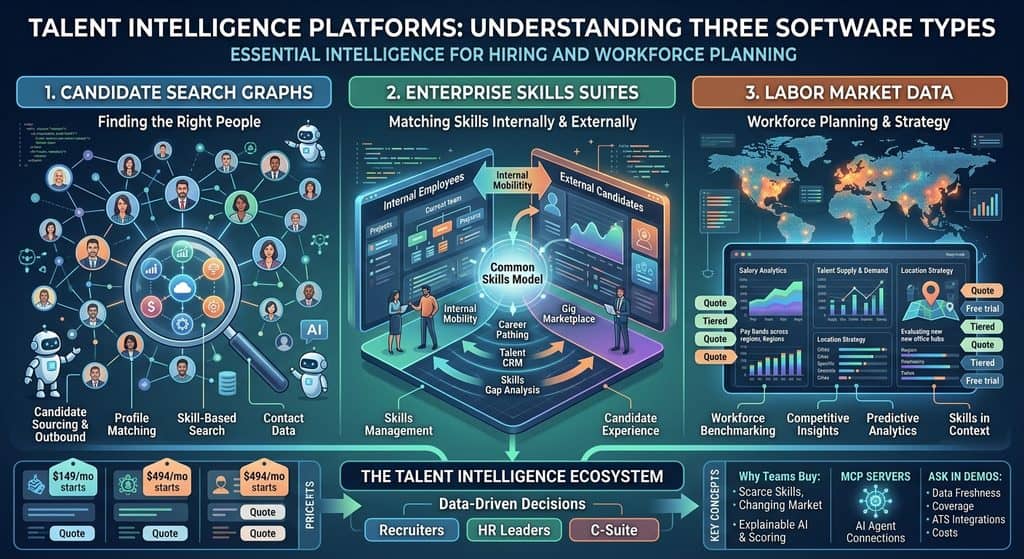
Talent intelligence is three different kinds of software sold under one name. If you need people to contact, look at SeekOut, Findem, hireEZ or HelloSky. If you want one skills model across hiring and internal mobility, look at Eightfold, Beamery, Phenom or Gloat. If you need market data to decide where to hire, what to pay and how hard a role will be to fill, look at Lightcast, LinkedIn Talent Insights, TalentNeuron, Draup, Horsefly, Revelio Labs or Claro Analytics. Only two of the 15 publish a price you can buy at today: SeekOut from $149 a month and hireEZ from $494 a month.
Prices, features and MCP servers checked on each vendor’s own site on 5 November 2026. No vendor paid for or reviewed this article.
What is a talent intelligence platform?
A talent intelligence platform uses large sets of people and job data to answer hiring questions an ATS cannot. Your ATS knows who applied. A talent intelligence platform knows who is out there, what skills they have, who employs them, what they cost and whether the market for that role is getting tighter.
The term is used for three different products, and most buying mistakes come from mixing them up:
- Candidate search graphs. Profiles of individual people you can search, rank and contact. Built for recruiters and sourcers.
- Enterprise skills suites. A skills model that matches people to roles both outside and inside the company, usually with a talent CRM or internal marketplace attached. Built for large HR and TA teams.
- Labor market intelligence. Totals, not names: how many people hold a skill in a city, what they earn, who is hiring them and how demand is moving. Built for workforce planning, location strategy and TA leaders.
A labor market tool will not give you a single candidate to call. A sourcing graph will not tell you whether Austin or Raleigh is the cheaper place to build a data team. Decide which question you are paying to answer before you book demos.
Why are recruiting teams buying talent intelligence in 2026?
Because hiring got harder to predict, and most teams are still guessing. A February 2026 Gartner survey found only 31% of recruiting functions use labor market data to shape their business and talent strategy.
Demand for scarce skills has not eased either. The ManpowerGroup 2026 survey of more than 39,000 employers in 41 countries found 72% still report hiring difficulty, and AI skills are now the hardest to find, ahead of engineering and IT.
Talent intelligence closes that gap in two ways. It tells leaders where the talent actually is before they commit to a location or a salary band, and it helps recruiters find people who match on skills rather than on job titles alone.
How do the 15 platforms compare at a glance?
Prices come from each vendor’s own site. “Quote” means the vendor publishes no price and sells through a demo.
| Platform | Type | Best for | Starting price | First party MCP |
|---|---|---|---|---|
| Candidate search | Corporate sourcing on hard roles | $149/mo annual | Yes | |
| Candidate search | Attribute search and market maps | Quote | Yes | |
| Candidate search | Open web outbound sourcing | $494/mo | No | |
| Candidate search | Executive search mapping | Quote | No | |
| Skills suite | Hiring plus internal mobility | Quote | No | |
| Skills suite | Talent CRM with a skills model | Quote | No | |
| Skills suite | Career site, CRM and mobility | Quote | No | |
| Skills suite | Internal talent marketplace | Quote | No | |
| Lightcast | Labor market | Long run market and skills data | Quote | Yes |
| LinkedIn Talent Insights | Labor market | Talent pool and company reports | Quote | No |
 TalentNeuron | Labor market | Workforce planning in Snowflake | Quote | No |
 Draup | Labor market | Workforce modeling with AI agents | Quote | Yes |
| Horsefly | Labor market | Location planning by country | Quote, tiered | No |
| Revelio Labs | Labor market | Company and competitor workforce data | Free trial, then quote | No |
| Claro Analytics | Labor market | Market reports from an RPO partner | Quote via Wilson | No |
Which talent intelligence platforms are best for finding candidates?
These four give recruiters individual profiles to search, rank and contact.
1. SeekOut
SeekOut searches more than a billion profiles with AI search, scorecards and drafted outreach, plus diversity and internal mobility filters that most sourcing tools lack. It is the cheapest way into this category: Recruit Core is $149 a month paid annually or $179 monthly, with 500 contact credits a month and a 14 day free trial. It runs its own MCP server, so you can query it from Claude or ChatGPT. Watch out: AI screening of inbound applicants is a paid add on.
2. Findem
Findem searches on attributes such as skills, past companies and career moves instead of job titles, and builds market maps next to the search results. It runs a first party MCP server on its own domain and connects to Greenhouse, Workday, Lever, Ashby, iCIMS and SmartRecruiters. Findem is quote based and sized for enterprise teams that have outgrown LinkedIn Recruiter.
3. hireEZ
hireEZ, formerly Hiretual, sources across the open web rather than one network and puts contact data and email sequences in the same product. Solo plans start at $494 a month with a 7 day free trial. That price is a real floor, so it suits outbound teams with budget rather than small desks. It has no MCP server.
4. HelloSky
HelloSky is built for leadership searches. It covers more than 100 million executive profiles, ranks them against your scorecard with evidence through a feature called SmartRank, and maps relationship paths through employment, board, investor and education ties. It plugs into search firm systems such as Loxo, Invenias, Gem, Clockwork and Ezekia. Pricing is quote only, and it is overkill for anything below the leadership level.
Which platforms work for both hiring and internal mobility?
These four sell one skills model across external candidates and current employees. All four are enterprise purchases with no published price. Compare them in our internal mobility category.
5. Eightfold
Eightfold matches people to roles on a skills graph inside and outside the company, and has added AI interviewing and agents on top. Gartner named it a Visionary in its 2026 Magic Quadrant for talent acquisition suites. It usually sits on top of Workday, SAP SuccessFactors, Oracle, Greenhouse or Lever rather than replacing them. Watch out: a class action filed in January 2026 alleges its candidate scoring falls under the Fair Credit Reporting Act, so ask your legal team to review it before you buy.
6. Beamery
Beamery is a talent CRM where the career site and the internal bench share one skills model. It scores how well a person fits a vacancy and shows its reasoning, and it works with Workday and SAP SuccessFactors. It is a platform rather than a sourcing tool, so smaller teams will pay for far more than they use.
7. Phenom
Phenom builds everything around the career site: a CRM, AI agents that screen applicants on the site, and internal mobility in the same platform. It connects to Workday, SuccessFactors, Greenhouse, Lever, iCIMS and Oracle Taleo, and has a public developer API. Pick it when rebuilding the candidate experience is the main project.
8. Gloat
Gloat is an internal talent marketplace for gigs, projects, mentoring and internal moves, run on a deep learning model of how work connects that Gloat calls the Workforce Graph. Its named customers include PepsiCo, Nestle, Novartis and HSBC. Implementation is measured in months, so it fits global employers, not a company that only needs an internal jobs page.
Which platforms give the best labor market data?
These seven answer the planning questions: where to hire, what to pay and how hard a role will be. Pair one with our free labor market trackers before you spend.
9. Lightcast
Lightcast has the deepest history in the category. Lightcast’s site lists more than 2.5 billion job postings, 800 million career profiles and data across 165 countries. Employers use Analyst and Talent Analyst for skills, pay and supply research. In October 2026 Lightcast announced ASK and MCP: a chat assistant inside Analyst and an MCP server that lets your own AI assistant query its data. It sells by quote and is stronger on macro trends than on niche executive roles.
10. LinkedIn Talent Insights
Talent Insights turns LinkedIn’s member data into talent pool reports (how many people hold a skill, where they sit, how they move) and company reports for benchmarking competitors. It is a separate product from LinkedIn Recruiter, and LinkedIn’s help page says it is sold through your LinkedIn account representative. Its numbers describe LinkedIn’s members, so coverage is thinner for frontline and hourly roles.
11. TalentNeuron
TalentNeuron’s dataset traces back to Wanted Analytics in 1999 and spent years inside Gartner. It processes about 3 million job postings a day in 33 languages and tracks more than 65,000 skills across 200+ markets. Data teams can query it directly in Snowflake and join it to their own HRIS and ATS data. It is an analytics product, so recruiters will not find candidates in it.
12. Draup
Draup runs a workforce graph with AI agents on top: Curie answers workforce strategy questions in plain English, and Etter maps how AI will change your roles. It has a first party MCP server and writes back to Workday and SuccessFactors. Draup describes its pricing as a flat rate enterprise subscription with unmetered usage, sold by quote.
13. Horsefly
Horsefly, from UK company AI Recruitment Technologies, is strong on location planning. It claims more than 1 trillion data points, a taxonomy of 815,000+ job titles and skills, and analysis across 170,000 towns and cities. Its pricing page is unusually clear about structure even though prices are quoted: Base covers 1 country and up to 5 users, Professional up to 15 countries and 15 users, Global all countries and 25 users, and Enterprise adds the API and up to 50 users.
14. Revelio Labs
Revelio Labs standardizes public employment records so you can compare headcount, hiring, attrition, pay and sentiment across companies. Its 2026 Revelio Terminal launch put more than 1.1 billion profiles, over 5 billion job postings and about 30 million employee sentiment records in one place. It is one of the few in this list with a free trial you can start without a sales call, and it is popular with investors and strategy teams as well as HR.
15. Claro Analytics
Claro was founded in 2014 and bought by RPO firm WilsonHCG in 2022. In July 2024 Wilson said it had fully integrated Claro into its own analytics and services. Claro covers supply and demand, competitor benchmarking, salary data and labor market reports. Today it makes most sense if you want market intelligence delivered with recruiting help from the same partner, rather than as standalone software.
How much do talent intelligence platforms cost?
Mostly, you will not know until a demo. Thirteen of the 15 sell by quote. The two exceptions are both sourcing tools.
| Pricing model | Platforms | What to expect |
|---|---|---|
| Published monthly price | SeekOut, hireEZ | $149 and $494 a month entry points, both with a free trial |
| Free trial, then quote | Revelio Labs | Try the data before you talk to sales |
| Tiered quote | Horsefly | Price rises with countries and users |
| Enterprise quote | Eightfold, Beamery, Phenom, Gloat, Findem, HelloSky, Lightcast, LinkedIn Talent Insights, TalentNeuron, Draup | Annual contracts sized by headcount, modules and data access |
| Bundled with services | Claro Analytics | Bought through Wilson alongside RPO or consulting |
Budget for setup too. Skills suites need clean HRIS data and months of rollout, and labor market vendors often sell consulting next to the software. Ask for first year cost and renewal cost as separate numbers.
Which talent intelligence platform should you pick?
| If you need | Start with | Why |
|---|---|---|
| Candidates on hard roles this quarter | SeekOut | Public price, trial and MCP |
| Search beyond job titles plus market maps | Findem | Attribute search with maps beside it |
| Leadership and board searches | HelloSky | Executive graph with relationship paths |
| One skills model for hiring and mobility | Eightfold or Beamery | Both cover internal and external talent |
| An internal gig and project marketplace | Gloat | Built for marketplace programs at scale |
| Where to open an office or hub | Horsefly or Lightcast | Location and supply data by city |
| Competitor headcount and attrition | Revelio Labs or LinkedIn Talent Insights | Company level workforce benchmarks |
| Labor data inside your own warehouse | TalentNeuron | Direct Snowflake share |
| AI assistants querying market data | Lightcast or Draup | Both run first party MCP servers |
What should you ask in a talent intelligence demo?
- Where does the data come from, and how fresh is it? Ask how often profiles and postings refresh and how duplicates are removed.
- How good is coverage for my roles and countries? Bring three real requisitions and one hard location and make them run the search live.
- Does it work with my ATS and HRIS? Ask for the named integration, not “we have an API”.
- How does the AI score people, and can I see why? With AI hiring laws spreading and the Eightfold lawsuit in the news, you want explainable scores and an audit trail.
- Can my AI assistant connect to it? A first party MCP server lets Claude or ChatGPT query the data with your permissions. Check our MCP Directory for live status.
- What happens at renewal? Get the year two price in writing.
Quick answers
What is the difference between talent intelligence and people analytics?
Talent intelligence looks outward at the external market: who is out there, what they cost and who else is hiring them. People analytics, such as Visier, looks inward at your own employees using your HR data. Large teams often run both.
Is there a free talent intelligence platform?
Not a full one. Revelio Labs offers a free trial, SeekOut offers 14 days and hireEZ offers 7 days. For free market data, start with government sources such as the BLS and our list of labor market trackers.
Is LinkedIn Talent Insights the same as LinkedIn Recruiter?
No. Recruiter is for finding and messaging individual people. Talent Insights reports totals: talent pool sizes, locations, movement and company benchmarks. They are sold separately.
Do staffing agencies need a talent intelligence platform?
Most agencies get more from a sourcing graph like SeekOut or hireEZ than from an enterprise suite. Labor market data helps when you pitch clients on pay, location or time to fill, and some agencies buy a single country Horsefly tier for that.
Which talent intelligence platforms have an MCP server?
Four in this list run their own: SeekOut, Findem, Draup and Lightcast. That lets Claude, ChatGPT and other assistants query their data directly.
How long does it take to roll out a talent intelligence platform?
A sourcing tool can be live the day you sign up. Labor market platforms take days to weeks of training. Skills suites and internal marketplaces such as Eightfold and Gloat often take months, because they depend on clean HRIS data.
Who owns Claro Analytics?
WilsonHCG, the RPO and talent solutions firm, bought Claro in March 2022 and folded it into its analytics and services in 2024.
Free newsletter
Get the Work Insiders weekly
One email a week: the recruiting and HR tech news that mattered, the tools we just added to the directory, and one practical guide. No spam, and you can unsubscribe in one click.