

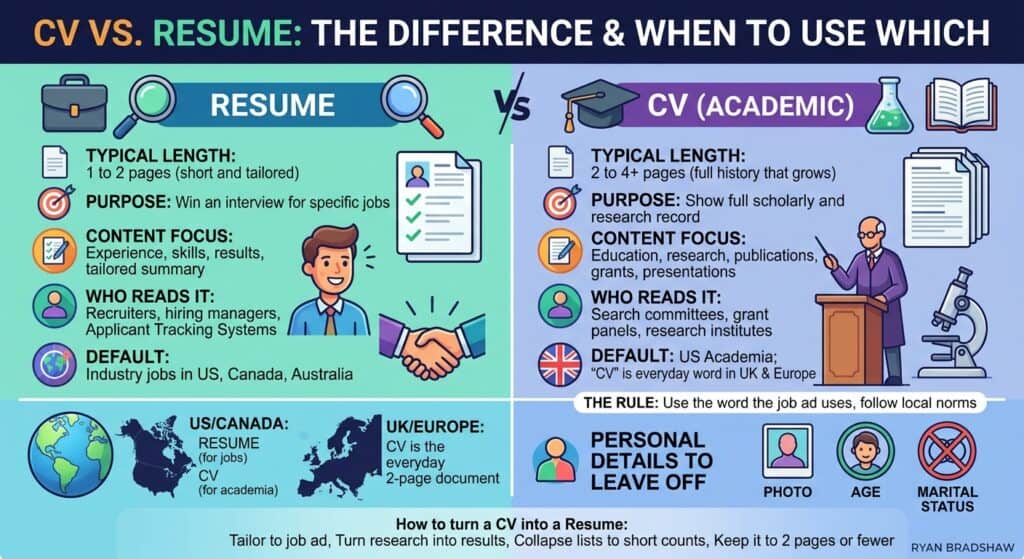
In the US and Canada, a resume is the short document you send for most jobs, usually one or two pages, and a CV is a long, complete record of an academic career used for faculty, research, grant and fellowship applications. In the UK, Ireland and most of Europe, “CV” simply means the two page job document Americans call a resume. The rule that settles it: use the word the job ad uses, then follow the length and personal detail norms of the country you are applying in.
What is the difference between a CV and a resume?
A resume is a short, tailored summary of the skills and experience that fit one job. A CV (curriculum vitae, Latin for “course of life”) is a complete record of your academic and professional history that grows over a career. Columbia University’s graduate school puts it plainly in its CV guidance: a resume should be one page, though some employers accept two, while a CV can run several pages and is used for academic and research positions.
| Resume | CV (US academic sense) | |
|---|---|---|
| Typical length | 1 to 2 pages | 2 to 4 pages early on, 10 or more for senior faculty |
| Purpose | Win an interview for one job | Show a full scholarly record |
| Tailoring | Rewritten for each role | Mostly cumulative, lightly tailored |
| Core content | Experience, skills, results, education | Education, research, teaching, publications, grants, presentations |
| Who reads it | Recruiters, hiring managers, applicant tracking systems | Search committees, grant and fellowship panels |
| Where it is the default | Industry jobs in the US, Canada, Australia | US academia; “CV” is the everyday word in the UK and Europe |
MIT’s career office sums up the split in its CV resources: in the US, “resume” is the term for industry and other non academic jobs, while in some international settings “CV” is used for every opportunity.
Is a CV the same as a resume outside the US?
In much of the world, yes. When a UK or European employer asks for your CV, they want what an American would call a resume: a short, focused document, not a ten page academic record. Here is how the words line up in the markets readers ask about most.
| Country or region | Word for the everyday job document | Notable norm |
|---|---|---|
| United States | Resume (CV only for academia and research) | Federal jobs on USAJOBS cap resumes at two pages |
| Canada | Resume | Government Job Bank advises two pages at most |
| United Kingdom | CV | Official advice says leave out age, date of birth, marital status and nationality |
| European Union | CV | The Europass CV format is widely recognized and suggests a photo |
| Australia | Resume | Government career site uses “resume” throughout |
The sources behind that table are worth a look before you apply abroad. The US Office of Personnel Management explains the two page limit that USAJOBS began enforcing on September 27, 2025. Canada’s Job Bank has a resume writing guide that says to keep it to two pages. The UK National Careers Service CV writing guide lists the personal details to leave off. The EU’s Europass CV builder calls Europass one of the best known CV formats in Europe, supports 31 languages and recommends adding a professional photo. Australia’s Your Career site uses “resume”.
When should you use a CV instead of a resume?
In the US, use a full CV only when the reader wants your whole academic record. Harvard’s graduate CV guide lists the main uses:
- Faculty and teaching positions at colleges and universities
- Fellowships and grants
- Submissions for publications and conference papers
- Some roles outside academia, such as think tanks, research institutes and research positions in industry
Use a resume for almost everything else: corporate jobs, startups, sales, operations, engineering outside research labs, and most roles you find on job boards. If you are applying to a UK or European employer, send a CV, but write it like a focused two page resume unless the role is academic.
What goes in an academic CV?
An academic CV is built around scholarship. Columbia and MIT both list a similar core set of sections:
| Section | What to include |
|---|---|
| Contact information | Name, email, phone, department or website |
| Education | Degrees, institutions, dates, dissertation title and advisor |
| Research experience | Projects, labs, your contribution and results |
| Teaching experience | Courses taught or assisted, mentoring |
| Publications | In your field’s citation style, newest first, your name in bold |
| Presentations | Title, conference, location, date |
| Grants, fellowships and awards | Funder, amount if appropriate, year |
| Service and memberships | Committees, reviewing, professional associations |
| Skills and languages | Lab methods, software, languages |
| References | Names and contact details of your referees |
Length follows content. MIT puts a typical CV at 2 to 4 pages for a younger professional and 4 to 7 pages for someone with more experience, and Columbia notes senior faculty CVs can reach ten or more pages. Order matters too: lead with the section the reader cares most about, such as research for a research university or teaching for a teaching college.
What goes in a resume?
A resume is built around fit and results. The standard sections are:
- Contact details: name, phone, email, city and a LinkedIn link.
- Summary: two or three lines on who you are and the job you want. Our resume objective examples show the difference between a summary and an objective.
- Experience: newest job first, with results rather than duties.
- Skills: the tools and abilities the job ad asks for, in its own words.
- Education and certifications: shorter than on a CV, moved to the top only if you are early in your career.
Most resumes now pass through an applicant tracking system before a person reads them. Simple formatting and standard headings help the system read yours correctly; our guide to the ATS friendly resume format explains what the software actually does with the file, and our explainer on what an ATS is covers why the “75% of resumes rejected” claim does not hold up.
What personal details should you leave off a CV or resume?
This is where country norms differ most, and getting it wrong can look odd to the reader or create risk for the employer.
| Detail | United States | United Kingdom | European Union (Europass) |
|---|---|---|---|
| Photo | Leave off | Usually left off | Europass suggests a professional photo |
| Age or date of birth | Leave off | Leave off | Check local norms |
| Marital status | Leave off | Leave off | Check local norms |
| Nationality or citizenship | Usually leave off; add work authorization only if it clears up doubt | Leave off | Check local norms |
| Race, religion, height, weight | Leave off | Leave off | Leave off |
The US column follows Columbia’s advice for positions in the United States, which lists age, height, weight, marital status, race and religion as details to exclude and suggests stating work authorization only when an employer might be unsure of it. The UK column follows the National Careers Service. Neither source recommends a photo, so in both countries a headshot is best left off.
How do you turn a CV into a resume?
PhDs and researchers moving into industry make this switch most often. Columbia’s guide to converting a CV frames it as moving from a full history of credentials to a concise case for one job. In practice:
- Keep a master CV. Harvard and MIT both recommend a complete archival version you never send, then cut tailored versions from it.
- Start from the job ad. Highlight the skills and outcomes it asks for, and keep only the experience that proves them.
- Turn research into results. “Built a data pipeline that cut analysis time from weeks to days” lands better with a hiring manager than a paper title.
- Collapse the lists. Replace full publication and presentation lists with one line, such as “12 peer reviewed papers, 3 as first author.”
- Cut to two pages or fewer. One page if you can, two if your experience genuinely needs it.
- Translate the jargon. Write for a recruiter who may not share your field, and use the job ad’s vocabulary. If you used AI tools in your research, our guide to explaining AI skills shows how to phrase them.
Going the other way, from resume to CV, mostly means adding: full publication and presentation lists, teaching, grants, service and references.
What should you send if a US job posting asks for a CV?
Look at the role before you look at the word. Some US employers, especially international companies and recruiting agencies, write “CV” when they mean resume. If the job is academic, a research post, a fellowship or a grant, send a full CV. For a corporate, sales, tech or operations role, send a tailored resume even if the ad says CV. The University of Michigan’s engineering career office tells applicants in its resume and CV guide to pay attention to the language the employer uses. When the label and the role disagree, match the document to the role.
Quick answers
Is a CV longer than a resume?
In the US academic sense, yes. A resume is usually one or two pages, while an academic CV runs from two to four pages early in a career to ten or more for senior faculty. In the UK and Europe, a CV for a regular job is about the same length as a resume.
Do Americans use CVs?
Mostly in academia and research, and for grants and fellowships. For nearly all other US jobs, employers expect a resume.
Should I put a photo on my CV?
Not for jobs in the US or UK. Some European employers expect one, and the EU’s Europass format suggests a professional photo, so follow the norms of the country you are applying in.
Can a resume be two pages?
Yes, if your experience needs it. Columbia notes two pages suit people with extensive experience, Canada’s Job Bank advises two pages at most, and US federal jobs on USAJOBS cap resumes at two pages.
What does CV stand for?
Curriculum vitae, Latin for “course of life.” The plural is curricula vitae.
Do recruiters care whether I call it a CV or a resume?
Rarely. What matters is that the document fits the job: the right length, the right details for the country and clear evidence that you can do the work. A recruiter will notice a ten page academic CV sent for a sales role far more than the name on the file.
Should my resume match the job description word for word?
Use the same names for skills and tools that the ad uses, so both the recruiter and the applicant tracking system can find them, but describe your real experience. Our job description templates show how employers phrase common roles.
Free newsletter
Get the Work Insiders weekly
One email a week: the recruiting and HR tech news that mattered, the tools we just added to the directory, and one practical guide. No spam, and you can unsubscribe in one click.