

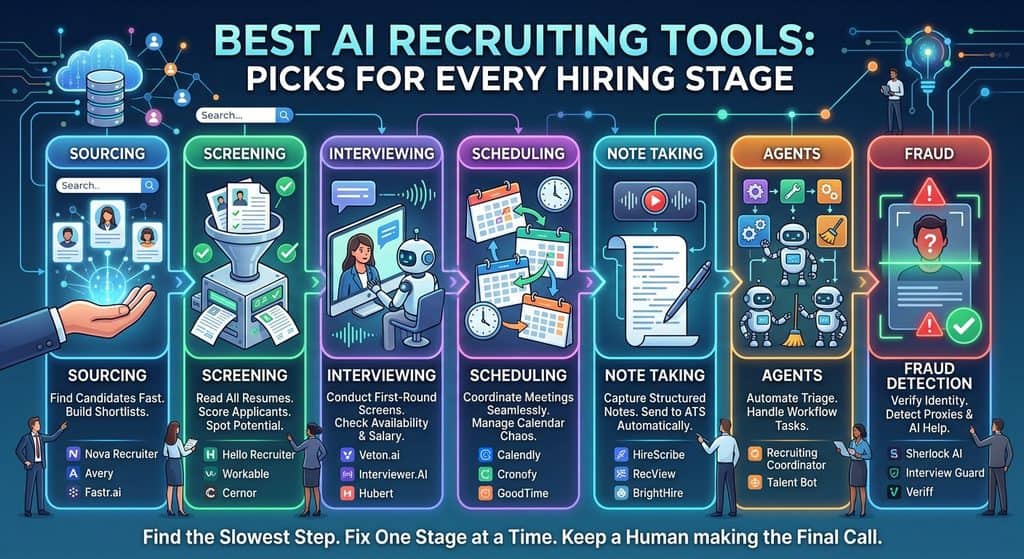
Quick answer: The best AI recruiting tools are the ones that fix one slow step in your own hiring funnel. Pick by job to be done: an AI sourcing tool if you lack candidates, an AI screener if you drown in applicants, an AI interviewer if first round calls eat your week, and fraud detection if you hire remote technical staff. Buy one stage at a time and test it on live roles for two weeks.
Who it suits: agency recruiters, in house talent teams and founders hiring without a recruiter who want to know which AI tool earns its place, stage by stage.
What to check: whether pricing is per seat, per credit or per role, whether the tool explains every score, and whether it writes back to your ATS.
What are the best AI recruiting tools in 2026 for each stage of hiring?
The best AI recruiting tools in 2026 split into seven jobs: sourcing, screening, interviewing, scheduling, note taking, agents and fraud detection. No single product wins every stage, and teams overspend by buying a suite before they know which stage is slow. Our picks below come from the Work Insiders directory, with prices from each vendor’s own pricing page.
| Stage | Pick | Entry price as listed, September 2026 | What it replaces | Who it fits |
|---|---|---|---|---|
| AI sourcing | Nova Recruiter | Free plan; Starter €49 per month plus VAT | LinkedIn Recruiter Lite searches | Solo headhunters and small desks |
| AI sourcing | Avery | Free search; Solo €299 per month | Manual European talent mapping | Recruiters hiring in Europe |
| AI sourcing | Fastr.ai | Pro $94 per month, no contract | Boolean strings | Individual sourcers |
| AI screening | Hello Recruiter | Free ATS plan; Starter $29 per month | First pass resume reading | Small teams with high applicant volume |
| AI screening | Workable | Standard $299 per month; agent credits from $0.095 each | ATS plus a separate screener | SMBs wanting one system |
| AI screening | Cernor | From $199 per live role | A contract screener for one req | Occasional high volume roles |
| AI interviewing | Veton.ai | Basic $299 per month, 100 interviews | Recruiter phone screens | Agencies and volume hiring |
| AI interviewing | Interviewer.AI | Essential $199 per month, 50 credits | One way video screens | Teams wanting async video |
| AI interviewing | Hubert | Quote based | Screening call centres | Enterprise volume hiring |
| Scheduling | Calendly | Free; Standard $10 per seat per month yearly | Email back and forth | Single interviewer bookings |
| Scheduling | Cronofy | Team $15 per seat per month; Business $799 per month annual | Coordinator panel juggling | Teams on Greenhouse or SmartRecruiters |
| Scheduling | GoodTime | Quote based, priced by candidates per year | A scheduling coordinator | Enterprise interview loops |
| AI note takers | HireScribe | $79 one time; free tier | Typing notes during calls | Privacy minded solo recruiters |
| AI note takers | RecView | Starter AUD 32.50 per seat per month annual | Manual ATS note entry | Agencies on Teams or Meet |
| AI note takers | BrightHire | Quote based | Interview debrief meetings | In house TA teams |
| AI agents | Recruiting Coordinator | Free template (needs a Grok Bot plan) | Coordinator admin | Teams already on Grok |
| AI agents | Talent Bot | Free template (needs a Grok Bot plan) | Daily applicant triage | Founders hiring directly |
| Candidate fraud | Sherlock AI | Starter $100 per month, 10 interviews | Gut feel on video calls | Remote technical hiring |
| Candidate fraud | Interview Guard | $100 per month plus $10 per interview | Proctoring by hand | Small teams testing fraud checks |
| Candidate fraud | Veriff | $0.80 per verification, $49 monthly minimum | Manual ID checks | Identity checks before offer |
How many recruiters actually use AI in 2026?
Just over half of organizations now use AI somewhere in recruiting. The SHRM 2025 Talent Trends research found 51% use AI to support recruiting, mostly for job descriptions, resume screening and candidate search. Nearly 9 in 10 users said it saves time, but only 24% said it helped them identify top candidates.
LinkedIn’s Future of Recruiting 2025 report found teams using generative AI save about 20% of their work week, roughly one full day.
Staffing firms move faster. Bullhorn’s GRID 2026 report found 30% of firms use some agentic AI. In Bullhorn’s candidate survey, 92% of people interviewed by an AI voice agent rated it as good as or better than a live recruiter screen.
| Finding | Figure | Source |
|---|---|---|
| Organizations using AI to support recruiting | 51% | SHRM 2025 Talent Trends |
| AI users applying it to resume screening | 44% | SHRM 2025 Talent Trends |
| Organizations integrating or experimenting with generative AI in hiring | 37%, up from 27% | LinkedIn Future of Recruiting 2025 |
| Staffing firms with AI embedded across the workflow | 10% | Bullhorn GRID 2026 |
| Candidates who trust AI to evaluate them fairly | 26% | Gartner, July 2025 |
| Candidates admitting to interview fraud | 6% | Gartner, July 2025 |
Which AI sourcing tool should a recruiter buy first?
An AI sourcing tool is worth buying first when you have open roles but too few qualified people in the pipeline. These tools take a plain English brief, search large profile databases and rank matches, so you stop writing Boolean strings. Browse the full AI sourcing directory for more options.
Nova Recruiter’s free plan gives 2 searches a month with 20 results each, and Starter at €49 per month adds unlimited searches, 50 contact credits and MCP access, so you can run searches from Claude or ChatGPT. Our guide to MCP for recruiters explains why that matters. Avery lets you search 125M+ European profiles free, then charges €299 per month for contact details and outreach from your own inbox. Fastr.ai Pro costs $94 per month with 250 contact credits and 3 active projects.
What does an AI sourcing tool not do well?
AI sourcing tools rank profiles on what is written, so they still miss people with thin LinkedIn profiles and niche titles. One recruiter on r/Recruitment who tested several tools found hireEZ, Fetcher and SeekOut only helped when scoring rules were kept very tight, and otherwise the work just moved around.
What should an AI screening tool do before a human reads a resume?
An AI screening tool should read every application against criteria you set, score it, and show the evidence behind each score so a recruiter can overrule it. The tool should never be the final reject button. Our deeper guide to the AI resume screener covers how the matching works and where bias creeps in.
Hello Recruiter is the cheapest serious option we found: Starter at $29 per month covers 3 active jobs and 4,000 AI resume evaluations plus fraud and impersonation detection. Workable bundles an ATS with a screening agent that uses 1 AI credit per candidate evaluated, and every paid account starts with 3,000 free credits. Cernor skips subscriptions entirely and charges from $199 per live role, which suits a company that only has one flood of applicants a quarter. See every option in the AI screening directory.
Are AI interviewers good enough to run first round screens?
AI interviewers are good enough for structured first round screens that check availability, pay, basic qualifications and a few role questions. They are weaker with senior candidates, where rapport matters more than coverage. The practical win is that every applicant gets screened within hours.
Veton.ai Basic costs $299 per month for up to 100 interviews with unlimited jobs and applicants. Interviewer.AI Essential costs $199 per month for 50 interview credits of up to 20 minutes, with unused credits rolling over. Hubert runs structured voice screens at enterprise volume and is quote based. Compare more in the AI interviewing directory.
Will candidates drop out if a bot interviews them?
Candidates mostly accept AI screens when told upfront. Because only 26% trust AI to judge them fairly, disclose the AI step and give a human contact.
Is AI scheduling worth paying for, or is Calendly enough?
Calendly is enough when one person interviews one candidate at a time. The free plan covers one event type and one calendar, and Standard at $10 per seat per month (billed yearly) removes those limits. Dedicated interview scheduling pays off once you run panel loops across several interviewers and time zones.
Cronofy’s Team plan costs $15 per assigned seat per month, and the Business plan at $799 per month billed annually adds Greenhouse and SmartRecruiters integrations. GoodTime prices by the number of candidates per year rather than per user, and only shares numbers in a custom proposal. The scheduling directory lists lighter options too.
Which AI note taker fits a recruiting team?
A recruiting note taker should push structured notes into the candidate record, not just email a summary. HireScribe runs entirely on your laptop with no bot joining the call, and costs $79 one time for unlimited summaries, although it has no direct ATS sync yet. RecView starts at AUD 32.50 per seat per month billed annually, and its Agency plan pushes notes to 10 ATS integrations. BrightHire suits in house teams that want interview intelligence and a published bias audit, and is quote based.
Our comparison of the best AI note takers goes tool by tool, and the note taker directory lists every option with prices.
What do AI agents and agentic ATS platforms actually do today?
An AI agent in recruiting runs a multi step task on its own, such as screening every new applicant overnight, then asks you to approve the output. An agentic ATS builds those agents into the system of record.
The Grok Bot templates in our AI agents hub are free, but they run inside Grok Bot, which needs SuperGrok Heavy, Cursor Ultra or Cursor Teams Premium. Recruiting Coordinator schedules full loops, builds interviewer prep packets and runs the debrief. Talent Bot reviews each new applicant against a fixed role definition every day. Req to Outreach turns a job description into a ranked shortlist and one draft email per person, and nothing sends until you approve it.
Inside an ATS, the Workable Agent sources, screens and chats with candidates on credits: 1 credit per evaluation, 2 per sourced profile and 10 per chat, with packs from $0.12 per credit. Our walkthrough of agent workflows shows how to chain these steps safely.
How do you stop fake candidates and deepfake interviews?
You stop fake candidates by layering checks: verify identity before the final interview and monitor live video interviews for proxies and hidden AI help. Gartner predicts that one in four profiles worldwide will be fake by 2028, and 6% of candidates it surveyed admitted to interview fraud.
Sherlock AI’s Starter plan costs $100 per month with 10 interviews included and $10 per extra interview. Interview Guard has the same entry shape at $100 per month plus $10 per interview, with a 7 day trial covering 5 interviews. For identity, Veriff charges $0.80 per verification with a $49 monthly minimum, while Persona starts at $250 per month on a 12 month minimum contract. The candidate fraud directory lists 19 tools.
How do you test an AI recruiting tool in two weeks?
You test an AI recruiting tool by running it beside your current process on two or three live roles and comparing outcomes, not demo impressions. The plan below fits inside most free trials.
| Days | What to do | What to measure |
|---|---|---|
| 1 to 2 | Pick 2 or 3 live roles, write the must have criteria, connect the ATS | Setup time and whether data syncs both ways |
| 3 to 5 | Run the tool and your normal process in parallel on the same candidates | Overlap between the AI shortlist and your own |
| 6 to 7 | Read 20 AI rejections by hand | How many good people the tool would have lost |
| 8 to 10 | Let the tool handle one stage fully, with a human approving | Hours saved per role and candidate response rate |
| 11 to 12 | Split outcomes by gender, age band and location where you hold the data | Whether any group passes at a much lower rate |
| 13 to 14 | Price the full year at your real volume, including credits and overages | Cost per screened candidate versus recruiter time saved |
What is a fair pass mark for a trial?
A fair pass mark is that the tool saves recruiter hours on every role, loses none of the candidates you would have hired and explains every score. If you cannot tell why it rejected someone, stop the trial.
What legal guardrails apply to AI hiring tools?
New York City’s Local Law 144 bars employers from using an automated employment decision tool unless it had a bias audit within the past year, the audit summary is public, and candidates get notice. Illinois has required notice of AI use in employment decisions since January 1, 2026, and the EU now applies its high risk rules for hiring AI from December 2, 2027.
At the federal level, the EEOC removed its AI guidance in early 2025, but Title VII, the ADA and the ADEA still apply to any tool that screens people out. The Mobley v. Workday case, covered by SHRM, shows vendors and employers can both face claims. Keep a human making the final call and keep records of every automated decision.
Quick answers
What is the cheapest AI recruiting tool that does real screening?
Hello Recruiter Starter at $29 per month includes 4,000 AI resume evaluations, as listed, September 2026. Klearskill starts at $10 per month if you bring your own AI key.
Do I need an AI agent or just an AI feature in my ATS?
Start with the AI features in your ATS. Add an agent only when a repeatable task, such as daily applicant triage, still takes hours each week.
Can AI interviews replace recruiter phone screens?
AI interviews can replace structured first round screens for volume roles. Keep human calls for senior hires and any candidate who asks for one.
Is it legal to use AI to reject candidates?
It is legal in most places if the tool does not discriminate and you meet local notice and audit rules, such as NYC Local Law 144. Keep a human reviewing rejections.
The bottom line
The best AI recruiting tools are chosen stage by stage. Find the slowest step in your funnel, buy one tool that fixes it, test it on live roles for two weeks and keep a human on every rejection. Start with the AI screening tools if applicant volume is your problem, or the AI sourcing tools if you simply need more people to talk to.
Sources: SHRM Talent Trends, LinkedIn Future of Recruiting, Bullhorn GRID 2026, Bullhorn candidate survey, Gartner candidate survey, NYC DCWP AEDT, Cooley on EEOC, SHRM on Workday, r/Recruitment thread, Nova Recruiter pricing, Avery pricing, Fastr.ai Pro, Hello Recruiter pricing, Workable pricing, Cernor, Veton.ai pricing, Interviewer.AI pricing, Calendly pricing, Cronofy pricing, GoodTime pricing, HireScribe pricing, RecView pricing, BrightHire pricing, Sherlock AI pricing, Interview Guard, Veriff pricing, Persona pricing, Klearskill pricing
Free newsletter
Get the Work Insiders weekly
One email a week: the recruiting and HR tech news that mattered, the tools we just added to the directory, and one practical guide. No spam, and you can unsubscribe in one click.