

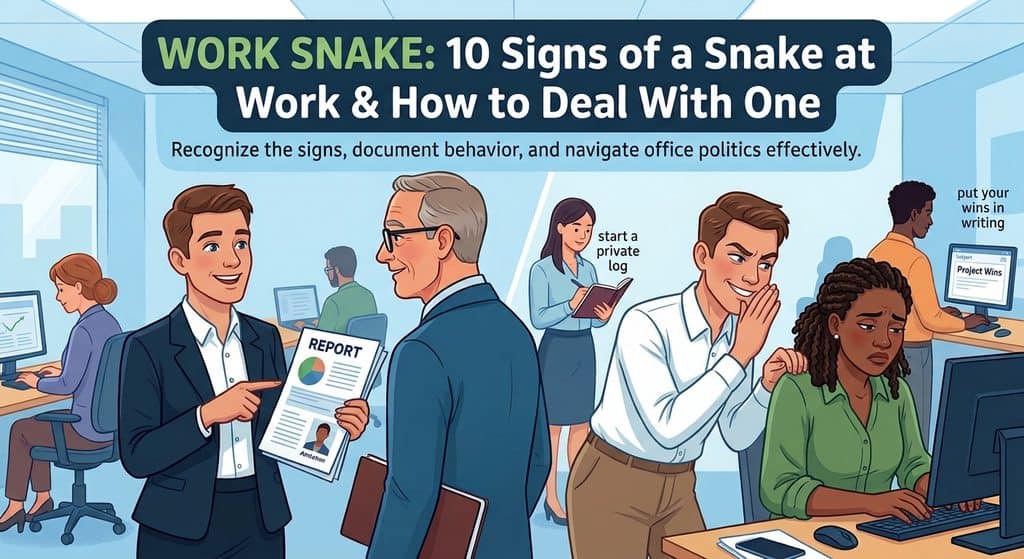
Quick answer: A work snake is a coworker who acts friendly to your face and works against you behind your back. They take credit for your work, feed gossip to the boss and quietly set you up to look bad. The way to beat one is not a counterattack. Keep a paper trail, put your wins in writing, share less, stay polite and take a documented pattern to your manager or HR. You are far from alone: in the September 2026 FlexJobs culture report, 65% of US workers said a coworker taking credit for their work is their biggest workplace turn off, ahead of micromanaging and gossip.
Updated November 2026.
What is a work snake?
A work snake, also called an office snake or a snake at work, is a colleague who chases their own advancement by undermining the people around them. The defining trait is the gap between how they act in front of you and what they do when you are not in the room. They are often charming, helpful in meetings and well liked by senior people, which is exactly why they are hard to spot and harder to call out.
Not every difficult coworker is a snake. Someone who is blunt, disorganized or annoying is not necessarily working against you. A snake is strategic. The behavior repeats, it benefits them and it costs you something real, such as credit, trust with your manager or a shot at a promotion.
What are the signs of a snake at work?
One sign on its own can be a misunderstanding. Three or four that keep showing up are a pattern. These are the ones people raise most often when they ask how to deal with a snake coworker.
| Sign | What it looks like | Your first move |
|---|---|---|
| Takes credit | Presents your idea or results as theirs, or says “we” when it was you | Recap your work in writing to your manager |
| Two faced praise | Compliments you in person, criticizes you to others | Assume anything you say may be repeated |
| Information fishing | Lots of friendly questions about your projects, opinions and plans | Keep answers short and work focused |
| Gossip broker | Always has news about someone else and wants your reaction | Do not add to it, change the subject |
| Selective cc | Loops your boss in only when you slip, never when you deliver | Send your own updates so the record is balanced |
| Withholding | “Forgets” to pass on a deadline, file or meeting change | Confirm key details in writing yourself |
| Blame shifting | Mistakes on shared work always land on someone else | Agree owners and tasks in writing up front |
| Managing up only | Warm with leadership, dismissive with peers and juniors | Watch how they treat people who cannot help them |
| Divide and rule | Tells each teammate what another “really” thinks of them | Check the story directly with the other person |
| Public jabs | Small digs in meetings framed as jokes or “just asking” | Respond calmly to the substance, not the tone |
Is it a snake, an annoying coworker or a bully?
Getting the label right matters, because each one needs a different response. Treating an awkward but harmless colleague like a snake makes you the difficult one, and treating real bullying as office politics can leave you unprotected.
| Annoying coworker | Work snake | Workplace bully | |
|---|---|---|---|
| Intent | Usually none, just habits | Self promotion at your expense | Control or intimidation |
| Style | Open and obvious | Covert, friendly on the surface | Often open, can be covert |
| Main harm | Distraction and irritation | Lost credit, trust and opportunities | Health, confidence and job security |
| Best response | A direct, friendly ask to stop | Documentation, visibility, distance | Documentation and a formal complaint |
Bullying is more common than most people think. The 2024 WBI survey found 32% of adult Americans say they have been bullied directly at work and another 14% have witnessed it, which the Workplace Bullying Institute puts at about 52.2 million workers bullied. If a snake’s behavior turns into repeated threats, humiliation or sabotage, treat it as bullying and escalate it that way.
Why does a work snake do so much damage?
Because the harm spreads well beyond the person they target. Research by Christine Porath and Christine Pearson in Harvard Business Review found that among people treated badly at work, 48% deliberately cut their work effort, 38% let the quality of their work slip, 80% lost work time worrying about the incident and 12% left their job.
The same piece cites an Accountemps finding that managers at Fortune 1000 firms spend about 13% of their time, roughly seven weeks a year, cleaning up after this kind of behavior.
It also drives people out. SHRM research found one in five Americans had left a job in the previous five years because of the culture, at an estimated turnover cost of $223 billion. And the Kickresume survey of nearly 3,000 workers found 85% had dealt with a difficult coworker, the credit stealer topped the list at 33%, and 58% said difficult colleagues significantly hurt their productivity.
How do you deal with a snake at work?
The goal is to make yourself a hard target and let the facts speak for you. These seven steps work whether the snake is a peer, someone on another team or a new hire who arrived with an agenda.
1. Start a private log today
Write down each incident with the date, what happened, who was there and any email or message that backs it up. Stick to facts, not feelings. “On 3 November she presented my client report in the team meeting as her own” carries weight. “She is so fake” does not. Keep the log somewhere personal, not on a shared drive, and keep copies of key emails.
2. Put your wins in writing
Credit stealing only works when nobody knows where the work came from. Send your manager a short weekly update listing what you shipped, share drafts by email rather than in conversation, and name your own contribution when you present. A written trail makes it very hard for anyone to claim your work later.
3. Share less, stay pleasant
You do not need to be cold, which only gives a snake a story to tell about you. Be polite, keep conversations on work and give short answers to questions about your plans, your opinions of colleagues or your personal life. A good test is to say nothing to a snake you would not be comfortable hearing repeated to your boss.
4. Refuse to join the gossip
Snakes trade in gossip because it builds alliances and gives them something to use later. If they bring you a story about someone else, do not react and do not add to it. A neutral line such as “I would rather hear that from her directly” ends the conversation without starting a fight.
5. Address it calmly, once, in private
Many snakes rely on people never saying anything. A short, calm conversation that names the behavior, not the person’s character, often stops it. Keep it factual, keep it brief and follow up with a friendly email that confirms what was agreed. That email goes in your log too.
6. Build your own allies
A snake’s power comes from controlling the story. Strong direct relationships with your manager, your peers and the people who rely on your work mean their version is not the only one anyone hears. Be generous with credit to others. People notice who shares it and who takes it.
7. Take a pattern to your manager or HR
When the behavior keeps coming back or is costing you real opportunities, escalate it. Bring your log, focus on the impact on the work and ask for something specific, such as clear ownership on shared projects. More on how to do that well below.
What do you say to a snake coworker?
Short, calm and factual beats clever every time. These lines name the behavior without giving the other person an outburst to report.
| Situation | What to say |
|---|---|
| They took credit in a meeting | “Thanks for raising the report. I can walk everyone through the numbers since I put it together.” |
| Private follow up on credit | “In the meeting the client analysis came across as yours. I did that work, so going forward I will present my own pieces.” |
| They bring you gossip | “I would rather not get into that. Did you see the update on the project?” |
| They fish for information | “Still working it out. I will share it with the team when it is ready.” |
| A dig framed as a joke | “I am not sure what you mean. Can you say that more directly?” |
| A deadline they never passed on | “To be safe, can you forward me anything about this project so nothing slips again?” |
How do you report a work snake to HR without looking petty?
Most people never report it. In the Kickresume survey, only 12% of workers took a difficult coworker to a manager or HR, while 17% asked the person to stop directly. Reporting works best when it sounds like a business problem, not a personal grudge.
- Lead with impact on the work: missed deadlines, confused clients, duplicated effort.
- Bring three to five dated examples from your log, with emails where you have them.
- Leave out labels like “snake” or “toxic”. Describe what happened.
- Ask for a specific fix, such as named owners on shared work or a change in reporting lines.
- Follow up in writing so there is a record that you raised it and when.
If the behavior is tied to your race, sex, age, religion, disability or another protected trait, it may be unlawful harassment rather than office politics. The EEOC harassment guidance explains where that line sits. Say so clearly when you report it. This is general information, not legal advice.
What if the work snake is your boss?
It is harder, but the same rules apply with more care. Keep your log, copy yourself on important emails and send recap notes after one on one meetings (“Just confirming what we agreed today”).
Build visibility with your skip level manager and other teams through your work, not complaints. If you escalate, go to HR or your boss’s manager with facts and impact, and expect it to take time. Staying is not always the right call, which brings us to the next question.
When is it time to leave because of a work snake?
Consider moving on when you have raised it and nothing changed, when leadership rewards the behavior, or when it is affecting your sleep, health or confidence.
Recruiters hear “my coworker” and “my manager” as reasons for leaving all the time, and the SHRM data backs that up: managers were the main reason 58% of people who quit a job left. When you interview elsewhere, ask how the team shares credit and how conflicts get resolved. The answers tell you a lot about whether snakes thrive there.
How can managers and recruiters keep snakes off the team?
Hiring is the cheapest fix, and few companies use it. In the same Harvard Business Review research, only 11% of organizations said they considered civility at all during hiring. A few simple habits close that gap.
- Ask behavioral questions about credit and conflict, such as “Tell me about a time a project you worked on succeeded. Who did what?” Listen for “I” versus “we”. Our interview question banks have more.
- Check references with peers and direct reports, not only former bosses. Snakes manage up well, so the people beside and below them tell a different story. See our reference check tools.
- Make credit visible. Name contributors in updates and celebrate shared wins so taking credit becomes obvious.
- Act on the first report. When managers ignore early complaints, good people leave and the snake stays. Use exit interview questions to catch patterns you missed.
Quick answers
What does “work snake” mean?
A coworker who seems friendly but works against you behind your back, usually by taking credit, spreading gossip or making you look bad to management.
How do I know if my coworker is a snake?
Look for a repeating pattern: your work shows up as theirs, things you said in private get back to others, and they are warmer with leadership than with peers.
Should I confront a snake at work?
Once, privately and calmly, focused on one specific behavior. Avoid public arguments. They give the snake a story to tell about you.
How do I stop a coworker from taking credit for my work?
Put your work in writing before it is shared, send your manager regular updates and present your own pieces in meetings.
Can I report a coworker for being two faced?
Yes, if it hurts the work. Report specific, dated examples and the impact, not personality. HR acts on facts, not labels.
Is a work snake the same as a bully?
Not always. Snakes are usually covert and self serving, while bullies intimidate. When snake behavior becomes repeated humiliation or sabotage, treat it as bullying.
Free newsletter
Get the Work Insiders weekly
One email a week: the recruiting and HR tech news that mattered, the tools we just added to the directory, and one practical guide. No spam, and you can unsubscribe in one click.