

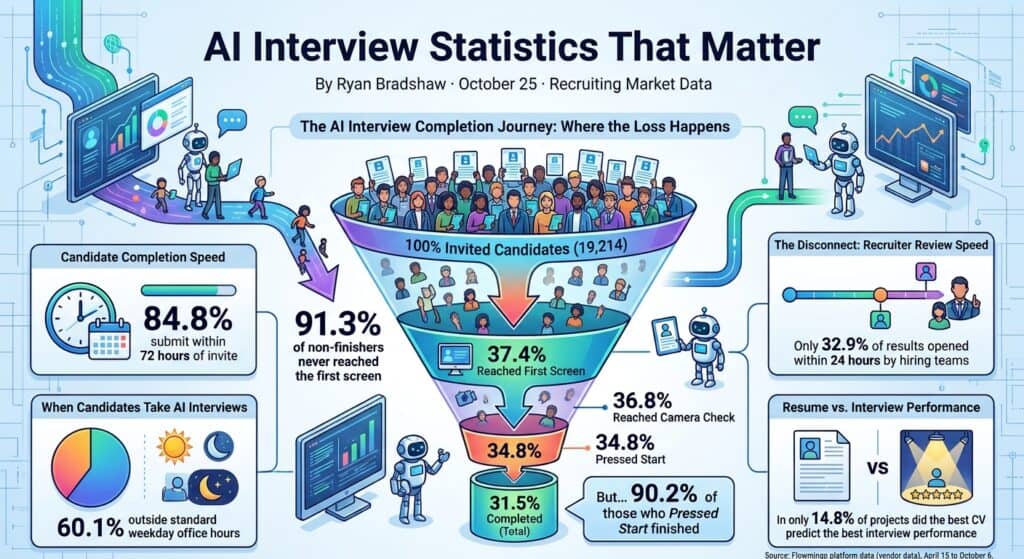
By Ryan Bradshaw · Statistics checked October 25, 2026
Quick answer: AI interviews are now mainstream: 63% of US job seekers have had one. The surprise is where candidates drop out. In 172,486 real first round AI interviews, 90% of candidates who pressed Start finished, but 91% of invited candidates who never finished did not even reach the first screen. The interview is rarely the problem. The invite is. Most finishers submit within 72 hours and 60% do it outside office hours, while hiring teams open only a third of results within a day.
What are the AI interview statistics that matter most?
Most AI interview statistics online are surveys about how people feel. The numbers below mix those surveys with behavior data: what candidates and hiring teams actually did. That second kind is rarer, and it changes what you should fix first.
| Statistic | Number | Source |
|---|---|---|
| US job seekers who have had an AI interview | 63% | Greenhouse, 2026 |
| Candidates who pressed Start and finished | 90.2% | Flowmingo platform data |
| Non finishers who never reached the first screen | 91.3% | Flowmingo platform data |
| Finishers who submitted within 72 hours | 84.8% | Flowmingo platform data |
| Interviews submitted outside weekday 9am to 5pm | 60.1% | Flowmingo platform data |
| Median time from start to submit | 25 minutes | Flowmingo platform data |
| Results opened by the hiring team within 24 hours | 32.9% | Flowmingo platform data |
| Projects where the best CV was also the best interviewer | 14.8% | Flowmingo platform data |
| US job seekers who quit a process over an AI interview | 38% | Greenhouse, 2026 |
| Candidates who trust AI to evaluate them fairly | 26% | Gartner, 2025 |
| More job offers after AI led interviews | 12% | Chicago Booth field study |
How common are AI interviews in 2026?
Very common for candidates, less common than you might think for employers. The Greenhouse 2026 report found 63% of US job seekers have now been interviewed by an AI, up 13 points in six months. It surveyed 2,950 active job seekers across five countries, and the headline figures come from its 1,200 US respondents.
On the employer side, the SHRM 2026 report found 39% of organizations use AI somewhere in HR, and recruiting is the most common place for it at 27%. A Resume.org survey of 1,399 US workers found 57% of companies use AI in hiring. Of those, 34% use it in interviews, and half of that group lets AI conduct the interview itself. When AI runs the interview, 71% say a human always stays in the loop, and 6% let AI run it alone.
Why do candidates see AI interviews more than employer surveys suggest? Because a small number of high volume employers send a very large number of invites. One employer screening 5,000 applicants with an AI interview reaches more job seekers than 100 small firms that never use one.
The supply side is crowded too. The Work Insiders directory lists 82 AI interviewing tools. Only 32 publish a price, 41 are quote only, and the median public starting price is $99 a month.
Do candidates actually finish AI interviews?
Yes, once they start. Flowmingo, a free AI hiring platform, shared data on 172,486 first round AI interviews sent by 1,807 hiring organizations between April 15 and October 6, 2026, with candidates in 179 countries. Of 27,706 candidates who pressed Start between August 16 and October 6, 90.2% finished.
Counted from the invite, the picture is very different. Of 19,214 invited candidates at 274 organizations, only 31.5% completed. The drop happens almost entirely before the interview begins: 62.6% never reached the first screen.
| Stage | Share of invited candidates |
|---|---|
| Invited | 100% |
| Reached the first screen | 37.4% |
| Reached the camera check | 36.8% |
| Pressed Start | 34.8% |
| Completed | 31.5% |
Where do candidates drop out of AI interviews?
At the invite. Of invited candidates who did not finish, 91.3% never reached the interview’s first screen. Only a small slice quit at the camera check or partway through.
That matches what candidates say in surveys. Greenhouse found 70% of US candidates were never clearly told upfront that AI would evaluate them, and 21% only found out once the interview started. Its top reasons for walking away were a prerecorded video interview scored by AI with no human present (33%), no disclosure of how AI would be used (27%) and AI monitoring during the process (26%).
Put those together and the lesson is plain. A candidate who opens an email and cannot tell what it is, how long it takes or why it needs a camera simply never clicks. Fixing the invite is the cheapest completion gain available.
How fast do candidates complete an AI interview?
Fast. Of 22,372 invited candidates who finished, 84.8% did it within 72 hours of the invite and 97.4% within seven days. The median gap from invite to submission was 24.9 hours.
For a recruiter, that sets the deadline. A three day window catches most of the people who will ever finish, and reminders belong inside those three days. Chasing after a week rarely pays off.
When do candidates take AI interviews?
Mostly when you are not at work. Of 68,363 completed interviews with a recorded time zone, 60.1% were submitted outside weekday office hours in the candidate’s own time zone, and almost one in five came in on a weekend.
| When candidates submit (local time) | Share of interviews |
|---|---|
| Weekday, 9am to 5pm | 39.9% |
| Weekday, before 9am or after 5pm | 40.8% |
| Weekend, any hour | 19.3% |
This is the real case for an asynchronous first round. Candidates who already have jobs can only interview at night or on a Saturday, and a phone screen booked for Tuesday at 2pm shuts them out. If you want employed candidates, an interview they can take in their own time is a big advantage. Pair it with good interview scheduling software for the later live rounds.
How long does an AI interview take, and on what device?
About 25 minutes. The median AI interview took 25 minutes from start to submit across 64,965 completed interviews, setup included, and the middle half of candidates took 18 to 34 minutes. Put that number in the invite. It answers the first question a busy candidate has.
| Measure | Result | Base |
|---|---|---|
| Median start to submit | 25 minutes | 64,965 interviews |
| Completed on a laptop | 74.6% | 68,394 interviews |
| Completed on a phone | 22.6% | 68,394 interviews |
| Completed on a desktop | 2.8% | 68,394 interviews |
| Languages used | 45 | 68,501 interviews |
| Interviews not in English | 8.2% | 68,501 interviews |
Three in four candidates sit down at a laptop. Many will open the invite on a phone and come back later on a computer, so make the link easy to find again and say upfront that a laptop works best.
How quickly do recruiters review AI interview results?
Much slower than candidates finish them. Hiring teams opened 32.9% of finished interviews within 24 hours and 52.7% within 14 days, across 65,817 interviews finished before September 30. When a result was opened, the median first open came 15.6 hours after the candidate submitted.
Recruiters do not open results at random. The AI score decides what gets watched first.
| AI interview score (out of 10) | Opened by the hiring team within 14 days |
|---|---|
| 0 to 4.9 | 47.2% |
| 5 to 6.9 | 51.3% |
| 7 to 7.9 | 59.3% |
| 8 to 10 | 67.8% |
Even the best scoring candidates had their result left unopened in the app a third of the time. Some of those were read from the email alert, but the gap still matters. Greenhouse found 51% of US candidates who finished an AI interview never heard back. A candidate who submitted at 10pm on Sunday is waiting, and the employer who replies Monday morning wins. Track this as a recruiting metric: time from AI interview to first human review.
Does the best resume predict the best AI interview?
Rarely. This is the finding that should make recruiters rethink resume screens. Flowmingo looked at 569 hiring projects where at least 10 candidates were scored on both their CV and their interview, covering 24,793 candidates at 284 organizations.
| Measure | Result |
|---|---|
| Hiring projects with 10 or more candidates scored on both | 569 |
| Candidates | 24,793 |
| Projects where the best interviewer also had the best CV | 14.8% |
| Top 20% of interviewers a top 20% CV cut would have removed | 64.2% |
| Candidates scoring 8 or more in the interview that cut would have removed | 67.7% (of 1,921) |
| Correlation between CV score and interview score | 0.36 |
In only 14.8% of projects did the strongest CV belong to the strongest interviewer. A shortlist that kept only the top 20% of resumes would have thrown out 64.2% of the top 20% of interviewers. A correlation of 0.36 is real but weak: a good resume tells you something, not much.
One caveat cuts the other way. Where a CV screen already decided who got interviewed, CV scores sit in a narrow range, which pulls the correlation down. Even so, the practical point stands. Keyword and resume screens miss people whose titles do not match the job, which is common in technical hiring. If you screen resumes with AI, as in our guide to screening resumes with Claude, set a looser cut and let the interview do more of the sorting.
Do AI interviews lead to better hires?
The best evidence so far says they can. In a Chicago Booth field study, economists Brian Jabarian and Luca Henkel randomly assigned about 70,000 applicants for entry level customer service jobs in the Philippines to a human recruiter, an AI voice interviewer, or their choice of the two. Humans made every hiring decision.
| Outcome | AI led vs human led interviews |
|---|---|
| Job offer rate | 9.73% vs 8.70% (12% more offers) |
| Job starts | 18% higher |
| Still employed after 30 days | 17% higher |
| Candidates who picked AI when given the choice | 78% |
The researchers credit structure. The AI asked every candidate the same questions, spoke less and got candidates to say more that was relevant to the job. Two limits matter: these were entry level, high volume roles, and recruiters spent longer reviewing AI interview output, which ate into the time saved.
How do candidates feel about AI interviews?
Split, and mostly let down by how employers run them. Candidates are not asking for AI to go away. Only 19% of US respondents in the Greenhouse survey want less AI in hiring. They want it done openly.
| Candidate view | Share | Source |
|---|---|---|
| Walked away from a process because of an AI interview | 38% | Greenhouse |
| Want the option of a human interview instead | 46% | Greenhouse |
| Want upfront disclosure of AI | 44% | Greenhouse |
| Want a human to review the AI evaluation first | 38% | Greenhouse |
| Came away more positive about the employer | 38% | Greenhouse |
| Came away more negative about the employer | 34% | Greenhouse |
| Believe most employers use AI responsibly | 21% | Greenhouse |
| Trust AI to evaluate them fairly | 26% | Gartner |
| Trust an employer less if AI evaluates them | 25% | Gartner |
The Gartner candidate survey adds the employer’s side of the trust problem: in a separate survey of 3,000 candidates, 6% admitted to interview fraud, such as having someone else sit the interview for them. That is why identity checks are now part of many AI interview tools.
Note the near tie between 38% who felt better about the employer and 34% who felt worse. The same technology wins or loses the candidate depending on disclosure, length and whether anyone replies afterwards.
What laws apply to AI interviews in the US?
A growing patchwork, almost all of it about notice and bias. None of the laws below bans AI interviews. They require you to tell candidates and to avoid discriminatory results. This is general information, not legal advice.
| Law | Status | What it requires |
|---|---|---|
| Illinois AI Video Interview Act | In force since January 2020 | Notice, an explanation of how the AI works and consent before AI analyzes video interviews |
| New York City Local Law 144 | Enforced since July 2023 | Annual bias audit and candidate notice for automated hiring tools |
| California FEHA rules on automated decision systems | In force since October 1, 2025 | No discriminatory effect; keep automated decision data for four years |
| Illinois HB 3773 | In force since January 1, 2026 | No discriminatory AI use in hiring; tell candidates when AI is used |
| Colorado SB 26 189 | Takes effect January 1, 2027 | Notice before use, explanation of adverse decisions, human review on request, records kept |
Two of these changed recently. Illinois HB 3773 amended the state’s Human Rights Act and covers any employer with one Illinois employee. Colorado repealed its 2024 AI Act before it took effect and replaced it in May 2026 with a narrower law built around notice and human review. California’s rules came from its Civil Rights Council and apply even when a human makes the final call.
The common thread lines up with what candidates ask for: say when AI is involved, say what it measures, and keep a person on the decision.
What should recruiters change based on these numbers?
- Rewrite the invite first. Say it is an AI interview, that it takes about 25 minutes, that it needs a camera and microphone, what it measures and when it is due. Most of your loss happens before the first screen.
- Give three days and remind inside them. 85% of finishers submit within 72 hours. Almost nobody finishes after a week.
- Keep the async format for employed candidates. 60% submit outside office hours. That is your passive talent showing up.
- Review within a day. Only a third of results get opened that fast. Replying first is an easy edge.
- Loosen the resume cut. The best CV was the best interviewer in fewer than one project in six.
- Offer a human option and disclose. 46% of candidates want one, and Illinois, New York City and soon Colorado require notice.
If you are comparing vendors, check whether the tool lets you edit the invite text, set reminders, show candidates how long it takes and export scores to your ATS. Our AI interviewing directory lists prices and features for 82 tools, and our AI tax tracker shows which vendors charge extra for AI features.
How reliable is this data?
The Flowmingo figures are platform records of what candidates and hiring teams did, not what they reported, which makes them unusual. They are also vendor data, and the limits matter. Candidates with a known location were mostly in India (43%), Nigeria (12%), the Philippines (9%) and Indonesia (7%); the United States was 2.4%. The employers are Flowmingo users, not a random sample.
Flowmingo excluded its own hiring, demo and sample interviews, practice runs, recruiters testing their own interviews and records with no candidate email. A candidate who restarted the same interview counts once. Data was counted up to October 14, 2026, so every interview had at least seven days. Start and first screen data begins August 16, 2026, which is why those findings use a shorter window. Every figure covers at least 143 organizations, and no single organization is more than 26% of any figure’s base.
The survey figures come from Greenhouse (US, 2026), Gartner (global, 2025), SHRM (US HR professionals, December 2025) and Resume.org (US workers, 2025). The Booth study is a randomized field experiment, the strongest design here, but in one country and one job type.
Quick answers
What percentage of candidates complete AI interviews?
About 90% of candidates who press Start finish. Counted from the invite, about 31.5% complete, because most non finishers never open the interview at all.
How many job seekers have had an AI interview?
63% of US job seekers in the Greenhouse 2026 survey, up 13 points in six months.
How long is a typical AI interview?
The median is 25 minutes from start to submit, setup included. The middle half of candidates take 18 to 34 minutes.
Why do candidates drop out of AI interviews?
Mostly they never start. Surveys point to unclear invites, no disclosure that AI is involved and AI scored video with no human present.
Are AI interviews better than human interviews?
In a randomized study of about 70,000 applicants, AI led interviews produced 12% more offers and 17% better 30 day retention, with humans still making the decisions.
Do I have to tell candidates I use an AI interview?
In Illinois and New York City, yes, and Colorado joins on January 1, 2027. Disclosing everywhere is the safer default and what candidates ask for.
Can I cite these numbers?
Yes. Please link to this page and label the Flowmingo figures as vendor data.
Free newsletter
Get the Work Insiders weekly
One email a week: the recruiting and HR tech news that mattered, the tools we just added to the directory, and one practical guide. No spam, and you can unsubscribe in one click.