

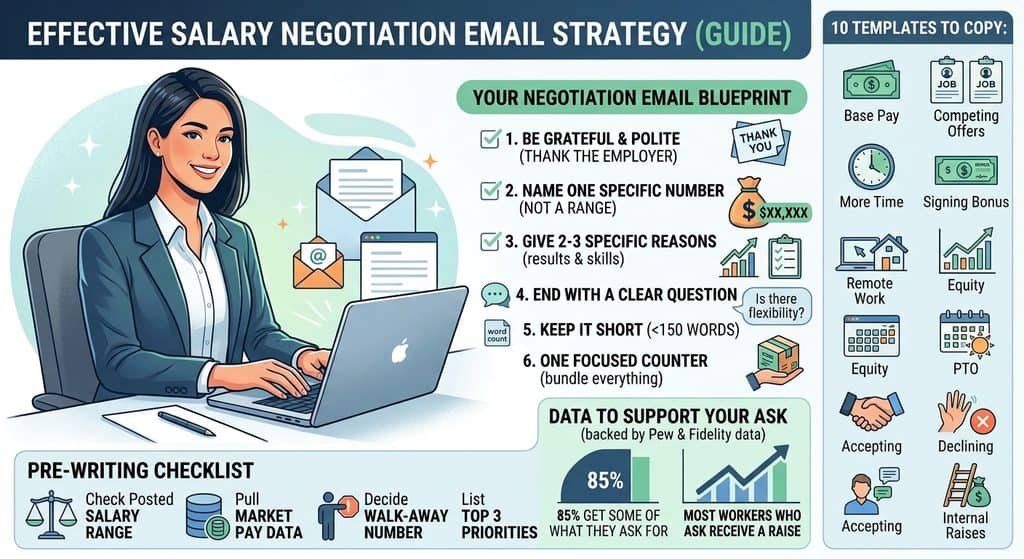
Quick answer: A good salary negotiation email thanks the employer, names one specific number, gives two or three reasons tied to the role, and ends with a clear question. Keep it under 150 words, send it within one or two business days of the written offer, and make one thoughtful counter rather than several small ones.
Who it suits: anyone holding a written offer, plus employees asking for a raise when a promotion lands. The 10 templates below cover base pay, competing offers, extra time, signing bonuses, remote work, equity, PTO, accepting, declining and internal raises.
What to check: the posted salary range (many states now require one), market pay data for your role and city, and the full package before you reply, because base salary is only one lever.
Is it actually safe to negotiate a job offer by email?
Negotiating a job offer by email is safe in most cases, and the data says most people who ask get something. A Pew Research survey of more than 5,000 US workers found that most did not ask for higher pay the last time they were hired. Among those who asked, 28% received the amount they requested and 38% received more than the first offer but less than their ask.
Fidelity found a similar pattern. In its 2022 study, reported by CNBC, 58% of Americans accepted their current job offer without negotiating, yet 85% of those who countered on salary or benefits got at least some of what they asked for. Fidelity’s negotiation guide adds that 73% of employers are willing to negotiate an initial offer.
Email is not risk free. In an r/careerguidance thread about an $85k offer, a few commenters described offers being pulled after aggressive counters, including one person who asked for $13,000 more base plus a $15,000 signing bonus. The original poster, who asked for $90k, ended up with $85k plus a $5,000 signing bonus. Polite, specific counters rarely cost you the job; large demands with no rationale sometimes do.
What should you know before you write the email?
First, check whether the job posting lists a pay range. Paycor’s tracker of state transparency laws counts 16 states plus Washington, DC with some form of pay transparency law, and states such as California, Colorado, New York and Washington require ranges in job postings. Indeed Hiring Lab found that 57.8% of US postings on Indeed included some pay information by September 2024, and 97.7% of New York postings did.
Second, pull market wage data. The Bureau of Labor Statistics OEWS program publishes annual wage estimates for about 830 occupations at national, state and metro level, a neutral number a recruiter cannot dismiss. Employer side tools such as Payscale are what many HR teams use to set bands, and our compensation software directory shows how those bands get built.
Third, decide your walk away number and your top three priorities before you type. If a recruiter asked about your current pay earlier in the process, our guide on salary history bans explains what you can decline to share.
What should you ask for in each situation?
| Your situation | What to ask for | Template to use |
|---|---|---|
| Offer sits below the posted range midpoint and you meet every requirement | A specific base number near or above the midpoint | 1. Base salary counter |
| You hold a written offer from another employer | A match or a number close to the other offer | 2. Competing offer |
| You are waiting on another process or need to review benefits | A firm decision date, usually 3 to 5 business days | 3. More time |
| Recruiter says base is at the top of the band | A one time signing bonus or an earlier salary review | 4. Signing bonus |
| Salary is fine but the commute or schedule is not | Remote days, core hours or a written hybrid agreement | 5. Remote or flexibility |
| Startup or public company offering stock | More shares or units, plus vesting and strike price details | 6. Equity |
| You would lose accrued vacation by leaving | Extra PTO days in year one or a later start date | 7. PTO |
| Promotion offered with a small raise | A raise that lands inside the new role’s range | 10. Internal raise |
What does a base salary counter email look like?
A base salary counter works best when it names one number, not a range. One reply in an r/jobs thread about a wordy counter draft gave blunt advice: do not give a range now, give a number, and cut the email down, because a negotiation is not an opening statement at a trial.
Template 1: Base salary counter
Subject: [Job title] offer: compensation question
Hi [Name],
Thank you for the offer for the [Job title] role. I am excited about [project or goal you discussed].
Before I sign, I would like to discuss base salary. Based on my [X] years in [skill area], my results in [one measurable win], and market data for this role in [city], I am asking for a base of $[number]. If we can reach that figure, I am ready to accept this week.
Is there flexibility to get there?
Best,
[Your name]
Template 2: Counter using a competing offer
A competing offer only helps if it is real and in writing.
Subject: [Job title] offer: update before I decide
Hi [Name],
Thank you again for the offer. [Company] is my first choice.
I want to be transparent: I have received a written offer from another employer with a base of $[number] and [bonus or equity detail]. I would much rather join your team. If you can bring the base to $[number], I will accept.
I need to respond to the other employer by [date]. Could we talk before then?
Thanks,
[Your name]
Template 3: Asking for more time
Subject: Timing on the [Job title] offer
Hi [Name],
Thank you for the offer. I am very interested.
Could I have until [specific date, 3 to 5 business days out] to respond? That gives me time to review the benefits documents.
Best,
[Your name]
How do you negotiate when the base salary is capped?
When a recruiter says the base is fixed, other levers usually remain. Robert Half suggests pivoting to a signing bonus, extra vacation or a salary review in six months when base pay will not move. Our guide to negotiating a signing bonus covers how to size the request.
Template 4: Signing bonus when base is capped
Subject: Re: [Job title] offer
Hi [Name],
I understand $[number] is the ceiling for this level.
To help close the gap, would you consider a one time signing bonus of $[number]? Leaving now means I give up [annual bonus, unvested match or other specific item] worth about that amount.
I would also welcome a formal compensation review at six months.
Best,
[Your name]
Template 5: Remote work or flexibility
Flexibility requests work best when they sound like a business plan rather than a perk. Our article on negotiating remote work goes deeper on framing.
Subject: [Job title] offer: working arrangement
Hi [Name],
I am pleased with the offer and ready to move forward on compensation.
One item I would like to confirm in writing is the working arrangement. I am asking for [two remote days per week / fully remote with quarterly onsite visits / core hours of 10 to 4]. I delivered [result] under that setup in my current role.
Can we add that to the offer letter?
Thanks,
[Your name]
Template 6: Equity
Subject: Questions on the equity portion
Hi [Name],
Thank you for the offer. Before I decide, could you share a few equity details: the total shares outstanding, the strike price or current valuation, the vesting schedule and cliff, and the exercise window if I leave?
Given the base is below my target, I would like to ask for [number] additional [options / RSUs] to bring the total package closer to $[number] a year.
Best,
[Your name]
Template 7: Extra paid time off
Subject: [Job title] offer: time off
Hi [Name],
I am happy with the offer. By leaving now, I forfeit [number] days of accrued vacation. Could the offer include [number] additional PTO days in my first year, or a start date of [date] so I can take a short break before joining?
If that works, I am ready to sign.
Best,
[Your name]
How do you accept or decline after negotiating?
Once you agree, put every term in writing before you resign from your current job. Robert Half recommends the document cover salary, any signing bonus and the job duties. When you are ready to leave your current employer, our guide to giving two weeks notice covers the next step.
Template 8: Accepting after negotiation
Subject: Accepting the [Job title] offer
Hi [Name],
Thank you for working through the details. I am delighted to accept the [Job title] role with a base salary of $[number], [signing bonus / remote arrangement / PTO], and a start date of [date].
Could you send the updated offer letter reflecting these terms? I will sign as soon as it arrives.
Looking forward to joining the team,
[Your name]
Template 9: Declining gracefully
Subject: [Job title] offer
Hi [Name],
Thank you for the offer and your time. After careful thought, I have decided to decline. The gap between the offer and my target of $[number] was too wide for me to accept at this point.
I would be glad to stay in touch if a future role fits better.
All the best,
[Your name]
How do you counter a raise that comes with a promotion?
Internal raises follow different rules because your employer already knows your work. Some states help here: Paycor notes that Washington requires employers to disclose pay for internal transfers and promotions when an employee asks, and California requires employers to give current employees the pay scale for their position on request. Ask for the new role’s range before you counter, then aim for a number inside it. If the promotion itself has not been offered yet, start with our guide on asking for a promotion.
Template 10: Counter for an internal raise
Subject: Compensation for the [New title] role
Hi [Manager name],
Thank you for the promotion to [New title]. I am excited to take on [new scope].
I would like to discuss the salary. The proposed $[number] sits near the bottom of the [New title] range of $[range]. Over the past year I [two measurable results]. I am asking for $[number], which places me at the range midpoint.
Could we review that before the change is finalized?
Thanks,
[Your name]
If raises keep landing below the range, our checklist of signs you are underpaid helps you decide whether to push harder or look outside.
What are the most common salary negotiation email mistakes?
| Mistake | Why it hurts | Fix |
|---|---|---|
| Giving a range instead of a number | The employer anchors on the bottom of your range | Name one figure |
| Citing your current salary or personal bills | Pay should reflect market value for the role, not your expenses | Cite market data and results |
| Countering after you already accepted | Robert Half says this is not good form | Negotiate before you sign |
| Countering several times over small amounts | Robert Half advises one thoughtful counter, two at most | Bundle every ask into one email |
| Bluffing about a competing offer | Employers may ask for proof or call your bluff | Mention only written offers |
| Forgetting the rest of the package | Bonus, equity and PTO can be worth more than a small base bump | Review total compensation first |
Should you send the email or pick up the phone?
Email gives you a written record and time to choose your words. Two commenters in the r/jobs thread still preferred a phone call, noting that emails can be misread. A sensible approach is to send the email with your number and reasons, offer a short call, and follow up any verbal agreement with the acceptance template. Our guide on replying to offers covers the first reply, and engineers can adapt the engineering email templates for technical roles.
Quick answers
How much should I ask for in a salary counter?
Anchor to market data and the posted range rather than a fixed percentage. A counter that lands near or slightly above the range midpoint, backed by specific results, is easier for an approver to sign off.
Can an employer withdraw an offer because I negotiated?
Yes, an employer can legally withdraw an offer in most US states, but Pew and Fidelity data show that most people who ask receive something.
Should I mention my current salary in the email?
No. Your current pay is not a reason the new role is worth more, and several states ban salary history questions.
Is it okay to negotiate an internal promotion raise?
Yes. Ask HR for the new role’s pay range first, then counter to a number inside it with evidence of the work you already do.
What if they say no to everything?
Ask for a six month salary review in writing. If the gap is still too large, decline politely with Template 9.
The bottom line
The best salary negotiation email is short, specific and grateful: one number, two or three reasons, and a clear question. Most people who ask get at least part of what they want, so the bigger risk is not asking. Check the posted range and market data first, bundle every request into one message, and get the final terms in writing. For more job search and pay guides, browse our career advice hub.
Sources: Pew Research Center, CNBC on Fidelity, Fidelity, Paycor, Indeed Hiring Lab, BLS OEWS, Robert Half, r/careerguidance thread, r/jobs thread
Free newsletter
Get the Work Insiders weekly
One email a week: the recruiting and HR tech news that mattered, the tools we just added to the directory, and one practical guide. No spam, and you can unsubscribe in one click.