

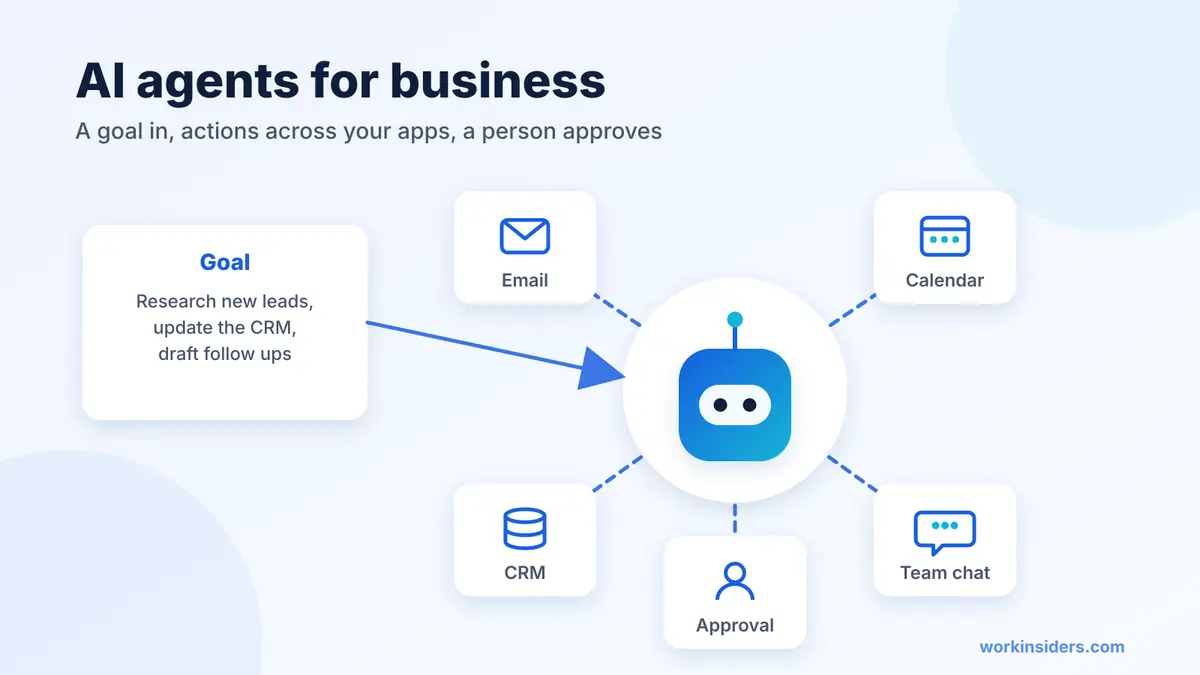
Quick answer: An AI agent for business is software that takes a goal, decides the steps, uses your apps to carry them out and reports back, instead of only answering a question. In 2026 most businesses get agents three ways: inside software they already pay for (Salesforce, Microsoft, LinkedIn Recruiter), from an automation platform such as Zapier, Make or n8n, or as an AI teammate product such as Lindy. Entry prices run from free tiers to about $50 a user a month, and usage based plans bill per action or per credit.
The catch: Gartner expects over 40% of agentic AI projects to be canceled by the end of 2027. Start with one narrow, repetitive job, keep a human approval step on anything that sends, deletes or decides about a person, and measure the time saved.
Who this is for: owners and operators of small and mid sized businesses, including recruiting and staffing firms, deciding where agents fit.
What is an AI agent for business?
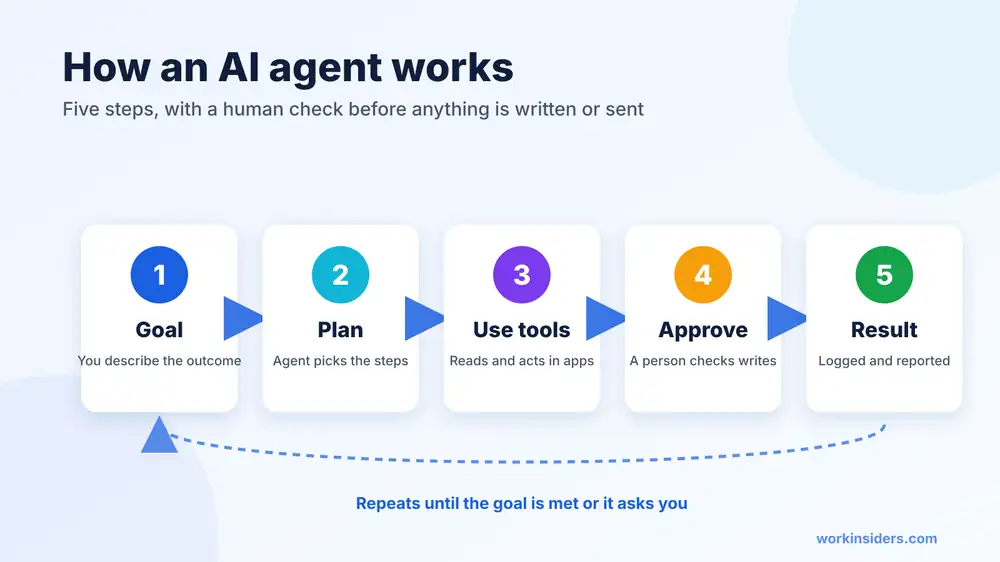
An AI agent is an AI model connected to tools, given a goal and allowed to work through the steps on its own. A chatbot answers. An automation follows the exact steps you wrote. An agent sits between the two: you describe the outcome, and it picks which app to search, what to read, what to draft and when to stop or ask you.
The word is used loosely. Gartner calls the habit of relabeling chatbots, assistants and robotic process automation as agents “agent washing”, and estimates only about 130 of the thousands of agentic AI vendors are real, per its June 2025 forecast. A simple test: if the product cannot take an action in another app without you clicking each step, it is an assistant, not an agent.
| Chatbot or assistant | Automation (Zap, scenario, flow) | AI agent | |
|---|---|---|---|
| You give it | A question | Exact steps | A goal and the tools it may use |
| Decides the steps | No | No | Yes |
| Acts in your apps | Rarely | Yes | Yes |
| Same result every run | No | Yes | No |
| Best for | Drafting and research | High volume, fixed rules | Varied tasks that need judgment |
How many businesses actually use AI agents in 2026?
Fewer than the headlines suggest, and mostly large ones. McKinsey’s 2026 State of AI survey found that 40% of respondents from organizations with more than $1 billion in revenue report scaling AI agents in at least one function, up from 27% a year earlier, while smaller organizations stayed flat at 22%, per McKinsey’s survey. Across all respondents, about two in ten report reaching the scaling phase with agents.
Gartner’s numbers point the same way. Its latest AI hype cycle says only 17% of organizations have deployed AI agents today, while more than 60% expect to within two years, per Gartner’s hype cycle. Separately, Gartner predicts 40% of enterprise applications will include task specific agents by the end of 2026, up from less than 5% in 2025, per its enterprise apps forecast. In plain terms, many small businesses will meet their first agent inside software they already own.
What kinds of AI agents can a small business buy?
There are four practical routes. Most businesses end up using two of them.
| Route | Examples | How it is priced | Best for |
|---|---|---|---|
| Agents built into software you already pay for | LinkedIn Hiring Assistant, Salesforce Agentforce, Microsoft Copilot Studio | Add on license or usage credits | Teams already standardized on that platform |
| Automation platforms with agent steps | Tasks, credits or workflow runs | Connecting many apps with some judgment in the middle | |
| AI teammate products | Lindy, Rerun, Tasklet | Per seat plus credits | Inbox, calendar and recurring admin work |
| Agent builders | Subscription plus usage | Research, enrichment and multistep outreach prep |
A fifth option is growing fast: connecting an assistant you already use, such as Claude or ChatGPT, to your apps through MCP servers so it can act on your data. We track which recruiting tools offer this in our MCP server guide.
How much do AI agents for business cost?
Prices below come from each vendor’s own pricing page, checked in November 2026. Agent pricing changes often, so confirm before you buy.
| Product | Entry price | What you get |
|---|---|---|
| Zapier Agents | Free, then $33.33 a month billed yearly | 400 activities a month free, 1,500 on Pro |
| Microsoft Copilot Studio | $200 a month per pack | 25,000 Copilot Credits a month, or pay as you go |
| Salesforce Agentforce | $500 per 100,000 Flex Credits | Per action billing, plus per user licenses |
| Lindy | $49.99 a user a month | 5,000 credits a month, $50 in free credits to start |
| Gumloop | $37 a month | Pro plan; enterprise plans by quote |
| n8n | €20 a month billed yearly | 2,500 workflow runs with agents, MCP and AI nodes |
Sources: Zapier pricing, Copilot Studio pricing, Agentforce pricing, Lindy pricing, Gumloop pricing, n8n pricing.
Notice how few of these are a flat fee. Most agents bill by what they do, so a busy agent costs more than a quiet one. Zapier is moving its standalone Agents product into AI by Zapier steps that draw from the normal task allowance, per Zapier’s migration note. McKinsey found about one in five organizations say AI operating costs, including token costs, already limit their AI use. Set a monthly cap before you switch an agent on.
Which business tasks are a good fit for an AI agent?
Agents do best on work that repeats every day, follows a loose pattern and is cheap to check. They do worst on one off decisions with a high cost of being wrong.
| Good fit | Poor fit |
|---|---|
| Researching a company or contact before a call | Deciding who gets hired, promoted or let go |
| Sorting an inbox and drafting replies for review | Sending money or signing contracts |
| Enriching new leads and updating the CRM | Deleting records without a backup |
| Meeting prep and follow up notes | Anything a regulator expects a person to own |
| Summarizing applications against a job brief | Rejecting candidates with no human review |
What does this look like in a recruiting or staffing business?
Recruiting is one of the clearest examples because so much of the day is search, screen and follow up. LinkedIn says recruiters using its Hiring Assistant review 81% fewer profiles to find a qualified match and see 66% higher InMail acceptance rates, per LinkedIn’s product page. Those are vendor figures, not independent tests, but they show where the time goes. Smaller agencies get similar help from agents that watch hiring signals, keep the ATS current or prep candidate submittals. Browse working examples on our AI agents page.
Why do so many AI agent projects fail?
Gartner gives three reasons for its forecast that over 40% of agentic AI projects will be canceled by the end of 2027: escalating costs, unclear business value and inadequate risk controls. Its analyst also notes that many use cases sold as agentic do not need an agent at all, per the Gartner release.
Governance is the second trap. Gartner predicts that by 2027, 40% of enterprises will demote or decommission autonomous agents because of governance gaps found only after something goes wrong in production, per its governance warning. Its advice is to match controls to what each agent can do: read only agents need light rules, while agents that write, send or delete need approvals, logs and a fast way to switch them off.
For small businesses the failure is usually simpler. Someone builds an agent for a vague job like “handle my email”, it makes a few odd choices, trust drops and nobody uses it again. A narrow job with a clear “done” avoids most of this.
How should a small business start with AI agents?
- Pick one job you do at least weekly. Write down the steps, the apps involved and how long it takes now.
- Check what you already own. Your CRM, ATS or Microsoft 365 plan may include an agent. That is usually cheaper than a new tool.
- Start read only. Let the agent research and draft before it can send or change anything.
- Add approvals on writes. Zapier, for example, lets you require approval before an AI step uses a tool that creates, updates or deletes data, per its AI step guide.
- Cap spend and review weekly. Track runs, cost and minutes saved for four weeks, then decide to expand or stop.
- Write the rules down. A one page policy on which data agents may touch saves arguments later. Our AI policy template is a good start.
If the job turns out to be fixed and predictable, you may not need an agent. A plain automation is cheaper and gives the same result every time. Our guide to AI workflow automation tools compares the main platforms, and our AI automation tools list covers twelve options with prices.
What should an agent never do without a person approving it?
Send external email in your name for the first time, change pay or billing, delete records, reject a job applicant or share personal data outside your company. Keep a person on each of those, even when the agent is usually right.
Quick answers
What is the difference between an AI agent and an AI assistant?
An assistant answers and drafts when you ask. An agent works toward a goal on its own, choosing steps and using your apps along the way.
Are AI agents worth it for a small business?
For narrow, repeated jobs such as lead research, inbox triage or meeting prep, often yes. For broad “run my business” goals, not yet.
What is the cheapest way to try an AI agent?
Use a free tier, such as Zapier’s free Agents plan with 400 activities a month, or an agent already included in software you pay for.
Do AI agents replace employees?
In practice they replace tasks. McKinsey found the share of people who expected AI related head count cuts last year was about double the share now reporting real cuts.
Are AI agents safe with customer or candidate data?
They can be, on business plans with admin controls, approvals on writes and only the connections the job needs.
What is the best AI agent for business automation?
There is no single best. Pick the one that connects to the apps you already use and bills in a way you can predict.
The bottom line
AI agents for business are real, useful and still early. The winners in 2026 are small, boring jobs with a clear finish line, run by an agent that lives in the software you already pay for or in an automation platform you can see into. Start read only, add approvals on anything that writes, cap the spend, and expand only after the numbers show time saved.
Sources: Gartner, June 2025, Gartner, August 2025, Gartner, May 2026, Gartner hype cycle, McKinsey State of AI, LinkedIn Hiring Assistant, Zapier, Microsoft, Salesforce, Lindy, Gumloop, n8n
Free newsletter
Get the Work Insiders weekly
One email a week: the recruiting and HR tech news that mattered, the tools we just added to the directory, and one practical guide. No spam, and you can unsubscribe in one click.