

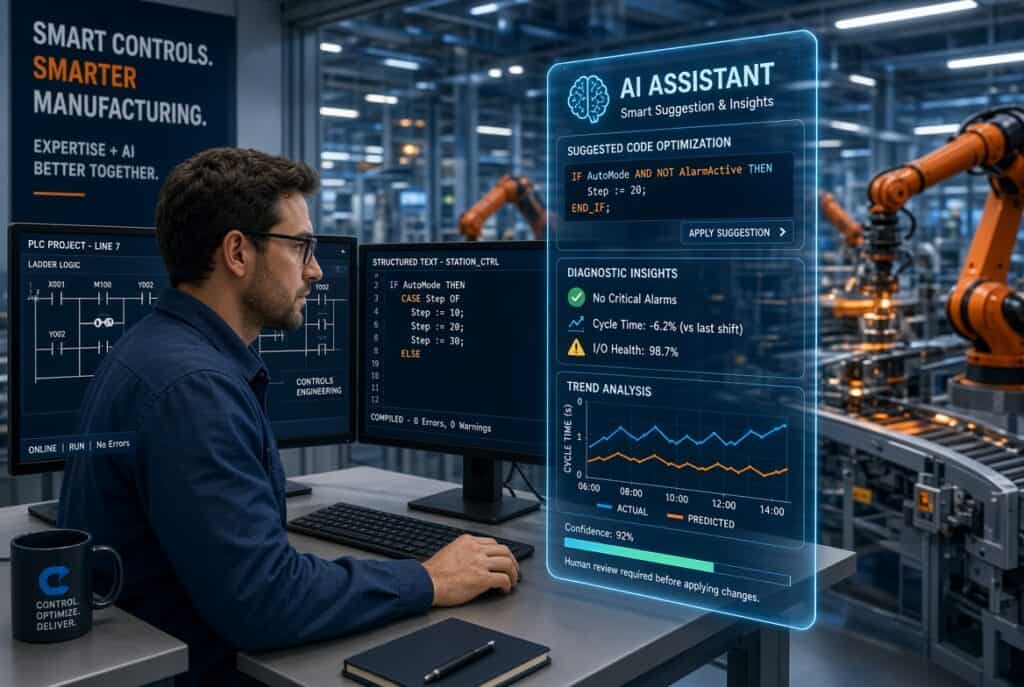
The short answer is no. AI is changing how PLC work gets done, but it is not eliminating the need for skilled controls engineers. In 2026, tools from Siemens, Rockwell, and others can generate code, draft documentation, and speed up routine tasks.
What they cannot do is understand a real process, take responsibility for safety, commission equipment on the plant floor, or troubleshoot systems under pressure.
Industrial engineers are projected to grow 11 percent from 2024 to 2034 according to the U.S. Bureau of Labor Statistics, much faster than the average for all occupations. PLC skills remain in active demand across automation engineer and controls roles.
The professionals who thrive are those who treat AI as a productivity tool while deepening process knowledge, safety expertise, and commissioning ability.
Will AI Fully Replace PLC Programmers in 2026?
No. AI will not fully replace PLC programmers in 2026 or in the foreseeable future.
AI tools can produce structured text, function blocks, and in some cases ladder logic from plain language descriptions. Vendors such as Siemens with its Eigen Engineering Agent and Rockwell with FactoryTalk Design Studio Copilot have embedded AI assistants directly into engineering environments. These tools can generate boilerplate routines, help with documentation, suggest test cases, and accelerate repetitive work.
The hard parts of the job remain human. Understanding the physical process, designing interlocks that protect people and equipment, validating behavior under real operating conditions, and standing behind the system when something goes wrong still require experienced engineers. AI generates suggestions. Engineers make decisions and accept accountability.
What Can AI Actually Do for PLC Programming Today?
AI is most useful for tasks that follow patterns and have clear structure.
It can generate standard motor control logic, batch recipes, or parameterized function blocks from a description. It can draft comments, alarm lists, and functional descriptions. It can assist with code migration from older platforms and help search technical manuals or error codes faster. Some specialized tools integrate with TIA Portal or Studio 5000 and attempt to respect project standards and hardware context.
Realistic efficiency gains on repetitive work range from about 15 to 30 percent in many field reports, with some vendor claims reaching higher on specific tasks. Complex custom applications see far smaller gains because heavy review and correction are still required.
AI output must always be reviewed. Subtle errors in timing, edge cases, or safety related logic can pass a first glance and still fail in production. No responsible engineer deploys unvalidated AI generated code to a live system.
What AI Still Cannot Do Reliably
AI lacks deep process knowledge. Every plant has unique equipment layouts, sensor behaviors, product variations, and historical quirks. An experienced engineer learns these through commissioning, conversations with operators, and time spent watching the process run.
Safety decisions remain human territory. Functional safety standards, risk assessments, and the final responsibility for safe operation cannot be outsourced to a language model. Regulatory accountability sits with the engineer and the company, not the software.
Commissioning and on site troubleshooting require presence and judgment. Sensors fail in unexpected ways. Mechanical issues interact with control logic. Operators report symptoms that do not match the code. AI cannot walk the floor, feel vibration, or negotiate a temporary bypass with the maintenance team.
Customer interaction, system architecture choices, and long term maintainability also stay with people. Writing code that another engineer can understand and modify years later is a skill AI does not fully master without strong human guidance.
How Are PLC Jobs and Salaries Looking in 2026?
Demand for PLC and controls skills remains solid. Job postings continue to list PLC experience for automation engineer, controls engineer, and systems integrator roles. A large wave of experienced engineers is approaching retirement, creating replacement openings even as overall automation adoption grows.
Industrial engineers show strong projected growth. Controls engineer total pay often falls in the $107,000 to $159,000 range according to recent compensation data, with medians around $130,000 in many reports. PLC programmers and technicians sit lower depending on experience and title, while senior controls engineers and specialists command higher figures, especially in regulated industries or complex system integration work.
The market rewards people who combine traditional PLC expertise with broader skills. Networking, HMI or SCADA knowledge, safety systems, structured text alongside ladder, and the ability to work with data or AI tools all strengthen a candidate’s position.
What Skills Should Manufacturing Engineers Focus On Now?
Process understanding comes first. The more you know about how the machine or line actually works, the harder you are to replace. Spend time with operators and maintenance. Learn the failure modes that never appear in the specification.
Safety and standards knowledge matter more, not less. As AI generates more code, the person who can review it against safety requirements and company standards becomes the quality gate.
Commissioning and troubleshooting experience remain high value. These skills are difficult to automate and are in short supply.
AI fluency is now useful. Learn how to prompt the tools inside your primary platform, how to review their output critically, and where they save time versus where they introduce risk. Treating AI as a junior assistant rather than a replacement produces the best results.
Broader system thinking helps. Understanding how PLCs connect to HMIs, networks, higher level systems, and data platforms positions you for more complex projects and higher responsibility roles.
How Should You Use AI Tools Without Creating Risk?
Start with low risk tasks. Use AI for documentation, comments, standard function blocks, or initial drafts of non safety logic. Always review every line before it enters the project.
Keep safety related code under strict human control. Validate AI suggestions against your standards and test thoroughly in simulation and on the machine.
Document what came from AI and what you changed. This supports traceability and future maintenance.
Combine AI speed with your process knowledge. The best results come when an experienced engineer directs the tool rather than accepting its first output.
Short Answers to Common Questions
Can ChatGPT or similar tools write production ready PLC code? They can generate usable starting points for structured text and some routines. Ladder logic generation remains weaker in general models. Production use always requires thorough review, testing, and engineering judgment.
Will AI reduce the need for junior PLC programmers? It may change how juniors spend their time by handling more boilerplate. Learning process knowledge, safety, and commissioning still requires hands on experience that AI cannot provide.
Should I learn AI tools as a controls engineer? Yes. Engineers who use them effectively complete routine work faster and free capacity for higher value tasks. Ignoring the tools puts you at a disadvantage compared with peers who adopt them carefully.
Is the PLC itself becoming obsolete? No. PLCs remain the reliable, deterministic layer for real time control. AI and higher level systems often sit above the PLC, feeding optimized setpoints or insights rather than replacing the controller.
What is the biggest risk if I ignore AI? You may spend more time on repetitive tasks while colleagues who use the tools deliver projects faster. The larger risk is failing to deepen the process and safety skills that AI cannot replace.
The reality in 2026 is clear. AI is a powerful assistant for PLC programmers and manufacturing engineers. It accelerates documentation, code drafting, and certain repetitive patterns. It does not understand the physical plant, accept safety responsibility, or replace the experience gained from commissioning and troubleshooting real systems.
Engineers who combine solid process knowledge with careful use of AI tools will be more productive and more valuable. Those who rely only on typing ladder logic without understanding the process will face more pressure. The job is evolving, not disappearing. Focus on the parts only humans can do well, and use the new tools to handle the rest.
Free newsletter
Get the Work Insiders weekly
One email a week: the recruiting and HR tech news that mattered, the tools we just added to the directory, and one practical guide. No spam, and you can unsubscribe in one click.