

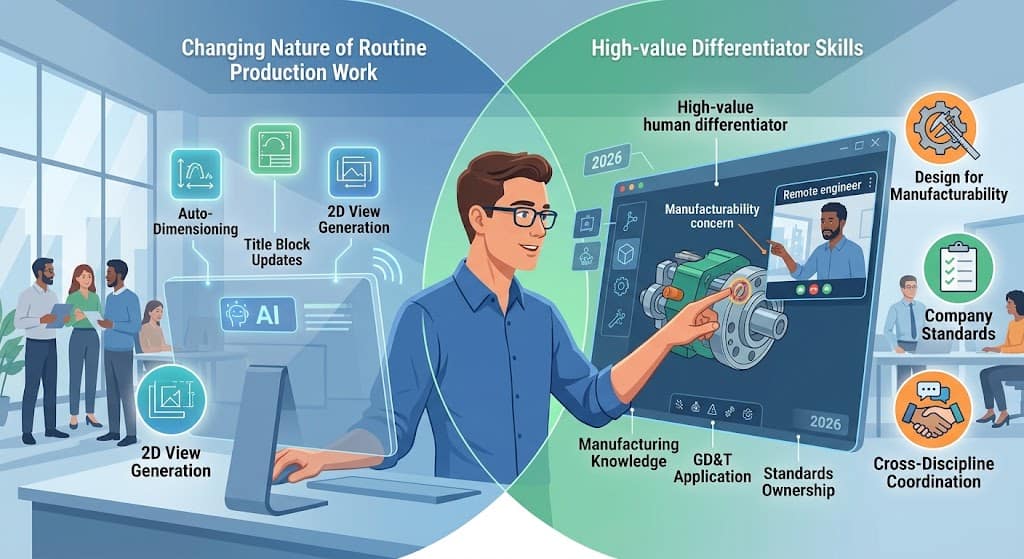
The core reality in 2026 is straightforward. AI is not eliminating CAD and drafting jobs. It is changing which parts of those jobs still command good pay and steady demand. Routine production work is getting faster and cheaper through software. Judgment, manufacturing knowledge, standards ownership, and the ability to direct AI tools are becoming the differentiators.
According to the U.S. Bureau of Labor Statistics, overall employment of drafters is projected to show little or no change from 2024 to 2034. About 16,200 openings are expected each year, mostly from people leaving the field or retiring rather than from strong new growth.
Mechanical engineers, by contrast, are projected to grow 9 percent over the same period, much faster than the average for all occupations.
Salary patterns already reflect this split. Pure production drafting roles have seen flat or slightly softer pay. Professionals who combine CAD skill with engineering judgment, BIM coordination, or AI supervision skills are pulling ahead. The people who treat AI as a collaborator rather than a threat are the ones employers are actively seeking.
Will AI Replace CAD Drafters in 2026?
No. AI will not fully replace CAD drafters in 2026 or in the near term after that.
Current tools excel at repetitive, rule based tasks. They handle title block population, standard view creation, basic dimension placement, PDF to DWG conversion, and routine annotation well. These are the parts of the job that once filled large portions of a junior drafter’s day.
What the tools still cannot do reliably is apply real world judgment. They struggle with ambiguous client intent, conflicting code requirements, manufacturability decisions, and professional accountability. Someone still has to decide which tolerance actually matters, whether a feature can be made economically, and whether the drawing set is ready to release under their name.
The shift is from production speed to verification and decision quality. Employers still need people who can catch the confident mistakes AI sometimes produces and who understand why a design is drawn a certain way.
What Skills Do Employers Actually Want Right Now?
Employers are moving away from hiring people who only produce drawings quickly. They want people who can direct tools, validate output, and contribute to better design decisions.
The highest value skills fall into a few clear groups.
Manufacturing knowledge ranks near the top. Understanding design for manufacturability, material behavior, tooling limits, and cost drivers lets you flag problems before they reach the shop floor. AI can generate geometry. It cannot yet replace deep process knowledge.
Tolerancing and GD&T remain durable. Deciding which dimensions are critical and how tight they need to be is still a human skill that protects quality and cost. Companies pay for people who own this judgment.
Standards fluency and company drawing standards ownership matter more than ever. When AI produces most of the boilerplate, the person who knows the required notes, layers, templates, and revision practices becomes the quality gate.
AI fluency itself is now expected. This does not mean becoming a machine learning engineer. It means knowing how to prompt the tools inside your CAD platform, how to review their output critically, and how to integrate them into a reliable workflow. Prompting well and validating thoroughly are practical skills you can build on the job.
Cross discipline coordination and communication continue to separate strong candidates. Clash detection, model coordination, and clear handoffs to manufacturing or construction teams still require human oversight and soft skills that software does not replace.
Some professionals add light scripting or automation skills (Python basics or platform specific rules such as iLogic). These help with repetitive internal processes and signal that you can improve team throughput. They are useful but secondary to manufacturing judgment and standards mastery.
How Can You Build These Skills Without Starting Over?
You do not need a new degree to stay competitive. Focused, practical steps work.
Start by deepening your manufacturing knowledge on the projects you already handle. Ask more questions about how parts are actually made. Review scrap and rework data when available. Study common process constraints for the materials and methods your company uses. This knowledge compounds quickly and is hard for AI to replicate.
Next, become deliberate about using the AI features already inside your primary CAD tools. Autodesk and other major platforms have added assistants, automated drawings, and generative options. Practice directing them on real work, then carefully checking the results. Track where they save time and where they introduce errors. That experience becomes concrete talking points in interviews and performance reviews.
Own your company’s standards completely. Volunteer to update templates, clean up libraries, or document best practices. The person who becomes the go to resource for “how we draw things here” gains influence and job security.
If your industry uses BIM or model based workflows, expand into coordination. Learning clash detection, model review, and basic collaboration tools opens higher paying paths such as BIM coordinator or digital delivery roles.
Build a simple portfolio of before and after examples. Show a drawing or model you improved with AI assistance, the checks you performed, and the manufacturing or quality insight you added. Concrete evidence of judgment beats generic claims about software proficiency.
What Do the Salary and Job Trends Actually Show?
The data points to a two track market.
General CAD drafter and operator roles without specialization often sit in the mid $60,000s to low $90,000s range, with limited upward pressure. Median pay for drafters overall was $65,380 in recent BLS figures.
Roles that add engineering level judgment or specialized coordination pay noticeably more. Mechanical and product design engineers with strong CAD skills commonly range from $118,000 to $143,000 according to compensation analyses. BIM managers and senior BIM engineers frequently clear $100,000 to $130,000.
Job openings for pure drafting remain steady because of turnover, but growth is concentrated in adjacent engineering and coordination positions. The path that protects both employment and earnings is moving toward those higher judgment roles rather than competing solely on drafting volume.
How Should You Talk About AI Experience in Interviews?
Hiring managers want to know that you use the tools productively and responsibly. Avoid both extremes: claiming AI will do everything or claiming you refuse to touch it.
Describe specific workflows. Explain how you use AI for initial layout or annotation, then the steps you take to validate dimensions, tolerances, and manufacturability. Mention any company standards or security practices you follow when working with AI generated content.
Emphasize the human value you still provide. Talk about catching errors the software missed, improving design for cost or quality, and coordinating with other disciplines. That combination of tool fluency plus judgment is what employers describe when they say they want AI ready candidates.
Short Answers to Common Questions
Is the pure CAD drafter role dying? The pure production focused version is shrinking in relative value. The broader role that includes judgment, standards ownership, and tool direction is evolving and still needed.
Should I learn Python as a CAD professional? It helps for automation and process improvement but is not the highest priority for most people. Manufacturing knowledge, GD&T, standards mastery, and practical AI tool fluency deliver faster returns for most drafters and designers.
Will salaries keep falling for traditional drafting work? Pressure exists on the purely production side. People who add the skills employers now pay premiums for are seeing stronger compensation trajectories.
What is the single highest leverage move in 2026? Treat AI as a time saver for routine work and invest the recovered time into deeper manufacturing understanding and standards ownership. That combination raises both your current value and your future options.
The professionals who thrive are not the ones who draw the fastest by hand or fight the tools. They are the ones who use the tools to free capacity for the work that still requires human expertise. Focus there, and your CAD or drafting career remains solid and adaptable well beyond 2026.
Free newsletter
Get the Work Insiders weekly
One email a week: the recruiting and HR tech news that mattered, the tools we just added to the directory, and one practical guide. No spam, and you can unsubscribe in one click.