

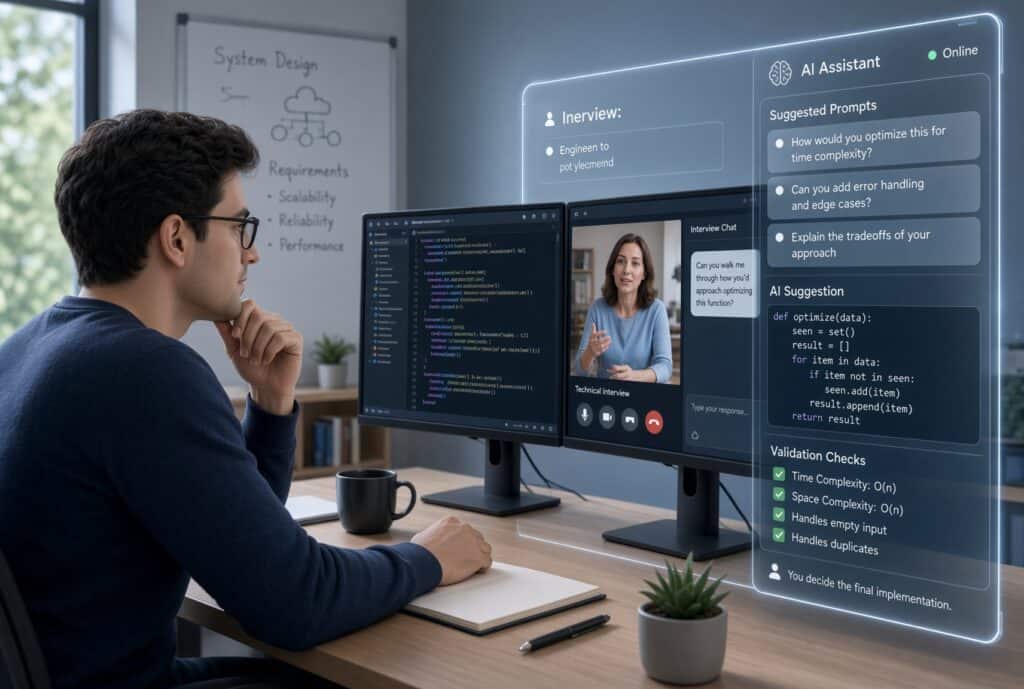
Engineering interviews in 2026 no longer test only whether you can write code from scratch under pressure. Major companies now evaluate how effectively you work with AI tools. Google is piloting AI assistants such as Gemini in code comprehension rounds. Meta, Canva, DoorDash, and others already allow or expect candidates to use tools like Copilot, Cursor, or Claude during technical sessions.
Interviewers score AI fluency, prompt quality, output validation, debugging of AI suggestions, and clear ownership of the final solution. Traditional LeetCode style recall still appears in some loops, but the stronger signal comes from how you direct AI, catch its mistakes, and explain your decisions. Candidates who treat AI as a junior collaborator rather than a magic solver perform better.
According to reporting on internal documents, Google interviewers specifically assess prompt engineering, output validation, and debugging skills during AI assisted rounds. This shift mirrors real work. Google has stated that a large share of its new code is AI generated and then reviewed by engineers.
Why Are Engineering Interviews Changing So Quickly?
Companies hire for the job as it exists today. Engineers now use AI daily for code generation, debugging, documentation, and exploration. Interview processes that ban AI test a skill that no longer matches the daily workflow.
When AI can produce correct solutions to classic algorithm problems in seconds, correctness alone stops differentiating strong candidates. The differentiator becomes process. How do you break down an ambiguous problem? How do you prompt the model effectively? How do you verify the output against requirements and edge cases? How do you improve a weak suggestion?
Canva publicly stated it expects candidates to use AI tools in technical interviews because nearly half of its engineers already use them daily. Other firms have moved toward realistic project based sessions or existing codebase analysis instead of pure whiteboard puzzles.
What Does an AI-Assisted Technical Interview Actually Look Like?
Formats vary by company, but common patterns have emerged.
In Google’s pilot code comprehension round, candidates receive an existing codebase. They read, debug, and optimize it while using an approved AI assistant. The interviewer watches how the candidate prompts the tool, evaluates suggestions, and decides what to keep or reject.
At Meta and similar companies, candidates often work in an environment that includes an AI chat panel alongside a code editor. Problems tend to involve extending existing code, fixing bugs, or adding features rather than inventing a full algorithm from a blank page. The AI can see the files but the candidate still controls what enters the final solution.
Some firms run open ended product style challenges where AI tools are expected. Others keep one traditional coding round without AI and add a separate AI assisted round so they can compare both skill sets.
Silence is usually a negative signal. Interviewers want to hear your reasoning as you work with the tool.
What Skills Do Interviewers Evaluate in These Rounds?
AI fluency ranks high. This includes writing clear prompts that give the model useful context, constraints, and expected output format. It also includes iterating when the first response falls short.
Output validation matters more than raw generation speed. Strong candidates read every line the model produces, test assumptions, check edge cases, and reject or rewrite weak parts. They never paste code they cannot defend.
Debugging AI suggestions is a core skill. Models can introduce subtle bugs, performance issues, or incorrect edge case handling. Interviewers watch whether you catch those problems.
Problem decomposition and ownership remain essential. You still need to clarify requirements, choose an approach, and take responsibility for the final design. AI accelerates the implementation path. It does not replace engineering judgment.
Communication while using the tool is scored. Explaining why you prompted a certain way, what you expected, and how you verified the result demonstrates senior level thinking.
How Should You Prepare for AI-Assisted Interviews?
Start using AI coding tools daily in real work or personal projects. Build muscle memory for prompting, reviewing, and refining. Cursor, Claude, Copilot, and Gemini are common options.
Practice on realistic codebases rather than only isolated LeetCode problems. Take an open source repository or a previous project, introduce bugs or incomplete features, and work through them with AI assistance while talking aloud.
Focus on verification habits. After every AI suggestion, ask yourself: Does this handle the stated requirements? What edge cases are missing? Is the complexity acceptable? Would I merge this as is?
Practice prompt structure. Include the goal, relevant constraints, examples of good or bad output when helpful, and the format you want. Refine the prompt when results are weak instead of accepting the first draft.
Prepare for both formats. Some loops still include traditional coding rounds without AI. Maintain fundamentals while adding AI collaboration skills.
Mock interviews that allow AI tools are more valuable than pure algorithm grind. Record yourself explaining decisions so you can improve narration under pressure.
How Do You Talk About AI Use During the Interview?
Be transparent and deliberate. Say what you are asking the model and why. For example: “I am giving the model the existing function signature and the performance constraint so it can suggest an optimized approach. I will then check the time complexity myself.”
Never treat the AI as an invisible cheat. Interviewers can usually see the chat history or at least observe your interaction pattern. Candidates who hide AI use or claim work they did not understand tend to fail follow up questions.
Own every line that ends up in the solution. If the model produced it, you still need to explain why it is correct and how you would maintain or extend it.
Discuss tradeoffs. Mention when you choose not to use AI because the problem is simple or because you need tighter control. That judgment itself is a positive signal.
Short Answers to Common Questions
Are AI tools allowed in technical interviews in 2026? At Google, Meta, Canva, and a growing number of other companies, yes in specific rounds. Policies differ by firm and even by team. Always confirm with the recruiter what is permitted.
What does Google evaluate in its AI assisted code comprehension round? Interviewers look at AI fluency, including prompt engineering, output validation, and debugging skills, along with the candidate’s ability to understand and improve existing code.
Should I still practice traditional LeetCode problems? Yes. Fundamentals still matter and some rounds remain AI free. Pair that practice with AI assisted work on larger, messier codebases.
How do I show strong AI collaboration skills? Narrate your process, write precise prompts, critically review every suggestion, catch errors the model makes, and take clear ownership of the final code.
Will this format replace all coding interviews? Not completely or immediately. Hybrid loops are common. Companies want both solid fundamentals and modern AI collaboration ability.
The engineering interview of 2026 rewards the same traits that matter on the job: clear thinking, careful validation, and the ability to multiply productivity with tools while remaining fully accountable for the result. Candidates who practice directing AI, verifying its output, and explaining their decisions will be ready for this shift. Those who only memorize solutions or treat AI as a black box will find the new formats harder to pass.
Prepare by using the tools the way strong engineers use them every day. That approach aligns interview performance with real world performance and gives you the best chance of success.
Free newsletter
Get the Work Insiders weekly
One email a week: the recruiting and HR tech news that mattered, the tools we just added to the directory, and one practical guide. No spam, and you can unsubscribe in one click.