

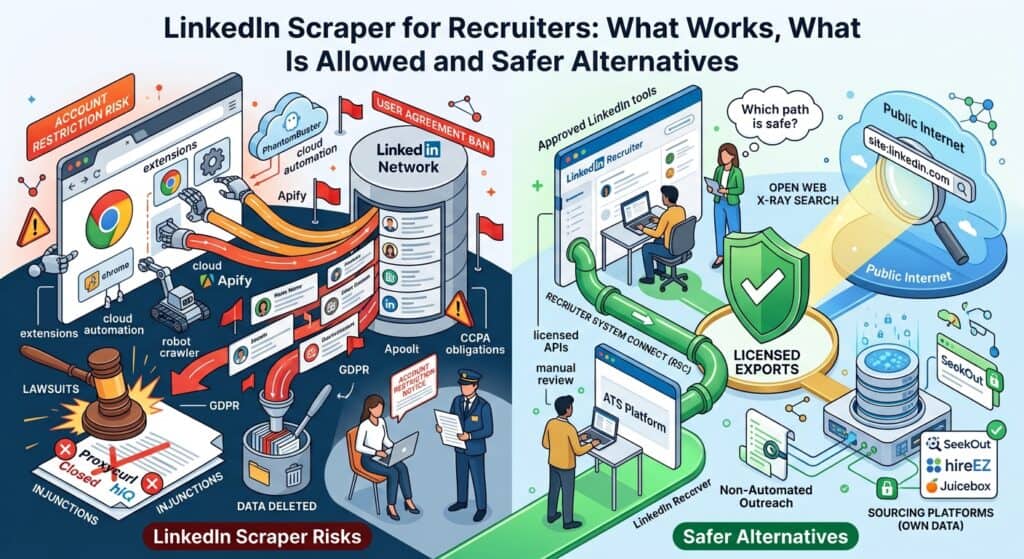
Quick answer: A LinkedIn scraper is any tool that copies profile data out of LinkedIn automatically, from Chrome extensions to cloud bots, Apify actors, data APIs and n8n workflows. LinkedIn’s User Agreement bans all of them, and LinkedIn has spent 2025 and 2026 suing the vendors that scrape at scale. For a recruiter, the real exposure is your own account and the candidate data you store, so the safer path is LinkedIn’s own exports, ATS integrations, open web X ray and sourcing platforms that bring their own data.
What changed in 2026: Proxycurl is gone after a LinkedIn lawsuit, ProAPIs is now permanently barred by a court judgment, and a federal judge tossed the “BrowserGate” suits over LinkedIn scanning users’ browser extensions. The enforcement trend points one way.
Who this is for: Recruiters, sourcers and agency owners who are shopping for a LinkedIn scraper, or who just got a restriction notice and want to know why.
What does “LinkedIn scraper” actually mean for a recruiter?
“LinkedIn scraper” covers five kinds of product that all pull names, titles, companies, work history and sometimes contact details out of LinkedIn into a spreadsheet, CRM or ATS. Your risk depends on which kind you use and whose account it runs through.
Chrome extensions
These run in your browser while you are logged in. Some export search results to CSV, some grab the profile on screen, and many “LinkedIn scraper email” tools add an email or phone lookup. LinkedIn sees the activity as yours.
Cloud automation like PhantomBuster
PhantomBuster’s LinkedIn Profile Scraper takes a list of profile URLs plus your LinkedIn session cookie and returns 44 data points per profile, with optional email discovery through partners like Hunter or Snov.io. The bot runs in the cloud, but it still acts as you, because it uses your cookie.
Apify actors
Apify is a marketplace of community built scrapers called actors. One popular listing, the Mass Profile Scraper, says it needs no LinkedIn cookies and returns work history, education, skills and attempted email and mobile lookups for $10 per 1,000 results. “No cookies” lowers your account risk, not the terms issue.
Data APIs and bulk datasets
Vendors such as Bright Data sell prebuilt LinkedIn datasets and a scraper API. Proxycurl was the best known API here until it shut down in July 2025.
AI agents and n8n or Clay workflows
The newest version chains a scraper to an AI model. A typical n8n workflow template launches a PhantomBuster agent with your LinkedIn session cookie, parses the output with GPT 4 and drafts outreach. The AI layer is new; the scraping underneath is the same, and so is the account risk.
| Type of tool | Examples | What it does | Risk level for a recruiter | Better for |
|---|---|---|---|---|
| Bulk export Chrome extension | Search result exporters, profile grabbers | Copies search results or profiles from your logged in session | High: runs on your account, named in LinkedIn’s ban on plugins | Nothing you cannot do with Recruiter exports |
| Contact finder extension | Email and phone lookup tools | Looks up contact details for one profile you are viewing | Medium: lower volume, but still a third party extension on LinkedIn | One at a time outreach to a shortlist |
| Cloud automation | PhantomBuster, n8n templates | Runs profile scraping and messaging from the cloud using your cookie | High: automated activity tied to your account | Sales teams willing to accept restriction risk |
| Scraper marketplaces | Apify actors | Scrapes profiles without your login, sells results per 1,000 | Medium for your account, high for data use and privacy | Market mapping, not candidate databases |
| Data APIs and datasets | Bright Data; Proxycurl (closed 2025) | Sells LinkedIn profile records in bulk | Vendor risk: suppliers can be sued and shut down | Data teams with legal review |
| Licensed LinkedIn products | LinkedIn Recruiter, RSC | Search, save and sync candidates to your ATS inside LinkedIn’s rules | Low | Any recruiter sourcing on LinkedIn daily |
| Sourcing platforms with their own data | SeekOut, hireEZ, Juicebox | Search their own profile indexes and your ATS | Low to medium: ask how the vendor gets its data | Volume sourcing and agentic workflows |
What does LinkedIn’s User Agreement say about scraping?
Section 8.2 of the LinkedIn User Agreement lists what members agree not to do. Item 2 is the scraping ban: you agree you will not “Develop, support or use software, devices, scripts, robots or any other means or processes” (the clause names crawlers and browser plugins as examples) “to scrape or copy the Services, including profiles and other data from the Services.”
Two other items in the same list matter just as much for recruiters. One bars using “bots or other unauthorized automated methods” to “add or download contacts” or “send or redirect messages.” Another bars copying or distributing information obtained from LinkedIn “whether directly or through third parties (such as search tools or data aggregators or brokers)” without the content owner’s consent. So buying scraped data from a vendor does not escape the rule.
LinkedIn repeats this on its prohibited software page: it does not permit any third party software, including crawlers, bots, browser plugins or browser extensions, that scrapes, changes the appearance of, or automates activity on LinkedIn’s website. There is no carve out for recruiting or public profiles.
Did my LinkedIn account get restricted because of a Chrome extension?
Quite possibly. This is one of the most common questions recruiters post on Reddit, and LinkedIn’s own help center answers it directly: any member who uses prohibited tools “risk[s] having their accounts restricted or shut down,” and the tools themselves may stop working without notice, according to the LinkedIn Help page.
LinkedIn also looks for extensions. In the 2026 “BrowserGate” dispute, Ars Technica reported that LinkedIn did not deny scanning browsers to identify extensions, and told the court it uses detection systems to find automated scraping and bot activity. The same report says a German tribunal found that the Teamfluence software, sold as a Chrome plugin, violated LinkedIn’s User Agreement and that LinkedIn’s suspension of the claimants’ accounts was “objectively justified.”
Your network, InMail history and often your Recruiter seat hang off that account. If it was restricted while you ran an exporter or automation tool, remove the tool before you appeal.
Is scraping LinkedIn legal?
It depends, and the trend is against scrapers. hiQ Labs v. LinkedIn is often quoted as proof that scraping public profiles is legal. That reading is incomplete.
What did hiQ v. LinkedIn actually decide?
In April 2022 the Ninth Circuit held that the federal anti hacking law’s “without authorization” provision does not apply to public websites like LinkedIn, according to a Morgan Lewis analysis. But in November 2022 the district court ruled that user agreement provisions banning scraping and fake profiles are enforceable as a contract. In December 2022 the parties settled with a stipulated $500,000 judgment against hiQ, a permanent injunction against scraping LinkedIn, and orders to delete its code and LinkedIn data. hiQ won the hacking argument and still had to stop.
What happened to Proxycurl?
LinkedIn sued Proxycurl’s parent Nubela in January 2025 in Northern California, alleging fake accounts were used to scrape millions of profiles and resell the data, with claims including breach of contract and fraud, as Law.com reported. On July 4, 2025, the CEO announced Proxycurl was shutting down, writing that “there is no winning in fighting this.” LinkedIn later said the resolution requires Proxycurl to permanently delete LinkedIn data obtained through unauthorized means, entered as a permanent injunction, per Social Media Today.
Has LinkedIn sued other scrapers since?
Yes. In October 2025 LinkedIn sued ProAPIs and its CEO, alleging a network of millions of fake accounts and customers paying up to $15,000 a month for scraped data, according to The Record. In September 2026 a consent judgment permanently barred ProAPIs from accessing LinkedIn data through fake accounts, bots or other automated technologies and from selling that data, Bloomberg Law reported.
The pattern: LinkedIn sues vendors, not individual sourcers, but when a vendor loses, its tool disappears from your workflow overnight. This is general information, not legal advice.
| Date | Event | Why it matters to recruiters |
|---|---|---|
| 2017 | District court grants hiQ an injunction against LinkedIn blocking it | Start of the “public data is fair game” argument |
| April 2022 | Ninth Circuit: anti hacking law’s “without authorization” does not cover public sites | Scraping public pages is not automatically a federal hacking crime |
| November 2022 | Court rules LinkedIn’s anti scraping terms are enforceable as a contract | Breaking the User Agreement is a real legal exposure |
| December 2022 | hiQ settlement: $500,000 judgment, permanent injunction, data deletion | The “winner” of hiQ still had to stop and delete everything |
| January 2025 | LinkedIn sues Nubela and Proxycurl | Developer APIs built on LinkedIn data are a target |
| July 2025 | Proxycurl shuts down; injunction requires data deletion | Tools built on Proxycurl lost their data source |
| October 2025 | LinkedIn sues ProAPIs over a fake account scraping operation | Enforcement continues against paid data resellers |
| September 2026 | BrowserGate suits over extension scanning dismissed | LinkedIn keeps detecting browser extensions |
| September 2026 | Consent judgment permanently bars ProAPIs from LinkedIn data | Second major data vendor removed from the market |
What privacy rules apply to scraped candidate data?
Even if a tool never touches your account, the data you store is your responsibility.
GDPR, if you source in Europe
When you collect personal data about someone from a source other than that person, GDPR Article 14 requires you to tell them who you are, why you hold their data, your legal basis, how long you will keep it and which source it came from. You must do this within a reasonable period and at the latest within one month, or at your first communication if you plan to contact them. A spreadsheet of 5,000 scraped European engineers creates 5,000 of those obligations.
CCPA, if you hold Californians’ data
The California Attorney General explains that covered businesses must honor California residents’ requests to know what personal information is held about them, to delete it and to correct it, and must give notice at or before collection. Names and email addresses count as personal information.
In practice: keep only candidates you have a reason to contact, record each record’s source, and set a retention period in your ATS.
What are the safer alternatives to a LinkedIn scraper?
Most recruiters want a scraper to get profiles into the ATS, find contact details or build lists faster. Each has a safer route.
LinkedIn Recruiter and Recruiter System Connect
If your goal is “get LinkedIn candidates into my ATS,” use LinkedIn’s own pipe. Recruiter System Connect links LinkedIn Recruiter with certified ATS partners, adds in ATS indicators and one click export, and is included with Recruiter Corporate and Recruiter Professional Services seats at no extra LinkedIn cost. It is not available on Recruiter Lite. If the seat price is the blocker, compare options in our guide to LinkedIn Recruiter alternatives.
Contact finders, used one profile at a time
A contact finder that looks up one candidate you have already found is very different from bulk exporting a search. It is still a third party extension, so not risk free, but it does not copy LinkedIn’s data at scale. We compare these tools in personal email finders.
Open web X ray
X ray searching uses Google or Bing to find public LinkedIn profiles without automating anything inside LinkedIn. A string such as site:linkedin.com/in "data engineer" "Austin" -jobs returns profiles you then review by hand.
Sourcing platforms with their own data
AI sourcing tools build their own indexes from many sources. SeekOut says it searches more than 1 billion profiles alongside your ATS, and hireEZ says its database holds over 1 billion profiles sourced from the open web. Juicebox works similarly. Ask each vendor in writing where its data comes from, because Proxycurl showed that a supplier’s lawsuit becomes your outage. See our SeekOut alternatives and the full sourcing tools directory.
Outreach without automation on LinkedIn
If the scraper is really feeding an outreach sequence, run that sequence by email or through tools that do not automate actions inside LinkedIn. Our LinkedIn outreach tools guide separates the two.
Is there a free LinkedIn scraper that is safe to use?
No. A free Chrome extension or Apify trial falls under the same Section 8.2 language as paid tools. The safest free options do not automate LinkedIn at all: X ray search, saving profiles by hand, and free tiers of sourcing platforms that search their own data.
How should a recruiting team choose?
Ask four questions of any tool before you buy:
- Does it run inside my LinkedIn session or need my LinkedIn cookie? If yes, my account carries the risk.
- Where does the data come from, and would the vendor survive a LinkedIn lawsuit?
- Can I record the source of every candidate record and delete it on request?
- Does LinkedIn offer a licensed path, such as Recruiter plus RSC, for the same job?
Skipping them leads to the errors in our recruiting automation mistakes guide.
Quick answers
Is using a LinkedIn scraper against LinkedIn’s rules?
Yes. Section 8.2 of the User Agreement bans software, scripts, crawlers and browser plugins that scrape or copy LinkedIn, including profiles. LinkedIn’s help center says members who use such tools risk restriction or shutdown.
Is scraping LinkedIn illegal?
Scraping public pages was found not to be “without authorization” under the federal anti hacking law in hiQ, but LinkedIn’s terms are enforceable as a contract. LinkedIn has since forced Proxycurl and ProAPIs to stop and delete data. This is general information, not legal advice.
Did Proxycurl really shut down?
Yes. Proxycurl announced its shutdown on July 4, 2025, after LinkedIn sued its parent company in January 2025, and the resolution requires it to delete LinkedIn data obtained without authorization.
Is PhantomBuster or Apify safer than a Chrome extension?
PhantomBuster’s profile scraper uses your LinkedIn session cookie, so your account still carries the risk. Apify actors that need no cookies spare your account, but the data use still conflicts with LinkedIn’s terms and privacy law still applies.
What is the safest way to get LinkedIn candidates into my ATS?
LinkedIn Recruiter with Recruiter System Connect, which syncs with certified ATS partners and is included with Recruiter Corporate seats. It is not available on Recruiter Lite.
Can I build an n8n or AI agent workflow around LinkedIn?
If any step scrapes LinkedIn or acts with your cookie, it carries the same restriction risk. Point agents at your ATS, open web search and licensed data instead.
The bottom line
Every kind of LinkedIn scraper, from a free Chrome extension to an AI agent, runs into the same Section 8.2 ban, and LinkedIn has shown through hiQ, Proxycurl and ProAPIs that it will keep enforcing it. Protect your account and your candidate data by using Recruiter with RSC, one at a time contact lookups, X ray search and sourcing platforms that own their data. Start with our sourcing tools directory to compare options.
Sources: LinkedIn User Agreement, LinkedIn prohibited software, LinkedIn RSC help, Morgan Lewis, Proskauer, Law.com, Nubela, Social Media Today, The Record, Bloomberg Law, Ars Technica, GDPR Article 14, California AG CCPA, PhantomBuster, Apify, n8n, Bright Data, SeekOut, hireEZ
Free newsletter
Get the Work Insiders weekly
One email a week: the recruiting and HR tech news that mattered, the tools we just added to the directory, and one practical guide. No spam, and you can unsubscribe in one click.