

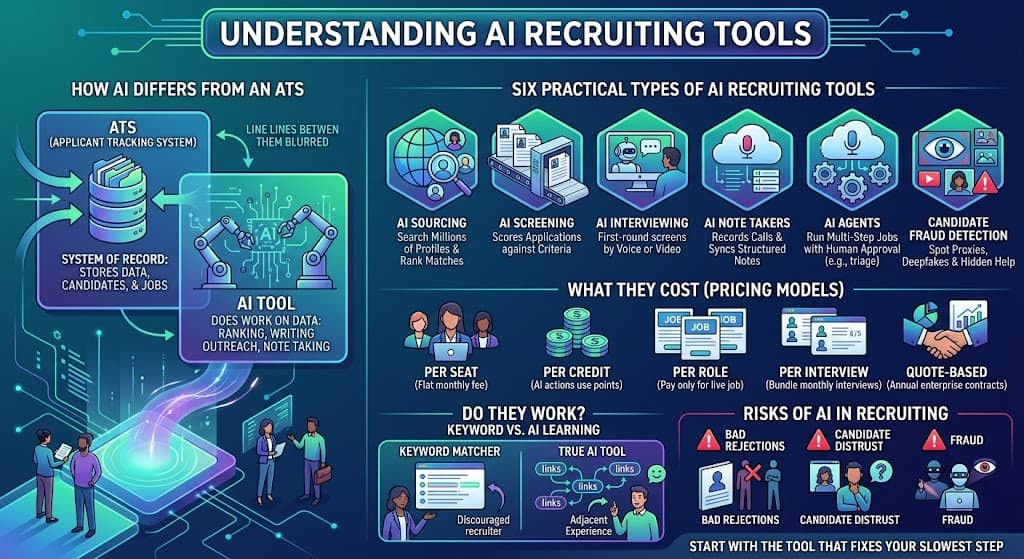
Quick answer: AI recruiting tools are software that use machine learning or large language models to do recruiting work that used to need a person: finding candidates, reading applications, running first round screens, taking interview notes and spotting fake applicants. Most teams get the best return by buying one tool for their slowest hiring step, not a full AI suite.
What they cost: from free plans and about $15 per user a month for an ATS with AI built in, up to quote based enterprise contracts. Pricing is per seat, per credit, per role or per interview, so always price a full year at your real volume.
Who this is for: agency recruiters, in house talent teams and founders who keep hearing about AI recruiting tools and want to know what they are, what they cost and whether they work.
What are AI recruiting tools?
AI recruiting tools are hiring products that use AI to handle a specific recruiting task, such as searching profiles in plain English, scoring resumes against your criteria, interviewing applicants by voice or video, or writing up call notes into your ATS. They sit beside your applicant tracking system or inside it, and they speed up one step of the funnel rather than replacing the recruiter.
The category now splits into six practical types. The table shows each one with real examples from the Work Insiders directory and their entry price as listed in September 2026.
| Type of AI recruiting tool | What it does | Example | Entry price as listed |
|---|---|---|---|
| AI sourcing | Searches millions of profiles from a plain English brief and ranks matches | Free plan; Starter $99 per seat per month billed annually | |
| AI screening | Reads every application against your must haves and explains each score |  Hello Recruiter Hello Recruiter | Free ATS plan; Starter $29 per month |
| AI interviewing | Runs structured first round screens by voice or video, day or night | $299 per month for 100 interviews | |
| AI note takers | Records calls and pushes structured notes into the candidate record | Free for 25 calls a month; Pro $60 per user per month | |
| AI agents | Run multi step jobs on their own, such as overnight applicant triage, then ask you to approve |  LinkedIn Hiring Assistant LinkedIn Hiring Assistant | Quote based add on to LinkedIn Recruiter |
| Candidate fraud detection | Flags proxies, deepfakes and hidden AI help during video interviews | $100 per month for 10 interviews |
If you already know which type you need, our ranked list of the best AI recruiting tools picks three options per hiring stage. This guide covers the questions people ask before they get that far.
Why is everyone searching for AI recruiting tools right now?
Searches for AI recruiting tools are climbing because adoption has moved from experiments to budgets. Korn Ferry’s 2026 trends survey of 1,674 talent leaders found 84% plan to use AI in recruiting this year, and 52% plan to add autonomous AI agents to their teams.
Application volume is the other driver. In the Greenhouse 2025 report, 34% of US recruiters said they spend up to half their week filtering spam and junk applications. When candidates use AI to apply to more jobs, recruiters reach for AI to sort them.
The big platforms are also pushing. LinkedIn announced Hiring Assistant 2 on September 29, 2026, and says over 20,000 companies used its agentic hiring tools in their first year of general availability.
| Finding | Figure | Source |
|---|---|---|
| Talent leaders planning to use AI in 2026 | 84% | Korn Ferry, October 2025 |
| Talent leaders planning to add AI agents in 2026 | 52% | Korn Ferry, October 2025 |
| US employers reporting some level of AI adoption | 92% | ZipRecruiter, July 2026 |
| Employers saying AI sped up their recruiting | 34% | ZipRecruiter, July 2026 |
| Employers saying AI raised applications per role | 48% | ZipRecruiter, July 2026 |
| Companies using LinkedIn’s agentic hiring tools | 20,000+ | LinkedIn, September 2026 |
The ZipRecruiter figures come from its 2026 AI Employer Report, a June 2026 survey of over 1,000 US hiring professionals.
How is an AI recruiting tool different from an ATS?
An ATS is your system of record: it stores jobs, candidates, stages and history. An AI recruiting tool does work on that data, such as ranking applicants or writing outreach. The line is blurring because most modern ATS products now ship AI features of their own.
For example, Manatal is an ATS with AI candidate recommendations from about $15 per user a month. Vitae AI charges agencies $79 per recruiter a month for an ATS, CRM and AI agents together, and can be run from Claude or ChatGPT. Leonar is an agency ATS and CRM from $95 per user a month with a sourcing agent add on.
Do I need both an ATS and a separate AI tool?
Start with the AI already inside your ATS. Add a separate tool only when one step still eats hours every week and your ATS cannot fix it, and check that the new tool writes results back to your ATS so you are not copying data by hand. Browse every applicant tracking system we list to compare built in AI features.
How much do AI recruiting tools cost?
AI recruiting tools range from free to tens of thousands of dollars a year, and the pricing model matters more than the headline number. A tool that looks cheap per seat can cost more than a per role tool if you only hire in bursts.
| Pricing model | How it works | Example as listed, September 2026 | Best for |
|---|---|---|---|
| Per seat | Flat monthly fee per recruiter | Juicebox from $99 per seat per month annual; agents $199 per agent per month | Teams sourcing every day |
| Per credit | Each AI action uses credits from a pool | Workable agent credits from $0.095 each | Uneven monthly volume |
| Per role | Pay only for each live job |  Cernor from $199 per live role Cernor from $199 per live role | Occasional hiring spikes |
| Per interview | Bundle of AI interviews per month | Veton.ai $299 per month for 100 interviews | Volume screening |
| Quote based | Annual contract through sales | LinkedIn Hiring Assistant, sold with LinkedIn Recruiter | Enterprise and large staffing firms |
| General AI assistant | One subscription used for many tasks | Claude Pro $20 a month, or $17 a month billed annually | Solo recruiters and small desks |
What is the hidden cost people miss?
The hidden cost is usually contact data and overages. Many sourcing tools charge separately for email and phone lookups, and credit based tools can run out mid month during a busy search. Price the full year at your real volume, including add ons, before you sign.
Can ChatGPT, Claude or Grok work as an AI recruiting tool?
Yes, for a lot of desk work. A general AI assistant can write job ads, summarize resumes, draft outreach sequences, build Boolean strings and turn call notes into client submittals. Recruiters on Reddit asking which AI tools agencies use most often name ChatGPT first, paired with a note taker and the AI inside their ATS.
What a general assistant cannot do on its own is search a profile database or update your ATS. That gap is closing through MCP, a standard that lets Claude, ChatGPT and Grok connect to recruiting tools directly. Our guide to MCP for recruiters explains how it works, and the recruiting prompt library has 53 prompts you can copy today.
Is it safe to paste candidate data into ChatGPT or Claude?
Only on a plan and setting that keeps your data out of model training, and only with the minimum personal data the task needs. Business plans usually exclude training by default; personal plans often need you to opt out. Check your client contracts and privacy rules before you paste resumes.
Do AI recruiting tools actually work, or are they just keyword matching?
Some do, and some are keyword matching with a nicer screen. That is the most common complaint in a r/RecruitmentAgencies thread where a recruiter tested eight tools for technical hiring. The tools that helped were the ones that learned from recruiter feedback and handled niche requirements, not the ones with the flashiest demo.
Recruiters themselves are unsure what their systems do. In the Greenhouse survey, 50% of US recruiters said AI has improved hiring overall, but 25% were not confident in their AI systems at all, and only 21% were very confident their systems were not rejecting qualified candidates.
The vendor numbers can be strong when the data is good. LinkedIn reports that recruiters using Hiring Assistant find qualified matches while reviewing 83% fewer profiles, and its prescreen finishes in a median of 6 minutes. Treat vendor figures as a ceiling and test against your own roles.
How do I tell a real AI tool from a keyword matcher?
Give it your hardest open role and watch three things: whether it surfaces people with adjacent experience instead of exact titles, whether it explains why each person ranks where they do, and whether rejecting a few matches changes the next batch. If the results never change after feedback, it is matching keywords.
What are the risks of using AI in recruiting?
The three real risks are bad rejections, candidate distrust and fraud. Each one is manageable if you plan for it before switching a tool on.
- Bad rejections: an AI screener can quietly drop good people. Keep a human reviewing rejections, and read our guide to the AI resume screener for how bias creeps in and which laws apply.
- Candidate distrust: only 8% of job seekers in the Greenhouse survey believe AI makes hiring fairer, while 87% want employers to be open about how they use it. Tell candidates when AI is involved and give them a human contact.
- Fraud: 91% of US recruiters in the same survey had spotted candidate deception, and 18% of hiring managers had seen deepfakes in interviews. If you hire remotely, a candidate fraud tool is now part of the stack.
New York City’s Local Law 144 already requires a yearly bias audit and candidate notice before an automated tool can be used in hiring decisions there, so check the rules wherever you hire.
Which AI recruiting tool should you start with?
Start with the tool that fixes your slowest step. Look at last month’s roles, find where time disappeared, and match it to the table below.
| If your problem is | Start with | Where to compare |
|---|---|---|
| Too few qualified candidates | An AI sourcing tool | AI sourcing tools |
| Too many applicants to read | An AI screener or your ATS’s AI ranking | AI screening tools |
| First round calls fill your week | An AI interviewer for structured screens | AI interviewing tools |
| Notes and ATS updates after every call | An AI note taker that syncs to your ATS | AI note takers |
| Repeat admin that follows the same steps | An AI agent with human approval | AI agents for recruiting |
| Fake or coached candidates on video | Fraud detection plus ID checks | Candidate fraud tools |
Should agency recruiters and in house teams buy different tools?
Usually, yes. Agency desks get the most from sourcing, outreach and note takers that build client submittals, because speed to a shortlist wins the fee. In house teams with heavy inbound volume get more from screening, scheduling and AI interviews. Both should test on live roles for two weeks before committing to a year.
New to all of this? The free AI Recruiting Academy walks through each tool type lesson by lesson, and you can filter every AI native tool in our directory in one click.
Quick answers
What is the best AI recruiting tool?
There is no single best one. The right tool depends on your slowest hiring step, which is why our best AI recruiting tools list ranks picks by stage.
Are there free AI recruiting tools?
Yes. Juicebox, Metaview and Hello Recruiter all list free plans with limits, and the free tiers of ChatGPT, Claude and Grok handle writing tasks. See our full list of free recruiting software.
Will AI replace recruiters?
Not on current evidence. Korn Ferry found 73% of talent leaders rank critical thinking as their top hiring priority, and AI tools still need a recruiter to set criteria, judge fit and close candidates.
How long does it take to set up an AI recruiting tool?
Simple sourcing and note taking tools work the same day. Screening and interviewing tools need your criteria, questions and an ATS connection, so plan a week of setup and two weeks of testing.
Do candidates mind being screened by AI?
Many accept it when told upfront, but trust is low. Disclose the AI step, keep it short and offer a human contact.
The bottom line
AI recruiting tools are worth it when they fix a specific, measurable bottleneck and keep a human on every rejection. Pick the step that costs you the most time, choose the pricing model that matches how you hire, test on live roles for two weeks, and only then sign for a year. When you are ready to choose, compare the best AI recruiting tools stage by stage.
Sources: Korn Ferry TA trends, Greenhouse AI report, ZipRecruiter employer report, LinkedIn Hiring Assistant 2, NYC DCWP AEDT, Claude pricing, r/RecruitmentAgencies thread, r/recruiting thread
Free newsletter
Get the Work Insiders weekly
One email a week: the recruiting and HR tech news that mattered, the tools we just added to the directory, and one practical guide. No spam, and you can unsubscribe in one click.