

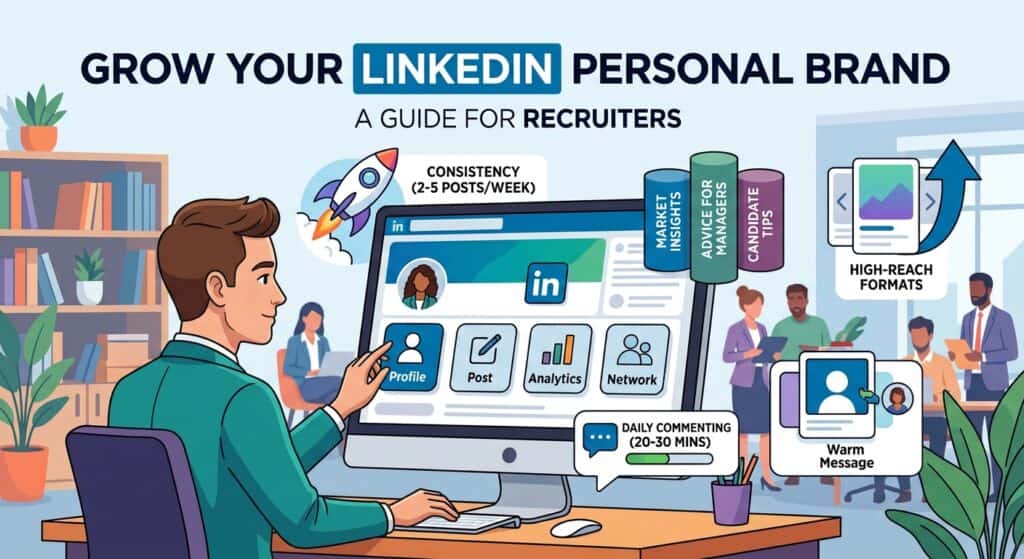
Quick answer: You grow a LinkedIn personal brand in 2026 by picking two or three topics and sticking to them, posting two to five times a week, spending 20 to 30 minutes a day leaving real comments, and turning your best ideas into carousels or a newsletter. Reach per post is down sharply since 2024, so consistency and a clear topic now matter more than follower count.
Who it suits: agency recruiters who want inbound clients and candidates, in house recruiters who want warmer outreach, and recruiting leaders building a team reputation.
What to use: a writing and scheduling tool such as Supergrow, AuthoredUp, Taplio or Kleo, plus your own calendar block for comments. Compare all 12 on our personal brand tools page.
Why should a recruiter grow a LinkedIn personal brand?
Because every candidate and hiring manager you contact checks your profile before they reply. A profile with recent, useful posts tells them you know the market and you are not one more bulk sender. That turns a cold message into a warm one.
LinkedIn’s own InMail data backs up the idea that relevance wins. Messages sent one by one get about 15% more responses than bulk sends, and the shortest InMails beat the average by 22%, according to LinkedIn’s InMail analysis. A personal brand does the same job at scale: people already know who you are and what you cover before your message lands.
For agency recruiters the payoff is business development. Hiring managers who read your market updates for three months are far easier to call than strangers. For in house recruiters the payoff is candidate trust and employer brand. Either way, the goal is not fame. It is being the obvious person to talk to about a narrow set of roles.
What changed in the LinkedIn algorithm in 2026?
The biggest change is that LinkedIn now shows people content based on interests, not just connections. Richard van der Blom’s 2026 study of 1.3 million posts from 50,000 creators found reach is down 60% for active creators over two years, as he explained on the Creator Science podcast. LinkedIn now builds a topic fingerprint for each creator and sends posts to people who engage with that topic.
Several practical rules follow from that research, summarized by LinkedIn consultant Melanie Goodman:
| Finding | What it means for a recruiter |
|---|---|
| Topic consistency drives distribution | Pick two or three related topics, such as one niche, its pay market and hiring advice, and stay there |
| One external link in the post body cut median reach by 18.8% | Share job links only when the post is built around them; keep most posts link free |
| Posts with no hashtags beat posts with hashtags by 5 to 10% | Use zero to three specific hashtags, never a long block |
| Only about 31% of the feed now comes from first degree connections | A focused 3,000 follower account can outperform a scattered 30,000 one |
| Newsletters outperform regular posts on reach and conversion | A monthly market update newsletter is worth starting once you post steadily |
The takeaway is simple. LinkedIn rewards being known for something specific. A recruiter who posts about controller and CFO hiring in Atlanta every week will travel further than one who posts about leadership, motivation and weekend plans.
How often should you post on LinkedIn?
Two to five times a week is the sweet spot for most people. Buffer analyzed more than 2 million posts from 94,000 accounts and found that moving from one post a week to two to five adds about 1,182 impressions per post, with bigger gains at higher volumes, according to Buffer’s frequency study.
| Posts per week | Extra impressions per post vs one a week | Engagement rate lift |
|---|---|---|
| 2 to 5 | About 1,182 | +0.23 points |
| 6 to 10 | About 5,001 | +0.76 points |
| 11 or more | About 16,946 | +1.40 points |
Van der Blom’s numbers point to a lower target of two to four posts a week, with daily posting lifting total reach but lowering reach per post. For a working recruiter with a full desk, three posts a week is realistic and sits inside both studies. Quality matters more than squeezing in a fourth post you do not care about.
What should a recruiter post about?
Post about what you see every day that your audience cannot. You talk to dozens of candidates and hiring managers a week, so you hold real market data. Turn it into short, useful posts. These five content pillars work for most recruiters:
Market insight
Salary ranges you are seeing, how long roles take to fill, which skills are scarce, and what candidates are asking for. Keep names and clients anonymous.
Advice for hiring managers
Why offers get declined, how long an interview process should take, and what a good job brief looks like. This is the pillar that wins clients.
Advice for candidates
Resume fixes, counteroffer traps and interview prep for your niche. This builds the candidate pipeline and gets saved and shared.
Stories from the desk
A search that went sideways, a placement that took nine months, a lesson from a lost deal. Stories hold attention longer than tips.
Your process
How you source, screen and brief. It shows hiring managers why working with you is different. Our business development prompts can help you turn calls into post ideas.
Which LinkedIn post formats get the most reach?
Document posts, the swipeable PDF carousels, win clearly. In Buffer’s data, carousels earned nearly 600% more engagement than text posts, images earned about 72% more than text, and video about 84% more. Posts with links had the lowest median engagement. You do not need to design from scratch: several personal brand tools build carousels from a post you already wrote.
Text posts are still the easiest way to build the habit. Start with text and images three times a week, then turn your best performing text post each week into a carousel.
How do comments help you grow faster?
Comments are now a second way to be seen. LinkedIn started counting impressions on comments, so a thoughtful comment on a big post can reach thousands of people outside your network. Van der Blom describes a 25 to 30 minute daily commenting routine, and warns that commenting on posts outside your topic confuses your fingerprint.
Build a short list of 20 to 30 accounts your buyers follow: hiring leaders, industry voices and other recruiters in your niche. Comment with a fact, a disagreement or a story, never “Great post”. Then reply to every comment on your own posts within the first hour.
How should you set up your LinkedIn profile for a personal brand?
Your profile is where the brand converts, so fix it before you post more. Readers land on it from every post and comment.
| Profile part | What to do |
|---|---|
| Headline | Say who you help and with what, for example “I place finance leaders at Atlanta growth companies” |
| Banner | Your niche, your region and one proof point such as placements made |
| About section | Who you work with, what a search with you looks like, how to reach you |
| Featured | Your best market update post, open roles page and a newsletter link |
| Recommendations | Ask placed candidates and clients for two or three recent ones |
Which tools help you grow a LinkedIn personal brand?
Tools save time on drafting, formatting, scheduling and analytics. They do not replace your opinions or your market knowledge. These are the personal brand tools listed in the Work Insiders directory, with starting prices as shown on each listing in October 2026.
| Tool | Best for | Starting price | Worth knowing |
|---|---|---|---|
| Writing in your voice, carousels and scheduling | $19/mo | 7 day trial; MCP server on the Pro plan | |
| Editing, previewing and analytics | $19.95/mo | Free trial, MCP and API | |
| AI posts, scheduling and a contact database | $39/mo | Free trial, MCP and API | |
| An all in one creator system with coaching | $99/mo | 7 day money back on monthly plans | |
| Posting through an official LinkedIn partner | $29/mo | No browser extension needed | |
| Teams drafting and approving posts together | $85/mo | Good for recruiting leaders and agencies | |
| Posts and carousels on a budget | Free plan, then $19/mo | Free tier to test | |
| Simple scheduling across networks | Free plan, then $5 per channel | Personal profile queue | |
| Repurposing posts across LinkedIn and X | $6 per channel | Free trial | |
| Scheduling plus an inbox and listening | Free plan, then $22/mo | API and MCP | |
| Scheduling across nine networks | $19/mo | API and MCP | |
| Commenting on prospect posts in your voice | $97/mo | Review every comment before it goes out |
Check how a tool connects to LinkedIn before you sign up. Tools that publish through LinkedIn’s official access carry less account risk than ones that drive your account through a browser extension. Supergrow and Kleo both say they use LinkedIn’s official API where it applies.
If you also run outbound messaging, keep it in a separate tool from your content. Our LinkedIn outreach tools page covers the sequencers.
What are recruiters asking about personal branding on Reddit?
Is a LinkedIn personal brand worth it, or just hype?
In one r/LinkedInTips thread, the top advice was to post three or four times a week with relevant material rather than ads, and to skip paying a consultant at the start. That matches the data.
Do impressions matter, or only comments and messages?
Messages and calls matter most. Impressions tell you whether LinkedIn understands your topic; inbound messages from the right people tell you the brand is working. Track both monthly.
Can a polished brand backfire?
Yes, when it reads as self promotion. Posts about your own wins should be rare. Posts that teach your audience something should be most of your feed.
What does a 30 day plan look like?
| Week | Focus | Actions |
|---|---|---|
| 1 | Profile and topics | Rewrite headline and About; choose two or three topics; list 20 accounts to comment on |
| 2 | Start posting | Three posts: one market insight, one hiring manager tip, one story; 20 minutes of comments daily |
| 3 | Add formats | Turn the best post into a carousel; schedule the week ahead in your tool |
| 4 | Review | Check which topic drew messages, not just likes; plan a monthly newsletter |
Quick answers
How long does it take to grow a LinkedIn personal brand?
There is no fixed timeline, but plan on several months of steady posting before inbound messages become regular. Buffer’s data shows each post performs better once you post at least twice a week.
How many times a week should a recruiter post on LinkedIn?
Two to five. Three a week is a realistic target alongside a full desk.
Should I put job links in my posts?
Only in posts built around the job. A single link in the post body cut median reach by 18.8% in van der Blom’s 2026 data.
Do hashtags still help on LinkedIn?
Barely. Use zero to three specific ones. Long hashtag blocks can hurt reach.
Can AI write my LinkedIn posts?
It can draft them. Tools like Supergrow and Kleo learn your voice, but edit every post and add your own market facts, or readers will scroll past.
What is the best tool for a LinkedIn personal brand?
For most recruiters, a writing and scheduling tool around $20 to $40 a month, such as Supergrow, AuthoredUp or Taplio, is enough. Compare them on our personal brand page.
A LinkedIn personal brand grows from focus, rhythm and conversation: a clear niche, two to five posts a week, daily comments and a profile that converts. Pick one tool to remove the busywork, block the time in your calendar, and judge progress by the messages you receive, not the likes.
Sources: Buffer frequency study, van der Blom interview, Melanie Goodman analysis, LinkedIn InMail data, r/LinkedInTips thread, Supergrow pricing, Kleo
Free newsletter
Get the Work Insiders weekly
One email a week: the recruiting and HR tech news that mattered, the tools we just added to the directory, and one practical guide. No spam, and you can unsubscribe in one click.