


An AI recruiting agent is software that takes a recruiting goal and runs a multi step loop until a human reviews the result. The goal might be fill a req, build a shortlist, or book screens. The loop uses search, ranking, outreach drafts, and calendar slots as tools. It is not a chat window that waits for your next prompt.
AI agents for recruiting are a desk workflow. You use them by stage, you pay for seats and credits, and a human still owns send, reject, offer, and culture fit.
Key insights sit here so you can steal the desk version without scrolling. An AI recruiting agent owns a goal plus tools plus a loop under human review. A chatbot only answers in chat. Use agents to source, then screen, then schedule. Humans still own offer, negotiation, and compliance.
Cost drivers are seats, agent add ons, contact and export credits, ATS sync, and implementation. Year one often exceeds sticker. Confirm live on the vendor site. A three person desk can land anywhere from under $5,000 to over $11,000 in year one at list price, depending on how the agent is billed.
SHRM Talent Trends reports that 51 percent of organizations use AI to support recruiting. Of shops using AI for recruiting, 89 percent say it saves time or increases efficiency. That is support work, not a replacement study.
Korn Ferry research adds the agent specific number. Of 1,674 talent leaders surveyed, 52 percent plan to add autonomous AI agents to their teams in 2026, and 84 percent plan to use AI in some form. A plan is not a deployment. Read it as demand, not proof that agents fill reqs.
Hard cases are bias and explainability, stale people data, LinkedIn rules, regulated human review, low candidate trust, and seats where culture fit is the job. Start on one req. Approve before send. Verify contacts before you burn a domain. Measure replies and interviews, not vanity shortlist size.
The numbers behind this page, each linked to its source.
| Number | What it measures | Source |
|---|---|---|
| 52% | Talent leaders who plan to add autonomous AI agents to their teams in 2026 | Korn Ferry research |
| 51% | Organizations that use AI to support recruiting | SHRM Talent Trends |
| 89% | AI recruiting users who say it saves time or increases efficiency | SHRM Talent Trends |
| 56% | HR functions that do not formally measure the success of their AI investments | State of AI |
| 26% | Job candidates who trust AI to evaluate them fairly | Gartner candidate survey |
| 85% | Share of tests in which AI resume rankers favored white associated names | University of Washington researchers |
| 57% | HR pros in states with AI workplace laws who were unaware of those laws | SHRM 2026 findings |
What are AI agents in recruiting?
AI agents in recruiting are goal driven programs that run a recruiting workflow with tools, then stop for a human. You give the agent a job (shortlist this req, draft first touch, propose screens). It searches, ranks, writes, or books, and it brings you a result to accept, edit, or kill.
An AI recruiting agent is not autocomplete on a job post, and it is not a chatbot on a career site. Autocomplete helps you write. A chatbot answers “what is the salary band” and waits. An agent takes “fill this req” and uses search, ranking, outreach drafts, and a calendar inside one loop.
In desk language, an AI recruiting agent is a sourcer intern who never sends without your yes. The intern can pull names overnight. You still own the send, the reject, and the offer.
SHRM Talent Trends is the right frame for how shops already use AI around recruiting, and it is not an agent census. SHRM reports that just over half of organizations (51 percent) use AI to support recruiting. Common uses in that research are writing job descriptions (66 percent), screening resumes (44 percent), automating candidate searches (32 percent), customizing job postings (31 percent), and communicating with applicants (29 percent). Those percents describe AI support on the desk. They do not prove that a named agent product filled the req.
For agents specifically, Korn Ferry research is the closest thing to a census. It found that 52 percent of 1,674 talent leaders plan to add autonomous AI agents to their teams in 2026. SHRM’s newer State of AI research lists recruiting as the top HR area for AI use at 27 percent, ahead of HR technology at 21 percent and learning and development at 17 percent. The surveys ask different questions, so do not stack the numbers. The shared signal is that recruiting is where HR tries AI first.
If the product cannot take a goal, use more than one tool, loop without a new prompt every click, and pause for a human, it is not an AI recruiting agent. It is a search box, a template, or a chat widget.
How do you use AI agents for recruiting by stage?
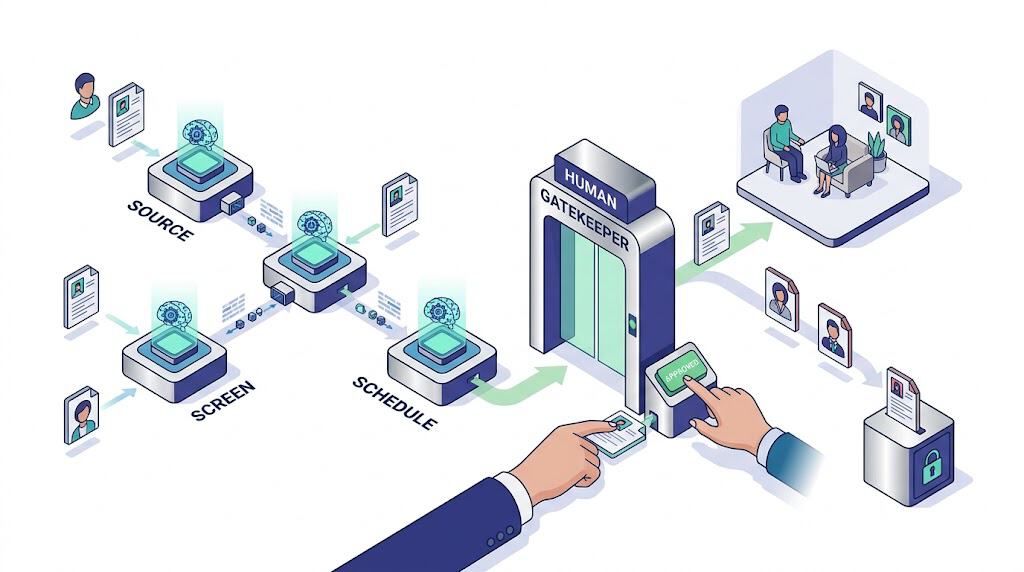
You use AI agents for recruiting by stage. Source, then screen, then schedule. Do not buy a loop that claims to “run TA” if you cannot name which stage it actually owns.
How to use AI agents for recruiting on a live desk is a write back problem as much as a search problem. The agent can find and draft. Your recruiting CRM software or ATS still has to be the system of record, or you will rerun the same names next month with no history.
Keep the stages separate in the brief. “Build 40 names, score them against this must have list, draft a first touch, propose two screen slots” is a workflow. “Go hire a senior engineer” is a wish.
The table below is the whole desk loop on one screen. Each stage has one job for the agent, one thing the human keeps, one number to watch, and one way it goes wrong.
| Stage | What the agent does | What the human owns | Number to watch | Main risk |
|---|---|---|---|---|
| Source | Searches a people index from a written brief, ranks, and captures names | Reading title, tenure, and whether the person is still in seat | Share of names still in the role | Stale data and LinkedIn rules |
| Screen | Scores each person against written must haves and explains the rank | Every reject and every adverse decision | Share of the shortlist you would actually screen | Bias and scores with no reasons |
| Outreach draft | Drafts the first touch and the follow ups | The yes before any send | Reply rate on verified addresses | Domain burn and off brand copy |
| Schedule | Proposes or books slots and logs the hold | Offer, close, and any reject note | Screens booked per approved shortlist | A message sent that nobody approved |
What does a good brief for an AI recruiting agent look like?
A good brief for an AI recruiting agent names one stage, one countable output, the must haves, the tools the agent may use, and the points where it has to stop for a person. Most bad agent output traces back to a brief that was a wish. Fill in these eight fields before you run the loop.
| Brief field | Example | Why it matters |
|---|---|---|
| Goal | 40 names for one senior payroll manager req | One stage and one countable output |
| Must haves | Multi state payroll, five or more years, led a team of three or more | Keeps the score on job related evidence |
| Exclusions | Current clients, the do not contact list, anyone rejected for this req in the ATS | Stops repeat outreach and awkward sends |
| Location and comp band | Hybrid in Chicago, band taken from the approved req | Stops outreach that is off band |
| Tools allowed | People index search, email draft, calendar slot proposals | Names what the loop may touch |
| Stop points | Stop before any send and before any reject | Human review is designed in, not bolted on |
| Write back | Name, stage, and reason to the ATS or CRM | The pool survives a tool switch |
| Success measure | Replies and booked screens, not list size | The agent is judged on the real bottleneck |
How do you source with an AI recruiting agent?
An AI sourcing agent takes a brief in natural language, searches a people index, and returns a ranked list for you to open. You still read titles, tenure, and whether the person is actually in seat.
Juicebox and Pin are examples of AI sourcing seats. They search large people indexes from a plain English brief. For the full bake off, see Juicebox vs Pin. This page will not rerun it.
Source stage work is find and capture, not “the agent hired them.” Write the names back into the CRM pool or the ATS so the desk keeps silver medalists when the req closes. If the agent only lives in a vendor inbox, you rented a list, not a pool.
Treat LinkedIn as a governed surface. The LinkedIn User Agreement restricts unauthorized scraping and automated access.
Do not assume an agent may scrape Recruiter or automate against LinkedIn unless the product’s own permitted integrations say so. If the live graph is still the channel, keep the Recruiter or Sales Nav question on Recruiter alternatives. LinkedIn outreach tools is the stack page for that channel.
How do you screen with an AI recruiting agent?
An AI recruiting agent screens by scoring people against a written brief and handing you an explainable shortlist. You reject or approve. The agent does not get a silent no that the candidate never hears explained.
Screen stage quality is the brief plus the reason. If the agent cannot say why this person beat the next person (skills, tenure, domain, location, must haves), you do not have a screen. You have a ranked vibe.
Bias risk sits on this stage, not later. A model that infers “fit” from names, schools, photos, or years of polish will bake in the same patterns you already have. Keep the score on job related evidence. Keep a human on every reject that becomes an adverse decision.
University of Washington researchers put a number on that risk. They ran more than three million comparisons of resumes against job descriptions using three large language models. The models favored white associated names 85 percent of the time and Black associated names 9 percent of the time, and they never preferred Black male associated names over white male associated names. The study tested open models, not a named recruiting product. The desk lesson is to keep names, photos, and schools out of the scoring input where the product allows it, and to look at who the agent ranks low, not only who it ranks high.
SHRM reporting on state AI laws notes that many HR pros lack awareness of state AI hiring rules, and that final selection is widely treated as human driven. Use that as the desk default. The agent ranks. A person decides.
SHRM’s 44 percent resume screening figure is adoption of a task, not an accuracy score for your vendor.
How do you schedule with an AI recruiting agent?
An AI recruiting agent schedules by proposing or booking slots from a calendar, then logging the hold. You still own the offer, the close, and whether the person will last on this team.
Schedule stage is the cleanest loop to automate because the goal is a time, not a judgment. “Find 30 minutes with these two interviewers next week” is a tool job. “Will this person lead the cell without blowing up the culture” is not.
Let the agent propose times, send the hold, and nudge no shows if you have approved that path. Do not let it send an offer letter, a “we went another way” note on a regulated reject, or a culture read it invented from a profile.
How much do AI recruiting agents cost?
AI recruiting agents cost seats, then add ons, then credits, then the integration work that never sits on the logo price. Sticker is the login. Year one is the meter.
How much do AI recruiting agents cost in public 2026 examples, not as a ranked buy list. Juicebox lists Starter at $99 per seat per month and Growth at $179 per seat per month when billed annually ($119 and $199 month to month in public writeups), and Business as custom annual. Juicebox Agents are a separate add on at $199 per agent per month, with unlimited contact and email credits on the agent, and auto email or auto shortlist as the pitch. Confirm live on Juicebox pricing.
Pin public pricing around September 2026 lists Solo from $99 per user per month billed annually, Professional from about $135 per user per month annual, with $179 month to month in public writeups, plus a Free plan with limited usage. Confirm live on Pin pricing.
Those two logos are cost examples of AI sourcing seats. They are not a trophy list, and this page is not the bake off. Deep compare lives on Juicebox vs Pin.
Here are the same public prices side by side, checked on the vendor pricing pages on September 19, 2026. Month to month billing runs higher at both vendors.
| Line item | Juicebox | Pin |
|---|---|---|
| Free plan | Yes, with limited searches | Yes, 50 sourced candidates every month |
| Entry paid seat | Starter at $99 per seat per month billed annually, with 500 contact credits and 500 export credits | Solo at $99 per user per month billed annually, single seat, with 500 contact lookup credits and 2 AI agents |
| Team seat | Growth at $179 per seat per month billed annually, with 1,500 contact credits and 1,500 export credits, up to 5 seats | Professional at $135 per user per month billed annually ($179 month to month), with 1,000 credits per seat per month and 2 AI agents per user |
| Top tier | Business, custom price, annual only | Business, custom price, with unlimited seats, contact lookup credits, and AI agents, plus premium ATS integrations |
| How the agent is billed | Separate add on at $199 per agent per month, with unlimited contact and email credits on the agent | Included in the paid seat |
Seats are the first driver. Every sourcer, coordinator, and hiring manager who needs a login is a seat. Agent add ons are the second. Some products meter the autonomous loop as a second line (Juicebox Agents at $199 per agent per month on the public page). Some fold an agent into a paid seat (Pin’s public Solo and up). Same word, different invoice.
Contact and export credits are how the bill grows after the seat. Lookups, emails, and phone numbers meter the work. Unlimited credits on an agent line can still sit next to a capped seat. Verify before you send so you do not spend credits on dead addresses.
ATS sync and CRM write back still cost, whether that is a native hook, a paid connector, or a person copying names into recruiting CRM software. If the agent cannot write to the record, you will pay in rework. Implementation is year one spend even when the vendor calls it onboarding. Brief templates, mailbox warmup, calendar permissions, reject reasons, and who is allowed to auto send all sit off the sticker.
Do not invent an ROI percent. SHRM reports that among organizations using AI for recruiting, 36 percent say it helps reduce recruitment, interviewing, or hiring costs, and 24 percent say AI improved the ability to identify top candidates. Those are SHRM survey shares for AI in recruiting, not a payback formula for one agent. Year one often exceeds sticker when credits, extra agents, and ATS sync stack. Budget the meter, not the landing page.
SHRM’s 2026 State of AI research explains why honest ROI numbers are rare. It found that 56 percent of HR functions do not formally measure the success of their AI investments, and only 16 percent use ROI as a metric. If you do not baseline reply rate, screens booked, and recruiter hours per req before the trial, you will not be able to say what the agent paid back.
What does year one cost for a three person desk?
Year one for a three person desk can land anywhere from under $5,000 to over $11,000 at list price, depending on whether the agent is billed inside the seat or as its own line. This is list price math only, from the public prices above. It leaves out ATS connectors, setup hours, and extra credits.
Three Juicebox Growth seats billed annually are $179 times 3 seats times 12 months, which is $6,444. Two Juicebox Agents add $199 times 2 agents times 12 months, which is $4,776. Year one at list is $11,220. The $99 entry sticker would have suggested $3,564 for the same three people. Three Pin Professional seats billed annually are $135 times 3 seats times 12 months, which is $4,860, with two agents per user inside the seat.
| Year one line | Juicebox example | Pin example |
|---|---|---|
| Seats | 3 Growth seats, $6,444 | 3 Professional seats, $4,860 |
| Agents | 2 add on agents, $4,776 | Included, 2 per user |
| Year one at list price | $11,220 | $4,860 |
| Not on the price page | ATS or CRM sync, setup hours, mailbox warmup, extra credits | ATS or CRM sync, setup hours, mailbox warmup, extra credits |
That gap is not a verdict on either product. Credits, data quality, and ATS sync differ, and the bake off lives on Juicebox vs Pin. The point is that the word agent sits on its own invoice line at one vendor and inside the seat at another. Price the desk, not the logo.
What is the difference between AI agents and chatbots for recruiting?
The difference between AI agents and chatbots for recruiting is the loop. An agent takes a goal, uses tools, and keeps going until a human reviews. A chatbot answers a question in a window and waits.
AI agents vs chatbots for recruiting is not a UI fight. A scheduling bot can be chat shaped and still only book a slot. An agent can hide in a sidebar and still own source, screen, and a draft sequence.
The four labels vendors use, side by side.
| Chatbot | Copilot or assistant | Rules automation | AI recruiting agent | |
|---|---|---|---|---|
| Starts from | A question | A prompt | A trigger | A goal |
| Tools it calls | None or one | One at a time | A fixed sequence | Several inside one loop |
| Keeps going without a new prompt | No | No | Yes, on a fixed path | Yes, until the review point |
| Adapts to what it finds | No | Only when you ask again | No | Yes, within the brief |
| Writes back to the ATS or CRM | Rarely | When a person pastes it | Yes, fixed fields | Yes, names, stages, and reasons |
| Work product | An answer | A draft | A status change | A shortlist, a logged sequence, or a booked screen |
A recruiting chatbot is Q&A. Candidates ask about benefits. Recruiters ask “summarize this resume.” The product replies. Nothing moves in the ATS unless a person pastes it.
An AI recruiting agent is workflow. You state the req. It searches an index, ranks against the brief, drafts a first touch, and proposes times. You approve, edit, or stop. The work product is a shortlist, a logged sequence, or a booked screen, not a paragraph of advice.
If a vendor says “agent” and the demo is only a chat that rewrites a job post, you bought a chatbot with a louder noun. Ask what tools it calls, what it writes back, and where a human has to click before a candidate sees a message.
Can AI agents replace recruiters?
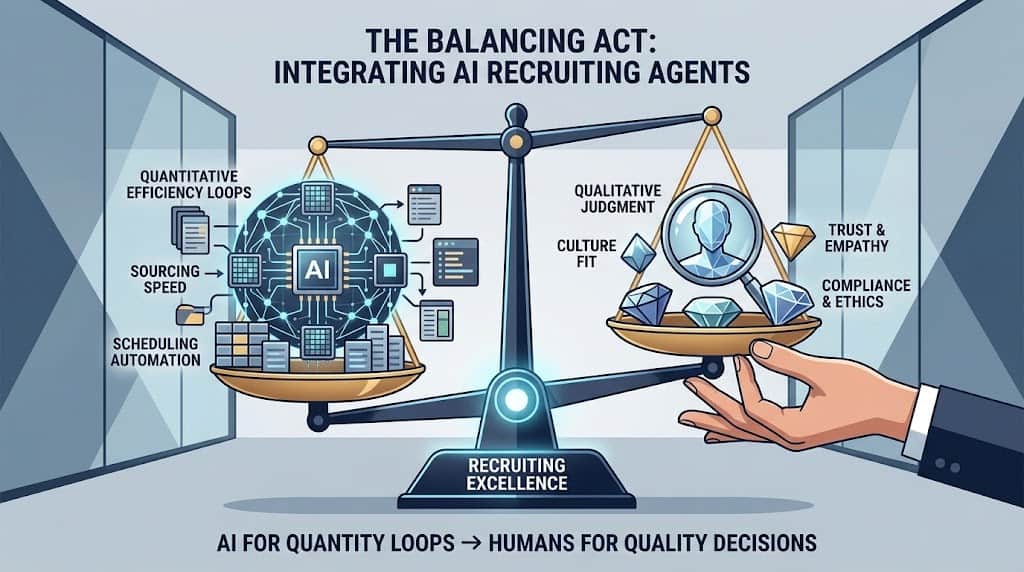
No. AI agents cannot replace recruiters on judgment, relationships, negotiation, or compliance ownership. Yes, they can take repetitive sourcing loops and first pass ranking under review.
SHRM’s 51 percent figure is organizations using AI to support recruiting. Of those using AI for recruiting, 89 percent say it saves time or increases efficiency. Efficiency is not a headcount plan. SHRM did not publish a replacement rate, so do not invent one.
SHRM’s 2026 State of AI research points to reshaped jobs, not removed ones. Across HR, 39 percent of organizations say AI implementation shifted job responsibilities, 57 percent see more upskilling and reskilling, and 7 percent report job displacement. Korn Ferry research adds that 73 percent of talent leaders rank critical thinking as their top hiring priority, with AI skills fifth. The scarce skill is judging what the agent hands back.
Recruiters still own the parts that break when you remove a person. Comp conversations. Counteroffers. A hiring manager who changes the brief after panel one. A candidate who needs a real answer on why this team. A regulated reject. A culture call on a lead who can do the work and will still torch the room.
Agents still help on the parts that are loops. Pull 40 names from a people index. Rank against a written must have list. Draft a first touch you will edit. Propose two screen slots. That is how to use AI agents for recruiting without pretending the desk vanished.
Do candidates trust AI recruiting agents?
Mostly no, and that shapes your reply rate. A Gartner candidate survey of 2,918 job candidates found that 26 percent trust AI to evaluate them fairly, while 52 percent believe AI already screens their application. Another 32 percent worry that AI could fail their application, and 25 percent trust an employer less when it uses AI to evaluate them.
Trust runs both ways. In the same Gartner research, 39 percent of candidates said they used AI during the application process, and 6 percent admitted to interview fraud, meaning they posed as someone else or had someone pose as them.
Gartner predicts that by 2028 one in four candidate profiles worldwide will be fake. An agent that takes profiles at face value will rank the fakes too. That is one more reason a person reads the shortlist.
The desk fix is plain disclosure and a real human on the thread. Tell candidates where AI sits in your process and where a person decides. Several laws now require that notice anyway. Put a named recruiter and a working reply path on every first touch the agent drafts, and answer replies yourself.
What laws apply to AI recruiting agents in 2026?
AI recruiting agents fall under the same anti discrimination laws as any tool that scores, ranks, or filters people, plus a growing patchwork of state and city AI rules. As of September 2026 there is no federal AI hiring statute. The rules that apply depend on where your candidates live, not only where your office sits.
The table below summarizes an Epstein Becker Green review of workplace AI regulation published September 1, 2026. Dates move, so check the status before you rely on it.
| Jurisdiction | Status in September 2026 | What it asks of a recruiting desk |
|---|---|---|
| New York City, Local Law 144 | In force since July 2023 | An independent bias audit within the past year, a public audit summary, and candidate notice at least 10 business days before an automated hiring tool is used |
| California, civil rights regulations on automated decision systems | In force since October 1, 2025 | State anti discrimination law applies to tools that make or facilitate hiring decisions. Anti bias testing, or the lack of it, can be weighed in a complaint |
| California, privacy agency rules on automated decision making | Take effect January 1, 2027 | Enhanced disclosures and opt out rights, or a documented exception, when automated tools replace human decision making in employment |
| Illinois, Human Rights Act amendment (HB 3773) | In force since January 1, 2026 | Notify applicants and employees when AI is used in covered employment decisions. Discrimination that flows from AI use is a civil rights violation. The detailed notice rules were withdrawn in June 2026 and are still unsettled |
| Texas, Responsible AI Governance Act | In force since January 1, 2026 | Bars AI used with intent to discriminate. Disparate impact alone does not create liability |
| Colorado, replacement AI law | Signed May 14, 2026, effective January 1, 2027 | The original Colorado AI Act was repealed before it took effect. The replacement focuses on notice and disclosure for automated tools used in consequential decisions. Rulemaking is open |
| Connecticut, Senate Bill 5 | Signed May 27, 2026, main duties start October 1, 2027 | Plain language disclosure and written notice to applicants when automated employment decision technology is used |
Courts are moving too. In Mobley v. Workday, a federal court in California let discrimination claims go forward against the vendor of an AI screening tool on the theory that the vendor acted as an agent of the employers using it. In May 2025 the court preliminarily certified a nationwide collective action on the age claim. The takeaway in the Epstein Becker Green review is that any tool that scores, ranks, or filters applicants can expose both the vendor and the employer.
SHRM 2026 findings show how wide the awareness gap is. At the time of that research, 19 states had enacted AI related workplace legislation, and 57 percent of HR professionals in those states were unaware of the rules. Hiring outside the United States brings its own regimes, including the EU AI Act, which treats hiring tools as high risk.
Five desk rules travel across all of these. Keep an inventory of every tool that scores or ranks people. Give notice wherever AI touches a hiring decision. Keep a documented human checkpoint before any adverse decision.
Ask the vendor for its bias audit. Read the vendor contract for who carries liability. This section is a map, not legal advice, so talk to employment counsel before you turn on auto reject anywhere.
What hard cases break AI recruiting agents?
Hard cases break AI recruiting agents when the data is stale, the decision is adverse, the platform forbids the move, or the seat is a culture and judgment job. The loop is only as good as the index, the brief, and the human stop.
Bias and adverse impact break a silent ranker. If the agent cannot explain the score, you have a legal and trust problem, not a UX nit. Keep job related criteria in the brief. Keep a human on rejects that close a person out.
SHRM reports that final selection is widely treated as human driven, and that many HR pros lack awareness of state AI laws. If you cannot name who reviewed the no, you are not ready to auto reject.
Stale people data breaks the send. Recruiting Reddit threads indexed in September 2026 keep hitting quality, not missing search. An agency agents thread in r/RecruitmentAgencies treated AI sourcing quality as weak and asked for tools that actually work. Credits do not help if the title is two jobs behind. Run a human read on “still in seat” before you send.
The wrong bottleneck breaks the business case. An AI agents thread in r/recruiting treated new AI recruiting agents as a fix for the easy part. Finding people is cheap. Getting a reply is the job. If your agent only inflates the shortlist, you automated the bottleneck you did not have.
LinkedIn terms break scrape fantasies. Treat LinkedIn as a governed surface. The LinkedIn User Agreement restricts unauthorized scraping and automated access. Do not assume an AI recruiting agent can scrape Recruiter or run unapproved automation. If you need the live graph, that is a Recruiter or Sales Nav decision, not an agent trick.
Regulated human review breaks auto close. Some jurisdictions expect a human in the process before an adverse hiring decision. Do not let an agent auto close a candidate in those loops. Pause for a named reviewer. Log the reason. The law table above names the rules that are in force. If nobody on the desk can name the rule, stop auto reject until they can.
Executive search, sensitive culture fits, and edge titles break keyword match. A plant director you cannot leak, a founder seat, a title that means five different jobs across five companies. The agent will match words and miss the room. Keep those reqs on a human search. Use the agent, if at all, as a first pass you will throw away without sending.
How should you start without burning the desk?
Start with one req, a human yes before any send, and the ATS or CRM as system of record. Do not connect your payroll domain on day one, and do not score the trial on how many names the agent dumped.
Pick one live req with a brief you already trust. Must haves, location, comp band, interviewers, what “good” looked like on the last hire. Vague briefs make confident junk.
Turn off auto send. The agent can shortlist and draft. You approve every first touch until you have seen a week of output you would actually sign.
Verify contacts before domain burn. Finder export is not a clean list. Guess, then verify, then send. how to cold email is the order of operations for domain and verification. Do not learn it on your corporate Google login.
Write back to the record. Names, stages, and reasons belong in the ATS or in recruiting CRM software, not only in the agent vendor. You will switch tools. The pool has to survive.
Measure reply rate and interview rate, not shortlist size. Recruiting Reddit threads indexed in September 2026 already said the quiet part. Finding people is easy. Replies are hard. If the agent adds 200 names and zero screens, you bought vanity.
Keep LinkedIn inside its rules and use permitted integrations only. If the seat stack question is Recruiter versus a finder, that call lives on Recruiter alternatives, not in an agent demo.
Do not confuse this category with general purpose desktop agents. Grok Bot is a different product class. Desktop teammates with their own computer, not a recruiting ops agent that sources and sequences against a people index. This page is the desk loop. That page is the desktop bot. Do not install one expecting the other.
What should you measure in an AI recruiting agent trial?
Measure the funnel the agent touches, against your own numbers from the last comparable req. Set the baseline before the trial starts. There is no honest industry benchmark for these, so the comparison that counts is your desk before and your desk after.
| Metric | How to count it | Red flag |
|---|---|---|
| Still in seat rate | Names whose current title and employer check out, divided by names delivered | You correct more than a few per batch |
| Verified contact rate | Addresses that pass verification, divided by addresses found | You pay credits for dead addresses |
| Reply rate | Replies divided by delivered first touches | The shortlist grows while replies stay flat |
| Screen rate | Booked screens divided by approved shortlist | The hiring manager declines most agent sourced screens |
| Recruiter hours per req | Hours on sourcing and scheduling, before and during the trial | Review time eats the hours the agent saved |
| Write back completeness | Records in the ATS or CRM that carry name, stage, and reason | The history lives only in the vendor inbox |
Run the trial until you can answer four questions with evidence. Did the names still hold that job? Did verified email land? Did anyone reply? Did a human still want to take the screen? If those four are weak, the agent is not ready for a second req.
What should you ask an AI recruiting agent vendor?
Ask an AI recruiting agent vendor what tools the agent calls, where a human has to click, what it writes back, how the agent is billed, and whether there is a bias audit you can read. These nine questions fit in one demo, and each has an answer that should end the call.
| Question | A good answer sounds like | Walk away if |
|---|---|---|
| What tools does the agent call in one loop? | It names search, ranking, drafting, and calendar | The demo is only a chat box |
| Where does a human click before a candidate sees anything? | Approval is the default and auto send is a choice per req | Auto send is on by default |
| Can it explain why one person outranked another? | Reasons tied to your must haves | A score with no reasons |
| What does it write back, and to which ATS or CRM? | Names, stages, and reasons, on the plan you are pricing | Sync only exists on a tier you did not price |
| How is the agent billed? | A clear line, either per agent or inside the seat, with credit caps stated | Unlimited, with a fair use clause nobody can quote |
| Where does the people data come from, and how fresh is it? | Named sources and a refresh cadence | Proprietary, with no refresh answer |
| How does it touch LinkedIn? | Only through permitted integrations | Scraping or browser automation on your login |
| Is there a bias audit, and can we read it? | An independent audit with a date and a summary | A claim that the AI is bias free |
| What happens to our pool if we leave? | Full export of names, stages, and notes | The pool stays with the vendor |
Short answers (FAQ)
What are AI agents in recruiting?
Software that takes a recruiting goal and runs a multi step loop with tools (search, rank, draft, schedule) under human review. Not a chatbot that only answers in a window.
How do you use AI agents for recruiting?
By stage. Source on a people index, screen against a written brief with an explainable shortlist, schedule holds a human still approves. Keep the ATS or CRM as the record. Approve before send.
How much do AI recruiting agents cost?
Seats plus agent add ons plus contact credits plus ATS sync plus implementation. Public examples in September 2026 include Juicebox Starter at $99 per seat per month and Growth at $179 when billed annually, and Agents at $199 per agent per month. Pin Solo starts from $99 per user per month annual, Professional from about $135 annual. Confirm live. Year one often exceeds sticker. No honest ROI percent lives on this page.
Can AI agents replace recruiters?
No for judgment, relationships, negotiation, and compliance. Yes for repetitive sourcing loops and first pass ranking you still review. SHRM’s 51 percent is AI used to support recruiting, and 89 percent of those users cite time or efficiency. That is not a replacement rate.
What is the difference between AI agents and chatbots for recruiting?
Agents own a goal, tools, and a loop. Chatbots own Q&A. A scheduling bot can look like chat and still only book a time. If nothing moves without a new prompt, it is a chatbot.
What is an AI sourcing agent?
A recruiting agent whose job is find and rank people from a brief, usually over a people index. Juicebox and Pin are sourcing seat examples. Deep compare is Juicebox vs Pin. You still verify “in seat” before outreach.
Do AI recruiting agents work on LinkedIn?
Only inside a product’s permitted integrations. LinkedIn restricts unauthorized scraping and automated access in the LinkedIn User Agreement. Do not assume an agent can scrape Recruiter. Treat LinkedIn as a governed surface.
Where do humans still own the desk?
Offer, culture fit, negotiation, regulated rejects, executive and leaky searches, and any send from your domain. The agent drafts. A named person decides.
Are AI recruiting agents legal?
Yes, but regulated. New York City requires an annual independent bias audit and candidate notice for automated hiring tools. Illinois has required notice when AI is used in hiring decisions since January 1, 2026. California has applied its anti discrimination rules to automated decision systems since October 1, 2025. Colorado’s replacement law starts January 1, 2027. See the Epstein Becker Green review for current status, keep a human on every adverse decision, and check with counsel.
Do candidates trust AI in hiring?
Not much. A Gartner candidate survey found that 26 percent of candidates trust AI to evaluate them fairly, and 25 percent trust an employer less when it uses AI to evaluate them. Say where AI is used and where a person decides.
Are AI recruiting agents biased?
They can be. University of Washington researchers found that language models ranking resumes favored white associated names 85 percent of the time. Score on job related evidence, demand a reason for every rank, and keep a human on rejects.
Which recruiting stage should you hand to an AI agent first?
Scheduling or sourcing. Scheduling is the cleanest because the goal is a time, not a judgment. Sourcing saves the most hours but needs a human read on who is still in seat. Screening carries the most legal risk, so add it last.
How many companies use AI agents for recruiting?
Korn Ferry research found that 52 percent of 1,674 talent leaders plan to add autonomous AI agents to their teams in 2026. SHRM found that 51 percent of organizations use AI to support recruiting. Neither number is a count of live agent deployments.