

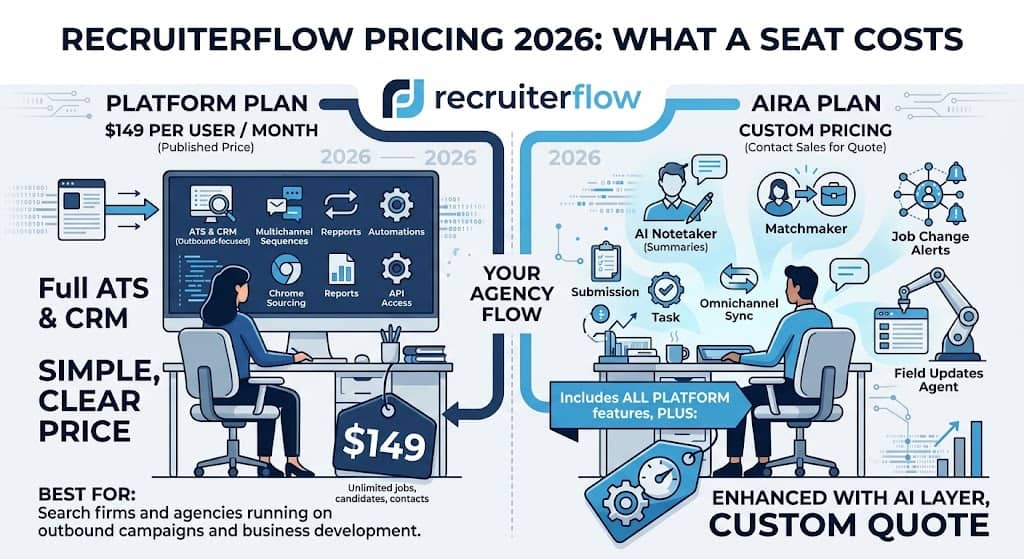
Quick verdict: Recruiterflow keeps its pricing unusually simple. There are two plans. The Platform plan is published at $149 per user per month and covers the full ATS and CRM, sequences, automations, Chrome sourcing, reports and API access. The AIRA plan, which adds the AI agents, is custom priced. There are no feature bolt ons to price separately, which is rarer in this category than it should be.
Who it suits best: search firms and recruiting agencies that run on outbound sequences and automation, and that want one number per recruiter rather than a platform fee plus modules.
What to check before you buy: the billing toggle on the pricing page shows a lower rate on annual billing, so confirm which figure your quote uses, and ask what the AIRA plan costs at your seat count before you assume the agents are affordable.
How much does Recruiterflow cost in 2026?
The Recruiterflow pricing page lists the Platform plan at USD $149 per user per month, and shows a lower $119 per user per month rate when the billing period is switched. The AIRA plan carries no published number.
| Plan | Price | What you get |
|---|---|---|
| Platform | $149 per user per month, with a lower rate shown on annual billing | ATS and CRM, multichannel sequences, recruitment automation, sales automation, client and team access control, bulk Chrome sourcing, reports, API access |
| AIRA | Custom | Everything in Platform plus the AIRA agents: notetaker, matchmaker, job change alerts, field updates, submission agent, task agent, omnichannel sync, custom BI dashboards |
What is included in the Platform plan?
Unlimited jobs, candidates, contacts and companies, LinkedIn imports, Chrome extension sourcing, a branded careers page, recruitment and sales automation with multichannel triggers and templates, synchronised communication, and reporting dashboards. API access is in the base plan rather than an enterprise upsell, which matters if you plan to connect Recruiterflow to anything else you run.
What does AIRA add?
AIRA is the AI layer. The notetaker writes one click summaries from email, text, calls, meetings and LinkedIn. The field updates agent proposes record changes so the database stays current. Job change alerts watch your network and update records when people move. There is also a phone and email finder, a matchmaker, a submission agent and a task agent.
Recruiterflow states that every current and future AIRA agent is included once you are on the plan, with no per agent fee, and that multi year custom plan customers keep new capabilities for the contract duration. That is a meaningful commitment in a market where most vendors are adding AI as a metered add on.
Is there a migration fee?
Recruiterflow lists a self serve import tool for spreadsheets as free. Anything more complex than a CSV is worth scoping in the sales conversation, because ATS migrations are where switching costs hide.
Who gets value out of a $149 seat?
Recruiterflow is built around outbound. The sequences, the sales automation and the client access controls all point at a search firm that is selling as hard as it is recruiting. If your recruiters send campaigns, chase business development leads and submit shortlists to clients every week, the seat pays for a working process rather than a filing cabinet.
It is a poor fit when recruiters only work inbound applicants. A team that posts jobs, reviews applications and never sends an outbound sequence is paying for the half of the product it does not touch, and a cheaper applicant tracking system will do.
How does Recruiterflow compare on price?
| Platform | Published entry price | Sequences included | Capterra score |
|---|---|---|---|
| Recruiterflow Platform | $149 per user per month | Yes, multichannel | 4.7 |
| Loxo Core | $149 per user per month, annual | Yes | 4.6 |
| Bullhorn Core | $165 per user per month | On quoted tiers | 4.0 |
| Crelate Business | $119 per user per month | On Business Plus | 4.5 |
| PCRecruiter | Around $115 per user per month | Limited | 4.3 |
At the same headline number as Loxo Core, Recruiterflow gives you sequences and sales automation while Loxo gives you AI search over your database, with its own sourcing graph one tier higher. The cheaper options either put automation behind an upgrade or do less of it.
Quick answers
Does Recruiterflow have a free trial?
The pricing page routes to a demo rather than a self serve trial. Ask the sales team what a trial looks like for your team size, since that is a negotiable part of most agency deals.
Is there a minimum number of seats?
No minimum is published. The price is per user per month, so a solo recruiter pays for one seat, though the automation features earn their keep faster across a team.
Do AI agents cost extra?
Not within the AIRA plan. Recruiterflow states that all current and future AIRA agents are included at no additional cost once you are on that plan. The plan itself is custom priced.
Is API access included?
Yes, on the Platform plan. That is worth noting against vendors that reserve API access for their top tier.
How many agencies use Recruiterflow?
The vendor cites more than 1,700 recruitment agencies on its pricing page and more than 2,100 search firms elsewhere on the same page. Treat those as vendor figures rather than audited numbers.
Which is better value, Recruiterflow or Loxo?
It depends on whether your bottleneck is finding people or working them. The full comparison sets the two side by side on price, sourcing and automation.
The bottom line
Recruiterflow charges one clear price for a complete agency platform and keeps its AI in a second plan rather than scattering it across add ons. That makes budgeting simple and makes the AIRA quote the only real unknown.
Buy the Platform plan if your desk runs on outbound sequences and client development. Push for the AIRA number early if the notetaker and job change alerts are what attracted you, because that is where the cost moves. Compare it with Loxo pricing and Bullhorn pricing at the same seat count before you decide.
Sources: Recruiterflow pricing, Loxo pricing, Bullhorn pricing, Crelate pricing, PCRecruiter FAQ