

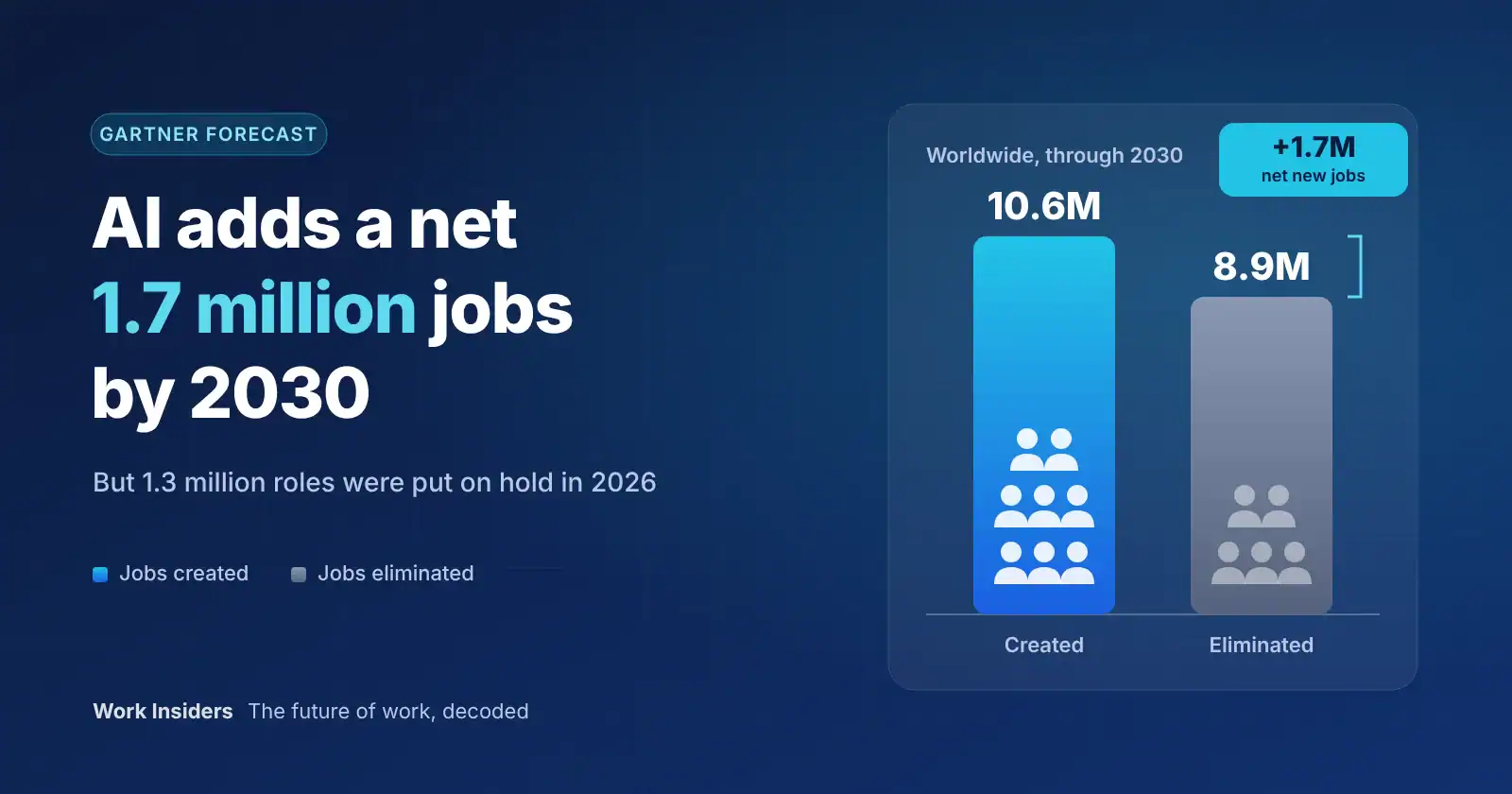
Quick answer: Gartner forecasts that AI will create 10.6 million jobs and eliminate 8.9 million worldwide by 2030, a net gain of 1.7 million. For recruiters the bigger story is hiring that never happens: executives put off creating 1.3 million positions in 2026, and Gartner expects 5 million people to have felt delayed hiring by 2030.
What it means for your desk: fewer new requisitions in the short run, demand moving toward AI and software engineering, and a likely round of corrective hiring when AI does not cover the workload companies expected it to.
Who this is for: agency recruiters, in house talent teams and HR leaders planning 2027 headcount.
What did Gartner forecast about AI and jobs?
Gartner released the forecast on November 10, 2026 at its IT Symposium/Xpo in Barcelona. The headline is that AI ends the decade as a net job creator: 10.6 million jobs created against 8.9 million removed worldwide, a net increase of 1.7 million, according to the Gartner press release.
Gartner also puts a ceiling on direct damage. Between 0.4% and 1.8% of workers are expected to lose a job directly because of AI by 2030, depending on the industry. That is a long way from the jobs apocalypse many headlines predicted.
| Measure | Gartner figure |
|---|---|
| Jobs created by AI through 2030 | 10.6 million |
| Jobs eliminated by AI through 2030 | 8.9 million |
| Net change by 2030 | 1.7 million more jobs |
| Workers losing a job directly to AI by 2030 | 0.4% to 1.8%, by industry |
| Positions deferred by executives in 2026 | 1.3 million |
| Jobs lost and gained in 2026 | 2.2 million lost, 1.6 million gained |
| People hit by delayed hiring by 2030 | 5 million |
| Workers who must adapt their roles through 2030 | 435.5 million, just over 20% |
All figures are global. Gartner did not publish a US breakout, a gap that 4 Corner Resources noted in its own read of the release.
Which industries gain and lose jobs from AI?
Gartner split its outlook into three industry groups, and they move in different directions. Technology is the clear winner, asset intensive industries roughly break even, and the public sector is the only group where losses beat gains.
| Industry group | Jobs created by 2030 | Jobs lost by 2030 | Net | Share of that workforce losing jobs to AI |
|---|---|---|---|---|
| Asset intensive (manufacturing, utilities, infrastructure) | 6.4 million | 6.0 million | Gain of 0.4 million | 0.4% |
| Technology | 1.9 million | 0.4 million | Gain of 1.5 million | 1.8% |
| Public sector | 0.4 million | 0.9 million | Loss of 0.5 million | 0.4% |
AI jobs created vs lost by 2030, by industry group
Millions of jobs worldwide, Gartner forecast
Why is the public sector the only loser?
Gartner’s view is that AI spending in government is unlikely to make up for severe skills shortages that have other causes, so jobs removed are not replaced at the same pace. Asset intensive industries hold the largest share of jobs worldwide, which is why their numbers are large even though only 0.4% of that workforce is expected to lose a job to AI, as IT Online reported.
Why do deferred jobs matter more to recruiters than layoffs?
Because a deferred job never shows up anywhere you can see it. Gartner counted 1.3 million positions that executives chose not to create or fill in 2026 while they waited to see what AI could do. Those roles are not on a layoff list and never become a job posting.
Gartner chief of research John Lovelock put it plainly: “Deferred jobs are not the same as lost jobs.” They are requisitions that simply never get opened, as HRD America reported.
For an agency desk, that is the quiet cause behind job orders that should have come in and did not. Add the 2026 totals (2.2 million jobs lost and 1.6 million gained) and the year ran about 0.6 million jobs behind before counting the deferred roles. Our layoffs tracker shows the cuts; it cannot show the roles that were never opened, so pair it with live openings on our job board.
What is corrective hiring?
Gartner analyst Helen Poitevin said AI expectations are running ahead of what the technology can actually do, so companies will eventually hire again as remaining staff carry heavier workloads, according to ITPro’s coverage. For recruiters, the accounts that froze hiring this year are the ones to stay close to, because they are the likeliest to come back with urgent roles.
Which tech roles are growing and which are shrinking?
Technology delivers about 1.5 million of the 1.7 million net new jobs, close to 90% of the total. It is also the most exposed sector: Gartner says nearly 70% of the tech workforce has high AI exposure, and 1.8% of it is expected to lose jobs directly to AI by 2030.
Inside tech the shift is about the kind of engineer, not the number. ITPro reported that traditional computer programmer roles are declining while demand climbs for software and AI engineers who can manage AI systems and orchestrate agents. If you recruit developers, the skills on the requisition are changing faster than the headcount.
| Trend | Direction | What to screen for |
|---|---|---|
| Traditional programmer roles | Shrinking | Reskilling into AI assisted development |
| Software and AI engineers | Growing | Agent orchestration, model integration, evaluation |
| Entry level hiring | Under the most pressure | Internships, apprenticeships, internal pipelines |
| Public sector roles | Net decline | Hard to fill skills that AI does not replace |
How many workers will need to change how they work?
Far more than will lose their jobs. Gartner estimates just over 20% of workers worldwide, about 435.5 million people, will need to adapt through 2030: changing their tasks, how they do them and where their responsibilities start and stop.
That is a training and internal mobility problem as much as a hiring one. Gartner’s HR research earlier this year made the same point, saying strong internal talent pipelines will be critical once AI starts creating more jobs than it removes, in its May HR research.
Poitevin also warned leaders against copying AI playbooks across industries or roles, saying it leads to bad judgment calls and missed targets. A plan that worked for a software company’s support team will not map cleanly onto a hospital or a plant floor.
How does this compare with earlier AI jobs forecasts?
Gartner has been steady on direction and is now putting firmer numbers on it. The table tracks how its view has moved, next to the bleakest warning that shaped the debate.
| When | Who | Forecast |
|---|---|---|
| November 2025 | Gartner | AI’s job impact neutral through 2026, more jobs created than destroyed by 2028 |
| May 2026 | Gartner HR research | AI creates more jobs than it eliminates beginning in 2028 |
| November 2026 | Gartner | Net gain of 1.7 million jobs by 2030; 1.3 million deferred in 2026 |
| 2025 | Anthropic CEO Dario Amodei | AI could wipe out half of entry level white collar jobs within one to five years |
The 2025 position comes from Gartner’s 2025 IT work survey. The Amodei warning is summarized in the HRD America article above. Note that the new forecast’s net figure is small next to a global workforce of billions; the real change is how jobs are done, not how many exist.
What should recruiters do with this forecast?
Treat it as a timing signal. Hiring is being postponed, not cancelled, and it is shifting toward specific skills. Here is how to act on each part of the forecast.
| Forecast signal | What to do | Where to start |
|---|---|---|
| 1.3 million deferred jobs | Keep in touch with clients who froze hiring; they are your corrective hiring pipeline | Hiring signals |
| Tech nets 1.5 million jobs | Build benches of AI and software engineers before demand returns | Sourcing tools |
| New money still hiring | Target recently funded companies, which hire first | Funding tracker |
| 435.5 million roles changing | Pitch reskilling and contract to hire, not just backfills | Staffing Market Brief |
| AI changes your own desk too | Use AI for the repetitive parts of sourcing and outreach | AI recruiting agents |
Quick answers
Will AI create more jobs than it destroys?
Gartner says yes by 2030: 10.6 million created against 8.9 million eliminated, a net gain of 1.7 million jobs worldwide.
How many jobs will AI eliminate by 2030?
About 8.9 million worldwide, which works out to between 0.4% and 1.8% of workers depending on the industry.
What is a deferred job?
A position an employer planned to create or fill but put on hold, often while testing AI. It is not a layoff; the job is simply never opened.
Which sector loses the most jobs to AI?
The public sector is the only group Gartner expects to shrink, with 0.9 million jobs lost and 0.4 million gained by 2030.
Which sector gains the most?
Technology, with 1.9 million jobs created and 0.4 million lost, about 90% of the net gain.
Are these US numbers?
No. Every figure in the forecast is global, and Gartner did not publish a US breakout.
When was the forecast released?
November 10, 2026, at Gartner IT Symposium/Xpo in Barcelona.
The bottom line
Gartner’s forecast is good news on paper: AI ends the decade 1.7 million jobs ahead. The near term is harder. Employers deferred 1.3 million positions in 2026, entry level hiring is under pressure and demand is concentrating in AI and software engineering. Recruiters who track hiring signals, stay close to frozen accounts and build engineering benches now will be ready when corrective hiring starts. Follow the shifts as they happen on our recruiting news feed.
Sources: Gartner press release, HRD America, IT Online, ITPro, 4 Corner Resources, Gartner HR research, Gartner 2025 survey
Free newsletter
Get the Work Insiders weekly
One email a week: the recruiting and HR tech news that mattered, the tools we just added to the directory, and one practical guide. No spam, and you can unsubscribe in one click.