

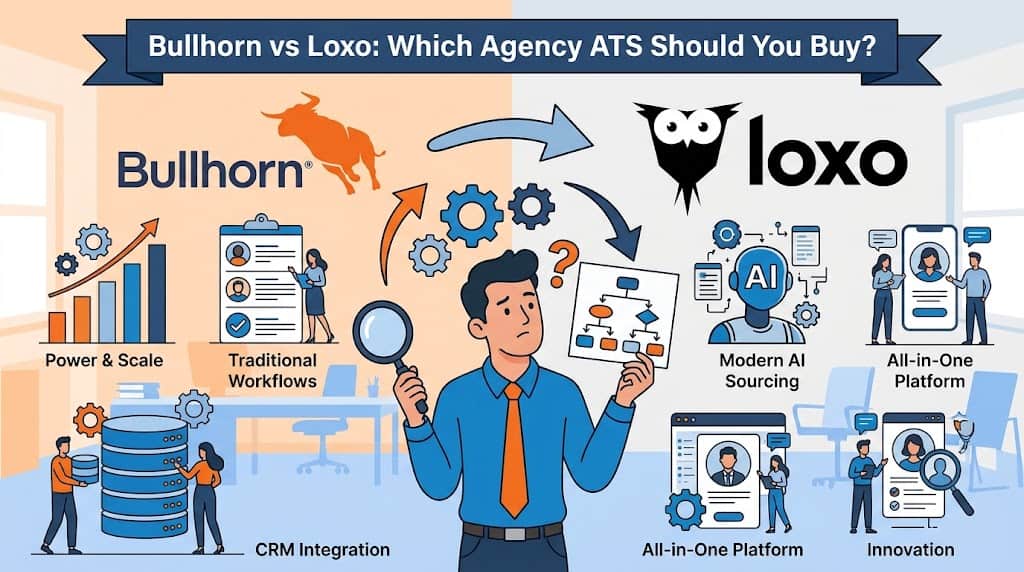
Quick verdict: Bullhorn is the incumbent and Loxo is the consolidator. Bullhorn Starter is $99 per user per month and Core is $165, with the AI, the CRM sales pipeline and the analytics on quoted tiers above. Loxo Core is $149 per user per month billed annually, and Loxo Professional at $199 adds a sourcing database of more than 850 million profiles plus 2,500 credits per seat. If you are buying an ecosystem, Bullhorn wins. If you are trying to replace three subscriptions with one, Loxo wins.
Pick Bullhorn if: you run temp or contract desks, need middle office billing, work through vendor management systems, or your clients and back office already expect Bullhorn.
Pick Loxo if: your recruiters source outbound every day and you currently pay for an ATS, a contact data tool and a sequencer separately.
How do Bullhorn and Loxo compare at a glance?
| Bullhorn | Loxo | |
|---|---|---|
| Published entry price | $99 per user per month, Starter | $149 per user per month, Core, annual |
| Realistic working tier | Core at $165 per user per month | Professional at $199 per user per month |
| Sourcing database | Not included, AI search sits on quoted tiers | 850 million profile graph on Professional |
| Contact credits | Quoted as part of AI data enrichment | 2,500 per seat per month on Professional, pooled |
| Marketplace | More than 300 partners on Core | Smaller, the platform is the integration |
| Back office and billing | Yes, Bullhorn One and Middle Office | No |
| MCP | No, API only | Yes, from Core |
| Capterra score | 4.0 | 4.6 |
Which one costs less to run?
At list price for a five seat perm desk, Bullhorn Core is $825 per month and Loxo Core is $745 per month billed annually. That comparison flatters Bullhorn, because Core does not include AI search, the CRM sales pipeline or automation, which sit on quoted Pro and Max tiers.
The fair comparison for an outbound desk is Bullhorn Pro, quoted, plus whatever you pay for contact data, against Loxo Professional at $995 per month for five seats with 12,500 pooled credits included. Once a sourcing tool and a data subscription are in the picture, Loxo usually lands cheaper, and the number is knowable before you talk to anyone.
What does each one hide behind a quote?
Bullhorn hides more. Pro, Max, all three larger Front Office tiers, Bullhorn One, the Salesforce based Recruitment Cloud editions and every module from Middle Office to Analytics are quoted. Loxo hides only Enterprise, which adds SSO, advanced permissions and a dedicated success team.
Where does Bullhorn clearly win?
Three places, and they are all structural rather than cosmetic.
First, contract and temp staffing. Timesheets, time interpretation, invoicing and pay and bill automation are real products inside Bullhorn One. Loxo does not compete here at all, so an agency billing hours has a short list of one.
Second, the ecosystem. More than 300 marketplace partners on Core means the odd tool your client insists on probably already connects. Add VMS automation across more than 110 vendor management systems and the case gets stronger for any firm working through client procurement portals.
Third, familiarity. Recruiters arrive knowing it, which shortens onboarding and makes hiring experienced billers easier.
Where does Loxo clearly win?
Loxo bundles the work that Bullhorn asks you to buy elsewhere. Sourcing across a large external graph, contact details attached to shortlists, AI search over your own database, email and calendar sync and a Chrome extension all sit inside the published seat price rather than behind a quote.
It also leads on the AI plumbing. MCP is listed from Core, so you can point your own AI tools at your Loxo data without waiting for a vendor roadmap. Bullhorn offers an API but no MCP.
Customer sentiment leans the same way. Loxo carries 4.6 on Capterra against 4.0 for Bullhorn, a gap that usually reflects interface and support experience rather than capability.
What do people complain about in each?
With Bullhorn, the recurring theme is that the published tiers are thin and the good features are quoted, so the demo and the invoice do not match. With Loxo, the thing to watch is that the published price is annual billing paid up front, so the monthly cash figure is higher than it looks if you were planning to pay month to month.
Which should a small agency choose?
For a perm search firm of two to ten recruiters doing outbound work, Loxo Professional is usually the better buy, because one line item replaces three. For a staffing firm placing contractors, billing hours and working through client vendor management systems, Bullhorn is the only one of the two that can run the whole business.
A useful test: write down every recruiting subscription you pay for today. If the list is one ATS, you are shopping on features and Bullhorn is competitive. If the list is four tools, you are shopping on consolidation and Loxo is designed for that.
Quick answers
Is Loxo cheaper than Bullhorn?
At the published entry tiers, no. Bullhorn Starter is $99 against Loxo Core at $149. Once you include sourcing and contact data, Loxo Professional at $199 typically costs less than Bullhorn plus the separate tools.
Does Bullhorn include sourcing?
Not at the published tiers. AI search and match and AI data enrichment sit on Pro, Max and the Amplify products, all quoted.
Can Loxo handle contract staffing?
It has no middle office for timesheets, invoicing or pay and bill. Agencies that bill hours need Bullhorn One or a separate back office system.
Which has better reviews?
Loxo, at 4.6 on Capterra against 4.0 for Bullhorn.
Is migration between them hard?
Both quote migration as part of the deal. Loxo lists free migration for teams of three or more seats, and Bullhorn lists free implementation on Starter and Core. Get the scope in writing either way.
What else should be on the shortlist?
Recruiterflow at $149 per user per month and Crelate from $85 per user per month. Both are covered in the alternatives guide.
The bottom line
These two are not really competing for the same job. Bullhorn sells a platform that can run a staffing business end to end, and charges for it through quoted tiers and modules. Loxo sells a recruiter a complete toolkit at one published price and wins by removing subscriptions.
Choose on your desk type rather than the demo. Contract and temp work points at Bullhorn. Outbound perm search points at Loxo. Then check the numbers yourself in the Bullhorn pricing breakdown and the Loxo pricing breakdown.
Sources: Bullhorn pricing, Loxo pricing