

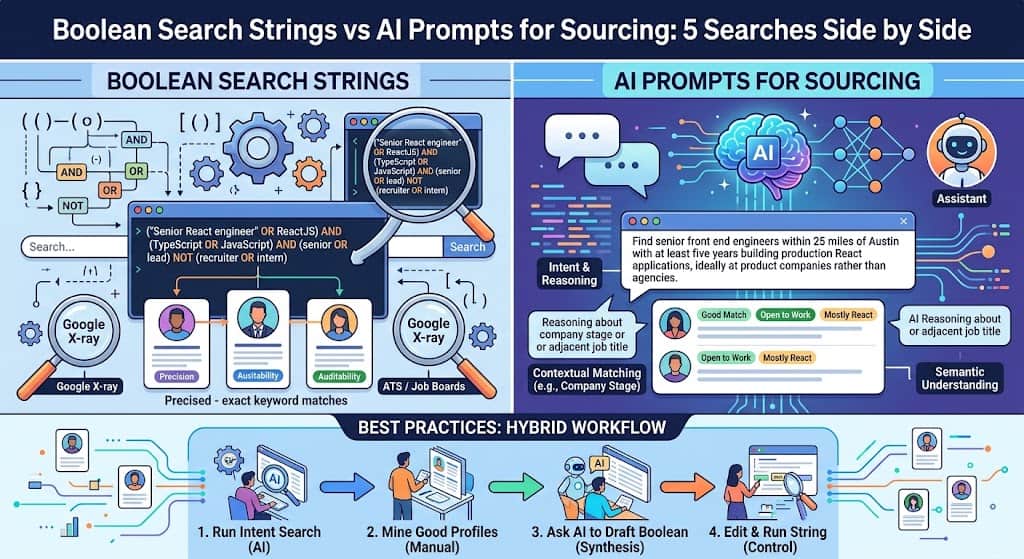
Quick answer: Boolean search strings and AI prompts are not rivals. AI prompts are better at intent, adjacent job titles and things a keyword cannot see, like company stage. Boolean is still better for precision, searches you can audit and repeat, and anything outside LinkedIn Recruiter, such as Google X ray or your ATS.
What changed in 2026: LinkedIn Recruiter now puts AI search that turns plain language into filters up front, and LinkedIn says Hiring Assistant 2 begins rolling out in early November.
Who this is for: Recruiters and sourcers who know AND, OR and NOT and want to see five searches run both ways, with what each finds and misses.
Is Boolean search dead now that LinkedIn has AI search?
No. Boolean is no longer the only way into a LinkedIn search, but it still matters. LinkedIn’s own help page lists Boolean and keyword searches as one of the ways to start an AI Search in Recruiter, right next to plain language queries and pasted profile links. The Recruiter product page also tells users they can switch from Hiring Assistant back to manual search with Boolean and more than 40 advanced filters.
What changed is the starting point. A recruiter who has never written a string can type a plain request and get a working search. That lowers the floor without raising the ceiling. On hard searches, sourcers who can read and fix a string still get better lists.
If you need the operator basics first, start with our Boolean search guide. This article skips them.
What did LinkedIn actually change in Recruiter search?
What is AI Search in LinkedIn Recruiter?
AI Search reads a plain language request and builds a structured search from filters like location, skills and job titles. According to LinkedIn Recruiter Help, it can also generate or refine a Boolean string, or search from an ideal candidate’s profile. A newer tier, Advanced AI Search, tries to match hard to define skills from a job description even when those words are not on a profile. It is limited to Recruiter and RPS+ customers using English settings.
LinkedIn’s own prompting tips say to brief the AI like another talent professional, refine the current search instead of starting over, and aim for about 200 candidates in a pool.
What is LinkedIn Hiring Assistant?
Hiring Assistant is LinkedIn’s AI agent for recruiters. You share hiring goals and it searches, reviews profiles and returns a shortlist. LinkedIn announced it would be globally available in English by the end of September 2025. It is sold as an add on to Recruiter. LinkedIn’s product page says it runs dozens of searches per role and claims recruiters using it review 81% fewer profiles to find a qualified match, based on its January 2026 data. Treat that as a vendor claim.
What does the same search look like as a Boolean string and as an AI prompt?
Five real searches, written both ways. Strings are for the Recruiter keyword field with location set as a filter. Prompts are what you would type into Recruiter AI Search, Hiring Assistant, Juicebox PeopleGPT or SeekOut Assist.
1. Senior React engineer in Austin
Boolean: (React OR "React.js" OR ReactJS) AND (TypeScript OR JavaScript) AND (senior OR lead OR staff OR principal) NOT (recruiter OR intern OR student OR bootcamp)
AI prompt: “Find senior front end engineers within 25 miles of Austin, Texas with at least five years building production React applications in TypeScript, ideally at product companies rather than agencies. Include people titled software engineer or full stack engineer if their recent work is mostly React. Exclude recruiters and students.”
What each finds and misses: The string treats a backend engineer who mentions React once the same as a React specialist, and misses engineers who only write “frontend”. The prompt handles “mostly React” and “product company” better because those are judgments, not keywords. It also lets in more mid level engineers with inflated titles, so check page one.
2. ICU nurse in Phoenix open to travel
Boolean: ("registered nurse" OR RN) AND (ICU OR "intensive care" OR "critical care" OR CCRN) AND (travel OR traveler OR "travel nurse" OR contract) NOT (student OR CNA OR "nursing assistant")
AI prompt: “ICU registered nurses in the Phoenix metro with at least two years of critical care experience who have worked travel or contract assignments, or who show they are open to new roles. CCRN is a plus. Exclude nursing students and CNAs.”
What each finds and misses: Few nurses write “open to travel”, so the string only finds those already listing travel contracts. The prompt can lean on Open to Work, which LinkedIn says makes candidates about 35% more likely to respond. The weak spot for both is coverage. Many bedside nurses keep thin profiles, so the same string run on job board resume databases often finds people neither LinkedIn method shows.
3. Controls engineer with Allen Bradley PLC experience in Ohio
Boolean: ("controls engineer" OR "automation engineer" OR "PLC programmer" OR "controls specialist") AND ("Allen Bradley" OR Rockwell OR ControlLogix OR CompactLogix OR "Studio 5000" OR RSLogix)
Google X ray version: site:linkedin.com/in ("controls engineer" OR "automation engineer") ("Allen Bradley" OR ControlLogix OR RSLogix) Ohio -jobs -recruiter
AI prompt: “Controls or automation engineers in Ohio who program Allen Bradley or Rockwell PLCs, ideally with ControlLogix and Studio 5000, in manufacturing plants or for system integrators. Include electrical engineers and maintenance technicians whose work is mostly PLC programming.”
What each finds and misses: Boolean wins. The search depends on specific product names, and a string lists each one where you can check it. AI search tends to read “PLC” broadly and pull in Siemens people. The prompt does help with adjacent titles like “maintenance engineer” that a title list misses.
4. VP Finance at a Series B SaaS company
Boolean: ("VP Finance" OR "VP of Finance" OR "Vice President of Finance" OR "Head of Finance" OR "Senior Director of Finance") AND (SaaS OR ARR OR "recurring revenue" OR subscription) AND ("Series B" OR "Series C" OR "venture backed" OR fundraise) NOT (banking OR "investment banking")
AI prompt: “Finance leaders titled VP Finance, Head of Finance or Senior Director of Finance, reporting to the CEO or CFO, at venture backed SaaS companies with 50 to 300 employees around the Series B stage. Must have led FP&A and supported a fundraise. United States, open to remote.”
What each finds and misses: Funding stage belongs to the company, so the string only finds executives who type “Series B” on their own profile, a small and odd group. AI tools can reason about company size and stage, so the prompt usually gives a better first list. But AI can be wrong about funding, so check the top companies yourself.
5. Bilingual Spanish customer success manager, remote
Boolean: ("customer success manager" OR "client success manager" OR CSM OR "customer success lead") AND (Spanish OR bilingual OR español OR bilingüe) AND (SaaS OR software OR platform)
AI prompt: “Customer success managers in the United States, open to remote work, who are fluent in Spanish and English and have managed a book of SaaS accounts, ideally serving Latin American customers. Include account managers whose role is mainly retention and renewals.”
What each finds and misses: Language skill often sits only in a profile’s languages section. Recruiter has a languages spoken filter, and a prompt that says “fluent in Spanish” lets the AI turn that into structured filters. A keyword string only looks for the words. The prompt also knows a renewals focused account manager is often the same job. The string is still the version you can paste into an ATS.
| Search | Boolean does better at | AI prompt does better at | Winner |
|---|---|---|---|
| Senior React engineer, Austin | Exact frameworks, clean exclusions | Judging “mostly React” and product company background | AI first, then edit |
| ICU nurse, Phoenix, travel | Reusable on X ray and job boards | Open to Work and intent signals | Split |
| Controls engineer, Allen Bradley, Ohio | Specific platform names, no Siemens noise | Adjacent titles like maintenance engineer | Boolean |
| VP Finance, Series B SaaS | Title precision | Company stage and size, reporting line | AI, with verification |
| Bilingual Spanish CSM, remote | Portability to ATS and job boards | Languages filter, renewal focused account managers | AI |
Why are AI prompts better at intent and adjacent titles?
A string only matches the words you thought of. An AI search works out the job behind your words and picks filters and titles to match. That is why LinkedIn’s guide suggests asking the AI for the top titles for a role at your company and adding them to the search. SeekOut tells users who are “not a Boolean pro” to paste a job description and let SeekOut Assist build the criteria, while keeping Boolean and wildcards for those who want them. AI helps most with roles outside your specialty, company attributes, soft criteria and “more people like this one” searches.
Why is Boolean still better for precision, auditing, X ray and ATS search?
Four reasons, none of which depends on how good the AI gets.
- Precision. A string says exactly what must appear. Recruiters on r/recruiting complain that LinkedIn Recruiter now returns profiles without their required keywords. One said they would rather see five exact matches than a padded list.
- Auditing. You can save a string, show it to a hiring manager and rerun it next quarter. An AI shortlist is harder to explain, and LinkedIn lists “greater transparency” into ranking as an upgrade in the Hiring Assistant 2 release.
- X ray. Google does not take a prompt. Several recruiters in that thread say X ray finds people Recruiter misses.
- ATS and job boards. Your ATS, resume databases and most CRMs still run keyword or Boolean queries.
What do sourcers on Reddit say about Boolean vs AI search?
Opinion is split. In an r/recruiting thread asking whether Boolean is a lost art, a hiring manager for a sourcing team said experienced candidates wrote sloppy strings in interviews. Others said Boolean is fading like cursive as filters improve, while one headhunter said Boolean skill is why they still beat competitors.
When LinkedIn’s AI search launched, the reaction in an earlier r/recruiting thread was mostly negative. Users said it returned irrelevant candidates and switched it off. In a 2025 thread in r/Recruitment, sourcers said writing the string is the fast part, AI is fine for a first draft, and the real work is market mapping and judgment. That matches my desk: the tool drafts, the sourcer decides.
What is the best hybrid workflow for sourcing with AI and Boolean?
Use AI for the wide net and Boolean for control:
- Run the intent search first. Paste intake notes into an AI search and review the first 25 results.
- Mine the good profiles. Note titles, skills and companies on the best five profiles.
- Ask an AI to draft the string. Give ChatGPT or Claude the job description plus those words, and name the platform.
- Edit by hand. Cut broad terms, add exclusions, check parentheses. Our free Boolean string builder helps here.
- Run the string everywhere else. Recruiter keywords, X ray, your ATS, job boards. Our LinkedIn Boolean guide covers the field differences.
- Compare the lists. People in only one list show what the other method missed.
How do I write a good AI sourcing prompt?
Brief it like a sharp junior sourcer. LinkedIn notes that clear prompts lead to better Hiring Assistant results. This template works in Recruiter, Juicebox, SeekOut or a chatbot:
Find [title] and close variants such as [2 or 3 adjacent titles] in [location or remote rule]. Must have: [2 to 4 hard requirements, with specific tools or licenses]. Nice to have: [1 to 3 items]. Company context: [industry, size, stage, or target companies]. Seniority: [years or scope]. Exclude: [titles, companies or backgrounds to skip]. Return about 200 profiles.
To have ChatGPT or Claude write the string instead, add: Now write this as a Boolean string for [LinkedIn Recruiter keywords / Google X ray / my ATS]. Use only AND, OR, NOT, quotes and parentheses. Put each skill's synonyms in one OR group. Do not invent certifications. More in our recruiting prompt library.
When should I use Boolean and when should I use an AI prompt?
| Situation | Use | Why |
|---|---|---|
| Role outside your specialty | AI prompt | It suggests titles and skills you would not know |
| Must have a named tool, license or clearance | Boolean | Exact terms, no loose matches |
| Company stage, size or “people like this one” | AI prompt | Keywords cannot see company attributes |
| Google X ray, GitHub, registries | Boolean | Search engines need operators |
| ATS rediscovery and job board resumes | Boolean | Most databases still run keyword queries |
| Hiring manager wants to see the logic | Boolean | A saved string is easy to audit |
| High volume, many similar roles | AI agent | Hiring Assistant style tools run many searches per role |
| Hard search with few candidates | Both | Compare lists to find the gaps |
Adoption is uneven. In LinkedIn’s 2025 Future of Recruiting survey, 37% of talent professionals said they were experimenting with or integrating generative AI. Those users reported saving about 20% of their workload. Most teams are still learning, so be fluent in both.
Quick answers
Can I still use Boolean in LinkedIn Recruiter in 2026?
Yes. LinkedIn supports Boolean in AI Search and in manual search with 40+ filters. Recruiters say keyword matching feels looser than before, so check results.
Can ChatGPT write Boolean search strings for recruiters?
Yes, as a first draft. Name the platform, ask for synonym groups, forbid invented requirements, then edit by hand.
Is LinkedIn AI search better than Boolean?
It is better at intent, adjacent titles and company context. Boolean is better for exact requirements and repeatable searches. On hard roles, run both and compare.
What is a good Boolean search string example for a niche technical role?
Put title variants in one OR group and specific tools in another, joined with AND. The controls engineer string above is a good model.
Should junior recruiters still learn Boolean?
Yes. You need it for X ray, your ATS and job boards, and to spot when an AI search went wrong.
The bottom line
Start with an AI prompt for intent and range, then turn what you learn into a Boolean string you control. Compare both lists on hard searches. For tools that do both, browse our sourcing tools directory or our SeekOut alternatives roundup.
Sources: LinkedIn AI Search help, LinkedIn AI search tips, LinkedIn Recruiter, LinkedIn News, LinkedIn Hiring Assistant, LinkedIn Hiring Release, Hiring Assistant best practices, Future of Recruiting 2025, Juicebox PeopleGPT, SeekOut sourcing, r/recruiting lost art, r/recruiting Boolean issues, r/recruiting AI Search, r/Recruitment thread
Free newsletter
Get the Work Insiders weekly
One email a week: the recruiting and HR tech news that mattered, the tools we just added to the directory, and one practical guide. No spam, and you can unsubscribe in one click.