

Quick answer
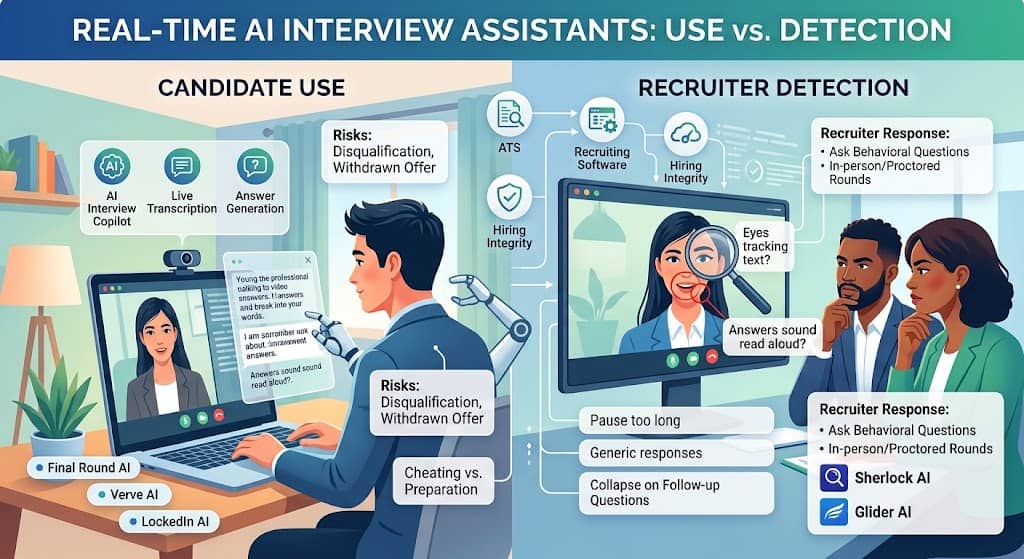
A real time AI interview assistant is an app that listens to a live interview, transcribes the interviewer’s questions and shows the candidate a suggested answer on a hidden overlay or a second device within seconds. The best known are Final Round AI, Verve AI, LockedIn AI, Parakeet AI, Sensei AI, Interview Coder and Cluely, with prices from free tiers to $299 a month. Recruiters spot most use through reading patterns and answers that collapse under follow up questions, and the best fix is an interview that rewards real experience.
Key takeaways
- These tools are built to stay hidden from screen sharing, so recruiters should rely on interview design and follow up questions, not on spotting a window.
- Use is no longer rare: Greenhouse found 65% of US hiring managers have caught applicants using AI deceptively, and 32% saw candidates reading from AI scripts.
- Employers are responding: Amazon’s recruiter guidance says candidates can be disqualified for AI use, and Google, Cisco and McKinsey have brought back in person rounds.
- For candidates, the risk is disqualification or a withdrawn offer.
- AI for preparation (mock interviews, research, practice answers) is widely accepted. AI feeding answers during a live interview is not, unless the employer says so.
- Write your AI rule down, tell candidates before the interview, and apply it the same way to everyone.
What is a real time AI interview assistant?
A real time AI interview assistant is desktop, browser or phone software that joins a candidate’s side of a video or phone interview. It hears the question, turns it into text, sends it to a large language model along with the candidate’s resume and the job description, and displays a short answer the candidate can read or paraphrase. Vendors also call it an AI interview copilot, and searchers often type “AI interview co pilot”.
How does an AI interview copilot actually work?
Most follow the same loop: listen, transcribe, generate, display. Final Round AI describes its CoPilot as listening to the call and streaming a suggested answer “in a private window only you can see”, and says its windows are hidden from screen sharing and recordings. Several also capture the screen to read coding problems, and some show answers on a phone instead.
Is an AI interview answer generator the same thing?
Not quite. An AI interview answer generator is usually a prep tool: you type a question and it drafts an answer to study. A live assistant does that during the real interview, which is where most employer policies draw the line.
Which AI interview assistants are candidates using in 2026?
We checked each vendor’s own pricing page in September 2026. Prices change often, so confirm on the vendor site. Where a page would not show prices, we say so rather than guess.
| Tool | What it does | Live or prep only | Price from (Sept 2026) |
|---|---|---|---|
| Final Round AI | Interview CoPilot listens to the call and shows suggested answers; also mock interviews and debriefs | Live and prep | Free prep tier; Pro listed from $25/mo |
| Verve AI | Live transcription, generated answers, screen capture for coding and online assessments | Live and prep | Free plan (3 sessions of 15 minutes); paid plans, see vendor site |
| LockedIn AI | Interview copilot, coding assistant, online assessment helper and mock interviews | Live and prep | See vendor site |
| Parakeet AI | Call assistant that detects questions, suggests answers and reads shared code | Live and prep | $38 for 1 credit (one hour of calls); Unlimited $149.90/mo |
| Sensei AI | Interview copilot with resume builder and coding copilot | Live and prep | Free 15 minute sessions; Pro $89/mo or $24/mo billed annually |
| Interview Coder | Coding interview assistant that suggests solutions to technical problems | Live | $299/mo or $799 one time |
| Cluely | Meeting assistant with live AI responses and notes | Live | Free starter; Pro $19.99/mo; screen share hiding tier $149.99/mo |
| Huru | AI mock interviews with feedback on your answers | Prep only | Free trial; $24.99/mo or $99/yr |
| Yoodli | AI roleplay and speaking practice with feedback | Prep only | Free starter; Pro $8/mo billed annually |
What about Cluely and Interview Coder?
Interview Coder was built by Columbia student Roy Lee, and Columbia pursued suspensions against him and cofounder Neel Shanmugam over it. The pair then launched Cluely with a “cheat on everything” campaign and raised $15 million from Andreessen Horowitz in June 2025. Cluely now markets itself as a meeting assistant, and in March 2026 Lee admitted misstating revenue figures he had given the press.
Which tools are for prep only?
Huru and Yoodli are practice tools: you rehearse with an AI interviewer and get feedback afterwards, with nothing running during the real interview. Google’s free Interview Warmup, long a popular prep option, is no longer live; its old address now points to a Google interview tips page that suggests practicing out loud with Gemini Live instead.
How common is AI interview cheating?
Common. In the Resume Genius survey of 1,000 US job seekers, reported by Newsweek in May 2026, 22% said they had used AI during real time interviews.
Assessment data points the same way. CodeSignal reported that cheating and fraud attempts on its proctored assessments rose from 16% in 2024 to 35% in 2025, and reached 40% for entry level roles.
The wider fraud problem goes beyond answer tools. Gartner predicts that by 2028 one in four candidate profiles worldwide will be fake, and 6% of candidates in its survey admitted to interview fraud, such as having someone else sit the interview. The FBI has warned that North Korean IT workers use US facilitators, including people who attend virtual interviews on their behalf, to get hired remotely.
What happens if a candidate gets caught using an AI interview assistant?
At many employers, the candidate is removed from the process. Amazon’s guidelines tell candidates not to use generative AI tools during interviews “unless explicitly permitted” and warn that failure to follow them “may result in disqualification”, according to Business Insider. Cisco’s head of talent acquisition told Computerworld that if a candidate is not explicitly invited to use AI, it should be treated as off limits.
The risk does not end at the offer. A hire whose interview was carried by a tool still has to do the job without it, and misrepresentation found later can lead to a withdrawn offer or dismissal. Some vendors also cooperate with employers: Parakeet AI says it will blocklist an employer’s domain or hiring process on request.
For candidates who want AI help without that risk, our candidate prep guide covers what employers generally allow and how to practice with AI before the day.
How can recruiters tell if a candidate is using AI in an interview?
You rarely see the tool itself, because most stay off the shared screen. You see behavior. Amazon’s internal guidance, reported by Business Insider, lists signs such as eyes tracking text, answers that sound read aloud, typing while the question is asked, and confident answers that do not address the question. The table below pulls these signs together.
| Sign | Why it happens | What to do |
|---|---|---|
| A pause of a few seconds before every answer, then fluent delivery | The tool needs time to transcribe the question and generate a reply | Ask short, quick questions and notice whether the pause stays the same length for easy and hard ones |
| Eyes moving side to side as if reading | The answer sits on an overlay or a second screen | Ask the candidate to talk you through their own screen or notes; do not accuse on this alone, since nerves and notes cause it too |
| Polished, generic answers with no names, numbers or mess | Language models produce tidy summaries, not lived detail | Ask “what went wrong”, “who disagreed with you” and “what would you do differently” |
| Answer drifts from the question asked | The transcript or the model misread the question | Rephrase the question mid answer and see whether the candidate adapts |
| Strong code, weak explanation | The solution came from a coding assistant | Ask why they chose that approach and have them change one requirement live |
| Self corrections on single words | Misreading text rather than thinking aloud | Move to a conversational question with no single right answer |
| Face or lips slightly out of sync, blurring when the hand moves | Possible deepfake or proxy candidate, a different risk from answer tools | Follow the FBI tip and ask the candidate to wave a hand in front of their face; verify ID before an offer |
No single sign proves anything. Treat it as a reason to probe further, note what you observed, and judge the whole interview. Our Academy lesson on candidates using AI covers how to raise it with a candidate fairly, and the lesson on deepfake interviews covers identity fraud.
How should you change your interview format to beat AI answers?
Design the interview so a generated answer is not enough. Questions about one specific past event, followed by two or three layers of follow up, are far harder to fake than “what are your strengths”. Our list of behavioral interview questions is a good starting bank.
Should you bring back in person interviews?
For high risk roles, one in person or proctored round is the simplest safeguard. Google CEO Sundar Pichai said the company is reintroducing at least one round of in person interviews, as Entrepreneur reported, and McKinsey asks hiring managers to meet candidates in person before an offer. A Gartner survey cited by Computerworld found 72.4% of recruiting leaders are interviewing in person to combat fraud.
What works for remote technical interviews?
Problems that change as you go, live debugging and system design with added constraints all expose copied answers quickly. Some teams now allow AI openly; our piece on AI assisted technical interviews explains that shift.
Does recording interviews help?
Yes, with consent. A note taker gives you a transcript to review for the pause and drift patterns above. See our guide to the best AI note takers and our Metaview vs BrightHire comparison.
What should an AI policy for interviews say?
It should say what is allowed, what is not, and what happens if the rule is broken, and it should reach the candidate before the interview. Gartner analyst Emi Chiba told Computerworld that employers should communicate AI expectations clearly, allowing AI in some stages and keeping others AI free. Sample wording you can adapt:
“You are welcome to use AI tools to research our company and practice for this interview. During the live interview and any assessment, please do not use AI tools, answer generators or anyone else’s help unless the interviewer invites you to. If we believe this rule was not followed, we may ask follow up questions or end your application. If you need an accommodation, tell us before the interview.”
Put the same text in the invite, the assessment instructions and the recruiter’s opening line. Apply it consistently, and route accommodation requests through your normal process so an assistive tool is not mistaken for cheating.
Which tools help detect interview fraud and AI cheating?
Integrity tools cover assessment proctoring, live interview monitoring and applicant fraud screening. Each produces flags a person should review, not proof. Prices checked on vendor sites in September 2026.
| Tool | What it checks | Where it works | Price from |
|---|---|---|---|
| Flags AI copilots, deepfakes and proxy candidates during the call | Zoom, Google Meet, Teams | $100/mo including 10 interviews | |
| Scores applicants against 700+ fraud signals at the application stage | Inside your ATS | Free trial; Growth $249 per user/mo billed annually | |
 HackerRank HackerRank | AI plagiarism detection using code patterns, copy paste and tab switching | Coding tests | See vendor site |
| Suspicion Score, full session proctoring and ID checks | Coding assessments and interviews | See vendor site | |
| 50+ proctoring checks including lip sync and deepfake identification | Assessments and interviews | See vendor site | |
| Face to ID and voice matching, secondary camera, integrity score | Proctored assessments | See vendor site | |
| Live technical interviews run by trained interview engineers | Engineering hiring | See vendor site | |
| Structured video interviews and assessments | Enterprise hiring | Quote based | |
| Honorlock | AI monitoring plus live human proctors | Workforce assessments | See vendor site |
Two cautions. HackerRank says the sessions its model flags are correct 85% of time, so human review still matters. Candidates must also consent before its AI plagiarism detection runs. You can compare more options in our AI interviewing category.
When is it acceptable for candidates to use AI in hiring?
Most employers accept AI for preparation: company research, practicing answers aloud, mock interview feedback and resume edits. The line is live help that misrepresents what the candidate can do on their own. Some employers, Cisco included, run exercises where AI use is invited.
The fair approach is to be as open about your own AI use as you ask candidates to be about theirs. If you screen resumes or run first interviews with AI, say so; our explainer on the AI resume screener covers the notice rules. For a structured way to train your team on all of this, the free AI Recruiting Academy has a full module on candidates using AI.
What else do people ask about AI interview assistants?
Can recruiters tell if you use an AI interview assistant?
Often, yes. They rarely see the app, but they notice reading patterns, fixed pauses and answers that collapse under follow up, and integrity tools flag off screen referencing.
Is using Cluely in an interview cheating?
If the employer has not allowed AI help during the interview, most would treat it as cheating, and Cluely itself launched with a “cheat on everything” slogan. Using AI to prepare beforehand is generally fine.
Is Final Round AI detectable?
Final Round AI markets its CoPilot as hidden from screen sharing and recordings, but that does not make its use undetectable. Interviewers judge the answers and behavior, not just the screen, and proctoring and fraud tools look for signals beyond what is shared.
What is the best AI interview assistant for preparation?
For practice without policy risk, a prep tool such as Yoodli or Huru is the safer choice. Check current plans on each vendor’s site.
Will I lose a job offer for using AI in an interview?
You can. Amazon’s guidance warns of disqualification, and misrepresentation discovered after an offer can lead to it being withdrawn under many company policies.
Are companies going back to in person interviews because of AI?
Some are. Google, Cisco and McKinsey have added in person rounds for some roles, and many others use proctored assessments or ID checks instead.
Free newsletter
Get the Work Insiders weekly
One email a week: the recruiting and HR tech news that mattered, the tools we just added to the directory, and one practical guide. No spam, and you can unsubscribe in one click.