

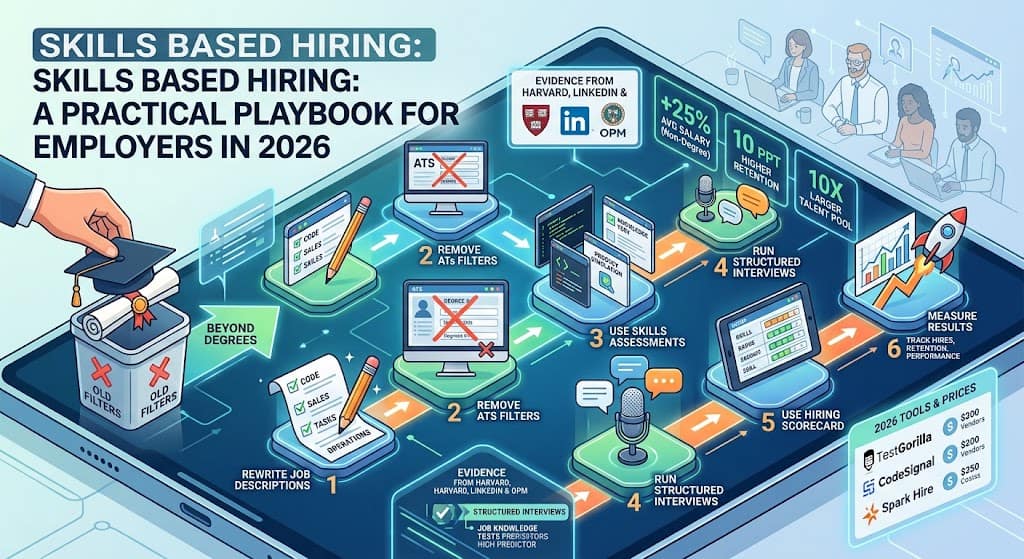
Quick answer: Skills based hiring means you decide who to hire from evidence of what candidates can do, such as work samples, job knowledge tests and structured interviews, instead of using degrees and past job titles as filters. Removing the degree line from a job ad is the easy part. The research shows most employers stop there, and their hiring barely changes.
Who it suits: employers hiring for roles where the work can be observed and tested, from customer support and sales to software, operations and skilled trades that do not require a license.
What to check: whether your ATS still filters on degrees, whether interviewers use the same questions and scorecard for every candidate, and whether you track the share of hires without degrees and how they perform.
What is skills based hiring, and how is it different from dropping a degree requirement?
Skills based hiring is a selection process built around the skills a job actually needs. You define those skills, test for them directly, and score every candidate against the same criteria. Credentials still count as evidence, but they stop acting as a gate.
Dropping a degree requirement is only one input. A 2024 report from Harvard Business School and the Burning Glass Institute, The Long Road from Pronouncements to Practice, found that removing degree language from postings changed actual hiring in fewer than 1 in 700 hires in 2023. The authors concluded that firms need “robust and intentional changes in their hiring practices”, not just edited job ads.
Does skills based hiring actually work?
Skills based hiring works for the employers that follow through, and the Harvard and Burning Glass data shows a clear split. According to HR Dive’s summary, 37% of the firms studied were skills based hiring leaders that raised their share of hires without bachelor’s degrees by nearly 20%. About 45% changed in name only, and 18% were backsliders whose early gains faded.
The payoff at the leading firms was measurable. At those firms, workers without degrees had a retention rate 10 percentage points higher than colleagues with degrees. Across the study, workers without degrees hired into roles that previously required one saw an average 25% salary increase, according to the report summary published by the Harvard Kennedy School.
LinkedIn’s Economic Graph team makes the talent supply case. Its Skills First report found that talent pools expand nearly 10 times on average when employers look at skills instead of job titles only. The companion data site cites a survey in which 88% of hirers agreed they filter out highly skilled candidates because they lack traditional credentials such as a past job title or degree.
Employer surveys show broad adoption on paper. TestGorilla’s 2025 report, based on 1,084 people involved in hiring in the US and UK, found that 85% of employers say they use skills based hiring and 76% use skills tests. It also found that 53% had removed degree requirements, yet 41% said degrees are more important than five years ago. TestGorilla sells assessments, so treat those adoption figures as a vendor survey rather than independent research.
Which governments have removed degree requirements?
Public employers have moved faster than most private ones. The National Governors Association reported in 2025 that over half of states have adopted policies encouraging skills based hiring, including removing degree requirements for many job postings, and that those states saw faster growth in postings that do not require degrees.
The federal government has gone further on assessment. The Office of Personnel Management’s Merit Hiring Plan (May 2025) builds on Executive Order 13932 from 2020 and the Chance to Compete Act of 2024. It tells agencies to eliminate unnecessary degree requirements, include at least one technical or alternative assessment before issuing a hiring certificate, and phase out applicant self assessment questionnaires by 2027. Self assessments may no longer be used to rank candidates, outside seasonal work and the lowest grades, without OPM permission. OPM keeps its guidance on a resources page.
How do you implement skills based hiring step by step?
The playbook below follows the order that matters most: fix the inputs, remove the filters, then replace them with methods that predict performance. Each step includes a check you can run this week.
Step 1: How do you rewrite a job description around skills?
Start with the work, not the old posting. List the five to eight tasks the person will do in their first six months, then name the skill each task requires and the level needed on day one. Move degrees to “or equivalent experience” or delete them, and separate must have skills from nice to have skills so candidates can judge their fit honestly. Our job description software directory lists tools that standardize this at scale, and the free JD bias checker flags exclusionary wording.
Step 2: How do you remove degree filters from your ATS?
Audit every knockout question, auto reject rule and saved search in your applicant tracking system. Degree fields are often hard coded into application forms, and recruiters build habits around them. In an r/recruiting discussion about resume overload, one recruiter said they clear 75% to 80% of applicants in 20 minutes using criteria that include pedigree and degree requirements. That habit survives any job ad rewrite unless you replace it with a skills screen. Our explainer on how an ATS works shows where those rules usually live.
Step 3: Which skills assessments and work samples should you use?
Use a short job knowledge test or work sample early, before resume review if volume is high. Keep it under 45 minutes, tie every task to a skill from Step 1, and set the pass mark before you see results. Our assessment software directory compares paid platforms, and the free assessment tools page covers options for small teams testing the idea first.
Step 4: How do you run structured interviews?
A structured interview asks every candidate the same job related questions in the same order and scores answers against a written rubric. Behavioral questions (“tell me about a time you…”) and situational questions (“what would you do if…”) both work when each one maps to a defined skill. Our list of behavioral interview questions is a good starting bank, and interview intelligence tools in our interviewing directory can help keep interviewers on script.
Step 5: What should a hiring scorecard include?
A useful scorecard lists each skill from Step 1, a 1 to 4 rating scale with written anchors for each level, and a space for evidence. Interviewers should score independently before the debrief so the loudest voice does not set the result. Weight skills in advance, and decide which ones are pass or fail.
Step 6: How do you measure whether skills based hiring is working?
Track four numbers by role: the share of hires without degrees, 90 day and 12 month retention, hiring manager ratings at six months, and pass rates by assessment stage for different candidate groups. The Harvard and Burning Glass finding that 45% of firms changed in name only is the reason to measure the share of hires, not the share of postings.
Which assessment methods predict job performance best?
The classic reference is Schmidt and Hunter’s 1998 meta analysis of 85 years of research, which put cognitive ability at the top. In 2022, Sackett, Zhang, Berry and Lievens reanalyzed the same literature in the Journal of Applied Psychology and concluded that earlier corrections for range restriction overstated validity. Their revised estimates are 0.10 to 0.20 lower for many methods, and structured interviews moved to first place.
| Selection method | Schmidt and Hunter 1998 | Sackett et al. 2022 | Practical note |
|---|---|---|---|
| Structured interviews | 0.51 | 0.42 | Top ranked in 2022, but results vary widely by design |
| Job knowledge tests | 0.48 | 0.40 | Best for roles with a defined body of knowledge |
| Empirically keyed biodata | 0.35 | 0.38 | Needs a validation study to build the scoring key |
| Work sample tests | 0.54 | 0.33 | Strong face validity with candidates |
| Cognitive ability tests | 0.51 | 0.31 | Largest Black White score gap in the 2022 table |
| Integrity tests | 0.41 | 0.31 | Targets counterproductive work behavior |
| Assessment centers | 0.37 | 0.29 | Expensive; mostly used for leadership roles |
| Situational judgment tests (knowledge) | Not estimated | 0.26 | Scalable for high volume screening |
| Unstructured interviews | 0.38 | 0.19 | Less than half the validity of structured interviews |
| Years of job experience | 0.18 | 0.07 | Weak on its own |
The figures are operational validity estimates, a correlation between the method and later job performance, taken from Table 3 of the Sackett paper, which lists both sets of numbers side by side. Schmidt and Hunter estimated 0.10 for years of education, and Sackett’s team excluded it for insufficient information. The SIOP summary notes that structured interviews also showed a relatively high spread around their mean, so a poorly built interview will not reach 0.42.
The practical takeaway for skills based hiring is that the strongest predictors are job specific: structured interviews, job knowledge tests and work samples. Schmidt and Hunter also found that pairing cognitive ability with a work sample or a structured interview raised combined validity to 0.63, which supports using a short assessment plus a structured interview rather than either one alone.
Which tools help at each step?
You can run a skills based process with spreadsheets and a shared rubric. Software helps once volume rises. Prices below were checked on each vendor’s pricing page and are shown as listed, September 2026.
| Step | Tool | Price as listed, September 2026 | What to check |
|---|---|---|---|
| Job descriptions | Datapeople | Quote based | Pay transparency monitoring and ATS integration |
| Job descriptions | Develop Diverse | Quote based | Inclusive language editor; ATS link on Professional plan |
| Assessments | TestGorilla | Free plan with 10 credits a month and 5 tests; Core $142 per month ($1,704 billed annually) | Custom tests and job simulations start on Plus, from $400 per month |
| Assessments | CodeSignal | Build $79 per month billed annually, $99 billed monthly | Annual Build includes 60 credits; extra credits $20 each |
| Assessments | TestInvite | Starter $900 per year | Credits needed per test and proctoring options |
| Assessments | Vervoe | Quote based | Work simulations with AI grading; enterprise focus |
| Interviewing | Spark Hire | Video interviews from $249 per month billed annually | Monthly option limits jobs and users |
| Interviewing | Willo | $59 per live role, or annual plans from $3,799 per year | Structured one way interviews per role |
| Interviewing | BrightHire | Quote based | Interview plans, rubrics and ATS scorecard sync |
Teams comparing AI led screening can also browse the AI interviewing directory, but apply the same rule as any assessment: every question and score should trace back to a defined job skill.
What are the biggest skills based hiring pitfalls?
| Pitfall | What it looks like | Fix |
|---|---|---|
| Change in name only | Degree removed from the ad, same people hired | Track the share of hires, not postings |
| Hidden ATS filters | Knockout questions still ask for a degree | Audit every rule and saved search |
| Unstructured final interviews | Managers override test results on gut feel | Same questions and scorecard for all finalists |
| Generic tests | Off the shelf test unrelated to the role | Map each test to a Step 1 skill |
| Ignoring adverse impact | Pass rates differ sharply by group | Monitor pass rates by stage and adjust cut scores |
| Long assessments | Strong candidates drop out | Keep early tests under 45 minutes |
| Manager skepticism | Hiring managers still prefer degrees | Share retention and performance data by cohort |
Industrial psychologists raise similar concerns. In an r/IOPsychology discussion of skills based hiring, commenters warned that the label is often attached to AI skills matching from resumes rather than real assessment, and that inferred skills need checking against work samples, structured interviews and job outcomes.
Quick answers
Does skills based hiring work for licensed jobs?
Yes, within legal limits. Nurses, electricians and drivers still need their licenses; skills based hiring removes requirements that are not legally or practically necessary.
What is the single best predictor of job performance?
In the 2022 Sackett et al. update, structured interviews had the highest mean validity at 0.42, followed by job knowledge tests at 0.40. Combining a structured interview with a work sample or knowledge test is stronger than either alone.
How many employers use skills based hiring?
TestGorilla’s 2025 survey found 85% of employers say they do. The Harvard and Burning Glass research suggests far fewer have changed who they actually hire.
Can small businesses do skills based hiring for free?
Yes. A written skills list, a short work sample, a structured interview guide and a shared scorecard cost nothing, and several assessment tools offer free plans.
Does skills based hiring improve retention?
At the firms that followed through, workers without degrees hired into roles that formerly required one had retention 10 percentage points higher than colleagues with degrees, according to the Harvard and Burning Glass report.
Should we still look at resumes?
Resumes remain useful context, but they should not be the first filter. Put a skills screen ahead of resume review for high volume roles.
The bottom line
Skills based hiring pays off only when it changes who gets hired. Rewrite roles around tasks and skills, strip degree filters from your ATS, and replace gut feel with the methods research ranks highest: structured interviews, job knowledge tests and work samples, scored on a shared scorecard. Then measure the share of hires without degrees and how they perform. Compare platforms in our assessments directory or start with free assessment tools.
Sources: Harvard and Burning Glass, HR Dive, LinkedIn Economic Graph, TestGorilla 2025 report, National Governors Association, OPM Merit Hiring Plan, Schmidt and Hunter, Sackett et al., SIOP
Free newsletter
Get the Work Insiders weekly
One email a week: the recruiting and HR tech news that mattered, the tools we just added to the directory, and one practical guide. No spam, and you can unsubscribe in one click.