

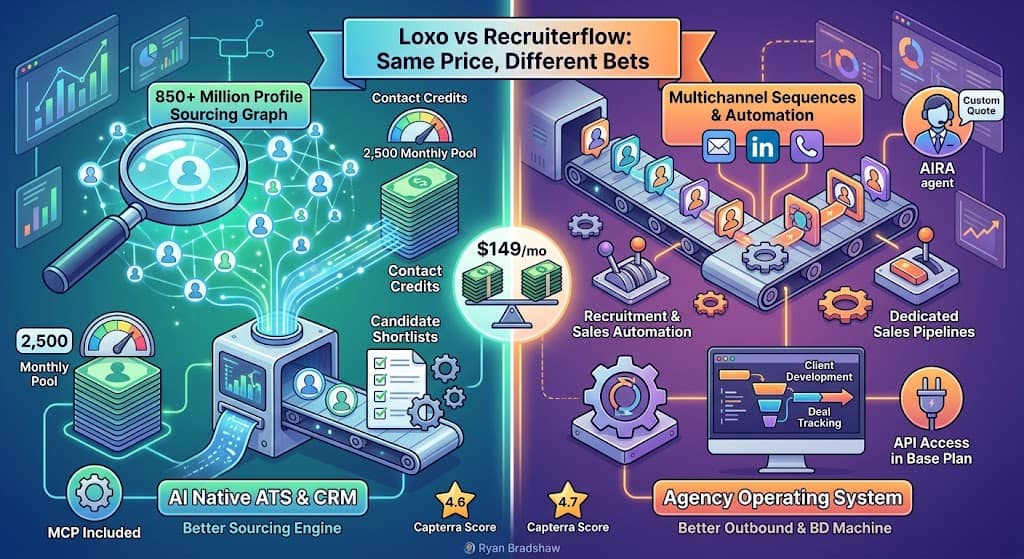
Quick verdict: Both list at $149 per user per month, and they spend that money on different things. Loxo Core buys an AI native ATS and CRM, with the 850 million profile sourcing graph and 2,500 credits per seat waiting one tier up at $199. Recruiterflow Platform buys the ATS and CRM plus multichannel sequences, recruitment and sales automation and API access in the base plan, with the AIRA agents on a custom quote. Loxo is the better sourcing engine. Recruiterflow is the better outbound and business development machine.
Pick Loxo if: finding candidates is the bottleneck and you want to stop paying for a separate contact data subscription.
Pick Recruiterflow if: you already know who to contact and the bottleneck is sequencing, following up and keeping client development moving.
How do they compare at a glance?
| Loxo | Recruiterflow | |
|---|---|---|
| Published price | Core $149, Professional $199 per user per month, annual | Platform $149 per user per month, lower on annual billing |
| Sourcing database | 850 million profiles on Professional | Chrome extension sourcing, finder on the AIRA plan |
| Contact credits | 2,500 per seat monthly, pooled, on Professional | Phone and email finder on AIRA |
| Sequences | Yes | Yes, multichannel, in the base plan |
| Sales and business development | CRM pipelines | Dedicated sales automation and deals |
| API access | Professional | Platform, the base plan |
| MCP | Yes, from Core | Yes, hosted |
| AI agents | Full agent workforce on Professional | AIRA plan, custom priced, all agents included |
| Capterra score | 4.6 | 4.7 |
Which one costs more once you add what you need?
At the published floor they are level. The difference appears at the second step.
A sourcing heavy desk needs Loxo Professional at $199 per user per month, because that is where the talent graph and the credits live. The same desk on Recruiterflow stays at $149 but keeps paying a contact data provider, which for most teams runs between $49 and $99 per user per month. Those two paths land close together, and which is cheaper depends on how many contact credits you actually burn.
A desk that wants AI agents faces the opposite shape. Loxo publishes the agent workforce as part of Professional at $199. Recruiterflow puts every AIRA agent on a custom plan, so the number is unknown until you ask. Recruiterflow does commit that no agent carries a separate fee once you are on AIRA, which is a better deal structure than per agent metering if the base number is reasonable.
Which publishes more of its pricing?
Loxo, narrowly. Two of its three tiers carry a number, and only Enterprise is custom. Recruiterflow publishes one of two plans, though it has fewer plans to hide.
Where does Loxo win?
Data. Loxo Source searches a proprietary graph of more than 850 million professionals in the same motion as your private database, and contact information arrives attached to shortlists rather than through a separate lookup. For a team that spends its mornings building lists, that is the product.
The credit model helps too. The 2,500 monthly credits are per seat but pooled across the team and refreshed in full each cycle, so a heavy week on one desk does not strand allowance on another.
Loxo also lists MCP from its entry tier, so smaller teams can connect their own AI tools without buying up.
Where does Recruiterflow win?
Workflow. Multichannel sequences, recruitment automation with triggers and templates, sales automation for business development, client and team access controls and reporting all sit in the base plan. So does API access, which Loxo reserves for Professional.
Recruiterflow is also the higher rated of the two on Capterra at 4.7, and its customers talk about support and automation recipes more than about database size. If your firm sells as much as it recruits, the deals and sales automation side has no direct equivalent in Loxo.
What does each one get wrong?
Loxo asks you to move up a tier for the feature most buyers came for, which makes the $149 headline a little optimistic, and its published price is annual billing paid up front. Recruiterflow keeps its AI layer behind a quote, so the plan people want to compare is the one they cannot see.
Which should a search firm choose?
Count your recruiters’ hours for a week. If more of them go into finding people than into contacting them, buy Loxo Professional and cancel the contact data subscription. If more go into follow up, client development and keeping deals alive, buy Recruiterflow Platform and add AIRA when the quote makes sense.
Teams that need both, and can only buy one, usually get further with Loxo, because sourcing data is harder to bolt on cheaply than an email sequence is.
Quick answers
Is Loxo or Recruiterflow cheaper?
Both publish $149 per user per month. Loxo is more expensive once you need sourcing at $199, and Recruiterflow is more expensive once you add a separate contact data tool or the custom priced AIRA plan.
Do both include an API?
Recruiterflow includes API access in the Platform plan. Loxo lists API access on Professional and above.
Do both support MCP?
Yes. Loxo lists MCP from Core and Recruiterflow offers a hosted MCP server, so both can be connected to AI tools directly.
Which has the bigger database?
Loxo, with a stated graph of more than 850 million professionals. Recruiterflow sources through its Chrome extension and offers a finder on the AIRA plan.
Which is better for temp staffing?
Neither. Both are built for perm and executive search. Agencies billing hours should look at Bullhorn middle office.
Can either replace a sequencing tool?
Both run sequences. Recruiterflow’s are multichannel and in the base plan, which is the stronger claim of the two.
The bottom line
Same sticker, different machine. Loxo is a sourcing platform that happens to include an ATS. Recruiterflow is an agency operating system that happens to source. Neither is the wrong answer, but paying $149 for the half you do not use is.
Read the Loxo pricing detail and the Recruiterflow pricing detail, then pick the one that fixes your slowest step.
Sources: Loxo pricing, Recruiterflow pricing