

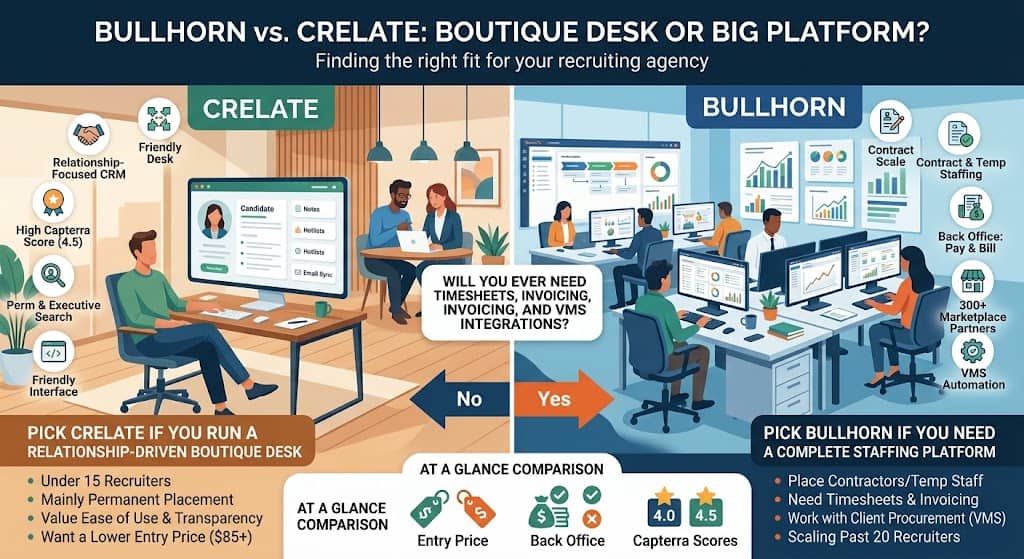
Quick verdict: Crelate is built for a boutique desk and Bullhorn is built for a staffing business. Crelate Essentials is $85 per user per month paid annually but caps you at two users and 20,000 contacts, so the real team plan is Business at $119. Bullhorn Starter is $99 per user per month and Core is $165, with everything interesting quoted above that. The deciding question is not price, it is whether you will ever need timesheets, invoicing and vendor management integrations.
Pick Bullhorn if: you place contractors, bill hours, work through client procurement systems, or expect to grow past twenty recruiters.
Pick Crelate if: you run a small perm or executive search desk on relationships, notes and hotlists, and want a lower entry price with a friendlier interface.
How do Bullhorn and Crelate compare at a glance?
| Bullhorn | Crelate | |
|---|---|---|
| Published entry price | $99 per user per month, Starter | $85 per user per month, Essentials, annual |
| Entry tier limits | None published | Up to 2 users and 20,000 contacts |
| Realistic team tier | Core at $165 per user per month | Business at $119 per user per month |
| Automation and sequences | Quoted, on Pro and above | Custom, on Business Plus |
| Client portals | Through the marketplace | Business, with premium portals on Business Plus |
| Back office and billing | Yes, Bullhorn One and Middle Office | No, onboarding sold separately per hire |
| Marketplace | More than 300 partners on Core | Marketplace partners on Business Plus |
| Capterra score | 4.0 | 4.5 |
Which is cheaper for a three person agency?
Crelate, clearly. Three recruiters cannot use Essentials at all because of the two user cap, so the comparison is Crelate Business at $357 per month against Bullhorn Core at $495 per month. That is roughly $1,650 a year of difference for a similar core job.
The gap narrows when you add what each one withholds. Crelate puts automation, sequences, business development workflows and full API access on Business Plus, which is custom priced. Bullhorn puts AI search, the CRM sales pipeline and analytics on Pro, also quoted. Both vendors will name a number for a three seat deal, and both numbers will be higher than the published ones.
Which one has the cheaper true floor?
Crelate, for one or two people. A solo recruiter with an assistant pays $170 per month on Essentials and gets applicant tracking, a recruiting CRM, a job portal, resume parsing and sourcing. Bullhorn has no equivalent two seat package at that price with those features.
Where does Bullhorn win?
Contract and temp staffing, without argument. Timesheets, time interpretation, invoicing and pay and bill automation exist inside Bullhorn One. Crelate has no back office, so an agency billing hours would need a second system beside it.
Scale is the second win. The marketplace of more than 300 partners on Core, plus VMS automation across more than 110 vendor management systems, matters once clients start dictating which portal you submit through. Bullhorn is also the name that recruiters arrive already knowing, which shortens onboarding when you hire experienced billers.
Where does Crelate win?
Crelate is built around the way a boutique desk actually works: notes on people, hotlists you keep for years, and email sync that keeps every conversation attached to the record. Reviewers rate it 4.5 on Capterra against 4.0 for Bullhorn, and the gap is usually about usability rather than features.
It is also more honest about limits. The entry plan states its seat and contact caps on the pricing page, and Business is a published number rather than a quote. For a small firm that wants to know its bill for the next twelve months, that transparency has value.
What does Crelate charge extra for?
Two things worth budgeting. Crelate Hire, the onboarding and compliance product, is priced per hire and adds checklists, state and local tax forms, WOTC integration and an employee portal. The Data Sync Service, which connects Crelate to back office and CRM systems, is priced on volume and frequency.
Which should you choose?
Answer one question first: will you bill hours? If yes, the choice is Bullhorn or Bullhorn plus a back office partner, and Crelate is not really in the running. If no, and you are under about fifteen recruiters doing perm or executive search, Crelate does the same day to day job for less and is easier to live in.
If you are somewhere between, price Bullhorn Core against Crelate Business Plus at your seat count and compare what each includes at that number rather than at the published floor.
Quick answers
Is Crelate a true Bullhorn alternative?
For perm and executive search desks, yes. For staffing firms that need timesheets and invoicing, no, because Crelate has no middle office.
Why is Crelate Essentials so cheap?
It is capped at two users and 20,000 contacts, and it leaves the AI assistant, client portals, reporting and email connections to Business.
Which has better integrations?
Bullhorn, by a wide margin, through its Core marketplace and VMS automation. Crelate reserves full API access and marketplace partners for Business Plus.
Which is easier to learn?
Crelate, according to review scores and the way it is designed around notes and hotlists rather than configurable enterprise workflows.
Do either publish their full pricing?
Neither does. Crelate publishes two of four tiers and Bullhorn publishes two small agency tiers. Everything above those is quoted.
What else should I look at?
PCRecruiter at around $115 per user per month, and Recruiterflow at $149. Both are in the alternatives guide.
The bottom line
Crelate is the better small agency product and Bullhorn is the better staffing platform. At three seats Crelate saves you real money and gives you a system your recruiters will not fight. At thirty seats, with contractors on assignment and clients sending work through vendor portals, Bullhorn is doing jobs Crelate never set out to do.
Work out which business you are running in two years, then read the Crelate pricing detail and the Bullhorn pricing detail with that in mind.
Sources: Bullhorn pricing, Crelate pricing