

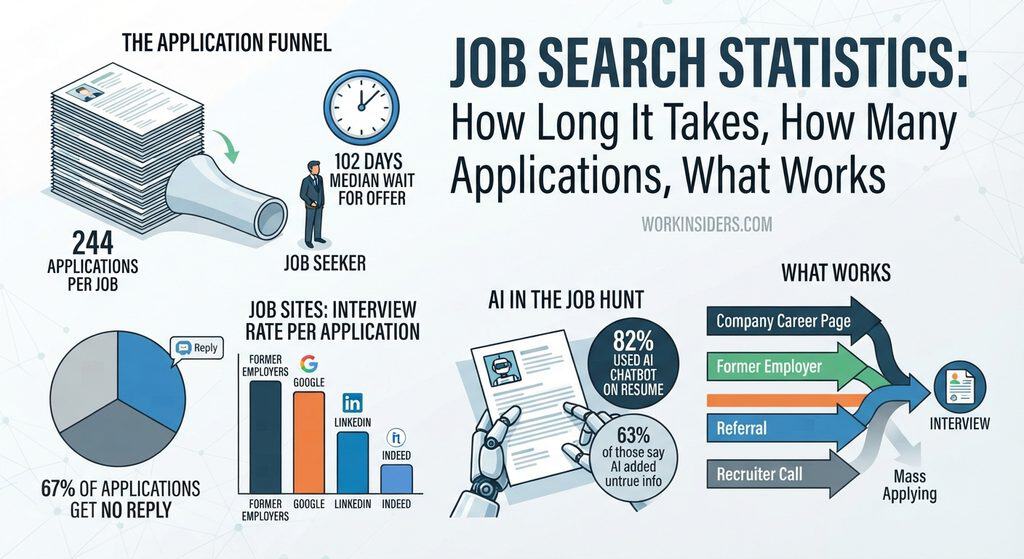
Finding a job in 2026 takes longer and more applications than it did a few years ago. The average job now gets 244 applications, more than double 2022, while companies have half as many recruiters to read them. The median job seeker waits 102 days for a first offer, two in three applications get no reply at all, and more than a quarter of unemployed Americans have been looking for six months or longer. What works has not changed much: applying on a company’s own careers page, going back to a former employer, a referral or a recruiter’s call all beat mass applying on LinkedIn or Indeed.
Job search statistics are easy to find and hard to trust: many are survey numbers from years ago with a new date on top. Every figure below comes from a 2025 or 2026 source we could trace to the people who collected it, and we say whether it is a survey, platform data or a government count. Where we have our own data, from the 42,308 jobs on our job board and the hiring signals we read from about 1,730 company job boards, we add it.
How long does it take to find a job in 2026?
About three to seven months, depending on who you ask and who is counting. Huntr, a job tracking app, found the median time from starting a search to a first offer reached 102 days in Q3 2026, up from 78 days a year earlier, in data from its users (Huntr Q3 2026). A survey of 1,000 US job seekers by United Way of the National Capital Area put the average search at 28.5 weeks, about 6.6 months (United Way NCA).
Government data agrees that searches are long. In October 2026, 1.96 million Americans, 27.6% of everyone unemployed, had been out of work for 27 weeks or more, per the BLS duration table. A year earlier the long term share was about 24%. The mean spell of unemployment is now over 27 weeks, though the median is closer to 12, because a smaller group of very long searches pulls the average up.
Searches also split into fast and slow. In a March 2026 Monster survey of 1,003 job seekers, 36% found a role in under a month, while 25% were still looking after six months or more, including 18% for over a year (Monster).
Who waits longest?
Tech workers have it hardest: 9.7 months on average and 103.7 applications each, the most of any industry in the United Way survey. Construction, manufacturing and hospitality searches were the shortest, under four and a half months. Older workers wait longer than younger ones, even though Gen Z sends the most applications (75.8 on average).
How many applications does it take to get a job?
Dozens. The average respondent in the United Way survey sent 62.6 applications, spent about 46 hours on them, and got 4.76 interviews. Huntr found that 29% of its surveyed users got a first interview within 10 applications, while 26% needed more than 50. Among users whose first offer came after at least 11 applications, 65% had it by their 50th.
From the employer’s side, the pile is enormous. Jobs on Greenhouse drew an average of 244 applications each in 2025, up from about 116 in 2022, while the average company on the platform went from 10.43 recruiters to 4.62, per the Greenhouse Hire Standard (March 2026, more than 640 million applications at 6,000+ companies). Ashby counted about 291 applications per hire in Q1 2026, against roughly 100 in early 2021, as summarized by Geekflare.
Part of the surge is people, part is software. LinkedIn CEO Dan Shapero said job seekers are sending 30% more applications than before the pandemic, as Fortune reported in September. The rest is AI tools that write and send applications in bulk, covered below.
Do employers reply to applications?
Mostly not. United Way’s respondents said 67% of their applications got no response, and 94.3% had applied for at least one job and never heard back. In Greenhouse’s October 2026 candidate report, 81% of US job seekers said they had been rejected from at least one job in the past year without ever speaking to a recruiter or an AI interviewer, as Black Enterprise reported.
Silence after an interview is common too. In Huntr’s October survey, 37% of job seekers who had interviewed said employers often or very often stopped responding afterwards. When asked what they wanted, half said simply a response or a reason, even if it was a no. United Way found 43.6% had reached a final round and still been turned down, and 35.1% had been asked to complete unpaid assessments or projects.
Which job sites get the most interviews?
Not the biggest ones. Across Huntr users over the past 12 months, applications found through Google’s job search got an interview 9.9% of the time, against 3.6% for both LinkedIn and Indeed. The same pattern held when Huntr compared the same people applying through both. Applying on a company’s own careers page beat applying through a job board, and going back to a former employer beat everything.
Personal routes still produce a large share of interviews. Asked where their most recent interview came from, Huntr’s survey respondents said 58% from applying online, 18% from a recruiter reaching out, 13% from an employee referral and 11% from networking. Online applications win on volume because people send so many of them; per application, the personal routes do far better.
Does mass applying work?
It gets more interviews in total but a worse rate per application. Huntr users who sent 11 to 20 applications got an interview from 8.0% of them; those who sent more than 100 got 2.4%, though 72% of the heavy appliers did land at least one interview. People who sped up to three times their usual weekly pace saw their rate fall from 9.5% to 5.6%, while their interviews per month went from 0.7 to 2.9. Applying to the same company eight or more times cut the per application rate to 2.4%.
Tailoring helps: 79% of Huntr’s respondents would rather send 20 tailored applications than 100 copies of one resume, and 64% tailor most or all of them. Resume length, on the other hand, showed no clear link to interviews in Huntr’s data.
How are job seekers using AI?
Heavily, and not always to good effect. In Huntr’s October survey, 82% had used an AI chatbot on their resume, and 63% of those said the AI had added something untrue. One in five had tried an auto-apply tool; of those, 9% got more interviews, 49% about the same and 25% fewer. Employers are using AI too: 63% of US job seekers said they had been interviewed by an AI, per a Greenhouse report covered by Fortune. For more, see our AI interview statistics and AI in hiring statistics.
Is it harder to get a remote job?
Yes. Only 10% of the 42,308 jobs open on our job board on November 23, 2026 were remote, 4,345 in all, and they draw more competition per opening. Huntr users got an interview from 3.4% of remote-only applications in Q3 2026, against 5.3% for hybrid or onsite roles. Huntr also found entry-level roles converted at 3.9% against 6.4% for senior roles in 2026, so early career and remote seekers face the steepest odds. Browse current openings on our remote jobs page, and see hybrid working statistics for where the office debate stands.
What does a job search cost?
Money and energy. In the United Way survey, 55.6% of job seekers used up savings, 38% missed bill payments or took on credit card debt, and nearly 20% fell behind on rent or a mortgage. Nearly 80% reported burnout, and 67% said looking for work felt like a full time job. Huntr found 60% had lowered their salary expectations in 2026, 37% by $10,000 or more.
What do these statistics mean for recruiters?
| What the data shows | What to do |
|---|---|
| 244 applications per job, half the recruiters | Inbound alone will not surface the best people; source and refer |
| 18% of recent interviews came from recruiter outreach | Candidates are open to calls; a direct message beats waiting in the pile |
| Two in three applications get no reply | Answer every candidate you spoke to; it is the easiest way to stand out |
| Former employers convert at 13% | Build alumni and silver medalist lists before posting a role |
| Searches run three to seven months | Long term job seekers are motivated and often underpriced; screen them seriously |
| 63% of AI-edited resumes may include something untrue | Verify claims in the first call instead of trusting keyword matches |
Hiring managers asking where to find people can start with our Who’s Hiring signals, which flagged 965 hard to fill roles this week, and the layoffs tracker for people newly back on the market. For the bigger picture, read our state of hiring 2026 report and layoff statistics.
How we built these statistics
We used only 2025 and 2026 sources and checked each figure against the publisher’s own page. They are three kinds: platform data (Greenhouse, Ashby, Huntr’s job tracker), surveys (United Way NCA, Monster, Huntr’s survey) and government counts (BLS). Platform data reflects that platform’s users, and surveys reflect who answered, so treat single numbers as estimates and look at the direction. Work Insiders figures were read from our job board and Who’s Hiring feed on November 23, 2026. You are welcome to use any chart here with a link back to this page.
What else do people ask about the job search?
How long does the average job search take in 2026?
Around three to seven months. Huntr’s median time to a first offer was 102 days in Q3 2026, and a 2026 United Way NCA survey found an average of 28.5 weeks.
How many applications does it take to get a job?
Often a few dozen. The average job seeker in the United Way survey sent 62.6 applications for 4.76 interviews, and 65% of Huntr users who needed more than 10 applications had an offer by their 50th.
How many people apply for each job?
About 244 per job on Greenhouse in 2025, more than double 2022. Popular roles at well known companies get far more, small local jobs far fewer.
What percentage of job applications get a response?
About one in three, by United Way’s survey, where 67% of applications got no response. Interview rates per application usually fall between 3% and 10%.
Is LinkedIn or Indeed better for getting interviews?
They tied at 3.6% per application in Huntr’s data. Applications found through Google’s job search (9.9%) and on employers’ own careers pages (6.0%) did better.
How many interviews before a job offer?
The United Way survey average was under five interviews per search. We break this down by role and process in how many interviews to expect before a job offer.
Why is it so hard to find a job right now?
Employers are hiring slowly while applications have doubled, partly because AI makes applying fast. Openings are steady at about 7.5 million, but hires lag, so each opening draws far more applicants than a few years ago.
Featured
How it worksHappierleads FeaturedPerson-level B2B website visitor identification.
Tomba FeaturedFind and verify emails on one credit meter.
Featured slots never change our picks or rankings.
Free newsletter
Get the Work Insiders weekly
One email a week: the recruiting and HR tech news that mattered, the tools we just added to the directory, and one practical guide. No spam, and you can unsubscribe in one click.