

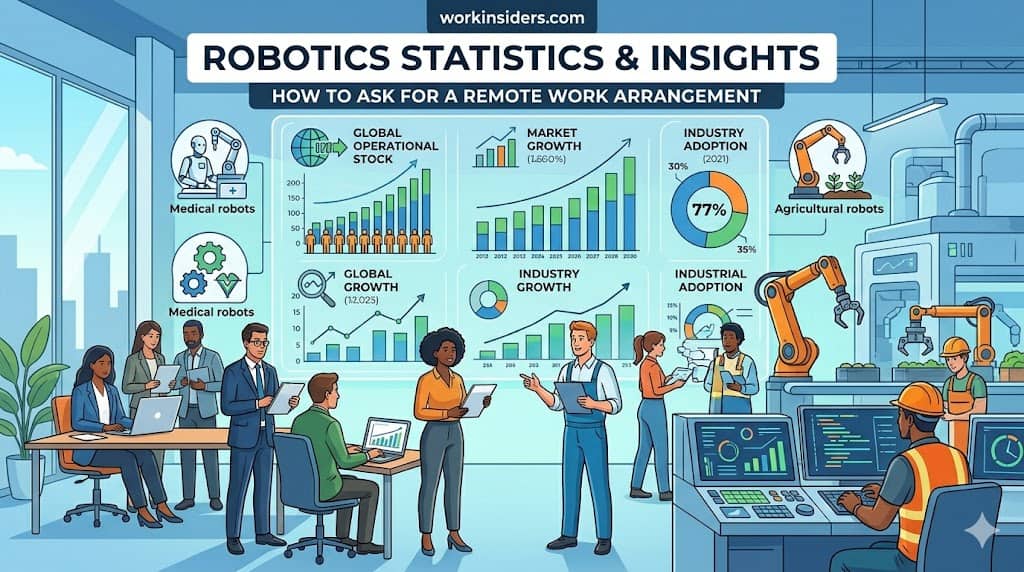
Robotics is no longer a futuristic concept, it’s a driving force reshaping industries, economies, and daily life. From factories optimizing production with industrial robots to healthcare leveraging surgical precision, the robotics sector is exploding with innovation.
Powered by advancements in AI, machine learning, and automation, robotics is addressing labor shortages, enhancing efficiency, and tackling global challenges like sustainability and aging populations.
According to industry reports, the global robotics market is surging, with projections indicating billions in revenue and millions of units deployed. But what do the numbers reveal?
This comprehensive article compiles 75 essential robotics statistics for 2025, sourced from reputable organizations like the International Federation of Robotics (IFR), Statista, McKinsey, and more. These stats cover market growth, sector-specific trends, employment impacts, and emerging technologies.
Organized into categories for clarity, these insights will help business leaders, innovators, and enthusiasts understand the robotics landscape. Whether you’re in manufacturing, healthcare, or agriculture, these figures highlight opportunities and challenges.
Global Robotics Market Overview
The robotics industry is experiencing explosive growth, fueled by technological advancements and widespread adoption.
- The global robotics market size is nearly $50 billion in 2025, up 11% from 2024, driven by demand across sectors.
- Revenue from the global robotics market is expected to reach $50.8 billion in 2025, with service robotics leading.
- The robotics market is projected to hit $147.26 billion by 2030, growing at a 17.4% CAGR.
- Globally, robot installations will grow by 6% to 575,000 units in 2025, continuing a decade-long doubling trend.
- The AI robotics market will grow at a 43.03% CAGR from 2025 to 2031, reaching $222 billion by 2031.
- The autonomous and last-mile delivery robot market will reach $2.53 billion in 2025, up from $1.85 billion in 2024.
- The cognitive robotics market is valued at $6.6 billion in 2025, projected to hit $19 billion by 2037 at a 10% CAGR.
- The United States will generate $10.25 billion in robotics revenue in 2025, leading global markets.
- Asia-Pacific industrial robotics revenue is projected at $4.26 billion in 2025, a 2% rise from 2024.
- The global robotics market could exceed $372 billion by 2034 at a 14.7% CAGR.
Industrial Robotics Statistics
Industrial robots are revolutionizing manufacturing, focusing on efficiency and automation.
- The industrial robotics market will reach $10.82 billion in revenue in 2025.
- The global industrial robotics market will expand from $17.6 billion in 2025 to $39 billion by 2035 at a 7.49% CAGR.
- The industrial robotics market is valued at $37.82 billion in 2025, up from $33.96 billion in 2024.
- Industrial robotics will grow at a 13.8% rate from 2025 to 2034, reaching $84.36 billion.
- The industrial robots market will grow from $21.94 billion in 2025 to $55.55 billion by 2032 at a 14.2% CAGR.
- The global industrial robotics market, valued at $18.18 billion in 2024, will grow 13.23% into 2025.
- Industrial robotics market size will reach ~$35 billion by 2030 from ~$17 billion in 2024, at a ~14% CAGR.
- The global market value of industrial robot installations hit $16.5 billion in 2024, a record high.
- By 2028, global robot installations will surpass 700,000 units.
- Asia-Pacific leads in industrial robot consumption, with China, Japan, and South Korea at the forefront.
Service Robotics Statistics
Service robots are expanding into professional and personal applications, enhancing productivity.
- Service robots for professional use reached nearly 200,000 units sold in 2024, up 9%.
- The U.S. service robotics market will reach $9.36 billion in 2025.
- The global service robotics market will grow from $28.46 billion in 2024 to $497.95 billion by 2033 at a 37.44% CAGR.
- Service robotics will lead with $40.58 billion in 2025 revenue, out of a $50.8 billion market.
- The global service robotics market is estimated at $26.35 billion in 2025, growing to $90.09 billion by 2032 at a 19.2% CAGR.
- The service robotics market is valued at $76.98 billion in 2025, projected to reach $213.32 billion by 2029 at a 29% CAGR.
- The service robotics market will hit $62.85 billion by 2025, up from $54.51 billion in 2024.
- The medical sector will account for 27.03% of the global robotics market in 2025.
- Mobile robots will generate 50-60% of revenue by 2030.
- Professional service robots see global growth in logistics and hospitality.
Medical Robotics Statistics
Medical robots are enhancing precision in healthcare, from surgery to rehabilitation.
- The global medical robots market, valued at $12.8 billion in 2024, will grow 16.6% into 2025.
- The surgical robotics market will triple to $12.6 billion by 2025.
- The surgical navigation market, valued at under $1.8 billion in 2024, will reach $2.8 billion by 2031 at a 6.8% CAGR.
- The surgical robotics market, worth $2.9 billion in 2024, is forecast to hit $9.2 billion by 2034.
- The medical sector will account for 27.03% of the global robotics market in 2025.
- The global medical robotics market will grow from $18.29 billion in 2024 to $57.31 billion by 2035 at a 10.94% CAGR.
- The global medical robotics market will grow from $16.6 billion in 2023 to $63.8 billion by 2032.
- AI-assisted robotic surgeries show a 25% reduction in operative time and a 30% decrease in complications.
- Service robots in medical applications were part of 200,000 units sold in 2024, growing into 2025.
- 2025 highlights innovations in surgical robotics, including soft robotics and AI integration.
Agricultural Robotics Statistics
Agricultural robots are addressing food security and labor shortages in farming.
- The global agricultural robots market will grow from $13.4 billion in 2023 to $86.5 billion by 2033 at a 20.5% CAGR.
- The agricultural robotics sector has over $2.6 billion in funding.
- By 2025, the agricultural robotics market will surpass $20 billion.
- The agricultural robotics market is valued at $16.9–$18.2 billion in 2025.
- The global agricultural robots market, valued at $7.34 billion in 2024, will reach $8.13 billion in 2025, growing to $26.35 billion by 2032.
- Agriculture service robotics revenue in the U.S. will reach $171.67 million in 2025.
- The agricultural robot market will grow from $17.5 billion in 2024 to $21.23 billion in 2025.
- Agri-robotics focuses on precision weeding, harvesting, and drones, transforming farming.
- 2025 sees autonomous machines revolutionizing agriculture.
- Farm robotics challenges highlight innovations like pineapple bloom identification in 2025.
Consumer Robotics Statistics
Consumer robots are entering homes, from vacuums to companions.
- The consumer robotics market is valued at $13.16 billion in 2025, forecast to reach $40.15 billion by 2030 at a 25% CAGR.
- The U.S. consumer robotics market, valued at $3.40 billion in 2024, will reach $13.62 billion by 2032, with the global market hitting $55.11 billion.
- The global consumer robotics market will grow from $10.75 billion in 2024 to $116.42 billion by 2035 at a 24.18% CAGR.
- Consumer service robotics revenue in the U.S. will reach $3.84 billion in 2025.
- Consumer robotics market revenue will grow 26.5% from 2025 to 2032, reaching nearly $51.41 billion.
- The U.S. market will grow at a 22.2% CAGR from 2025 to 2030, with semi-autonomous robots leading.
- Consumer robots are part of the $50.8 billion 2025 market, focusing on service applications.
- Rising demand for smart home devices drives consumer robotics growth.
- AI-powered automation is key to consumer adoption in 2025.
- Top companies are shaping consumer robotics in 2025.
AI and Robotics Trends
AI integration is accelerating robotics capabilities.
- Top 2025 trends include physical AI, analytical AI, generative AI, humanoids, and sustainability.
- Trends feature advanced AI, collaborative robots (cobots), autonomous mobile robots (AMRs), and soft robotics.
- AI and robotics saw a dip but recovered in 2024, leading to 2025 highs.
- India’s AI market will hit $8 billion by 2025, growing at a 40% CAGR.
- China invested ~$100 billion in AI and robotics in 2025.
- The industrial automation market will reach $226.8 billion in 2025, up from $206.3 billion in 2024.
- AI and robotics developments are tracked for 2025.
- Geopolitical trends influence AI and robotics in 2025.
- Human-inspired robotic designs are forecast for 2025, enhancing adaptability.
- Robotics is quietly transforming work and cities in 2025.
Employment and Societal Impact
Robotics influences jobs, presenting both opportunities and challenges.
- AI will replace two million manufacturing workers by 2025.
- By 2030, 30% of U.S. jobs could be automated, with 60% altered, starting in 2025.
- Skills for AI-exposed jobs are changing 66% faster in 2025.
- Robots increase manufacturing employment in the East Asia and Pacific region.
- Robots reduce employment for non-White workers by 4.5 points compared to 1.8 for White workers, widening gaps.
Conclusion
These 75 robotics statistics for 2025 underscore a transformative era where automation meets human ingenuity.
With markets hitting $50 billion globally and sectors like medical and agriculture seeing explosive growth, robotics is poised to add trillions to economies while addressing pressing issues like labor shortages and precision needs. However, challenges remain, including job displacement and ethical AI integration.
For businesses, embracing robotics means investing in training and innovation to stay competitive. As projections show continued expansion to hundreds of billions by 2030, the key is balanced adoption, leveraging robots to augment, not replace, human capabilities. Stay ahead by monitoring trends from sources like IFR and Statista. In 2025, robotics isn’t just technology; it’s the foundation of a smarter, more efficient world. Optimize your strategies now, and thrive in this robotic revolution.
Free newsletter
Get the Work Insiders weekly
One email a week: the recruiting and HR tech news that mattered, the tools we just added to the directory, and one practical guide. No spam, and you can unsubscribe in one click.