

In 2026, 97% of companies use Applicant Tracking Systems (ATS) to filter resumes, rejecting 75% before human review due to missing keywords. For remote jobs, incorporating terms like “asynchronous collaboration” and “virtual team leadership” boosts ATS match rates from 60% to 92%, leading to more interviews.
A 2025 LinkedIn report shows 78% of remote postings require at least three remote-specific skills. Top universal keywords appear in over 80% of job descriptions, but tailoring to remote tools like Slack and Zoom is key for passing screens.
Focus on self-management, digital tools, and communication keywords to stand out. Harvard Business School found 88% of employers miss qualified candidates from poor keyword matches. Use them naturally in context, like “Managed cross-timezone teams via asynchronous communication, reducing delays by 30%.”
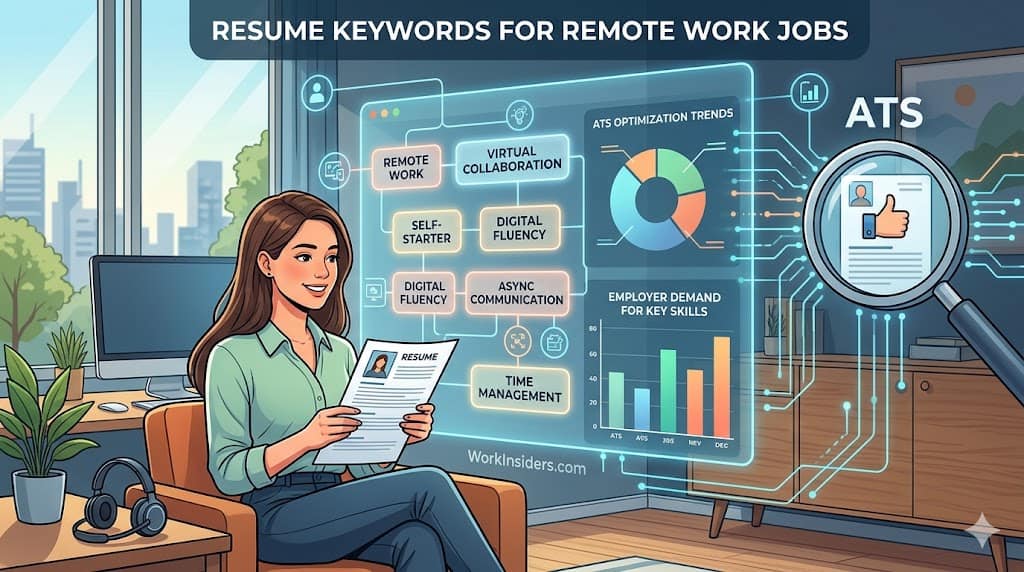
What Are Resume Keywords and Why Do They Matter for Remote Jobs?
Resume keywords are specific terms from job descriptions that ATS scans to match candidates. For remote roles, they include skills like “distributed team” and “time-zone coordination.”
ATS rejects 70-80% of applications for keyword mismatches in competitive remote hiring. Without them, your resume vanishes before a recruiter sees it.
In 2026, 90% of employers rely on ATS for global talent pools, making keywords essential for remote positions. They prove you fit the remote work style.
Keywords go beyond basics; modern ATS analyzes context, like career progression alongside terms like “virtual collaboration.” This helps in high-volume remote job markets.
Why is “Asynchronous Communication” the #1 keyword right now?
In 2026, “Async” is the buzzword of the year. It refers to the ability to communicate and move projects forward without requiring everyone to be online at the same time. This is vital for global companies.
Employers value this because it reduces “Zoom fatigue” and increases productivity. Instead of saying “I am a good communicator,” use: “Mastered asynchronous communication protocols to reduce meeting dependency by 30%.” This shows you respect deep work and can handle global team coordination.
How Can I Find the Right Keywords for Remote Job Applications?
Start by copying the job description into a text editor and highlighting repeated terms like “asynchronous messaging” or “cloud-based tools.”
Tools like Jobscan or Resumly’s keyword analyzer can scan your resume against the JD, showing matches. Aim for 80% alignment.
Review industry reports; LinkedIn’s 2024 trends highlight remote keywords in 78% of postings. Adapt them to your experience.
Avoid stuffing; weave keywords into achievements, like “Led virtual team leadership for 10-member distributed group.” This keeps it natural.
For remote-specific searches, use phrases like “remote Python developer” on job boards to mirror postings.
How do I optimize my resume for an AI recruiter?
AI-powered ATS platforms (like MokaHR or Oleeo) rank you based on “Keyword Density” and “Skill Matching.” To beat the bot, you must mirror the language in the job description exactly.
- Match the Phrasing: If the job post says “Virtual Meetings,” don’t write “Online Calls.”
- Use Standard Fonts: Stick to Arial or Calibri. AI can struggle to read “creative” fonts.
- Spell Out Acronyms: Use “Search Engine Optimization (SEO)” so the AI catches both terms.
- Avoid Graphics: Charts and images can “break” the ATS parsing logic, making your resume unreadable.
What Are the Top Resume Keywords for Remote Jobs in 2026?
Top keywords fall into categories: self-management, collaboration tools, and communication. They appear in over 80% of remote JDs.
Self-motivated professionals using these get 3x more interviews. Include 3-5 per section.
Which Self-Management Keywords Should I Use for Remote Roles?
Keywords like “ability to work independently” and “self-managed” show you thrive without oversight.
“Time management” is crucial; 68% of remote workers report positive experiences with it. Example: “Prioritized tasks across time zones, boosting productivity 25%.”
“Adaptability” helps in fluid remote settings; include it if you’ve switched tools mid-project.
These terms filter into ATS; missing them drops scores by 30%.
What Collaboration Tool Keywords Boost Remote Resumes?
List “Slack,” “Microsoft Teams,” “Zoom,” “Asana,” and “Jira” under skills. 93% of employers plan remote interviews using these.
“Cloud-based project management” appears in 78% of tech remote JDs. Tie to results: “Coordinated via Asana, completing projects 15% faster.”
“Virtual collaboration” is a must; it’s in most distributed team postings.
These keywords prove technical savvy, key for remote roles.
How Do Communication Keywords Help in Remote Job Hunting?
Use “asynchronous communication” and “written communication” to highlight remote strengths.
“Virtual team leadership” shows you guide remote groups effectively.
“Remote stakeholder communication” with tools like Slack reduces misunderstandings.
Back with data: Strong virtual skills cut onboarding time by 40%.
How Should I Incorporate Keywords Without Sounding Robotic?
Place keywords in context, like starting bullets with action verbs: “Implemented asynchronous collaboration, enhancing team efficiency.”
Create a core competencies section with 8-12 terms: “Virtual Leadership Skills, Time-Zone Coordination.”
Tailor per job; swapping 3-5 keywords raises ATS scores by 60%.
Keep it conversational: “I excel in distributed teams, using Zoom for seamless updates.”
Quantify: “Managed remote teams, increasing output by 22% via agile methodologies.”
What Common Mistakes Should I Avoid with Remote Resume Keywords?
Don’t overuse; keyword stuffing lowers ATS scores by 30%. Aim for natural flow.
Ignore formatting; fancy designs confuse ATS, rejecting 43% of resumes. Use plain text.
Skip location filters; if remote, note “open to distributed roles” to avoid geo-rejections.
Forget updates; 2026 trends favor “digital nomad experience.”
Overlook soft skills; 98% of workers prefer remote, but trust via keywords is key.

Which software should I list for a remote job resume?
Don’t just say “Microsoft Office.” Remote employers need to know you can navigate their specific “digital office.” You should list tools in a dedicated “Skills” or “Technology” section.
Essential Remote Tech Stack:
- Communication: Slack, Microsoft Teams, Loom, Discord.
- Project Management: Asana, ClickUp, Monday.com, Jira.
- Documentation: Notion, Confluence, Google Drive.
- Security: VPN Proficiency, LastPass/1Password, Cybersecurity Awareness.
Listing Loom (video messaging) specifically shows you know how to give updates without a live meeting, which is a highly valued remote work skill.
Quick Q&A: Resume Keywords for Remote Work Jobs
What are essential remote keywords for tech roles? “Asynchronous collaboration,” “cloud-based project management,” and “DevOps” top lists for 2026. Add “distributed systems” if relevant.
How many keywords per resume? 3-5 targeted per section; total 10-15 to hit 80% ATS match.
Do keywords work for non-tech remote jobs? Yes, like “virtual presentations” for sales or “cross-functional teams” for marketing.
Can I use synonyms for keywords? Stick close to JD terms; ATS prefers exact matches, but context helps.
What’s the impact of missing keywords? 75% rejection rate; fix it to triple interview chances.
Do I need to put “Remote” next to my job title? Yes. It is standard practice to list it as: Job Title | Company | Remote.
Should I list my physical address on a remote resume? You can, but it’s becoming optional. It is often better to list your City, State, and Timezone (e.g., “New York, NY | EST”) so recruiters know your availability.
What is the best way to prove virtual collaboration? Use metrics. For example: “Coordinated cross-functional projects across 3 timezones using Trello and Slack, finishing 10% under budget.”
How Long Does It Take to Optimize a Resume for Remote Keywords?
Tailoring takes 15-30 minutes per application; scan JD, add 3-5 keywords, rephrase bullets.
Tools speed it up; ATS checkers like Jobscan give instant feedback.
In high-volume markets, optimized resumes land interviews in weeks, per SHRM data.
Repeat for each job; consistency yields results faster.
What Tools Can Help with Remote Resume Keywords?
Free options: LinkedIn’s job analyzer or Google Docs for highlighting.
Paid: Jobscan scans for matches, boosting scores 60%.
Resumly’s keyword tool extracts from JDs directly.
ATS builders ensure compatibility, avoiding 43% format rejections.
Why Are Remote-Specific Keywords More Important in 2026?
Remote work is standard; 28.2% hybrid, 12.7% full remote. Keywords prove fit.
AI-enhanced ATS now checks context, favoring precise terms.
98% recommend remote; competition demands tailored resumes.
LinkedIn reports show rising remote competencies in JDs.
Final Tips for Landing Remote Jobs with Keywords
Customize every resume; generic ones fail 70% of ATS.
Track applications; note keywords used for patterns in callbacks.
Network on LinkedIn with keyword-rich profiles.
Stay updated; trends like “async-first” evolve yearly.
With these, you’ll pass screens and showcase remote readiness effectively.
Free newsletter
Get the Work Insiders weekly
One email a week: the recruiting and HR tech news that mattered, the tools we just added to the directory, and one practical guide. No spam, and you can unsubscribe in one click.