
Staffing Market Brief/October 2026 issue
Staffing Market Brief: October 2026
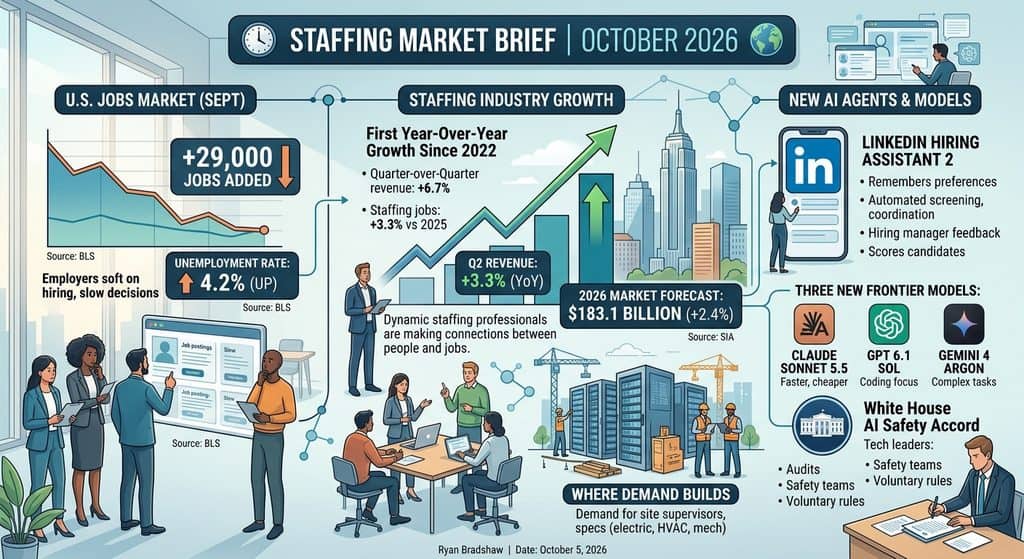
The month in staffing and recruiting: September's 29,000 jobs report, staffing's first year over year growth since 2022, the $183.1 billion forecast, LinkedIn Hiring Assistant 2 and three new AI models.
- +29,000jobs added in September
- 4.2%unemployment rate
- +3.3%Q2 staffing revenue vs last year
- $183.1B2026 U.S. staffing market (est.)
In this issue
- Hiring cooled sharply
- Staffing is growing again
- LinkedIn's recruiter agent gets an upgrade
Quick answer: September was a soft month for hiring but a better one for staffing firms. The U.S. added only 29,000 jobs and unemployment rose to 4.2%, yet staffing revenue grew year over year for the first time since late 2022 and the 2026 market forecast sits at $183.1 billion. On the AI side, LinkedIn announced Hiring Assistant 2 for November, three frontier models shipped in one week, and the big AI labs signed a voluntary safety accord at the White House.
Who this is for: Agency owners, recruiters and talent leaders who want the month in five minutes, with every number linked to where it came from.
What are the top 3 headlines this month?
- Hiring cooled sharply. Employers added just 29,000 jobs in September and unemployment ticked up to 4.2%, according to the BLS jobs report.
- Staffing is growing again. Staffing revenue rose 3.3% year over year in the second quarter, the first year over year gain since late 2022, per the American Staffing Association.
- LinkedIn’s recruiter agent gets an upgrade. LinkedIn unveiled Hiring Assistant 2 on September 30, rolling out to existing users in November, as reported by HR Brew.
What do the numbers look like at a glance?
| Indicator | Latest reading | Source |
|---|---|---|
| Jobs added, September | +29,000 | BLS |
| Unemployment rate | 4.2% | BLS |
| Wage growth, past 12 months | 3.0% | BLS |
| Staffing revenue, Q2, year over year | +3.3% | ASA survey |
| ASA Staffing Index vs same week 2025 | +3.3% | ASA index |
| U.S. staffing market, 2026 (estimate) | $183.1 billion, +2.4% | SIA forecast |
Which sectors are hiring right now?
Here is the BLS picture for the sectors most agencies recruit into: manufacturing and industrial, engineering and IT, and the staffing and site work around them. Each card shows the latest monthly reading, the change from the month before and the change from a year earlier.
Work Insiders Market Pulse
US jobs by sector, October 2026 issue
Checked against BLS data on 29 Oct 2026
Manufacturing and industrial
Manufacturing, all
12.652M
▲ 0.07% vs August
▲ 0.3% vs Sep 2025
Durable goods makers
7.898M
▲ 0.10% vs August
▲ 1.1% vs Sep 2025
Machinery, incl. robot makers
1.101M
▲ 0.41% vs August
▲ 1.4% vs Sep 2025
Transportation equipment
1.766M
▲ 0.19% vs August
▲ 1.8% vs Sep 2025
Computers and electronics
1.000M
▲ 0.01% vs August
▲ 0.7% vs Sep 2025
Manufacturing job openings
522K
▼ 9.4% vs July
▲ 25.5% vs Aug 2025
Engineering and IT
Engineering and architecture services
1.779M
▲ 0.33% vs August
▲ 2.6% vs Sep 2025
IT services (computer systems design)
2.355M
▼ 0.19% vs August
▼ 1.3% vs Sep 2025
Information (software, telecom, data)
2.739M
▼ 0.36% vs August
▼ 4.2% vs Sep 2025
Professional and business services openings
1.186M
▼ 9.1% vs July
▲ 8.3% vs Aug 2025
Staffing and site work
Temporary help
2.487M
▼ 0.44% vs August
▲ 0.6% vs Sep 2025
Construction
8.364M
▲ 0.13% vs August
▲ 1.3% vs Sep 2025
Warehousing and storage
1.832M
▼ 0.22% vs August
▼ 1.2% vs Sep 2025
Job openings, all industries
7.079M
▼ 3.49% vs July
▲ 2.3% vs Aug 2025
US national figures, seasonally adjusted. M means million, K means thousand. Green means the number rose, red means it fell. Job counts come out a month ahead of openings, so the two use different months.
About these figures and sources
Job counts come from the BLS Current Employment Statistics survey and count jobs, not people, so one person with two jobs counts twice. Openings come from the BLS Job Openings and Labor Turnover Survey and cover every unfilled position, not staffing agency orders. The groups overlap (machinery and transportation equipment sit inside manufacturing, for example), so do not add the cards together. BLS has no separate robotics series; companies that build industrial robots are counted inside machinery manufacturing. Changes are worked out from the unrounded figures, and BLS revises recent months, so later readings can differ.
| Indicator | BLS series | Month | Latest | Prior month | Year earlier |
|---|---|---|---|---|---|
| Manufacturing, all | MANEMP | Sep 2026 | 12,652,000 | 12,643,000 | 12,612,000 |
| Durable goods makers | DMANEMP | Sep 2026 | 7,898,000 | 7,890,000 | 7,814,000 |
| Machinery | CES3133300001 | Sep 2026 | 1,101,000 | 1,096,500 | 1,085,700 |
| Transportation equipment | CES3133600001 | Sep 2026 | 1,766,400 | 1,763,000 | 1,735,400 |
| Computers and electronics | CES3133400001 | Sep 2026 | 1,000,400 | 1,000,300 | 993,700 |
| Manufacturing openings | JTS3000JOL | Aug 2026 | 522,000 | 576,000 | 416,000 |
| Engineering and architecture services | CES6054130001 | Sep 2026 | 1,778,800 | 1,773,000 | 1,733,800 |
| IT services | CES6054150001 | Sep 2026 | 2,355,400 | 2,359,800 | 2,387,600 |
| Information | USINFO | Sep 2026 | 2,739,000 | 2,749,000 | 2,859,000 |
| Professional and business services openings | JTS540099JOL | Aug 2026 | 1,186,000 | 1,305,000 | 1,095,000 |
| Temporary help | TEMPHELPS | Sep 2026 | 2,486,800 | 2,497,700 | 2,471,600 |
| Construction | USCONS | Sep 2026 | 8,364,000 | 8,353,000 | 8,255,000 |
| Warehousing and storage | CES4349300001 | Sep 2026 | 1,831,800 | 1,835,900 | 1,853,400 |
| Job openings, all industries | JTSJOL | Aug 2026 | 7,079,000 | 7,335,000 | 6,919,000 |
Source: BLS employment survey and BLS openings survey, read through FRED at the St. Louis Fed. Work Insiders is not endorsed by BLS.
What it means for recruiters: Engineering services are the strongest card on the board, up 2.6% on a year ago, and machinery and transportation equipment makers keep adding people, which fits the data center and engineering demand covered below. Manufacturers also posted a quarter more openings than a year earlier, even after a dip in August. IT is the soft spot: IT services and the information sector both employ fewer people than last year, so expect more available tech candidates and fewer new reqs there.
Staffing and recruiting market
How bad was the September jobs report?
Weak. The U.S. added 29,000 nonfarm jobs in September, well short of the roughly 90,000 economists expected in a Bloomberg survey, and unemployment rose to 4.2%. Health care (+17,000), construction (+11,000) and manufacturing (+9,000) did the hiring. Earlier months got worse too: July was revised from +21,000 to a loss of 10,000, and August from +162,000 to +133,000, a combined 60,000 fewer jobs than first reported. Average hourly earnings were up 3.0% over the past year, according to the BLS release of October 2.
What it means for recruiters: Direct hire demand outside health care and the trades is likely to stay cautious. Expect more candidates on the market and slower decisions from hiring managers, so tighten your feedback agreements at intake.
Is the staffing industry growing again?
Yes, modestly. The ASA’s quarterly survey shows staffing revenue up 3.3% and staffing employment up 0.6% (about 12,000 jobs) in the second quarter compared with a year earlier. It is the first year over year growth the survey has recorded since late 2022. Quarter over quarter, revenue rose 6.7% and employment 5.0%, per the ASA survey release.
The weekly picture agrees. The ASA Staffing Index dipped 1.4% to 93 in the week of September 7 to 13 because of the Labor Day holiday, but staffing jobs were still 3.3% higher than the same week of 2025 and the four week average held at 94.
What it means for recruiters: A soft jobs market and a growing staffing market can happen together. When employers are unsure about the economy, they lean on temporary and contract labor before they commit to permanent headcount.
How big will the U.S. staffing market be in 2026?
Staffing Industry Analysts now expects the U.S. staffing market to grow 2.4% in 2026 to $183.1 billion, then another 2.2% in 2027 to $187.0 billion. These are estimates from the SIA September update, which covers the overall industry and 12 occupational segments.
Where is staffing demand building?
Data centers and engineering. SIA reported that engineering staffing rose 1% in 2025 while the overall industry declined, and led every segment in March 2026 with 12% median year over year growth. Data center construction is a main driver, pulling in project managers, site supervisors and electrical, mechanical and HVAC specialists, with demand spilling into power, utilities and telecom, according to SIA’s engineering report.
What it means for recruiters: If you run business development, data center builders and their subcontractors are worth a spot on your target list. Our guide to finding hiring companies shows how to track them.
AI: what’s new
What is LinkedIn Hiring Assistant 2?
It is the next version of LinkedIn’s AI recruiting agent, announced September 30 at Talent Connect in New York. It remembers how each recruiter hires, learns from every requisition and hire, scores candidates against custom rubrics, pulls in verification signals and ATS insights, and automates more of the busywork such as screening responses, hiring manager feedback and interview coordination. Recruiters can switch steps on or off and override any recommendation. It rolls out to existing English language Hiring Assistant users in November as a free upgrade, per HR Brew.
What it means for recruiters: Agents that remember your preferences are becoming normal inside the big platforms. Compare it with the independent options in our AI agents directory.
Which new AI models came out this month?
Three frontier models landed within a few days of each other:
| Model | Released | What changed | Who can use it now |
|---|---|---|---|
| Claude Sonnet 5.5 (Anthropic) | September 28 | Output more than 30% faster and up to 30% cheaper per task than the previous Sonnet | Claude users and developers (Anthropic) |
| GPT 6.1 Sol (OpenAI) | September 29 | Close to GPT 6 Astra performance at a lower cost, with a focus on coding and professional work | Announced at DevDay (Business Standard) |
| Gemini 4 Argon (Google) | September 30 | Google’s most capable model, built for long, complex work in software, legal, finance and cybersecurity | A small group of cyber defenders first, wider release later (Google blog) |
OpenAI also announced “dots,” always on agents inside ChatGPT that keep working on a task after you close the app.
What it means for recruiters: The everyday tools you already use for job ads, outreach and intake notes just got faster and cheaper. You do not need to switch tools to benefit. If you are new to this, start with Claude for recruiters.
How many companies plan to use AI agents in recruiting?
About half. In Korn Ferry’s 2026 talent acquisition trends survey of 1,674 talent leaders, 84% said they plan to use AI in recruiting this year and 52% plan to add autonomous agents to their teams. The same survey found 73% rank critical thinking as their top hiring priority, ahead of AI skills, per Korn Ferry’s research.
What it means for recruiters: The work is shifting from doing every step by hand to supervising tools that do the steps. The human judgment calls stay with you.
What did the White House AI safety accord change?
On September 30, leaders of Nvidia, Google, Meta, xAI, Anthropic and OpenAI signed a voluntary AI safety accord at the White House. It asks frontier AI developers to track risky model capabilities, block models from carrying out cyberattacks, run dedicated safety teams, bring in outside auditors and have independent board committees oversee the work, according to SiliconANGLE.
What it means for recruiters: Nothing changes in your hiring process tomorrow. It is a useful signal, though, that oversight and audits are becoming standard, so it is a good moment to write down your own firm’s rules for how AI is used with candidates.
Quick answers
What was the unemployment rate in September 2026?
4.2%, up slightly from the prior month, with 29,000 jobs added.
Is the staffing industry recovering in 2026?
It is stabilizing. Revenue grew 3.3% year over year in Q2, the first gain since late 2022, and SIA forecasts 2.4% growth for the full year.
Which staffing sectors are growing fastest?
Engineering, driven by data center construction, with health care still the largest U.S. segment and the biggest source of new jobs in September.
When does LinkedIn Hiring Assistant 2 roll out?
November 2026, as a free upgrade for existing English language Hiring Assistant users.
Do recruiters need to change AI tools because of the new models?
No. Claude, ChatGPT and Gemini upgrades show up inside the apps you already use.
The bottom line
The job market is soft, but staffing is back to growth because uncertain employers reach for flexible labor first. Point business development at engineering and data center work, keep an eye on health care, and expect the AI tools on your desk to keep getting cheaper and more capable each month. Past issues live on the Staffing Market Brief page. For the daily version of this briefing, follow our recruiting tech news feed, and if your team is new to AI, start with the AI Recruiting Academy.
Sources: BLS Employment Situation, ASA quarterly survey, ASA Staffing Index, SIA forecast, SIA engineering, HR Brew, Anthropic, Business Standard, Google blog, Korn Ferry, SiliconANGLE
Live staffing market charts
These charts refresh every day, so they can show newer numbers than the issue above.
View the numbers
| Month | Change in jobs |
|---|---|
| Oct 2026 | +19K |
| Sep 2026 | −6K |
| Aug 2026 | +16K |
| Jul 2026 | −10K |
| Jun 2026 | +17K |
| May 2026 | +200 |
| Apr 2026 | +11K |
| Mar 2026 | +8K |
| Feb 2026 | +2K |
| Jan 2026 | +19K |
| Dec 2025 | −14K |
| Nov 2025 | +14K |
| Oct 2025 | −20K |
| Sep 2025 | −12K |
| Aug 2025 | −11K |
| Jul 2025 | −10K |
| Jun 2025 | −9K |
| May 2025 | −14K |
| Apr 2025 | −800 |
| Mar 2025 | −5K |
| Feb 2025 | −6K |
| Jan 2025 | −3K |
| Dec 2024 | −8K |
| Nov 2024 | +2K |
View the numbers
| Month | Job openings | Unemployed people |
|---|---|---|
| Sep 2026 | 7.52M | 7.11M |
| Aug 2026 | 7.19M | 7.03M |
| Jul 2026 | 7.34M | 6.92M |
| Jun 2026 | 7.18M | 7.09M |
| May 2026 | 7.54M | 7.31M |
| Apr 2026 | 7.59M | 7.37M |
| Mar 2026 | 6.89M | 7.24M |
| Feb 2026 | 6.92M | 7.57M |
| Jan 2026 | 7.24M | 7.37M |
| Dec 2025 | 6.55M | 7.50M |
| Nov 2025 | 6.85M | 7.78M |
| Sep 2025 | 7.17M | 7.61M |
| Aug 2025 | 6.92M | 7.38M |
| Jul 2025 | 7.09M | 7.27M |
| Jun 2025 | 7.20M | 7.05M |
| May 2025 | 7.31M | 7.25M |
| Apr 2025 | 7.10M | 7.16M |
| Mar 2025 | 6.95M | 7.13M |
| Feb 2025 | 7.24M | 7.10M |
| Jan 2025 | 7.43M | 6.87M |
| Dec 2024 | 7.30M | 6.92M |
| Nov 2024 | 7.57M | 7.09M |
| Oct 2024 | 7.38M | 6.95M |
| Sep 2024 | 6.94M | 6.85M |
Free newsletter
Get the Work Insiders weekly
One email a week: the recruiting and HR tech news that mattered, the tools we just added to the directory, and one practical guide. No spam, and you can unsubscribe in one click.