


Quick answer: A good onboarding checklist for new employees runs in five stages: before day one, day one, week one, the first 30 days, and days 31 to 90. The legal pieces have hard deadlines in the US: the employer side of Form I9 within 3 business days of the first day of paid work, and a new hire report to your state within 20 days. Everything else is about one thing: making sure the new person knows what good looks like, who to ask, and has the tools to start. Only 12% of employees strongly agree their company onboards new people well, according to Gallup, so a simple checklist that actually gets followed already puts you ahead.
Written by a recruiter who has onboarded hundreds of placements. Updated November 2026. Not legal advice: check your state rules with HR or counsel.
What should an onboarding checklist for new employees include?
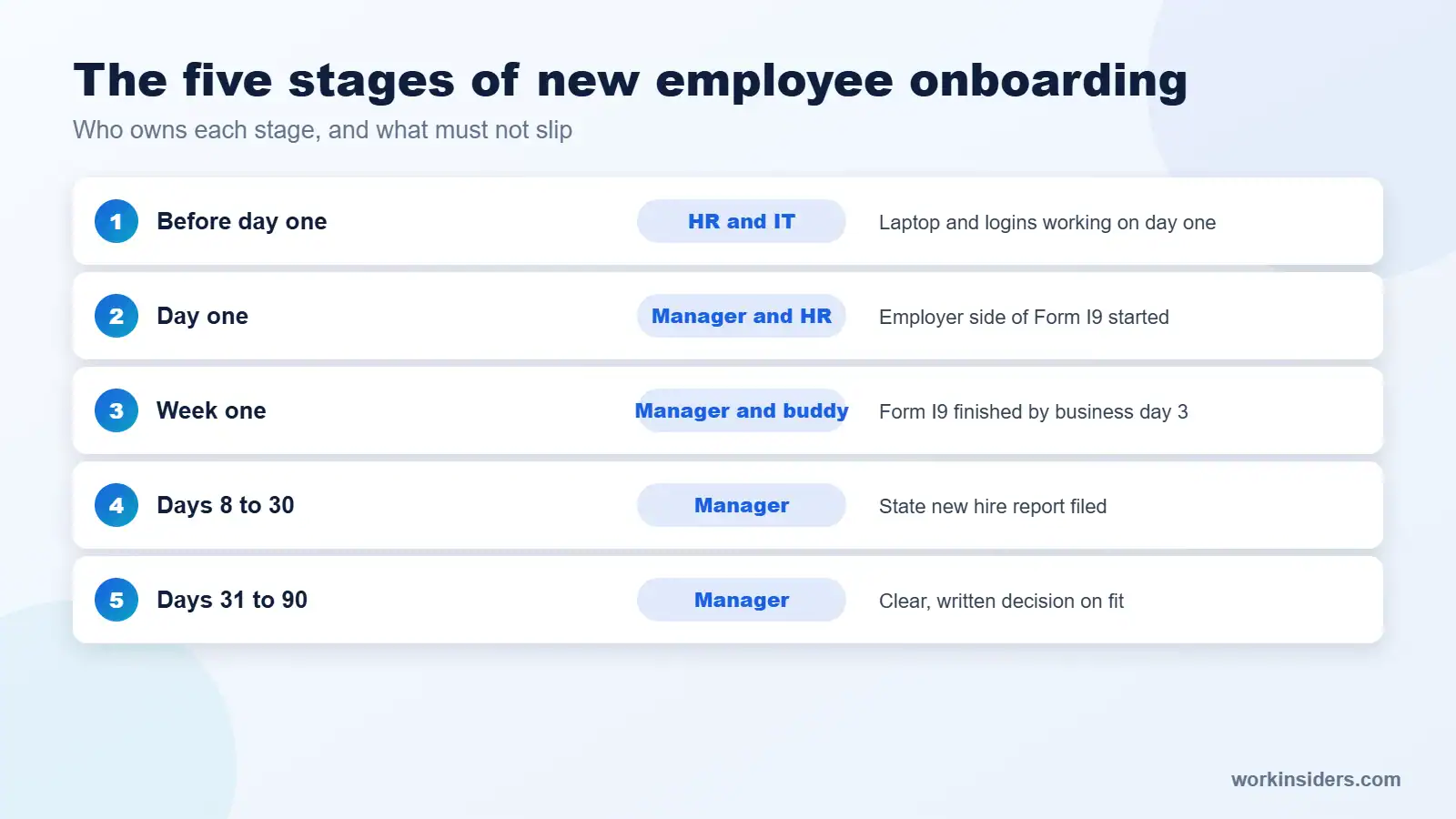
It should include every task between a signed offer and the end of the first 90 days, the person who owns each one, and the date it is due. Most checklists fail because they stop at paperwork and laptop setup. The paperwork matters, but the reason people leave in the first few months is usually that nobody told them what success looks like or checked in once the welcome lunch was over.
Here is the shape we recommend, and the full checklist follows below.
| Stage | Main goal | Owner | Must not slip |
|---|---|---|---|
| Before day one | Paperwork, equipment and access ready | HR and IT | Laptop and logins working on the first morning |
| Day one | Welcome, Form I9, first real conversation with the manager | Manager and HR | Employer side of Form I9 started |
| Week one | Learn the team, the tools and the first small task | Manager and buddy | Form I9 finished by business day 3 |
| Days 8 to 30 | First real deliverable and a written 30 day check in | Manager | State new hire report filed by day 20 |
| Days 31 to 90 | Full ownership of the role and a 90 day review | Manager | Clear yes or no on fit, written down |
What do you need to do before the new hire starts?
Before day one, you want the new person to have nothing to wait for. The week between offer acceptance and start date is also when candidates get cold feet or a counteroffer, so a warm note from the manager does real work here. If the offer itself still needs writing, our free offer letter generator does it in a minute.
- Send the signed offer letter and a welcome email with start date, time, address or video link, dress code and who to ask for.
- Send tax and payroll forms ahead: Form W4, your state withholding form, direct deposit and emergency contacts.
- Tell the new hire which documents to bring for Form I9, using the official list of acceptable documents.
- Order the laptop, phone and any equipment, and test them before day one.
- Create email, chat, payroll and HR system accounts, plus access to the core tools for the job.
- Pick a buddy who is not the manager and tell them what the role involves.
- Block time on the manager’s calendar for day one and a check in at the end of week one.
- Write the first week schedule and the 30, 60 and 90 day goals (draft is fine).
- Announce the new hire to the team with one line on who they are and what they will own.
What should happen on an employee’s first day?
The first day should leave the new person with three things: their tools working, a clear picture of their first week, and at least one real conversation with their manager. Paperwork fits around that, not the other way round.
- Greet them in person or on camera at the start time. Do not leave them in a lobby or a waiting room.
- Start the employer side of Form I9 by examining their original documents. The employee must complete their section by the first day of work for pay.
- Walk through logins, the laptop and the two or three tools they will use most.
- Manager one to one: what the role is for, what the first 90 days look like, how the manager likes to communicate.
- Introduce the buddy and the immediate team. Lunch or a short video coffee works.
- Share the employee handbook and benefits enrollment deadlines. Benefits windows are often 30 days, so flag the date.
- Give them one small, finishable task so they end the day having done something.
What is the Form I9 deadline for new employees?
The employer must complete and sign Section 2 of Form I9 within 3 business days of the first day of work for pay, per USCIS I9 guidance. If someone starts on Monday, Section 2 is due by Thursday. For jobs that last less than 3 days, it is due on the first day. Staffing agencies get a choice of start date, either the first assignment or the day the person joins the assignment pool.
What belongs in the first week of onboarding?
Week one is about learning how the team works and doing one small piece of real work. New hires remember whether week one felt organized far longer than they remember the welcome swag.
- Finish Form I9 Section 2 by business day 3.
- Run any required training: harassment prevention, security, safety. Some states require harassment training within a set period, so check yours.
- Shadow two or three colleagues doing the core work of the role.
- Meet the five to ten people they will work with most, each for 20 minutes.
- Agree the 30, 60 and 90 day goals in writing with the manager.
- End of week check in: what is confusing, what is missing, what went well.
What should happen in the first 30, 60 and 90 days?
After week one, onboarding becomes a management job. The checklist turns into a short list of meetings and written goals, and the most common failure is simply that the check ins stop happening.
| Window | What the new hire should be doing | What the manager does |
|---|---|---|
| Days 8 to 30 | Handling routine work with help, delivering a first real project | Weekly one to ones, written 30 day check in, file the state new hire report by day 20 |
| Days 31 to 60 | Working independently on most tasks, asking fewer basic questions | Feedback on the first project, adjust goals if the role looks different from the job ad |
| Days 61 to 90 | Owning the role, suggesting improvements | 90 day review in writing: on track, needs support, or not a fit |
Federal law requires employers to report new and rehired employees to a designated state agency within 20 days of hire, and some states want it sooner, according to the federal child support office. Most payroll providers file this for you, so confirm yours does rather than assuming it. For recruiter hires specifically, our 30 60 90 plan template spells out goals by month.
Why does onboarding matter so much for retention?
Because the first months are when people decide whether they made a mistake. In Gallup’s onboarding research, only 12% of employees strongly agree their organization does a great job onboarding new employees. The same article cites SHRM figures putting turnover as high as 50% in the first 18 months and the cost of replacing someone at six to nine months of their salary. Treat those as directional rather than precise, but the point holds: a missed check in at day 30 is far cheaper to fix than a resignation at day 120.
From the recruiting side, the pattern is familiar. When a placement falls off in the guarantee period, the reason is rarely pay. It is usually that the job was different from what was described, the manager disappeared after week one, or nobody gave them the tools to do the work. Every one of those shows up on a checklist.
Who owns each part of onboarding?
| Owner | Tasks |
|---|---|
| HR or people ops | Offer, tax and payroll forms, Form I9, new hire report, benefits, handbook, required training |
| IT or office manager | Laptop, phone, accounts, security setup, building access |
| Hiring manager | First week plan, goals, weekly one to ones, 30 day check in, 90 day review |
| Buddy | Daily questions, introductions, how things really work |
| Recruiter (agency or in house) | Check in after day one and at day 30, flag problems early during the guarantee period |
Which onboarding tasks should you automate?
Automate the forms, reminders and account creation. Keep the conversations human. Most HR systems and payroll tools can send documents for e signature before day one, track Form I9 deadlines, file new hire reports and assign tasks to IT and managers automatically. Our onboarding software picks compare tools by company type with real prices, and the onboarding category lists every tool we track. For the bigger picture of what to automate first, see our guide to HR automation tools.
If you have no software yet, a shared spreadsheet with one row per task and columns for owner, due date and done works fine for a team under 50. The checklist below is built to paste straight into one.
Free onboarding checklist template to copy
| When | Task | Owner | Done |
|---|---|---|---|
| Offer accepted | Send welcome email with start details | Manager | ☐ |
| Offer accepted | Send Form W4, state tax form, direct deposit, emergency contacts | HR | ☐ |
| Offer accepted | Share Form I9 acceptable documents list | HR | ☐ |
| 5 days before | Laptop, phone and accounts ready and tested | IT | ☐ |
| 5 days before | Assign buddy, book manager time, write week one plan | Manager | ☐ |
| Day 1 | Employee completes Form I9 Section 1 | Employee | ☐ |
| Day 1 | Manager one to one on role and 90 day plan | Manager | ☐ |
| Day 1 | Handbook and benefits deadlines shared | HR | ☐ |
| Business day 3 | Employer completes Form I9 Section 2 | HR | ☐ |
| Week 1 | Required training complete | HR | ☐ |
| Week 1 | 30, 60 and 90 day goals agreed in writing | Manager | ☐ |
| Week 1 | End of week check in | Manager | ☐ |
| Day 20 | State new hire report filed (or confirmed with payroll) | HR | ☐ |
| Day 30 | Written 30 day check in; benefits enrolled | Manager and HR | ☐ |
| Day 60 | Feedback on first project; goals adjusted | Manager | ☐ |
| Day 90 | Written 90 day review | Manager | ☐ |
What do people on Reddit say goes wrong with onboarding?
The complaints in HR and career forums are remarkably consistent. No laptop on day one. A manager who is on vacation the first week. A week of reading policy documents with no real work. Being told the role is one thing and finding it is another. And the quiet one: nobody asking how it is going after the first few days. Each of these has a line on the checklist above, which is the whole point of having one.
Quick answers
How long should onboarding last?
Plan for at least 90 days. Paperwork and setup take a week, but most people need about three months before they fully own a role, which is why the 90 day review is the natural end point.
What forms does a new employee fill out in the US?
At minimum Form I9 and Form W4, plus your state withholding form, direct deposit and emergency contacts. Benefits enrollment and policy acknowledgements usually follow in the first 30 days.
When is Form I9 due?
The employee completes Section 1 by the first day of work for pay. The employer completes Section 2 within 3 business days of that first day.
Do I have to report new hires to the state?
Yes. Federal law requires reporting new and rehired employees to your state within 20 days of hire, and some states set a shorter deadline. Payroll providers often do it for you.
What is the difference between orientation and onboarding?
Orientation is the first day or two of welcome, forms and policies. Onboarding is the whole process from offer to roughly day 90, including goals, training and check ins.
Should remote hires get a different onboarding checklist?
Same stages, with two changes: ship equipment early enough to test it before day one, and schedule more short video check ins in week one, since remote hires cannot just lean over and ask.
Featured
How it worksHappierleads FeaturedPerson-level B2B website visitor identification.
Tomba FeaturedFind and verify emails on one credit meter.
Featured slots never change our picks or rankings.
Free newsletter
Get the Work Insiders weekly
One email a week: the recruiting and HR tech news that mattered, the tools we just added to the directory, and one practical guide. No spam, and you can unsubscribe in one click.