

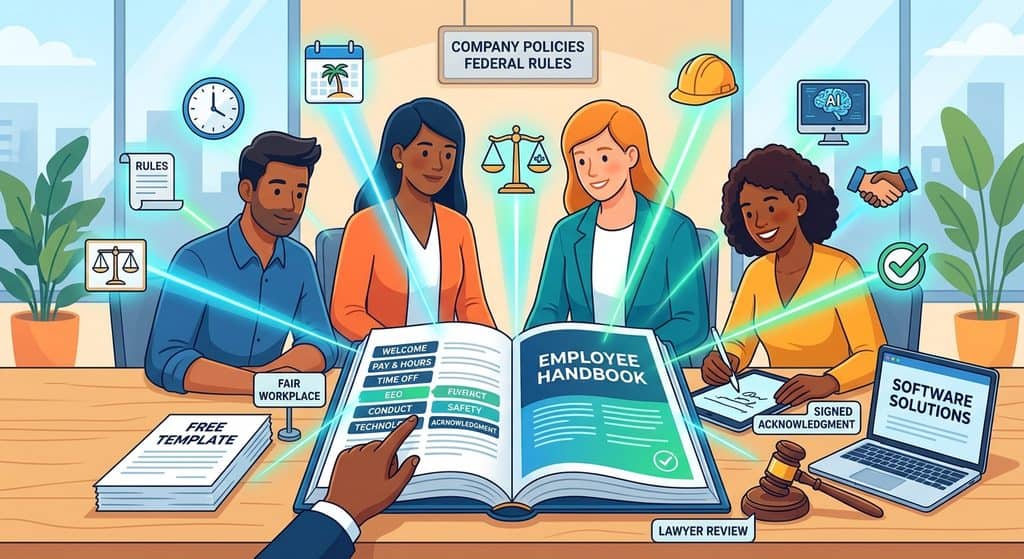
Quick answer: A small business employee handbook needs about a dozen sections: welcome, employment basics, equal opportunity and anti harassment, pay and hours, time off and leave, benefits, conduct, technology and privacy, safety, discipline, leaving the company, and a signed acknowledgment. No federal law requires a handbook, but once you have one some rules apply to it. If you are covered by the FMLA and have eligible employees, federal regulations say your FMLA notice must go in the handbook (or be given to each new hire). Keep the at will language clear, write conduct rules narrowly, and have a lawyer check the state specific sections before you hand it out.
Updated November 2026. This template is a starting point, not legal advice. Employment law varies by state and city.
Do small businesses legally need an employee handbook?
No federal law requires one. Many companies still write one by their 10th to 15th hire, because the handbook is where you put the notices and policies you are required to give employees anyway, and it is the first thing a lawyer, investigator or unemployment hearing officer will ask to see.
Headcount changes which laws apply. Title VII, the main federal anti discrimination law, covers employers with 15 or more employees, according to the EEOC coverage rules. The FMLA covers private employers with 50 or more employees. Many states set lower thresholds, so a 6 person company can still be covered by state anti discrimination and leave laws.
What sections should an employee handbook include?
| Section | What goes in it | Why it matters |
|---|---|---|
| 1. Welcome and purpose | Who you are, what the handbook is for, that it can change | Sets tone and preserves your right to update it |
| 2. Employment basics | At will statement, employee classifications, introductory period, background checks | Avoids implied contract claims |
| 3. Equal opportunity and anti harassment | EEO statement, harassment definition, how to report, no retaliation | Core legal protection for you and staff |
| 4. Pay and hours | Pay schedule, overtime, timekeeping, breaks, expense claims | Wage and hour claims are common and costly |
| 5. Time off and leave | Holidays, PTO or sick leave, FMLA and state leave, jury duty, voting | Many state sick leave and FMLA notice rules |
| 6. Benefits | Health plans, retirement, eligibility dates (point to plan documents) | Keeps benefits promises tied to the real plan |
| 7. Conduct | Attendance, dress, conflicts of interest, confidentiality | Expectations everyone can point to |
| 8. Technology and privacy | Devices, email monitoring, AI tool use, social media | Sets privacy expectations before a problem |
| 9. Safety | Reporting injuries, emergencies, workplace violence, drugs and alcohol | OSHA duties and workers’ compensation |
| 10. Discipline and complaints | How problems are handled, open door policy | Fairness, consistency and a paper trail |
| 11. Leaving the company | Notice, final pay, return of property, references | Final pay deadlines vary by state |
| 12. Acknowledgment | Signed receipt | Proof each employee got and read it |
Sample employee handbook policies you can copy
Replace anything in brackets. Keep the language plain. A handbook nobody can read protects nobody.
Welcome and right to change
“Welcome to [Company]. This handbook explains how we work together and what you can expect from us. It is a guide, not a contract. We may update these policies at any time, and we will tell you when we do. If anything here conflicts with the law or with a written agreement signed by [Company’s CEO], the law or the agreement applies.”
At will employment
“Employment at [Company] is at will. This means you or [Company] may end the employment relationship at any time, with or without cause or notice. Only [title] can make a different agreement, and it must be in writing and signed.” Montana is the main US exception to at will employment for most workers, so Montana employers should adjust this section.
Equal opportunity and anti harassment
“[Company] makes employment decisions without regard to race, color, religion, sex (including pregnancy, sexual orientation and gender identity), national origin, age, disability, genetic information, veteran status or any other status protected by law. We do not tolerate harassment. If you experience or see harassment, report it to [name or role] or [backup contact]. You will not be punished for making a report in good faith, and we will look into every report promptly.”
Pay and timekeeping
“We pay [weekly, every two weeks, twice a month] on [day]. Nonexempt employees must record all time worked accurately and will be paid overtime as required by law. Working off the clock is not allowed. Tell [payroll contact] right away if your pay looks wrong and we will fix it.”
Technology and AI tools
“Company devices, email and accounts belong to [Company] and may be monitored. Do not put confidential company, customer or candidate information into AI tools that [Company] has not approved. Approved tools are listed in [location].” AI use is the policy most older handbooks are missing in 2026, and it is worth writing even a short one.
Acknowledgment
“I received the [Company] Employee Handbook dated [date]. I understand it is my responsibility to read it and ask questions. I understand the handbook is not a contract and that my employment is at will. Signature, printed name, date.”
What does the FMLA require you to put in a handbook?
If your business is covered by the FMLA and has any eligible employees, you must give each employee the FMLA general notice. Under 29 CFR 825.300, you do that by including the notice in your employee handbook or other written leave and benefits guidance if you have it, or by giving a copy to each new hire. Electronic distribution is allowed. You also still have to post the FMLA poster where employees can see it, even if nobody is eligible yet.
State leave laws, paid sick leave and family leave programs often have their own notice rules. Our leave management tools list covers software that tracks those, and the leave application guide shows how employees request time off in practice.
Which handbook rules can get you in trouble with the NLRB?
Broad conduct rules are the risk, even in companies with no union. The National Labor Relations Act protects most private sector employees’ right to discuss pay and working conditions with each other. In 2023 the NLRB adopted a stricter work rules standard in a case called Stericycle, aimed at rules broad enough to chill that right. Board standards shift over time, so check the current one with counsel. The practical drafting advice has stayed the same for years:
- Do not ban employees from discussing their pay.
- Avoid blanket bans on “negative” comments about the company or managers, on or off social media.
- Define “confidential information” specifically (customer lists, trade secrets), not as everything.
- Explain the business reason for rules on recording, media contact and civility.
Which sections change by state?
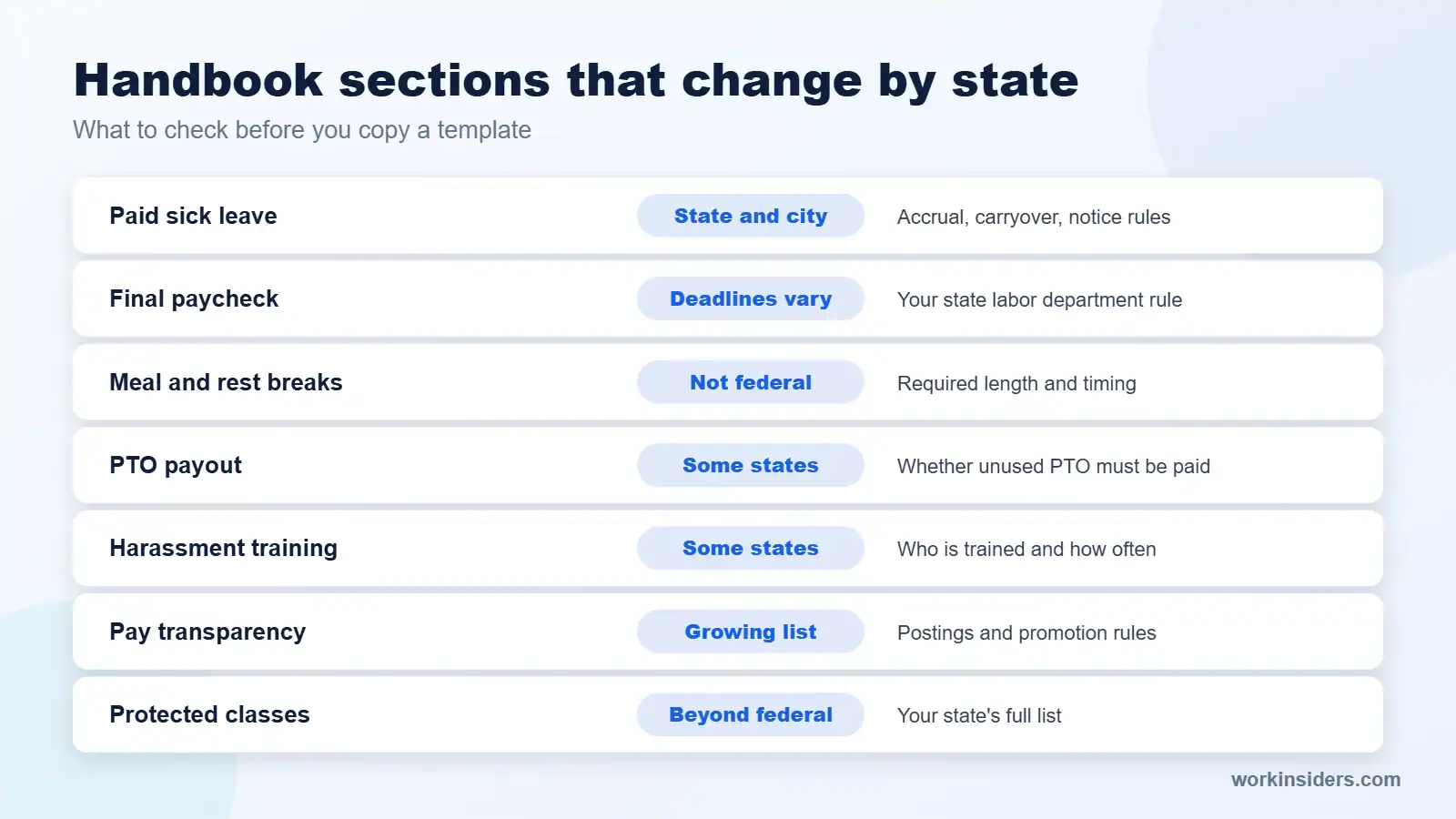
| Topic | Why it varies | What to check |
|---|---|---|
| Paid sick leave | Many states and cities mandate it | Accrual rate, carryover, notice wording |
| Final paycheck | Deadlines range from immediately to the next payday | Your state labor department rules |
| Meal and rest breaks | Federal law does not require them, some states do | Required break length and timing |
| PTO payout | Some states treat earned vacation as wages | Whether unused PTO must be paid at exit |
| Harassment training | Some states require it on a schedule | Who must be trained and how often |
| Pay transparency | A growing list of states require ranges in job ads | Whether your postings and promotions are covered |
| Protected classes | States add classes beyond federal law | Your state’s full list for the EEO statement |
If you hire in more than one state, you need either a core handbook plus state supplements, or software that builds the state sections for you.
Should you use a free template or handbook software?
A free template is fine for a single state company under about 25 people, as long as a lawyer reviews it once. Once you hire across states, or you are updating policies every time a state law changes, software that maintains attorney written policy blocks saves time. In our directory, Handbooks.io and SixFifty build multi state handbooks, and AirMason turns a handbook into a digital, trackable one. The full HR compliance category compares more options with prices.
| Option | Best for | Trade off |
|---|---|---|
| Free template plus lawyer review | One state, under 25 employees | You must track law changes yourself |
| Handbook software | Multi state employers, fast growing teams | Monthly or annual cost |
| HR system with handbook module | Teams already on an HRIS | Policy content may be thinner than specialist tools |
| Employment lawyer drafts it | Regulated industries, complex workforce | Highest upfront cost |
How do you roll out a new employee handbook?
- Have counsel review the state specific and legal sections.
- Send it with a short note on what changed and the date it takes effect.
- Collect a signed acknowledgment from every employee, electronically is fine.
- Add it to your onboarding checklist so every new hire gets it on day one.
- Review it once a year and whenever you start hiring in a new state.
Quick answers
Is an employee handbook required by law?
No federal law requires one. But if you have one and are covered by the FMLA with eligible employees, the FMLA general notice must be in it or given to each new hire.
How long should an employee handbook be?
Most small business handbooks run 15 to 30 pages. Shorter is better if it covers the required notices and the policies you actually enforce.
Is an employee handbook a contract?
It should not be. A clear disclaimer, an at will statement and a signed acknowledgment that says it is not a contract all help, but promises like guaranteed severance can still be argued as binding.
Do employees have to sign the handbook?
No law forces a signature, but you should collect one. The signed acknowledgment is your proof that the employee received the policies.
How often should a handbook be updated?
At least once a year, and whenever a state where you have employees changes a leave, pay or harassment training rule.
Can I use a free handbook template?
Yes, as a starting point. Have an employment lawyer check the state specific sections before you distribute it.
Featured
How it worksHappierleads FeaturedPerson-level B2B website visitor identification.
Tomba FeaturedFind and verify emails on one credit meter.
Featured slots never change our picks or rankings.
Free newsletter
Get the Work Insiders weekly
One email a week: the recruiting and HR tech news that mattered, the tools we just added to the directory, and one practical guide. No spam, and you can unsubscribe in one click.