

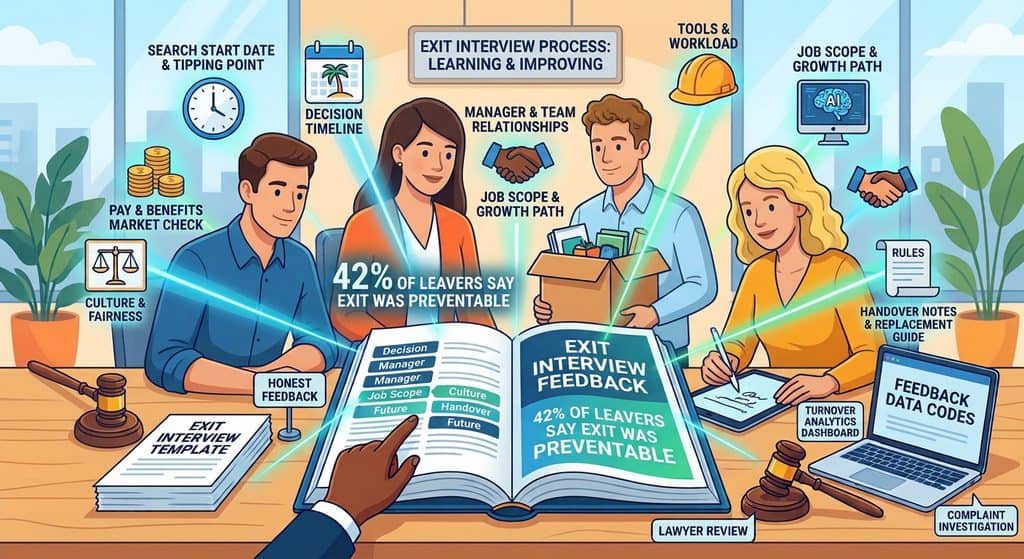
Quick answer: The best exit interview questions ask about specific moments, not general feelings: when the person started looking, what tipped the decision, what their manager could have done differently and what the new job offers that yours did not. Keep it to 10 to 15 questions, have someone other than the direct manager run it, and promise (and keep) confidentiality for the details. It is worth doing well: in a 2024 Gallup study, 42% of employees who left voluntarily said their manager or organization could have done something to prevent it, and 45% said no manager or leader had talked with them about their satisfaction, performance or future in the three months before they left.
Written by a recruiter who has heard the real reasons candidates leave jobs thousands of times. Updated November 2026.
What is an exit interview and why does it matter?
An exit interview is a structured conversation or survey with an employee who is leaving, usually in their last week. Its job is to find out why people leave so you can stop the next resignation. It is not a chance to change their mind, and it is not a place to argue with what they say.
The stakes are real. Gallup’s turnover study of voluntary leavers found 42% said their exit was preventable, 36% did not talk to anyone before resigning, and 77% left within three months of starting a job search or without searching at all. Gallup also estimates replacement costs at about 40% of salary for frontline staff, 80% for technical professionals and 200% for leaders and managers. An exit interview is the cheapest research you will ever do on that problem.
What are the best exit interview questions to ask?
Pick 10 to 15 from the groups below. Ask every leaver the same core questions so you can compare answers over time, then add one or two that fit the person’s role.
Questions about the decision to leave
- When did you first start thinking about leaving? Listen for a specific event, such as a reorg, a new manager or a missed promotion.
- What was the main reason you decided to go?
- Was there one moment that made the decision final?
- Were you actively looking, or did someone reach out to you? A recruiter call that landed tells you your people are reachable and open.
- What does the new role offer that this one did not?
- If one thing had been different, would you have stayed? What would it have been?
Questions about the manager and team
- How would you describe your relationship with your manager?
- Did you get the feedback you needed to do your job well?
- Did you feel your work was recognized? Give an example if you can.
- Was there anything your manager could have done to keep you?
- How well did your team work together?
- Did you feel comfortable raising problems? What happened when you did?
Questions about the job itself
- Was the job what you expected when you were hired? If not, what was different?
- Did you have the tools and resources to do your job?
- Was your workload manageable most weeks?
- Did you see a path to grow here? What would it have taken?
- Which parts of the job did you enjoy most, and least?
- How did you feel about your pay and benefits compared with the market?
Questions about the company
- How would you describe our culture to a friend?
- Did you understand how your work connected to company goals?
- How well did leadership communicate decisions that affected you?
- Was your onboarding good enough to set you up to succeed?
- Did you feel you were treated fairly here? If not, can you tell me more?
- Would you recommend this company to a friend looking for a job? Why or why not?
Questions that help the person after you
- What should we look for in the person who replaces you?
- What do you wish you had known in your first month?
- What is undocumented about your job that your replacement will need?
- Is there anything unfinished we should know about?
- Would you consider coming back in the future?
- Is there anything else you want us to know that I have not asked?
What should you listen for in exit interview answers?
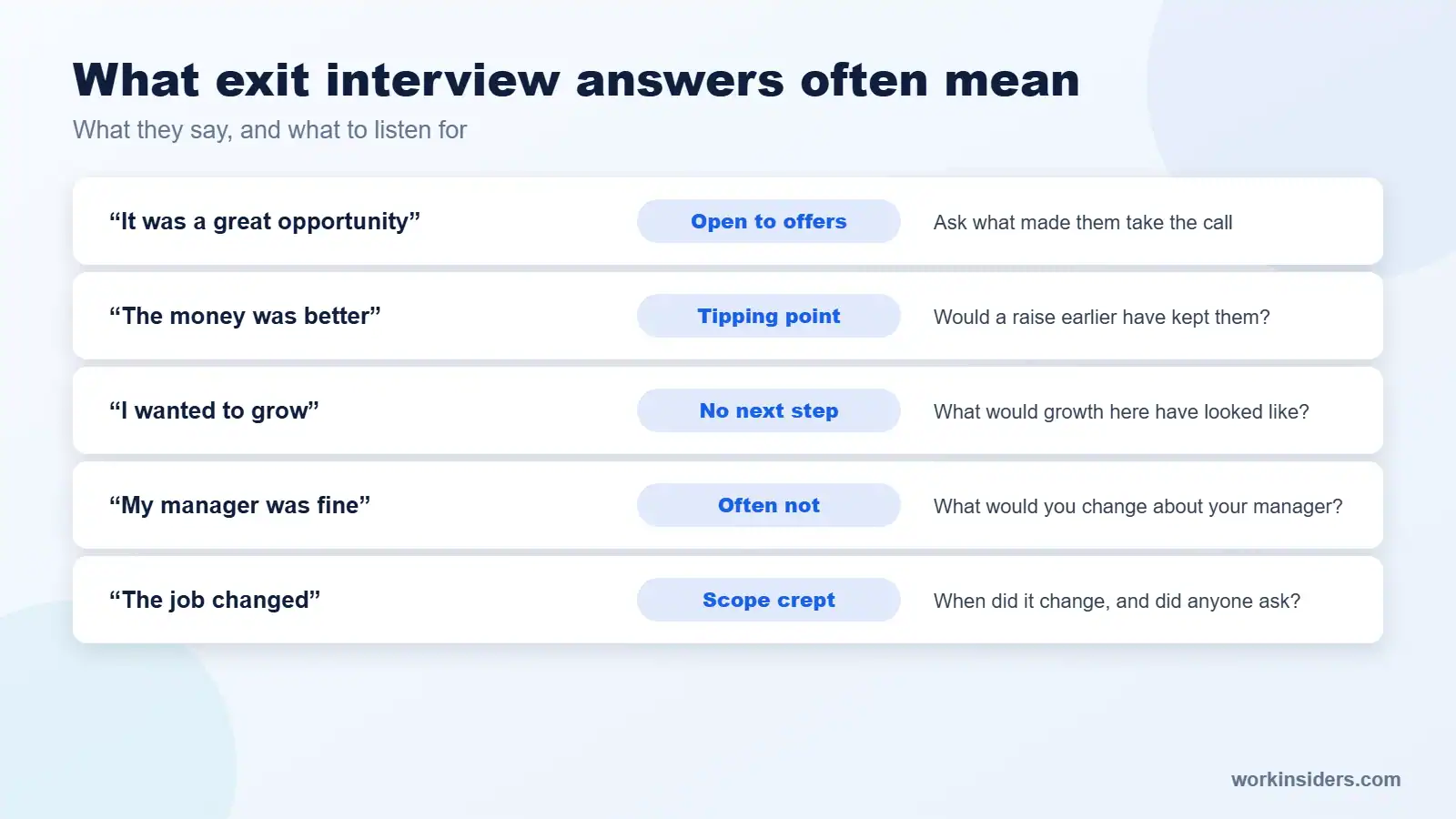
Most leavers give a safe answer first, usually pay or “a great opportunity”. The useful answer tends to come after a follow up. Ask “what made you open to that conversation?” or “when did that start?” and wait.
| What they say | What it often means | Good follow up |
|---|---|---|
| “It was a great opportunity” | They were open to offers before it came | What made you take the call? |
| “The money was better” | Pay was the tipping point, not always the root cause | Would a raise six months ago have kept you? |
| “I wanted to grow” | No visible next step, or a promotion went elsewhere | What would a next step here have looked like? |
| “My manager was fine” | Often a hint they were not, said politely | What would you change about how the team was run? |
| “The job changed” | Scope crept or a reorg removed the part they liked | When did it change, and did anyone ask you about it? |
Gallup’s data backs up the follow up: compensation and benefits made up only 30% of the actions leavers said could have kept them, which means most of the fixable reasons are about the job, the manager and the future.
Who should run the exit interview?
Someone other than the person’s direct manager. HR, an HR business partner or a skip level leader works best, because the manager is often part of the reason and the leaver will not say so to their face. Small companies without HR can use a short anonymous survey sent from a neutral address, followed by an optional conversation with the founder.
| Format | Best for | Watch out for |
|---|---|---|
| Live conversation with HR | Getting the story behind the answer | Leavers soften criticism face to face |
| Anonymous survey | Honest ratings, comparing trends across many leavers | No follow up questions, low response rates |
| Survey then short call | Most teams: data plus depth | Takes more time to run |
| Third party interviewer | High turnover roles or sensitive situations | Costs money |
When is the best time to hold an exit interview?
In the last week, but not the last day. On the final afternoon people are packing up and want to leave on good terms, so they say little. A few days before, they have already mentally left and will be more candid. Some companies also send a short follow up survey 30 to 90 days later, when the person has a new job to compare against and nothing left to lose by being honest.
What questions should you avoid in an exit interview?
- Anything about protected characteristics, family plans or health, the same rules as a hiring interview.
- Questions that pressure them to name colleagues who are also looking.
- Questions about their new salary as a condition of anything. Some states restrict pay history questions in hiring, and it sours the conversation.
- Leading questions like “you were happy here overall, right?”
- Arguing or defending. Write it down, say thank you, move on.
If someone raises harassment, discrimination or a safety issue in an exit interview, treat it as a complaint and follow your normal investigation process. Leaving does not cancel your duty to look into it. This is not legal advice, so loop in HR or counsel.
What should you do with exit interview data?
Code each answer into a small set of reasons, such as manager, pay, growth, workload, job changed, culture and personal, then review the counts every quarter by team and by manager. One exit is an anecdote. Five people from the same team naming the same manager is a pattern you can act on.
- Log every interview in one place, with the reason codes.
- Track your turnover rate alongside it. Our turnover rate calculator does the math, and the new hire turnover calculator covers early exits.
- Share themes, never named quotes, with leadership each quarter.
- Pick one fix per quarter and check whether the reason count drops.
- Close the loop with stay interviews: ask current staff the same questions before they decide to go.
Engagement and people analytics tools can run exit surveys and code the results automatically. Browse the engagement tools and people analytics tools in our directory if you want software to do it.
Free exit interview template
| Section | Question | Answer or rating |
|---|---|---|
| Details | Name, role, team, manager, start date, last day | |
| Decision | When did you first start thinking about leaving? | |
| Decision | What was the main reason you decided to go? | |
| Decision | If one thing had been different, would you have stayed? | |
| Manager | Did you get the feedback and support you needed? (1 to 5) | |
| Job | Was the job what you expected when hired? (yes, partly, no) | |
| Job | Did you see a path to grow here? (1 to 5) | |
| Pay | How did your pay compare with the market? (below, at, above) | |
| Company | Would you recommend us to a friend? (0 to 10) | |
| Handover | What should we look for in your replacement? | |
| Future | Would you consider coming back? | |
| Open | Anything else you want us to know? | |
| Interviewer only | Primary reason code: manager, pay, growth, workload, job changed, culture, personal |
Hiring the replacement next? Our interview question banks cover recruiting and HR roles, and the recruiting templates include an intake and scorecard to start the search.
Quick answers
How many questions should an exit interview have?
Ten to fifteen is enough for a 30 minute conversation. Ask the same core questions every time so you can compare answers across leavers.
Are exit interviews mandatory?
No. US law does not require them, and employees can decline. Make it optional and short to get more people to agree.
Should the manager do the exit interview?
Usually not. HR or a skip level leader gets more honest answers, since the manager is often part of the reason someone leaves.
Are exit interviews confidential?
Promise confidentiality for who said what, and share only themes. You cannot promise to keep a legal complaint, such as harassment, confidential from the people who must investigate it.
What is the most important exit interview question?
“If one thing had been different, would you have stayed, and what would it have been?” It turns a complaint into a fix you can test.
How honest are people in exit interviews?
Less honest face to face, especially about managers. A short anonymous survey before the conversation, and a neutral interviewer, both help.
Featured
How it worksHappierleads FeaturedPerson-level B2B website visitor identification.
Tomba FeaturedFind and verify emails on one credit meter.
Featured slots never change our picks or rankings.
Free newsletter
Get the Work Insiders weekly
One email a week: the recruiting and HR tech news that mattered, the tools we just added to the directory, and one practical guide. No spam, and you can unsubscribe in one click.