Physical Address
304 North Cardinal St.
Dorchester Center, MA 02124
Physical Address
304 North Cardinal St.
Dorchester Center, MA 02124

With years of experience analyzing emerging tech trends in agriculture, I’ve tracked the rapid shift toward agricultural robotics. Backed by credible sources like market reports from Grand View Research and MarketsandMarkets, plus real-world deployments shared by robotics experts, farming robots have moved from prototypes to profitable, large-scale operations.
The global agricultural robot market is exploding from USD 17.73 billion in 2025 to projections of USD 56.26 billion by 2030, with a CAGR of 26.0%. This isn’t hype; it’s driven by labor shortages, sustainability demands, and proven ROI in fields worldwide.
Key insight up front: Farming robots now handle planting, weeding, spraying, and harvesting at scale, slashing chemical use by up to 90% in some cases and addressing global agricultural labor shortages that drive up food prices by billions annually.
Farming robots, or agribots, are autonomous or semi-autonomous machines that perform agricultural tasks using AI, computer vision, sensors, and sometimes lasers or mechanical tools. They tackle everything from precision weeding to crop monitoring without constant human input.
They matter now because traditional farming faces massive challenges. Labor shortages hit hard, with seasonal workers scarce in many regions. Environmental regulations push for less chemical runoff, and food demand keeps rising. Robots deliver precision that humans can’t match consistently, working 24/7 in tough conditions.
The labor crisis costs agriculture billions annually, with shortages forcing fields to go unharvested or overworked staff. Robots step in for repetitive, back-breaking jobs like planting, monitoring, weeding, and harvesting.
They enable end-to-end workflows: autonomous tractors plant, drones scout, and ground robots weed or spray. This reduces fatigue, cuts seasonal hiring needs, and keeps operations running smoothly even during off-hours.
John Deere acquired GUSS Automation, a leader in autonomous sprayers. Their systems have sprayed over 2.6 million acres with 500,000 operational hours and achieved 90% chemical reduction.
Watch this video showing a GUSS sprayer navigating an orchard row, releasing targeted mist on trees under a clear sky. The machine moves autonomously between dense foliage, demonstrating precision spraying without human guidance.
FarmWise deploys AI-powered weeders that pull unwanted plants mechanically, eliminating pesticides and human fatigue at industrial scale.
This video captures a FarmWise weeder in a vegetable field, with its orange mechanical arms precisely uprooting weeds between young crop rows. The robot follows the furrows smoothly, avoiding damage to plants.
Carbon Robotics’ LaserWeeder G2 uses deep computer vision and CO₂ lasers to zap weeds precisely. It processes 4.7 million images per hour, eliminates up to 600,000 weeds hourly, and has killed over 30 billion weeds across 100+ crops with 150+ units deployed.
In this footage, the LaserWeeder moves through crop rows, with close-ups of lasers vaporizing small weeds instantly amid green sprouts. The overcast sky highlights the machine’s wide span covering multiple rows.
SwarmFarm Robotics in Australia creates modular bots like “Robbie” for spraying, seeding, or cultivating, promoting right-to-repair and decentralized farming.
This clip features a SwarmFarm robot traversing a barren field, dropping seeds or spray with its yellow tank and wheels kicking up dust under blue skies.
These examples come from a detailed thread by robotics expert Lukas Ziegler, featuring videos of robots in orchards, vineyards, and vegetable fields.
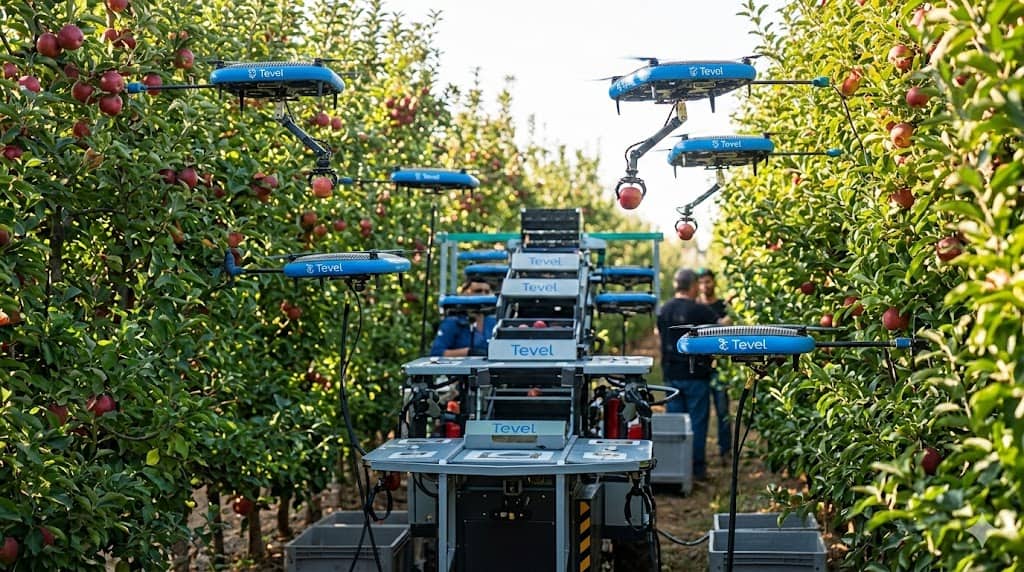
Tevel Aerobotics Technologies offers Flying Autonomous Robots that hover next to trees, using AI and computer vision to pick ripe fruit with suction arms, avoiding bruises.
Deployed in orchards worldwide, from California to Chile, these drones collect real-time data on fruit quality and can operate 24/7. They pick everything from apples to plums, addressing labor gaps in specialty crops.
Imagine blue flying robots darting through apple trees, extending arms to gently harvest red fruits. This attached video frame shows a fleet in action, moving in formation down orchard rows.
Precision is the game-changer. Robots target only weeds or pests, avoiding blanket applications.
GUSS sprayers cut chemicals by 90%. Laser-based systems like Carbon Robotics leave soil untouched while eliminating weeds. Mechanical weeders from FarmWise skip pesticides entirely.
This reduces runoff, protects waterways, and meets stricter regs. It also lowers input costs and supports organic or low-chemical farming.
Robots drive ROI through efficiency gains. They operate longer hours, reduce labor expenses, and optimize inputs for higher yields.
Market data shows autonomous systems improve profitability. One trial noted 20% yield boosts in greenhouses with AI. Farmers report lower diesel and fertilizer use, plus better crop quality.
With models like robotics-as-a-service, mid-sized farms access tech without huge upfront costs.
The market jumps from USD 17.73 billion in 2025 to USD 56.26 billion by 2030, at a CAGR of 26.0%.
Drivers include labor shortages, AI advancements, GPS integration, and indoor farming expansion. Companies like Deere, AGCO, and startups pour investments in, with over $1 billion funneled into weeding and harvesting tech recently.
Adoption isn’t universal yet. High initial costs, integration with existing equipment, and needs for reliable connectivity slow some farms.
Safety, interoperability, and training matter too. But prices drop (cheaper LiDAR, sensors), and modular designs help.
Early adopters in specialty crops lead, with broader rollout expected soon.
Are farming robots profitable right now? Yes. Deployed systems like autonomous sprayers log hundreds of thousands of hours and deliver 90% chemical cuts, paying back through savings and yields.
What crops benefit most from robots? Specialty crops like orchards, vineyards, vegetables, nuts, and strawberries see big gains from precision weeding, spraying, and harvesting.
Do robots replace all farm workers? No. They handle repetitive tasks, freeing humans for strategy, oversight, and complex decisions. Hybrid approaches dominate.
How much can robots cut chemical use? Up to 90% in spraying and weeding, per real deployments from GUSS and Carbon Robotics.
Is the future of farming robotic swarms? Likely. Compact, AI-driven swarms work gently, learn seasonally, reduce brute force, and build resilience with less environmental impact.
Farming robots aren’t coming they’re here, reshaping agriculture quietly but powerfully. From laser-zapping weeds to flying harvesters picking fruit, the data and videos prove the future is operational today. As labor pressures mount and sustainability becomes non-negotiable, these machines form the backbone of next-gen farming. The robot harvest has begun.