

At workinsiders.com, our team of recruiters and workplace researchers has spent years analyzing what actually gets people promoted. We have reviewed thousands of real promotion conversations, surveyed hiring managers, and tracked career trajectories across industries.
What we find, again and again, is that waiting for your manager to bring up a promotion is one of the most common and costly mistakes professionals make. According to LinkedIn’s Workplace Report, employees who proactively advocate for advancement are significantly more likely to receive it than those who wait to be recognized. This guide gives you the exact framework to make that conversation happen.
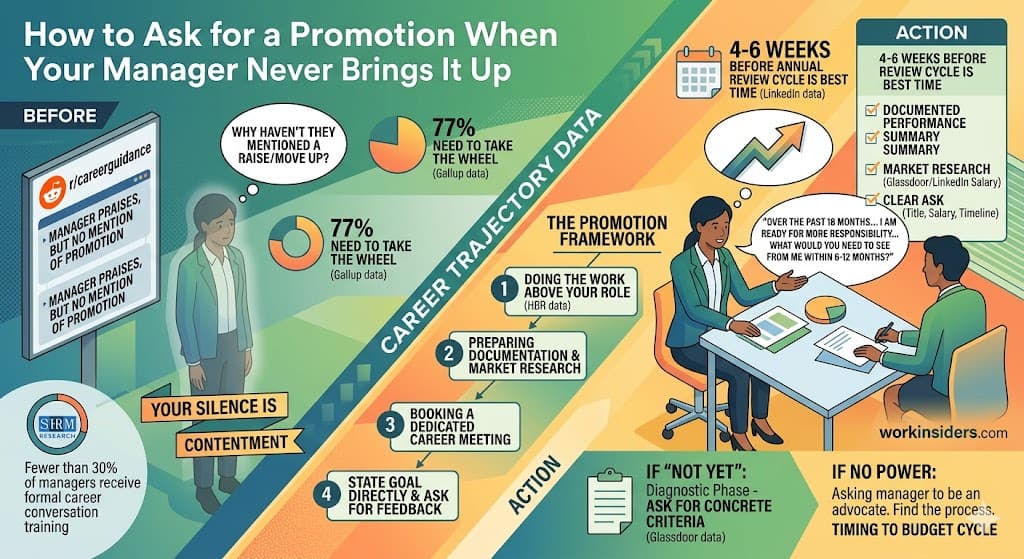
Key Insights Before You Read On
You do not need permission to start the promotion conversation. Most managers are too focused on team output, deadlines, and their own performance reviews to proactively advocate for your career. The data from Gallup’s State of the Workplace shows that only 23% of employees feel their managers actively support their career growth. That means the other 77% need to take the wheel themselves.
Here is what the research and real-world data tells us up front:
The best time to ask is 4 to 6 weeks before your company’s annual review cycle. Asking too late puts you in a reactive position. Asking too early without documented proof weakens your case. Timing is not about luck. It is about strategy.
Why Do Managers Never Bring Up Promotions?
This is one of the most searched questions on Reddit’s r/careerguidance and r/jobs communities. People ask variations of it constantly: “Why hasn’t my boss mentioned a raise in three years?” or “My manager praises my work but never mentions moving me up.”
The answer is not always sinister. Most managers are not withholding your promotion out of malice. They are overwhelmed. They assume you are satisfied. They do not know your financial goals. And in many organizations, promotions have to be formally requested, budgeted for, and justified in writing before HR will even consider them.
According to SHRM’s research on employee relations, fewer than 30% of managers receive formal training on how to conduct career development conversations with their reports. Your silence is being read as contentment.
How Do You Know You Are Ready for a Promotion?
Before you walk into that meeting, you need to answer this question honestly. Being good at your current job is not the same as being ready for the next level. Promotions reward future potential as much as past performance.
Ask yourself whether you are already doing the work of the role above you. If you have been taking on tasks that fall under a senior title, leading projects without the title, or mentoring others informally, you have a concrete case. Harvard Business Review has documented repeatedly that employees who perform above their job description for 6 or more months have the strongest grounds for a promotion request.
Also consider whether your results are quantifiable. Numbers talk. Revenue generated, costs cut, error rates reduced, clients retained, projects delivered on time and under budget. The stronger your data, the harder your case is to deny.
What Is the Best Way to Start the Promotion Conversation?
This is where most people freeze. They imagine an awkward confrontation or fear damaging the relationship with their manager. In reality, framing the conversation as a collaborative planning discussion rather than a demand is the move that works.
The opening line matters. Something like: “I want to talk about my growth trajectory here and what it would take for me to move into a senior role” is low-pressure, forward-looking, and invites your manager to be part of the solution. You are not issuing an ultimatum. You are starting a professional dialogue.
Request a dedicated meeting for this conversation. Do not tack it onto the end of a one-on-one or bring it up after a stressful project review. Book 30 minutes specifically for career development.
How Should You Prepare for the Promotion Conversation?
Preparation is what separates a confident ask from a rambling wishlist. You need three things going into that meeting.
A documented performance summary. This is a one-page outline of your contributions, written in business terms. Tie your work to outcomes the organization cares about. If you increased customer retention by 15%, say that. If you led a cross-functional team that launched a product two weeks early, say that. Forbes notes that hiring managers and executives respond most strongly to candidates who speak in results language rather than task language.
Market research on the role you want. Check Glassdoor and LinkedIn Salary for benchmarks. Know what people in your target title earn in your city and industry. Walk in knowing your market value so the compensation discussion does not catch you off guard.
A clear ask. Vague requests get vague responses. Know the exact title you want, the approximate salary range you are targeting, and the timeline you have in mind. Do not say “I was hoping for more responsibility.” Say “I would like to be considered for the Senior Marketing Manager role and would like to understand what the path looks like from here.”
What Should You Say When Asking for a Promotion?
Reddit threads in r/AskHR and r/personalfinance are full of people asking for scripts, and for good reason. The words you choose shape how your ask lands.
Here is a framework that works:
Start by anchoring to your tenure and contributions. Then state your goal directly. Then ask for feedback and a clear next step. It sounds like this in practice:
“Over the past 18 months, I have led three product launches, managed a team of four, and grown our client base by 20%. I am ready for more responsibility and would like to discuss what the path to a Director-level role looks like here. What would you need to see from me to make that happen within the next 6 to 12 months?”
Notice that the final question shifts the conversation into action mode. You are not asking permission. You are asking for criteria. That is a fundamentally different dynamic.
What If Your Manager Says You Are Not Ready Yet?
This is the response most people dread, and it is also where many promotion conversations go to die. But “not yet” is not a no. It is a negotiation with no defined terms yet.
When your manager says you are not ready, your job is to make it concrete. Ask what “ready” looks like. Ask for specific, measurable criteria. Get the goalposts in writing if at all possible. A follow-up email after the meeting summarizing what was discussed is both professional and protective.
According to Glassdoor’s employment data, professionals who receive specific developmental feedback and act on it within 90 days are twice as likely to be promoted in the next review cycle compared to those who do not follow up at all.
How Long Should You Wait Before Asking Again?
If your first ask does not result in an immediate promotion, give it 60 to 90 days before circling back. Use that time to hit whatever benchmarks were discussed. Then schedule a follow-up meeting explicitly framed around the progress you have made.
Do not let the conversation fade. Silence after an initial ask is how promotion discussions get shelved indefinitely. Staying visible, continuing to perform above your level, and checking in regularly signals that you are serious and not easily discouraged.
What If Your Manager Has No Power to Promote You?
This is more common than people realize, especially in larger organizations. Your direct manager may genuinely support you but lack the authority to approve a new headcount or title change without sign-off from their own manager or HR.
If this is the case, ask your manager to be an advocate for you in the rooms you are not in. Ask whether there is a formal process you can go through directly with HR. Find out when the budget cycle opens for headcount planning. Timing your ask to coincide with budget discussions gives it the best possible chance of getting approved.
Short Q&A: Real Questions People Ask About Promotions
Q: How do I ask for a promotion via email if I am remote? A: Request a video call rather than asking via email. Career conversations deserve a real-time dialogue. Use email only to formally confirm what was discussed after the conversation.
Q: What if I have been in the same role for 3 or more years? A: That tenure strengthens your case if your performance is strong. Frame it as loyalty and institutional knowledge, not stagnation. Bring data showing your growing contributions over that period.
Q: Should I mention a competing job offer to get a promotion? A: Only if you are genuinely prepared to leave. Using a real offer as leverage is a recognized tactic, but it backfires badly if you are bluffing. Companies often call that bluff, and the relationship rarely recovers if you stay.
Q: How do I ask for a promotion when I am the only one doing my job? A: Focus on scope and complexity rather than replacability. Frame the ask around the level of responsibility you carry, not the fact that no one else does your work.
Q: What if my company has a pay freeze? A: Ask for the title change without the immediate salary increase. A senior title opens doors, internally and externally, even when compensation is temporarily frozen. Revisit compensation at the next available cycle.
The Mindset Shift That Changes Everything
Asking for a promotion is not about being pushy or entitled. It is about treating your career like a professional negotiation, not a performance review you sit back and wait to receive.
The managers and executives who get promoted themselves are almost universally people who clearly articulate their goals, back them up with evidence, and ask for what they need. That is not arrogance. That is professional self-advocacy, and it is a skill that pays dividends for your entire career.
If your manager has never brought up your promotion, that is not a verdict. It is a vacuum. And you have every right to fill it.
Sources: LinkedIn Workplace Report, Gallup State of the Workplace, SHRM Employee Relations, Harvard Business Review, Forbes Career, Glassdoor
Free newsletter
Get the Work Insiders weekly
One email a week: the recruiting and HR tech news that mattered, the tools we just added to the directory, and one practical guide. No spam, and you can unsubscribe in one click.